Trump Defends Relationship With Putin and Accuses Iran of ‘Bullsh*tting’ in Talks to End War
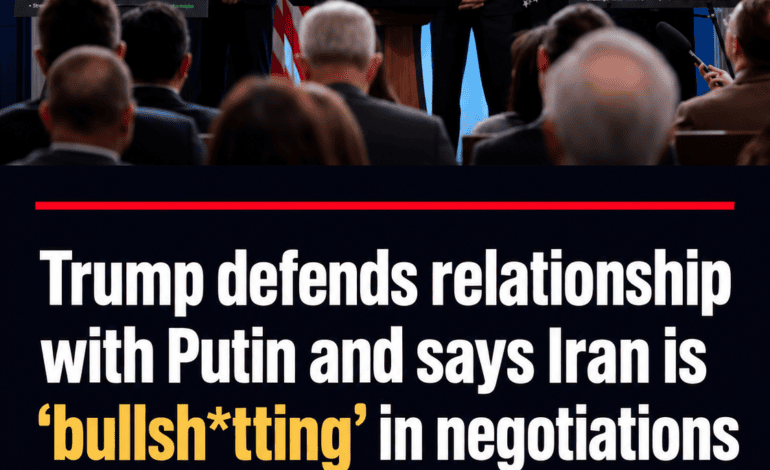

WASHINGTON, November 20, 2026 — President Donald Trump defended his personal relationship with Russian President Vladimir Putin on Friday and accused Iran of negotiating in bad faith, using a White House news conference to lay out his position on two wars his administration has tried to bring to an end. Trump said he believed Putin wanted to stop Russia’s war in Ukraine. He also said Iran wanted an agreement with Washington but was offering terms he would reject. apnews.com
The remarks came one day after Trump met Putin and Chinese President Xi Jinping in Shenzhen, China. The three leaders issued a declaration pledging further talks on nuclear risks and cooperation on fuel supplies. The document contained no settlement for Ukraine or Iran. At Friday’s briefing, with Vice President JD Vance and Secretary of State Marco Rubio beside him, Trump announced no timetable for renewed negotiations with Tehran and no new ceasefire agreement for Ukraine. The White House
What Trump said about his relationship with Putin
Trump had called Putin a friend during his trip to China. Asked at the White House whether the Russian president was also a friend to the United States, he replied, “I can’t speak to America.” He then described his own relationship with Putin as “very good” and argued that his ability to talk directly with the leaders of powerful countries could help resolve conflicts. apnews.com
Trump said he believed Putin would “love to end the war” in Ukraine and portrayed both the Russian leader and Ukrainian President Volodymyr Zelenskyy as struggling to find a way out. Putin’s own public remarks in Shenzhen focused in part on retaliation. He vowed to respond to Ukrainian strikes on the Kerch Bridge, which links occupied Crimea to Russia. The Washington Post reported that Putin also ruled out returning to talks on a limited ceasefire covering energy facilities or Black Sea shipping after the strikes. apnews.com
For Ukraine and its European allies, an immediate question is whether Moscow will agree to a halt in fighting on terms Kyiv can accept. Trump’s assessment of Putin’s intentions has yet to produce that commitment. A joint statement issued in Berlin on Thursday said Ukraine was prepared for an immediate ceasefire and backed direct talks between Kyiv and Moscow with U.S. and European participation. The leaders also called on Russia to agree to a winter pause in attacks on energy infrastructure. president.gov.ua
What Trump said about negotiations with Iran
On Iran, Trump told reporters, “They want to make a deal, but they don’t want to make a deal that’s acceptable to me.” He then used an expletive to accuse Iranian leaders of misleading people for decades. He gave no detailed account of Tehran’s latest offer, leaving unanswered which provisions he opposed and whether U.S. and Iranian negotiators were actively exchanging proposals. His description of Iran’s intentions was his own assessment. The Times of Israel
The day before the briefing, Trump had also signaled that he felt little urgency to decide on renewed major military action. Reuters reported that he suggested the United States could wait until after January 1 to see what happened. In a Fox News interview from Shenzhen highlighted by the White House, Trump said he wanted an agreement durable enough to survive a change in U.S. leadership. Taken together, the remarks left the administration’s immediate course unclear. The president expressed a preference for a lasting agreement while leaving open how Washington would try to secure it. Reuters
The nuclear dispute remains central. Washington has long accused Iran of seeking nuclear weapons, an allegation Tehran denies. In a November report reviewed by Reuters, the International Atomic Energy Agency raised concerns about an enrichment facility in Isfahan that it had been unable to inspect. The agency also sought information about Iran’s stockpile of highly enriched uranium and access to sites damaged in strikes. Those inspection questions have practical consequences for any agreement that depends on verifying what happened to the stockpile. reuters.com
Why the June U.S.-Iran agreement left so much to negotiate
The current impasse follows an earlier attempt to end the conflict, which began with U.S. and Israeli strikes on Iran on February 28. In June, the White House sent Congress a 14-point interim agreement known as the Islamabad Memorandum of Understanding. The document set out steps to halt military operations, restore commercial passage through the Strait of Hormuz and negotiate a final agreement within 60 days, with an extension possible if both sides agreed. Reuters
Some of the most consequential details were left for the next round. Those included how to handle Iran’s stockpile of enriched uranium and what limits would apply to future enrichment. The timetable for sanctions relief also depended on further agreement. The memorandum gave negotiators a framework, while the work of deciding how concessions would be implemented and verified remained ahead of them. By Friday’s briefing, Trump had announced no comprehensive agreement resolving those issues. Reuters
Vance helped lead the earlier diplomatic effort. This month, Trump said he had told the vice president to move on from those talks, and he described the June effort in a Fox News interview as a “waste of time,” while saying it had not been a mistake. His remarks on Friday offered no indication that Vance or another U.S. official was about to resume that work. Any new round would need to clarify who is negotiating, which earlier commitments still apply and what each side is now prepared to offer. washingtonpost.com
What Trump, Xi and Putin agreed to in Shenzhen
The declaration issued after the November 19 summit made four broad commitments. The United States, Russia and China agreed to work on United Nations reform, increase the supply of refined petroleum products, emphasize state consent and official immunity in relation to international courts, and hold further discussions about reducing nuclear risks. The three leaders also reaffirmed the principle that nuclear war must never be fought. The White House
The public text gave no deadline for nuclear-risk talks and contained no commitments to reduce the countries’ arsenals. The pledge to increase fuel supplies also came without specific volumes or delivery dates. Ukraine and Iran went unnamed in the document. The commitments therefore give governments several topics for follow-up, with the next measure of progress being whether officials set dates and publish more specific terms. The White House
Ukraine diplomacy continued in parallel. Axios reported that Trump spoke separately with Putin in Shenzhen and then called from Air Force One into a meeting in Berlin attended by Zelenskyy, European leaders and U.S. envoys Steve Witkoff and Jared Kushner. The Ukrainian presidency said the Berlin discussions covered air defense, diplomatic efforts and long-term security guarantees. Germany, France, the United Kingdom and Ukraine called for guarantees that would take effect once a ceasefire began, with options including monitoring and continued military support. axios.com
Why the Strait of Hormuz matters to the Iran talks
Trump also linked the outcome of the dispute with Iran to U.S. gasoline prices. The Strait of Hormuz is a major route for oil and petroleum products leaving the Persian Gulf, and wartime disruptions sharply reduced the amount of fuel moving through it. U.S. Energy Information Administration data put average flows at 21.6 million barrels per day in the final quarter of 2025, compared with 5.1 million in the second quarter of 2026 and 9.1 million in the third. The rebound recovered some of the lost volume, with shipments still well below their prewar level in the latest quarterly figures. Межа
The agency said rising flows through Hormuz helped bring Brent crude down by more than $30 a barrel by November 18 compared with its October average. It also cited alternative export routes and transfers between ships as factors helping more oil reach buyers. The partial recovery explains how crude prices could fall while the conflict remained unresolved. A durable deal would matter to shippers because it could make passage more predictable and reduce the risk that another flare-up interrupts deliveries. U.S. Energy Information Administration (EIA)
The Iran war faces another test in Congress
A day before Trump’s news conference, the Senate rejected a war powers resolution by a vote of 48–51. The House had already passed the measure, which sought to require Trump to end U.S. military involvement in the conflict or obtain congressional approval to continue. Three Republican senators, Susan Collins, Lisa Murkowski and Rand Paul, supported it. Democrat John Fetterman voted against it. U.S. Senate Daily Press
The vote was Congress’s first on the conflict since the November 3 midterms, when Democrats won control of both chambers for the next Congress. Democratic leaders have said ending the war will be a priority after they take office in January. Lawmakers have also discussed limiting funding for offensive operations. That gives the administration another deadline to contend with even if U.S.-Iran negotiations stay stalled. Reuters
What to watch next in the Iran and Ukraine peace efforts
For Iran, the immediate question is whether Washington and Tehran will name negotiators and set a date to return to talks. A substantive round would have to address access for nuclear inspectors, the disposition of enriched uranium, sanctions relief and the security of commercial shipping through Hormuz. The June framework shows that those issues were already on the table. Friday’s briefing offered little clarity about which could move first. Reuters
For Ukraine, the next test is whether Russia agrees to direct talks with Kyiv or accepts a limited pause in attacks on energy facilities as winter approaches. European and Ukrainian leaders have put those proposals on the table, along with plans for monitoring a future ceasefire and protecting Ukraine against another attack. Friday’s briefing made clear that Trump sees his relationship with Putin as a way to advance those talks. Whether it can deliver a ceasefire depends on what Moscow and Kyiv are prepared to agree to
Discover more from MatterDigest
Subscribe to get the latest posts sent to your email.