How a Seriously Wounded U.S. Airman Survived 36 Hours on a Mountain While Evading Iranian Bounty Hunters
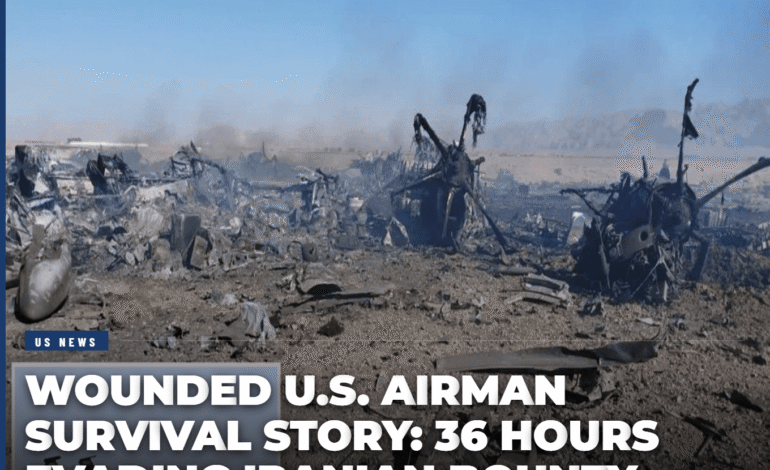

Wounded U.S. Airman Survival Story: 36 Hours Evading Iranian Bounty Hunters
Introduction
In the chaos of modern conflict zones, survival often depends on more than just training—it demands resilience, instinct, and extraordinary mental strength. One such story has emerged involving a severely injured member of the United States Air Force who managed to evade capture for 36 hours under extreme conditions.
Alone, wounded, and hunted, the airman climbed rugged terrain, concealed himself in a narrow mountain crevice, and avoided detection by individuals reportedly linked to forces aligned with Iran.
This account has drawn attention not only for its intensity but also for what it reveals about survival training, modern warfare risks, and the realities faced by military personnel in hostile environments.
How did the wounded U.S. airman survive for 36 hours?
The airman survived by climbing to higher ground, hiding in a mountain crevice to avoid detection, conserving energy, and using survival training techniques until rescue teams located him.
The Incident: A Mission Gone Wrong
While specific operational details remain limited due to security concerns, reports indicate that the airman was involved in a mission over a volatile region in the broader Middle East.
During the operation:
- The aircraft encountered hostile conditions
- The situation escalated rapidly
- The airman was forced into an emergency scenario, resulting in severe injuries
The exact cause—whether mechanical failure, hostile engagement, or a combination of factors—has not been fully disclosed. However, what is clear is that the airman found himself stranded in enemy-adjacent territory with limited resources.
Severe Injuries and Immediate Danger
Upon reaching the ground, the airman was already in critical condition.
Reported injuries included:
- Significant physical trauma
- Blood loss
- Possible fractures
- Limited mobility
Despite these conditions, the airman understood the immediate risk: capture.
In hostile regions, downed military personnel can become high-value targets. In this case, reports suggested that local armed individuals—described as bounty hunters—were actively searching for him, with incentives reportedly tied to groups connected to Iran.
The Climb: Fighting Pain to Reach Higher Ground
Rather than remaining near the landing site, the airman made a critical decision—to move.
Why Movement Was Essential
Staying near the crash site would have increased the likelihood of detection. Instead, the airman:
- Began climbing a nearby mountain
- Sought elevation to gain a tactical advantage
- Aimed to find concealment away from predictable search zones
This decision required immense physical effort.
Climbing under normal conditions is demanding. Doing so while injured, dehydrated, and under threat elevates the challenge to an extreme level.
The Hiding Place: A Narrow Crevice
After reaching higher ground, the airman located a small crevice in the mountain.
This became his shelter—and his lifeline.
Why the Crevice Was Critical
The location offered several advantages:
- Natural concealment from aerial and ground searches
- Protection from direct line of sight
- Limited accessibility for pursuers
However, it also came with severe drawbacks:
- Restricted movement
- Exposure to harsh temperatures
- Limited airflow
- No access to food or water
For 36 hours, the airman remained hidden in this confined space.
Evading Pursuers: A Deadly Game of Cat and Mouse
During this period, individuals reportedly searched the surrounding area.
Reports of Bounty Hunters
Sources suggest that:
- Armed groups were actively scanning the terrain
- Incentives had been offered for capturing the airman
- The search area included the mountain region where he was hiding
These individuals were believed to have connections to networks aligned with Iran, although the exact nature of these ties remains unclear.
Survival Under Extreme Conditions
The airman’s survival during these 36 hours highlights several key factors.
1. Training
Members of the United States Air Force undergo Survival, Evasion, Resistance, and Escape (SERE) training.
This includes:
- Techniques for avoiding detection
- Strategies for conserving energy
- Methods of staying calm under pressure
These skills likely played a crucial role.
2. Mental Resilience
Perhaps the most important factor was psychological endurance.
The airman had to:
- Remain silent despite pain
- Resist the urge to move unnecessarily
- Stay alert to nearby threats
- Maintain hope of rescue
Mental discipline in such conditions can mean the difference between life and death.
3. Strategic Thinking
Choosing the crevice was not random—it reflected tactical awareness.
By selecting a location that minimized visibility and access, the airman reduced the chances of being discovered.
The Rescue: A Race Against Time
After approximately 36 hours, rescue efforts succeeded in locating the airman.
How Rescue Was Achieved
While details remain limited, recovery operations likely involved:
- Coordinated search efforts
- Intelligence gathering
- Possible aerial reconnaissance
- Ground team deployment
Given the risks in the region, the rescue itself would have required careful planning and execution.
Medical Condition Post-Rescue
Upon recovery, the airman received immediate medical attention.
Key concerns included:
- Stabilizing injuries
- Treating dehydration
- Preventing infection
- Assessing long-term damage
Surviving both the injuries and the exposure was a significant outcome in itself.
Broader Implications
This incident sheds light on several important issues.
1. Risks in Modern Conflict Zones
Even routine missions can quickly become life-threatening due to:
- Unpredictable environments
- Presence of non-state actors
- Complex geopolitical dynamics
2. The Role of Proxy Groups
The mention of bounty hunters linked to networks aligned with Iran highlights the growing role of indirect actors in conflict zones.
These groups often operate:
- Outside formal military structures
- With varying levels of coordination
- Motivated by financial or ideological incentives
3. Importance of Survival Training
This case reinforces the value of military training programs designed to prepare personnel for worst-case scenarios.
Without such preparation, the outcome could have been very different.
Public and Military Reaction
The story has generated widespread attention and admiration.
Within Military Circles
The airman’s actions are being viewed as:
- A testament to training effectiveness
- An example of extraordinary resilience
- A case study for future training scenarios
Among the Public
For many, the story represents:
- Courage under pressure
- Human endurance
- The realities faced by service members
Lessons Learned
This incident offers several key lessons:
1. Preparation Saves Lives
Training is not theoretical—it directly impacts survival.
2. Decisions Matter
Choosing to move, climb, and hide strategically made a critical difference.
3. Mental Strength Is Crucial
Physical endurance alone is not enough.
Conclusion
The story of this wounded airman is one of survival against overwhelming odds.
Injured, isolated, and pursued, he relied on training, instinct, and determination to endure 36 hours in one of the most dangerous environments imaginable.
While many details remain classified, the core of the story is clear:
A single individual, facing extreme adversity, made the right decisions at the right moments—and lived to tell the story.
In doing so, he not only survived but provided a powerful reminder of the resilience and capability of those who serve in the United States Air Force.
Discover more from MatterDigest
Subscribe to get the latest posts sent to your email.