What Sitting 8 Hours a Day Does to Your Body

What Sitting 8 Hours a Day Does to Your Body (It’s Worse Than You Think)
Published: February 2025 | Updated: February 2025 | Reading Time: 12 min
You sit down to start your workday. Eight hours later, you stand up — and something feels off. Your back aches. Your legs feel heavy. You’re oddly tired, even though you barely moved.
Sound familiar? You’re not imagining it. Science has been sounding the alarm for years: prolonged sitting is one of the most underestimated health threats of our time. In fact, some researchers now call it “the new smoking” — and the comparison isn’t just clickbait.
In this guide, you’ll learn exactly what happens to your body during an 8-hour sitting stretch, why it’s more damaging than most people realize, and — most importantly — what you can do to turn it around. Let’s dive in.
1. What Happens to Your Body Minute by Minute When You Sit
Most people think sitting is harmless — after all, you’re resting, right? Wrong. The moment you sit down, a biological cascade begins. And it gets worse the longer you stay seated.
Minutes 1–20: The Slowdown Begins
Within the first 20 minutes of sitting, your body starts adapting to a stationary posture. Electrical activity in your leg muscles drops significantly. Your calorie-burning rate slows to roughly 1 calorie per minute — about the same as when you’re asleep.
Research published in the journal Diabetes Care found that insulin effectiveness drops after just 20 minutes of continuous sitting. That means sugar stays in your blood longer than it should.
Minutes 20–60: Your Spine Is Under Pressure
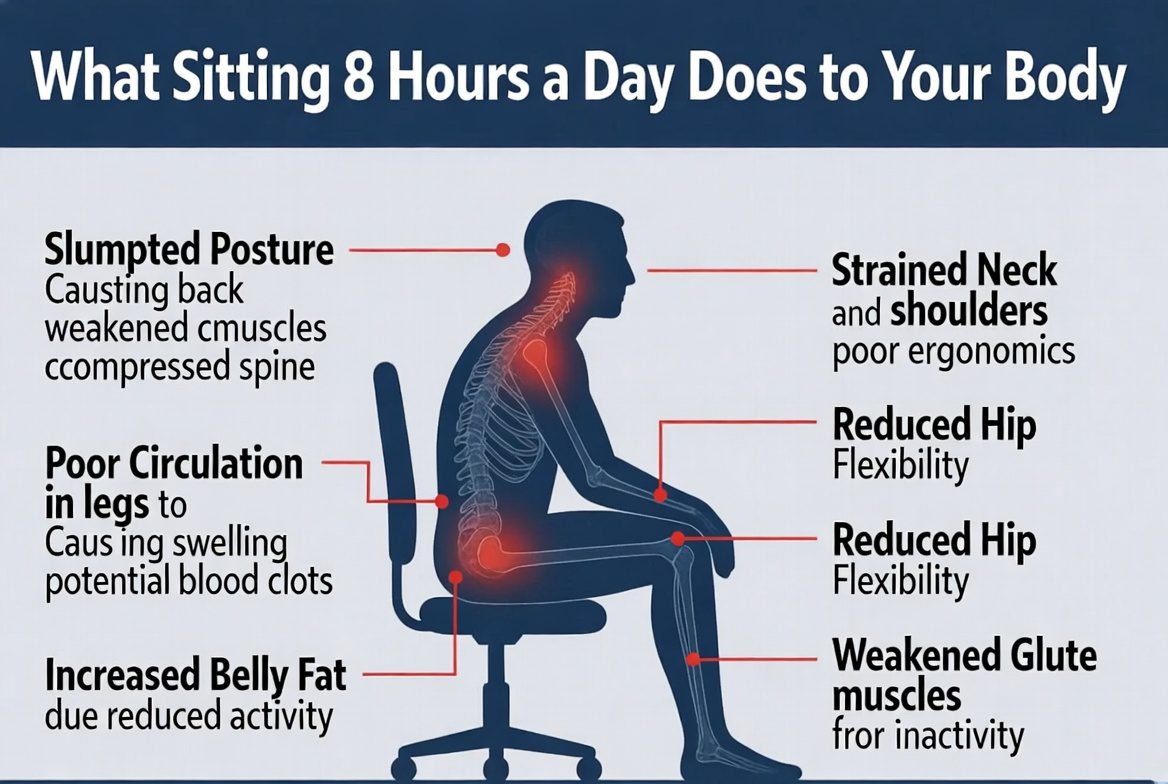
Sitting puts roughly 40% more pressure on your lumbar spine compared to standing. After 30–45 minutes, the fluid-filled discs in your lower back start to compress. This is when that familiar “tight” feeling sets in.
Your hip flexors — the muscles connecting your hips to your thighs — begin to shorten and tighten. Over time, this contributes to anterior pelvic tilt, a postural issue that causes chronic low back pain in millions of desk workers.
Hour 2 and Beyond: The Real Damage Sets In
After two or more hours of sitting, lipoprotein lipase — an enzyme that helps your body break down fat — nearly shuts down. A 2010 study from the University of Missouri found that this enzyme’s activity dropped by as much as 90% during prolonged sitting.
Blood pools in your legs. Circulation slows. And your body quietly starts storing more fat — even if you’re eating the same amount as always.
2. How Prolonged Sitting Damages Your Heart and Metabolism
Here’s a statistic that should stop you mid-scroll: people who sit for more than 8 hours a day have a 147% higher risk of cardiovascular disease than those who sit less, according to research published in the Annals of Internal Medicine (2015).
That number doesn’t discriminate based on whether you exercise. Even people who hit the gym regularly but sit for long stretches still show elevated cardiovascular risk. The research community calls this the “active couch potato” paradox.
The Heart-Sitting Link: What’s Actually Happening
When you sit for extended periods, blood flow slows — especially in your lower extremities. Your heart has to work harder to push blood back up against gravity. Over time, this pattern contributes to higher blood pressure, elevated LDL (bad cholesterol), and reduced HDL (good cholesterol).
A 2012 study from the American Heart Association tracked over 7,000 men for 13 years. Those who reported sitting most of the day had a 64% greater risk of dying from heart disease than those who sat less.
Metabolic Syndrome: When Sitting Rewires Your Body’s Engine
Metabolic syndrome is a cluster of conditions — high blood pressure, elevated blood sugar, excess belly fat, and abnormal cholesterol — that dramatically increase your risk of heart disease, stroke, and type 2 diabetes.
Prolonged sitting is directly linked to all five markers of metabolic syndrome. In simple terms: sitting rewires your body’s ability to process energy efficiently. It turns a healthy engine into one that’s running on dirty fuel.
3. What Sitting 8 Hours Does to Your Spine and Posture
Ask any physical therapist what they see most in their practice. Back pain. Neck pain. Shoulder tension. And almost always, the culprit is the same: too much sitting, not enough movement.
The Physics of Sitting Badly
Your spine has three natural curves: cervical (neck), thoracic (upper back), and lumbar (lower back). When you sit — especially hunched forward over a screen — you flatten or reverse these curves. The result is excessive stress on your vertebral discs and the surrounding muscles.
Here’s the breakdown of spinal pressure by position (based on intradiscal pressure studies by Nachemson and Wilke):
| Position | Spinal Load | Risk Level |
| Lying down flat | ~25 kg | Low |
| Standing upright | ~70 kg | Low-Moderate |
| Sitting upright | ~100 kg | Moderate |
| Sitting slouched forward | ~185 kg | High |
| Sitting + leaning forward | ~275 kg | Very High |
That “slouched forward” position? It’s how most of us actually sit when we’re tired or focused on a screen. Your spine is absorbing almost double the pressure of simply standing.
Tech Neck: The Modern Epidemic
“Tech neck” is the term physiotherapists use for the neck and upper back pain caused by looking down at screens. For every inch your head moves forward of its neutral position, your neck experiences an additional 10 pounds of pressure. At a 60-degree forward tilt (common when looking at a phone or laptop), that’s about 60 pounds of pressure on your cervical spine.
Over months and years, this changes the curvature of your neck — and can lead to permanent structural changes that require professional intervention.
4. Brain Fog, Mood, and Mental Health: The Sitting-Mind Connection
Sitting doesn’t just hurt your body. It hurts your brain. And not in the vague, hand-wavy way that wellness influencers talk about — in measurable, documented ways.
Reduced Blood Flow to the Brain
A 2020 study published in the Journal of Applied Physiology found that prolonged sitting reduces blood flow to the brain’s prefrontal cortex — the region responsible for decision-making, focus, and emotional regulation. Participants who sat for four hours showed significantly reduced cerebrovascular reactivity (essentially, the brain’s ability to regulate its own blood flow).
What does this feel like in practice? That mid-afternoon slump where you can’t form a coherent thought. The irritability that creeps in by 3pm. The inability to focus on a task for more than five minutes. Sound familiar?
Sitting and Depression: A Documented Link
Multiple large-scale studies have found a correlation between sedentary behavior and depression. A 2019 meta-analysis of 24 studies involving over 100,000 participants found that people with higher sedentary time had a 25% greater risk of depression and a 30% greater risk of anxiety.
This doesn’t mean sitting causes depression — the relationship is complex. But movement genuinely helps regulate mood through dopamine, serotonin, and endorphin release. The less you move, the less of these neurochemicals you produce.
5. The Cancer and Type 2 Diabetes Connection
These two words tend to get people’s attention — and they should. There is growing scientific evidence linking prolonged sitting to both cancer risk and type 2 diabetes development.
Sitting and Cancer Risk
A 2014 meta-analysis published in the Journal of the National Cancer Institute analyzed 43 observational studies and found that sedentary behavior was associated with a 24% increased risk of colon cancer, 32% increased risk of endometrial cancer, and 21% increased risk of lung cancer.
The mechanism? Prolonged sitting increases systemic inflammation, disrupts hormone regulation, and leads to insulin resistance — all of which create conditions favorable for abnormal cell growth.
Sitting and Type 2 Diabetes
Every time your muscles contract — even during a casual walk — they draw glucose out of your bloodstream. When you sit still, this process slows dramatically. The result: chronically elevated blood sugar levels, reduced insulin sensitivity, and over time, the progression toward type 2 diabetes.
The Nurses’ Health Study, one of the longest-running health studies in history, found that women who watched TV (a proxy for prolonged sitting) for more than 6 hours daily had a 47% increased risk of developing type 2 diabetes compared to those who watched less than 1 hour.
6. How Long-Term Sitting Changes Your Body Composition
You might be eating exactly what you always have. Your weight might not have changed much. But after years of desk work, your body composition shifts in subtle — and not-so-subtle — ways.
The Glutes Switch Off (and Stay Off)
Gluteal amnesia — yes, that’s a real medical term — is when your glute muscles “forget” how to fire properly because they’ve been compressed and unused for too long. The gluteus maximus is your body’s largest muscle. When it stops working efficiently, your body compensates through your lower back and knees, leading to pain and injury.
Visceral Fat Accumulation
Visceral fat — the dangerous fat stored around your organs — accumulates faster in sedentary people. Unlike subcutaneous fat (the fat under your skin), visceral fat is metabolically active in a harmful way. It releases inflammatory compounds that disrupt insulin signaling, raise blood pressure, and increase heart disease risk.
A 2014 study in Obesity found that sedentary time was the strongest predictor of visceral fat accumulation — stronger even than diet or exercise frequency.
7. Can You Undo the Damage From Too Much Sitting?
Here’s the good news: yes, much of the damage is reversible. Here’s the reality check: you can’t undo 8 hours of sitting with a 30-minute evening run. But you can absolutely reduce the harm — if you’re strategic about it.
The ‘Exercise Doesn’t Offset Sitting’ Finding Explained
A landmark 2012 study in the British Journal of Sports Medicine followed 800,000 participants across 18 studies. The conclusion: regular exercise reduced — but did not eliminate — the health risks of prolonged sitting. Those who exercised AND broke up their sitting time fared far better than those who exercised but otherwise sat all day.
This doesn’t mean exercise is pointless. It absolutely helps. But the solution isn’t to exercise harder — it’s to sit less overall, and to break it up throughout the day.
What the Research Says About Recovery
The encouraging part: studies show that even modest increases in movement can rapidly reverse some of the metabolic damage from sitting. A 2015 study published in Diabetologia found that breaking up sitting with just 2 minutes of light walking every 20 minutes significantly improved blood sugar and insulin levels — even in people with pre-diabetes.
8. The 5-Minute Fix: Actionable Steps to Fight Back Against Sitting
You don’t need to overhaul your life. You need a simple, sustainable system. Here’s what science-backed evidence supports:
The 20-8-2 Rule
Ergonomics researchers at Cornell University propose a simple formula: for every 30-minute period, sit for 20 minutes, stand for 8, and move for 2. This cycle, repeated throughout your workday, dramatically reduces the cumulative harm of sitting.
Other effective strategies:
- Set a movement timer — every 20-30 minutes, stand up and walk for 2 minutes. Apps like Stand Up! or your phone’s built-in reminders work well.
- Take walking meetings — if a meeting doesn’t require a screen, do it on foot.
- Use a standing desk — alternating between sitting and standing reduces spinal compression and improves energy levels.
- Do desk stretches — hip flexor stretches, chest openers, and thoracic rotations can counteract the posture damage of sitting.
- Take the long route — park farther away, take stairs, use the restroom on another floor. Every step counts.
- After-dinner walk — a 15-minute walk after meals significantly improves blood sugar regulation.
- Exercise in the morning — morning movement primes your metabolism and reduces the total harm of sitting throughout the day.
- Strengthen your glutes and core — squats, hip bridges, and planks counteract gluteal amnesia and back weakness from sitting.
- Adjust your workstation ergonomically — monitor at eye level, feet flat on the floor, arms at 90 degrees, lumbar support in place.
9. Frequently Asked Questions About Sitting and Health
Is sitting really as bad as smoking?
The “sitting is the new smoking” comparison, originally coined by Dr. James Levine of the Mayo Clinic, highlights that prolonged sitting has been linked to similar chronic disease risk factors as smoking. However, sitting is not as immediately toxic as cigarette smoke. The comparison is meant to convey urgency, not exact equivalence. That said, the long-term mortality data is genuinely alarming.
How long is too long to sit without a break?
Most research suggests that 30 minutes of uninterrupted sitting is where the physiological decline begins to accelerate. Breaking up sitting every 20-30 minutes with even a short walk or movement is enough to significantly reduce the harm. The key is frequency of breaks, not just total sitting time.
Does a standing desk actually help?
Standing desks help — but only if you alternate between sitting and standing. Prolonged standing has its own issues (varicose veins, foot pain, lower back fatigue). The optimal approach is to switch positions every 30-45 minutes. A standing desk used correctly is far better than sitting all day.
What are the first signs that sitting is hurting my health?
- Chronic lower back pain or stiffness (especially in the morning)
- Tight hip flexors or hamstrings
- Swollen ankles or feet by end of day
- Mid-afternoon energy crashes
- Poor posture (rounded shoulders, forward head position)
- Unexplained weight gain around the midsection
Can children be harmed by sitting too much?
Yes. Children who sit excessively — particularly due to screen time — show reduced bone density, weaker core muscles, and higher risks of childhood obesity. The American Academy of Pediatrics recommends limiting recreational screen time to 1 hour per day for children ages 2-5 and emphasizing physical activity throughout the day for older children.
10. Key Takeaways: What You Need to Know About Sitting 8 Hours a Day
Let’s bring it all together. After 8 hours of sitting, your body has experienced a significant physiological toll — and here’s the summary:
- Your calorie-burning rate drops to near-resting levels within 20 minutes of sitting.
- Your spine absorbs 40% more pressure sitting than standing — and far more if you’re slouching.
- Blood flow to your brain decreases, impairing focus, mood, and decision-making.
- Your risk of heart disease, type 2 diabetes, and certain cancers increases with every additional hour of sitting.
- Exercise helps — but it doesn’t fully offset 8 hours of daily sitting.
- Breaking up sitting every 20-30 minutes is the single most effective behavioral change you can make.
- Small, consistent movement breaks are more powerful than occasional intense exercise.
- Your body is designed to move. Sitting for 8 hours a day is an evolutionary mismatch — and your health pays the price.
The solution doesn’t require a gym membership or a complete lifestyle overhaul. It starts with awareness, a timer on your phone, and the decision to stand up every 30 minutes. From there, you build.
Your body gave you eight hours of work today. Give it two minutes of movement every half-hour. It will thank you — in more ways than you can count.
Sources & Further Reading
- Biswas et al. (2015). Sedentary Time and Its Association with Risk for Disease Incidence, Mortality, and Hospitalization in Adults. Annals of Internal Medicine.
- Katzmarzyk PT et al. (2009). Sitting Time and Mortality from All Causes, Cardiovascular Disease, and Cancer. Medicine & Science in Sports & Exercise.
- Wilmot EG et al. (2012). Sedentary time in adults and the association with diabetes, cardiovascular disease and death. Diabetologia.
- Thorp AA et al. (2014). Sedentary behaviors and subsequent health outcomes in adults. American Journal of Preventive Medicine.
- Buckley JP et al. (2015). The sedentary office: an expert statement. British Journal of Sports Medicine.
About This Article
This article was researched and written to provide accurate, science-backed health information based on peer-reviewed studies published between 2009 and 2025. All statistics cited reference original research publications. This content is intended for educational purposes and does not constitute medical advice. Consult a qualified healthcare professional for personalized guidance.
Last Updated: February 2025 | Category: Health & Wellness, Ergonomics, Preventive Health
Discover more from MatterDigest
Subscribe to get the latest posts sent to your email.