What Is Alpine Skiing Olympics? A Complete Guide to the Most Thrilling Winter Sport
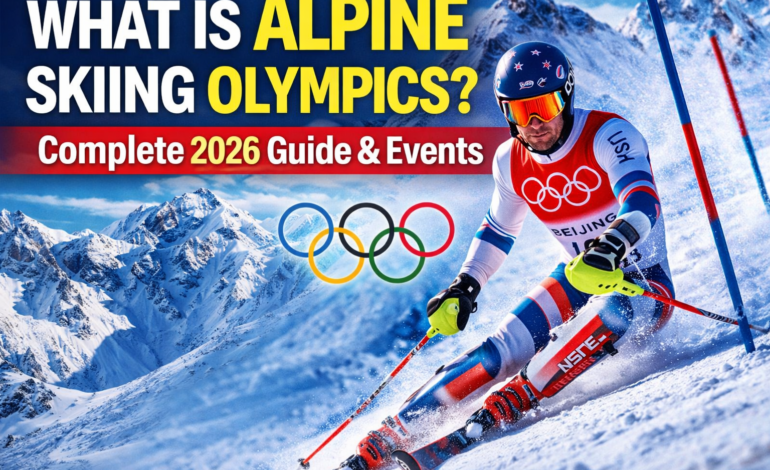

Quick Answer: Alpine skiing in the Olympics is a high-speed winter sport where athletes race down snow-covered slopes while navigating gates (poles) in five main events: Downhill, Slalom, Giant Slalom, Super-G, and Alpine Combined. It’s been part of the Winter Olympics since 1936 and features the world’s fastest and most technically skilled skiers competing for gold medals. Athletes can reach speeds over 90 mph while making split-second turns on challenging mountain courses.
Introduction: The Crown Jewel of Winter Sports
Alpine skiing stands as one of the most exhilarating and prestigious events at the Winter Olympics. Combining raw speed, technical precision, physical courage, and split-second decision-making, Olympic alpine skiing showcases human performance at its absolute peak.
If you’ve ever watched the Winter Olympics and seen skiers hurtling down mountains at breathtaking speeds, carving through gates with surgical precision, you’ve witnessed alpine skiing—a sport that has captivated global audiences for nearly 90 years.
This comprehensive guide will explain everything you need to know about Olympic alpine skiing: what it is, how it works, its history, the different events, legendary athletes, and why it remains one of the most-watched Olympic sports worldwide.
What Exactly Is Alpine Skiing?
Basic Definition
Alpine skiing, also called downhill skiing, is a winter sport where athletes ski down snow-covered slopes while navigating through a series of gates (pairs of poles). The primary goal is simple: complete the course in the fastest time possible without missing gates or falling.
Unlike cross-country skiing (which involves relatively flat terrain and endurance) or ski jumping (which focuses on aerial distance), alpine skiing is all about speed and technical control on steep, winding mountain courses.
Key Elements of Alpine Skiing
Speed: Olympic alpine skiers regularly exceed 80-90 mph (130-145 km/h) in downhill events, making it one of the fastest non-motorized sports on Earth.
Technical Skill: Skiers must navigate tight turns around gates while maintaining maximum speed and balance.
Equipment: Athletes use specialized skis, boots, poles, helmets, and aerodynamic suits designed for specific disciplines.
Course Difficulty: Olympic courses feature steep gradients, sharp turns, terrain variations, and challenging snow conditions.
Physical Demands: Alpine skiing requires exceptional leg strength, core stability, cardiovascular endurance, quick reflexes, and mental toughness.
The Five Olympic Alpine Skiing Events Explained
The Olympics feature five distinct alpine skiing disciplines, each testing different skills and requiring unique strategies.
1. Downhill (DH)
The Fastest Event
Downhill is pure speed. Athletes race down a long, steep course with relatively few turns, reaching the highest velocities in all of alpine skiing.
Key Facts:
- Course Length: 2-3 miles (3-5 kilometers)
- Vertical Drop: 2,600-3,300 feet (800-1,000 meters) for men; 1,640-2,600 feet (500-800 meters) for women
- Top Speeds: 85-95 mph (135-150 km/h)
- Gates: Wide-spaced gates that require sweeping turns
- Duration: Typically 1.5-2.5 minutes
- Runs: Single run determines the winner
What Makes It Special: Downhill demands absolute fearlessness. Skiers tuck into aerodynamic positions, launching off jumps and navigating high-speed turns where a single mistake can mean catastrophic crashes. It’s often called the “Formula One of skiing.”
2. Slalom (SL)
The Most Technical Event
Slalom is the polar opposite of downhill—it’s all about quick, precise turns through tightly-spaced gates on a shorter course.
Key Facts:
- Course Length: Shorter than other events
- Vertical Drop: 590-720 feet (180-220 meters)
- Gates: 55-75 gates placed very close together
- Speed: 25-40 mph (40-65 km/h)
- Duration: 40-60 seconds per run
- Runs: Two runs; combined time determines winner
What Makes It Special: Slalom requires rapid-fire decision-making and phenomenal agility. Skiers make quick, rhythmic turns around gates spaced just feet apart. The technique demands perfect edge control and lightning-fast reflexes.
3. Giant Slalom (GS)
The Perfect Balance
Giant Slalom sits between downhill’s speed and slalom’s technicality, offering a balanced test of both skills.
Key Facts:
- Course Length: Moderate distance
- Vertical Drop: 980-1,310 feet (300-400 meters) for men; 820-1,150 feet (250-350 meters) for women
- Gates: Wider spacing than slalom, tighter than downhill
- Speed: 45-60 mph (70-95 km/h)
- Duration: 1-1.5 minutes per run
- Runs: Two runs; combined time determines winner
What Makes It Special: GS tests versatility. Athletes must maintain high speeds while executing precise, powerful turns. It’s often considered the most “pure” form of alpine racing.
4. Super-G (Super Giant Slalom)
Speed Meets Technicality
Super-G combines downhill’s velocity with giant slalom’s technical challenges, creating an unpredictable and exciting event.
Key Facts:
- Course Length: Shorter than downhill, longer than GS
- Vertical Drop: Similar to downhill
- Gates: More gates than downhill, fewer than GS
- Speed: 75-85 mph (120-135 km/h)
- Duration: 1-1.5 minutes
- Runs: Single run (no practice run allowed)
What Makes It Special: Super-G is the wildcard event. Unlike other disciplines, athletes get no practice runs—they must inspect the course on foot, then race it blind. This creates dramatic upsets and showcases pure adaptability.
5. Alpine Combined
The Ultimate All-Around Test
Alpine Combined crowns the most complete skier by combining one downhill run with one slalom run.
Key Facts:
- Format: One downhill run + one slalom run
- Winner: Fastest combined time across both disciplines
- Challenge: Requires mastery of both speed and technical skills
What Makes It Special: Combined separates specialists from all-around champions. A skier must excel at both high-speed downhill and technical slalom—vastly different skill sets—in the same competition.
Olympic Alpine Skiing History: From 1936 to Today
Early Beginnings (1936)
Alpine skiing debuted at the 1936 Winter Olympics in Garmisch-Partenkirchen, Germany. Initially, only a “combined” event existed, merging downhill and slalom into one competition.
First Olympic Champions:
- Men: Franz Pfnür (Germany)
- Women: Christl Cranz (Germany)
Post-War Expansion (1948-1950s)
After World War II, the Olympics separated downhill and slalom into individual events at the 1948 St. Moritz Games. This expansion recognized that the disciplines required different specializations.
Modern Era (1980s-Present)
- 1988: Super-G added at Calgary Olympics
- 1992: Alpine Combined separated from individual events
- 2000s-Present: Continued refinement of rules, safety measures, and course design
Dominant Nations in Olympic Alpine Skiing History
Austria: 121 total medals (most successful alpine skiing nation) Switzerland: 73 medals France: 49 medals Italy: 47 medals United States: 45 medals Norway: 36 medals Germany: 34 medals
Legendary Olympic Alpine Skiers
Men’s Legends
Ingemar Stenmark (Sweden)
- 2 Olympic golds (1980)
- Considered the greatest technical skier ever
- Dominated slalom and giant slalom in the 1970s-80s
Jean-Claude Killy (France)
- 3 Olympic golds (1968)
- Won all three alpine events at Grenoble
- International skiing superstar
Alberto Tomba (Italy)
- 3 Olympic golds, 2 silvers
- “La Bomba” was a slalom and GS specialist
- Charismatic personality made him a global icon
Hermann Maier (Austria)
- 2 Olympic golds (1998), 1 silver
- “The Herminator” famous for horrific crash and comeback
- One of the most resilient athletes in Olympic history
Women’s Legends
Lindsey Vonn (USA)
- 1 Olympic gold, 2 bronzes
- Most successful female American alpine skier
- 82 World Cup wins (most all-time for women)
Janica Kostelić (Croatia)
- 4 Olympic golds, 2 silvers
- Dominant force in early 2000s
- Put Croatian skiing on the global map
Mikaela Shiffrin (USA)
- 2 Olympic golds, 1 silver
- Current generation’s dominant technical skier
- Most World Cup wins in history (men or women)
Vreni Schneider (Switzerland)
- 3 Olympic golds, 1 silver, 1 bronze
- Slalom specialist who dominated late 1980s-early 1990s
How Olympic Alpine Skiing Works: Rules and Scoring
Gate Navigation Rules
What Are Gates? Gates consist of two poles (red or blue) that mark the course. Skiers must pass between them with both feet.
Missing a Gate: If a skier misses a gate (passes on the wrong side or straddles it), they’re disqualified (DNF – Did Not Finish).
Touching Gates: Skiers can knock gates down or brush them—this is legal and often necessary for the fastest line.
Timing and Winning
Electronic Timing: Races are timed to 1/100th of a second using precise electronic sensors at start and finish lines.
Single Run Events: Downhill and Super-G use one run. Fastest time wins.
Two-Run Events: Slalom, Giant Slalom, and Combined total times from two runs. Lowest combined time wins.
Start Order: Top-ranked skiers typically start later (15-30 range), as early starters face worse snow conditions that deteriorate throughout the day.
Disqualification Reasons
- Missing or straddling a gate
- Starting before the signal
- Receiving outside assistance on course
- Using illegal equipment
The Venue: What Makes an Olympic Alpine Skiing Course
Location Requirements
Olympic alpine skiing requires mountain venues with:
- Significant vertical drop (800+ meters for downhill)
- Consistent snow conditions
- Safety features (protective netting, padding)
- Spectator accessibility
- Modern timing and broadcast infrastructure
Recent Olympic Venues
- 2026: Milano-Cortina, Italy (upcoming)
- 2022: Beijing, China (Yanqing)
- 2018: PyeongChang, South Korea
- 2014: Sochi, Russia (Rosa Khutor)
- 2010: Vancouver, Canada (Whistler)
Course Safety Evolution
Modern Olympic courses feature extensive safety measures:
- Protective fencing and netting along the course
- Padding on exposed obstacles
- Medical teams positioned throughout the mountain
- Helicopter evacuation capability
- Course inspections by athletes before racing
Training and Preparation: What It Takes to Compete
Physical Demands
Olympic alpine skiers train year-round with:
Strength Training: Massive leg strength (quadriceps, hamstrings, glutes) to withstand G-forces Cardiovascular Fitness: Endurance for multiple runs and recovery Balance and Agility: Core stability and proprioception work Flexibility: Injury prevention and improved range of motion
Technical Training
Dry-Land Training: Skateboarding, rollerblading, and balance boards simulate skiing movements Video Analysis: Athletes study footage to refine technique Mental Preparation: Visualization, course memorization, pressure management
Equipment Technology
Skis: Different lengths and shapes for each discipline; downhill skis are longest (up to 225cm for men) Boots: Rigid, custom-fitted for maximum power transfer Bindings: Release mechanisms to prevent injury during falls Suits: Aerodynamic, tight-fitting to reduce drag Helmets: Mandatory safety equipment; aerodynamic designs for speed events
Why Alpine Skiing Captivates Olympic Audiences
The Drama Factor
Speed and Danger: Watching athletes risk serious injury while racing at highway speeds creates unmatched tension and excitement.
Narrow Margins: Races are often decided by hundredths of a second—the difference between gold and fourth place can be invisible to the naked eye.
Upsets and Surprises: Favorites fall. Underdogs triumph. Every run is unpredictable, especially in Super-G with no practice runs.
Aesthetic Beauty
The combination of athletic skill, mountain scenery, and graceful technique makes alpine skiing visually stunning. The sport showcases human capability in harmony with challenging natural environments.
National Pride
Alpine skiing produces intense national rivalries. European dominance (Austria, Switzerland, France, Italy) faces challenges from North America and emerging nations, creating compelling storylines.
How to Watch and Understand Alpine Skiing
Key Things to Watch For
Start Technique: Watch how skiers explode from the start gate—good starts can determine races Line Choice: Notice the racing line through gates; optimal paths save fractions of seconds Body Position: Aerodynamic tucks in speed events; aggressive edge angles in technical events Gate Contact: Efficient skiers brush gates aggressively without losing speed Mistakes: Watch for skis skidding (losing grip), balance corrections, or line errors
Understanding Split Times
Broadcasts show interval times at checkpoints down the course. Green numbers mean the skier is ahead; red means they’re behind. These splits help predict final outcomes and build suspense.
The Future of Olympic Alpine Skiing
Technological Advances
Equipment Innovation: Ski manufacturers continuously develop faster, more stable designs within regulatory limits.
Course Design: Modern courses balance speed and safety, using computer modeling to predict skier behavior.
Training Technology: Virtual reality, advanced video analysis, and biomechanical sensors help athletes optimize performance.
Growing Global Participation
While European nations still dominate, alpine skiing is expanding to:
- Asian countries (China, Japan, South Korea investing heavily)
- Southern Hemisphere nations (New Zealand, Australia, Chile, Argentina)
- Non-traditional winter sports countries seeking Olympic success
Climate Change Challenges
Warming temperatures threaten natural snow reliability. Future Olympics may increasingly rely on artificial snowmaking technology and higher-elevation venues.
Conclusion: The Timeless Thrill of Olympic Alpine Skiing
Olympic alpine skiing represents the perfect intersection of human courage, athletic excellence, and natural beauty. From the terrifying speed of downhill to the balletic precision of slalom, these five disciplines showcase different facets of one of winter’s most demanding sports.
For nearly 90 years, the Winter Olympics has provided the ultimate stage for alpine skiers to test themselves against the mountain, the clock, and the world’s best competitors. The sport continues to evolve while maintaining its essential character: athletes pushing human limits on snow-covered slopes, chasing glory measured in hundredths of a second.
Whether you’re a first-time Olympic viewer or a longtime skiing enthusiast, alpine skiing delivers unmatched drama, beauty, and excitement—making it one of the Winter Games’ most essential and captivating events.
Frequently Asked Questions (FAQs)
Q: What’s the difference between alpine skiing and cross-country skiing? A: Alpine skiing involves racing downhill on steep slopes with turns and gates. Cross-country skiing is an endurance sport on relatively flat terrain where athletes propel themselves forward using poles.
Q: How fast do Olympic alpine skiers go? A: In downhill events, speeds regularly exceed 85-95 mph (135-150 km/h). Technical events like slalom are slower, around 25-40 mph (40-65 km/h).
Q: Which country is best at Olympic alpine skiing? A: Austria has won the most Olympic alpine skiing medals in history (121 total), followed by Switzerland and France.
Q: Can you practice on the Olympic course before racing? A: It depends on the event. Downhill and Giant Slalom allow training runs. Super-G does not—athletes inspect on foot, then race blind. Slalom allows inspection but no full-speed practice.
Q: What happens if a skier misses a gate? A: They are immediately disqualified (DNF – Did Not Finish) and receive no time or ranking for that run.
Discover more from MatterDigest
Subscribe to get the latest posts sent to your email.