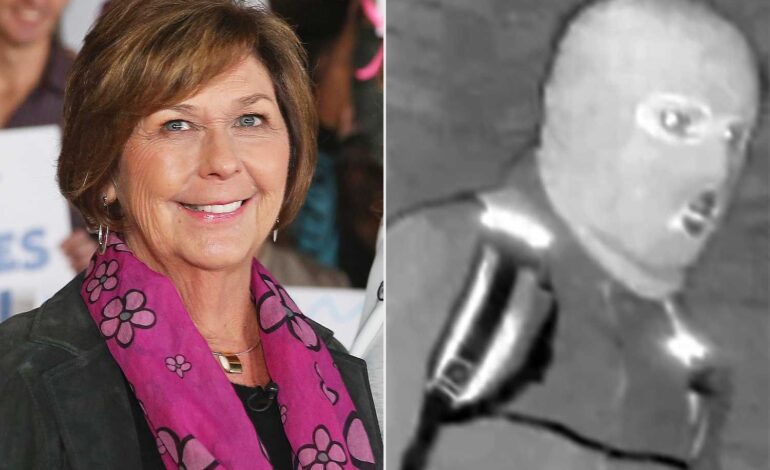

Masked Figure Shadowed Nancy Guthrie for Four Hours Before Her Pacemaker Failed at 2:28 AM — The Fatal Photograph Investigators Can’t Explain
New evidence in the Nancy Guthrie disappearance case has sent shockwaves through the investigation. According to early investigative reports, a masked and unidentified individual was allegedly present in the vicinity of Nancy Guthrie’s residence for approximately four hours before her pacemaker stopped functioning at exactly 2:28 AM. A single piece of forensic evidence — now being referred to inside the investigation as the fatal photograph — has become the centerpiece of a case that grows more disturbing with every new detail that surfaces.
What investigators initially approached as a missing persons case involving a medical event has been fundamentally reframed by what this new evidence suggests. The night was not random. The silence was not accidental. And the question of what happened to Nancy Guthrie in those final hours before her disappearance is no longer a matter of speculation. It is a matter of active criminal investigation — one that experts say points toward something far darker than anyone initially imagined.
For hours, no one noticed. The night was quiet. Too quiet. As if something unseen was carefully unfolding behind closed doors. What investigators would later uncover shattered that apparent calm completely — and what it revealed about the final hours of Nancy Guthrie’s life is now being described as one of the most chilling and technically sophisticated criminal timelines in recent memory.
What Is the Fatal Photograph and Why Has It Become the Center of the Investigation?
Every major investigation has a turning point — a single piece of evidence that reframes everything that came before it and forces investigators to look at the case with entirely new eyes. In the Nancy Guthrie disappearance, that turning point has a name: the fatal photograph.
The image was extracted from a low-resolution security camera located near the Guthrie residence. It was recovered and enhanced using forensic imaging techniques that can sharpen detail from footage that would otherwise be too degraded to interpret clearly. The process of recovering and analyzing the image took time — which is why it did not surface immediately in the early stages of the investigation.
What the photograph shows is a blurred silhouette near a hallway exit, captured just minutes before Nancy Guthrie’s pacemaker stopped transmitting data at 2:28 AM. The figure is not clearly identifiable. The image quality, even after enhancement, does not allow for the kind of definitive facial recognition that would immediately resolve the question of who was present. But what the image does show — unmistakably, according to the forensic analysts who have reviewed it — is that someone was there.
Not passing through. Not walking to or from another destination. The analysis of the image, combined with the broader surveillance timeline being reconstructed by investigators, suggests that the figure in the photograph had been in the vicinity of the property for an extended period before the moment the image was captured. Investigators now believe that this presence was not incidental. It was sustained, deliberate, and timed.
The fatal photograph has not yet been officially verified as definitive proof. But it has become the centerpiece of the investigation — the single image that changed everything investigators thought they knew about what happened the night Nancy Guthrie vanished.
The photograph has also ignited a new wave of forensic work. Digital analysts are working to extract every possible detail from the image and from the broader footage recovered around the same timeframe. Image analysis experts have noted that while enhancements can clarify shapes and movement, they cannot always confirm identity. The figure in the photograph remains, as of this writing, unidentified. But the identity question may be the least significant thing the image reveals. What matters most, investigators say, is the timing.
Who Was the Masked Figure Seen Near Nancy Guthrie’s Home — and What Were They Doing?
The presence of an unidentified masked individual near Nancy Guthrie’s residence in the hours before her pacemaker failed is the detail that has most alarmed both investigators and the public following this case closely.
According to early investigative reports, the figure was allegedly observed — either through surveillance footage or through accounts provided by witnesses whose identities have not been made public — in the vicinity of the property between approximately 10:30 PM and 2:28 AM. That is a span of nearly four hours. Four hours of proximity to the home of an 84-year-old woman. Four hours of presence that, if confirmed, was never detected or responded to by anyone with the ability to intervene.
What makes the presence of this figure so disturbing is not simply that someone was there. It is the nature of the presence that the investigation has begun to piece together. The figure was not simply visible in a passing sense — someone who happened to be in the area during a late-night walk, or a neighbor whose path happened to take them near the property. The analysis of the surveillance data suggests something different: a figure that was observing, waiting, and possibly anticipating a specific moment.
Authorities have not officially confirmed forced entry into the property, which only deepens the mystery. How could someone remain undetected in close proximity to a residence for four hours? What was that person waiting for? And if the pacemaker failure at 2:28 AM was not a natural medical event — if it was, as investigators are now seriously considering, the result of deliberate external interference — then the presence of this figure in those final hours takes on a meaning that is almost impossible to process.
Even more disturbing is a detail that has emerged from investigators analyzing the behavior pattern of the figure in available footage. The suggestion is that this person was not merely passing through or present by coincidence. The analysis indicates active observation — a sustained, deliberate monitoring of the residence that appears to have been timed around something specific. The most specific thing that happened that night, at exactly 2:28 AM, was the failure of Nancy Guthrie’s pacemaker.
Could the Pacemaker Failure at 2:28 AM Have Been Deliberately Caused?
This is the question that has pushed the Nancy Guthrie case from a missing persons investigation into the territory of a potential criminal act of extraordinary technical sophistication. And it is a question that investigators, cybersecurity specialists, and medical device experts are now taking extremely seriously.
Modern pacemakers are wireless devices. Many of them communicate with monitoring systems and medical oversight networks through radio frequency or Bluetooth-adjacent transmission protocols. This wireless capability is a genuine medical advancement — it allows remote monitoring, enables software updates, and allows cardiologists to track a patient’s heart health without requiring the patient to come into an office for every routine check.
But that wireless capability also creates a vulnerability. Any system that communicates wirelessly can, under certain conditions and with the right equipment, be interfered with. Academic researchers and cybersecurity professionals have been documenting the theoretical vulnerability of implanted medical devices for more than a decade. What has previously been treated as a theoretical risk — the kind of thing that gets discussed at security conferences and in academic papers — is now being examined as a possible explanation for what happened to Nancy Guthrie’s pacemaker at exactly 2:28 AM.
Digital forensic analysts working the case are now examining whether any form of external interference could have impacted the device. No official statement has been made confirming or denying this possibility. But the fact that analysts with the technical expertise to assess that question are now actively doing so is itself significant. It means that investigators have not been able to rule out interference — and in an investigation that is as methodical and evidence-driven as this one, that inability to rule something out carries weight.
Could someone have the technical capability to disrupt a life-sustaining medical device remotely or physically — and then be standing just outside the home at the exact moment it happened? That is the question investigators are now trying to answer.
Medical specialists who have been consulted on the case have confirmed that pacemaker failures of this kind, while rare, are not impossible. The critical question is not whether such a failure could happen — it can, for a variety of reasons. The critical question is whether the specific pattern of failure in this case, at this specific time, in the presence of an unidentified masked figure outside the property, is consistent with a natural medical event or with something else entirely.
What Do Investigators Know About the Motive Behind the Suspected Surveillance?
Adding yet another layer of complexity to an already deeply troubling case is the question of motive. Who would spend four hours in the dark outside the home of an 84-year-old woman? What would drive that kind of sustained, deliberate presence? And what would connect that presence to the precise moment her life-support device failed?
Authorities have not publicly identified any suspects or clear reasons for the alleged surveillance. At this stage, the investigation is focused on gathering and analyzing evidence rather than on building a public case against any named individual. The details of what investigators believe about motive — what they know, what they suspect, and what they are still working to establish — have not been disclosed.
What has emerged from sources familiar with the investigation is a picture of a case that does not fit any of the conventional patterns. This is not a robbery that went wrong. The property was not disturbed. This is not a case of opportunistic violence. The timeline — four hours of presence before a precise medical event — does not suggest improvisation. It suggests planning.
Some theories suggest personal connections — someone who knew Nancy Guthrie’s routines, her medical situation, her home’s layout, and the specifications of her devices well enough to exploit that knowledge. Others have raised the possibility of professional connections — service providers, contractors, or medical personnel who would have had access to information about her pacemaker and her security infrastructure that a stranger would not.
The lack of concrete evidence to support any specific theory has kept the investigation from moving toward a conclusion on the motive question. But the very specificity of what appears to have happened — the precise timing, the sustained surveillance, the simultaneous failure of multiple systems at a single critical moment — makes a random or accidental explanation increasingly difficult to sustain.
How Has the Forensic Investigation Evolved Since the Fatal Photograph Was Discovered?
The discovery and analysis of the fatal photograph has accelerated the pace and changed the direction of the forensic investigation in significant ways.
Prior to the photograph emerging as a significant piece of evidence, the investigation was focused primarily on physical evidence from the property, the pacemaker data, and the simultaneous failure of the home surveillance system. Those lines of inquiry remain active. But the photograph has added a new dimension — a human dimension — that changes the investigative framework.
If there was a person present at the property during the hours before the disappearance, then the investigation is not just about what happened to Nancy Guthrie’s devices. It is about who was there, what they were doing, and whether their presence was connected to the medical event and subsequent disappearance. That means witness interviews, behavioral analysis, digital forensics focused on identifying the figure in the photograph, and a broader examination of who might have had both the knowledge and the access to carry out what the evidence suggests.
Investigators are reportedly widening their scope accordingly. The examination of personal connections, service providers, and recent contractors mentioned in earlier reporting has taken on new urgency in light of what the photograph implies. If the figure in the image is someone known to Nancy Guthrie — or known to someone in her network — that narrows the field of inquiry significantly. If the figure is someone unknown, it raises a different and in some ways more alarming set of questions about how they acquired the information they would have needed.
Public reaction to each new development in the case has been swift and intense. Social media platforms are flooded with theories, interpretations, and debates about what the evidence means. Investigators have been careful not to respond to or validate online speculation, and for good reason — in a case this sensitive, premature conclusions or the spread of inaccurate information can actively harm the investigation by contaminating witness accounts or alerting potential suspects.
What Does the Emerging Evidence Mean for the Final Hours of Nancy Guthrie’s Life?
As each new piece of evidence emerges in this case, the picture of Nancy Guthrie’s final hours before her disappearance becomes simultaneously clearer and more disturbing.
What began as a mystery — an elderly woman missing without explanation, her devices failed at the same moment — has evolved into something that investigators now describe as a case with very specific, very deliberate characteristics. The presence of a masked figure. The four-hour surveillance window. The precise failure of a medical device at a documented time. The fatal photograph that captures something in the moments before that failure.
Taken individually, each of these elements could conceivably be explained in ways that do not imply criminal intent. Medical devices do fail. Security cameras do malfunction. People do move through neighborhoods at unusual hours for reasons that have nothing to do with the residents they happen to pass near. And photographs captured by low-resolution surveillance systems are not always what they appear to be.
But taken together, as investigators are now compelled to take them together, these elements paint a picture that is very hard to explain through coincidence alone. The specificity is too precise. The timing is too exact. The combination of technical sophistication and sustained physical presence does not fit the profile of an accident or a random event.
Investigators are expected to release further updates as forensic examinations continue. What those updates will reveal remains unknown. But one thing that the emerging evidence has already made definitively clear is this: the final hours of Nancy Guthrie’s life were anything but ordinary. And what happened in the dark, between midnight and 2:28 AM, is no longer a simple medical question. It is a criminal one.
Key Takeaways: The Fatal Photograph, the Masked Figure, and Where the Investigation Stands
A newly recovered and forensically enhanced image — now called the fatal photograph — has revealed the presence of an unidentified masked figure near Nancy Guthrie’s residence in the hours before her disappearance.
The figure is believed to have been present for approximately four hours, between 10:30 PM and 2:28 AM — the exact moment Nancy Guthrie’s pacemaker stopped functioning and she subsequently vanished.
Forensic analysts and digital investigators are now examining whether the pacemaker failure could have been the result of deliberate external interference rather than a natural medical event.
No suspect has been officially identified, and investigators have not publicly named any individuals in connection with the alleged surveillance or the pacemaker failure.
The investigation has expanded significantly in response to the new evidence, with a broader examination now underway of personal connections, service providers, and anyone who could have had access to information about Nancy Guthrie’s devices and home security infrastructure.
The final hours of Nancy Guthrie’s life are no longer an unexplained medical mystery. They are an active criminal investigation — one that grows more alarming with every new piece of evidence that surfaces from the dark.
© 2026 Matter News. All rights reserved.
Discover more from MatterDigest
Subscribe to get the latest posts sent to your email.