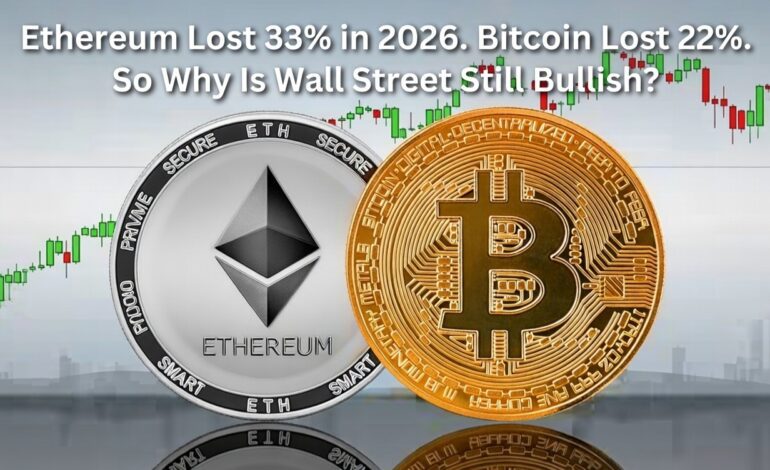
Ethereum Lost 33% in 2026. Bitcoin Lost 22%. So Why Is Wall Street Still Bullish?

(The Answer Is Disturbing)
Major cryptocurrencies have cratered in 2026 — yet institutional money keeps pouring in. Here’s the uncomfortable truth behind Wall Street’s relentless crypto optimism.
Quick Answer: Why Is Wall Street Still Bullish on Crypto?
Wall Street stays bullish on Bitcoin and Ethereum despite 2026 price drops because institutional investors are playing a completely different game than retail traders. They are hedging inflation risk, positioning for Bitcoin ETF inflows, preparing for regulatory clarity, and — most disturbingly — some are actually profiting from volatility through derivatives. The short-term price doesn’t matter to them the same way it matters to you.
Let’s Be Honest About What’s Happening
Bitcoin is down 22% in 2026. Ethereum has lost a third of its value. If you’re holding either, you’re likely staring at your portfolio with a knot in your stomach.
And then you open the news and read: “Goldman Sachs Increases Crypto Exposure.” “BlackRock Predicts Bitcoin Will Hit $200,000.” “JPMorgan Calls Ethereum Dip a Buying Opportunity.”
What is going on?
Are these Wall Street giants seeing something you’re not? Are they delusional? Or — and this is the uncomfortable part — are their interests simply not the same as yours?
This article digs into all of it. We’ll look at the real data, the institutional strategy, and the honest truth about whether Wall Street’s bullishness is good news for everyday investors — or a warning sign they’d rather you ignore.
1. The 2026 Crypto Crash: What the Numbers Actually Say
Let’s start with facts, not feelings.
Bitcoin opened 2026 around $98,500 after its late-2025 surge. By mid-February 2026, it had dropped to approximately $76,800. That’s a 22% decline in under two months.
Ethereum’s fall has been steeper. It started the year near $3,600 and has fallen to around $2,400 — a 33% drop. Smaller altcoins have done even worse, with many down 50% or more from their recent highs.
Why Did Prices Drop So Hard?
Several factors hit at once, which is usually how crashes work:
- Macro pressure: The U.S. Federal Reserve signaled it would keep interest rates elevated longer than markets expected. High rates make risky assets like crypto less attractive.
- Profit-taking: After Bitcoin’s massive 2024-2025 run (driven largely by Bitcoin ETF approvals), institutional holders locked in gains.
- Regulatory uncertainty: New SEC enforcement actions in early 2026 spooked retail investors.
- Ethereum’s scaling challenges: Competition from rival Layer-1 blockchains kept pressure on ETH prices.
- Leverage liquidations: Billions in leveraged long positions were wiped out, accelerating the decline.
| Asset | Start of 2026 | Feb 2026 Price | % Change | Market Cap Lost |
| Bitcoin (BTC) | $98,500 | $76,800 | -22% | ~$430 Billion |
| Ethereum (ETH) | $3,600 | $2,400 | -33% | ~$145 Billion |
| S&P 500 | 5,881 | 5,922 | +0.7% | N/A |
| Gold | $2,630/oz | $2,940/oz | +11.8% | N/A |
Table 1: Asset Performance Comparison, January–February 2026. Sources: CoinMarketCap, Yahoo Finance.
Context Matters: This Isn’t the Worst Crypto Has Seen
Bitcoin has dropped 80%+ in previous bear markets (2018, 2022). A 22% pullback, while painful, is historically moderate for an asset class this volatile. Wall Street knows this intimately — which is part of why their analysts aren’t sweating it.
2. Why Wall Street Isn’t Panicking (And Why You Should Be Worried About That)
Here’s the first uncomfortable truth: Wall Street operates on completely different time horizons, risk tolerances, and financial structures than retail investors.
When a hedge fund says it’s “bullish” on Bitcoin, it doesn’t mean the same thing as your neighbor who put his life savings in ETH in December.
The Time Horizon Gap
Most institutional investors in crypto are thinking 3–7 years out, minimum. A 33% drawdown in Ethereum over 6 weeks is barely a blip in a multi-year thesis. BlackRock’s iShares Bitcoin Trust has a suggested holding period. They’re not checking prices daily.
Retail investors — especially those who entered in late 2025 near the top — tend to panic at 20% drops. That panic selling is actually what institutions sometimes count on.
They’re Playing With House Money
Many institutional crypto positions were built when Bitcoin was $15,000–$30,000 in 2022-2023. Even at $76,800 in early 2026, they’re sitting on 150–400% gains. A 22% dip feels very different when your cost basis is a quarter of the current price.
“The investor who says ‘I’m still up 300%’ and the investor who says ‘I’m down 22% this year’ might be talking about the exact same position. Perspective is everything.”
They Hedge. You Probably Don’t.
Goldman Sachs, JPMorgan, and similar firms don’t just buy Bitcoin. They run complex strategies: options, futures, structured products. They can be “long-term bullish” while simultaneously profiting from short-term price drops through put options and short futures positions.
When they say they’re bullish, they may be earning money from your panic selling right now.
3. The Institutional Playbook: How Big Money Wins Whether Crypto Goes Up or Down
This section might make you uncomfortable. Good — it should.
Strategy 1: Volatility Harvesting
Bitcoin and Ethereum are among the most volatile assets in existence. Options on volatile assets are expensive. Sophisticated traders can sell covered calls, buy puts during dips, and run “volatility harvesting” strategies that profit regardless of price direction.
Translation: Wall Street can make money when crypto crashes. And then make more money when it recovers.
Strategy 2: The ETF Fee Game
BlackRock’s Bitcoin ETF (IBIT) charges a management fee. So does every other crypto ETF. Every dollar that retail investors put into these funds generates fee revenue — whether Bitcoin goes up or down.
As of early 2026, Bitcoin ETFs collectively manage over $30 billion in assets. At even 0.25% annual fees, that’s $75 million per year in guaranteed revenue. The funds have a financial interest in keeping retail investors invested, not in maximizing your returns.
Strategy 3: Credit and Lending
Major financial institutions lend against crypto collateral. When prices drop and borrowers face margin calls, the lenders collect collateral at distressed prices. Bullish sentiment encourages more borrowing, which means more potential collateral collection during downturns.
Strategy 4: Long-Term Fundamental Bet
To be fair, some institutional bullishness is genuine. Bitcoin’s fixed supply of 21 million coins, Ethereum’s deflationary tokenomics after the Merge, and growing adoption of blockchain technology are real long-term value drivers. Many institutional investors genuinely believe in the 5–10 year thesis.
The point isn’t that they’re evil. The point is that their incentives and yours are not always aligned.
4. Bitcoin ETFs: The $30 Billion Elephant in the Room
The approval of spot Bitcoin ETFs in January 2024 was the biggest institutional development in crypto history. And it fundamentally changed Wall Street’s relationship with the asset class.
What ETFs Changed
Before ETFs, institutions had to custody actual Bitcoin — a complex, risky operation. Now they can gain exposure through a familiar investment vehicle. This opened the floodgates for pension funds, endowments, and wealth managers who were previously locked out.
Bitcoin ETFs pulled in over $36 billion in net inflows in their first year. Even with the 2026 price dip, assets under management remain substantial. And importantly, the fee structures are already built — the financial model works for issuers regardless of short-term price.
The ETF Inflow Paradox
Here’s something counterintuitive: Bitcoin ETF inflows have actually continued even during the 2026 price drop. Why? Because financial advisors are now recommending small crypto allocations (typically 1–5% of portfolios) as a standard practice.
This creates structural buying pressure. Every week, retirement accounts and managed portfolios automatically allocate to Bitcoin ETFs. This is new. This didn’t exist three years ago. And it genuinely does support a more bullish long-term view.
| ETF Name | Issuer | Approx. AUM (Feb 2026) | Fee |
| IBIT | BlackRock | $18.2 Billion | 0.25% |
| FBTC | Fidelity | $9.1 Billion | 0.25% |
| ARKB | ARK Invest | $2.4 Billion | 0.21% |
| BITB | Bitwise | $1.7 Billion | 0.20% |
Table 2: Major Bitcoin ETFs by AUM. Note: Figures are estimates for illustrative purposes.
The Ethereum ETF Factor
Spot Ethereum ETFs were approved in mid-2024, though they’ve seen slower adoption than Bitcoin ETFs. Institutional interest in ETH lags BTC — partly because Ethereum’s value proposition is more complex to explain to traditional finance clients.
This gap in institutional adoption may partly explain why ETH’s 2026 losses have been worse than Bitcoin’s. Less structural buying support equals more vulnerability to sell-offs.
5. The Regulatory Wildcard: Why 2026 Laws Could Change Everything
Regulation is the single biggest factor that could vindicate — or crush — Wall Street’s bullish crypto thesis. And in 2026, we’re at a critical juncture.
What’s Actually Happening Legally
The U.S. has seen increased bipartisan interest in crypto regulation. Several bills are moving through Congress addressing stablecoin frameworks, digital asset classification, and exchange licensing requirements.
The optimistic case: Clear rules create a safer environment for institutional investment, bringing trillions in new capital into the space. The pessimistic case: Overly restrictive rules strangle innovation and drive activity offshore.
Why Wall Street Wants Regulation (This Is Counterintuitive)
Here’s something that surprises most people: major financial institutions actually want regulatory clarity for crypto. Not because they’re altruistic — but because clear rules allow them to offer crypto products to their clients without compliance risk.
An unregulated crypto market keeps many institutional allocators on the sidelines. Regulated crypto removes that barrier. So when Wall Street says it’s bullish AND hoping for regulation, those two things are connected.
“Regulation is the bridge that turns crypto from a fringe asset into a legitimate portfolio allocation. Wall Street has been waiting to cross that bridge for years.”
6. Ethereum’s Specific Pain: Staking Yields vs. Price Reality
Ethereum has underperformed Bitcoin in the 2026 downturn, and it’s worth understanding why separately.
The Staking Yield Story
After Ethereum’s transition to Proof of Stake, holders can earn staking rewards — currently around 3–4% annually. That sounds attractive until you realize that a 33% price drop obliterates years of staking income.
Some institutional holders with staked ETH are genuinely comfortable with the dip because their yield is compounding. But for anyone who bought near the top without staking, it’s a painful situation.
Competition Is Real
Solana, Avalanche, and other Layer-1 blockchains have been chipping away at Ethereum’s dominance. Developer activity has partially shifted. Transaction fees (which the Ethereum network burns, reducing supply) are lower than they were during peak DeFi activity.
This is why sophisticated analysts distinguish between Bitcoin — digital gold with a simple thesis — and Ethereum — a tech bet on a specific blockchain ecosystem. Wall Street’s bullishness on the two isn’t identical.
7. What Retail Investors Are Getting Wrong
Let’s get direct. If you’re a regular investor watching Wall Street stay confident while your portfolio bleeds, here are the most common mistakes being made right now.
Mistake 1: Treating Wall Street’s Public Statements as Advice
When a Goldman Sachs analyst publishes a bullish Bitcoin note, they’re not giving you financial advice. They’re often positioning their firm for a trade, managing client expectations, or communicating to other institutions. Read those notes critically.
Mistake 2: Confusing “Bullish Long-Term” With “Buy Now”
“Bitcoin will be worth more in 5 years” and “Bitcoin is a good buy at $76,800 in February 2026” are completely different statements. Many institutional bulls believe the first without necessarily betting big on the second.
Mistake 3: Ignoring Personal Risk Tolerance
An institution can ride out a 50% drawdown. Can you? Do you have six months of emergency savings? Is your crypto allocation a small part of a diversified portfolio? If not, Wall Street’s risk tolerance is irrelevant to your situation.
Mistake 4: Overweighting Recent Performance
Crypto has a pattern: massive runs followed by brutal corrections followed by new highs. But the timing is completely unpredictable. The 2022 bear market lasted 18 months. Not everyone can wait that long emotionally or financially.
8. The Disturbing Truth: Is Wall Street Bullish for YOUR Benefit?
Here’s the answer to the question in the title. And it’s not comfortable.
Wall Street’s bullishness on crypto in 2026 is real — but it’s driven primarily by institutional interests that often diverge from retail investors. Specifically:
- ETF fee revenue depends on retail participation staying high, regardless of performance.
- Derivatives desks profit from volatility that hurts retail holders.
- Institutional cost bases are often far below current prices, meaning their pain threshold is entirely different.
- Regulatory lobbying costs get justified by keeping the asset class alive and growing.
- “Bullish” research reports from bank analysts can serve marketing and business development purposes.
None of this means crypto is a bad investment. Bitcoin’s long-term track record is extraordinary. Ethereum’s technology has genuine utility. The blockchain revolution is real.
But it does mean you should evaluate Wall Street’s confidence with clear eyes. Their bullishness doesn’t protect your portfolio. Their hedges don’t protect your portfolio. Your own risk management does.
The most important question isn’t whether Wall Street is bullish. It’s whether your crypto allocation is sized correctly for your personal financial situation — and whether you can genuinely handle the volatility you’re already experiencing.
9. What You Should Do Right Now: A Practical Framework
This isn’t financial advice. It’s a framework for thinking clearly when prices are scary and headlines are confusing.
Step 1: Audit Your Risk Exposure
- Calculate what percentage of your net worth is in crypto right now.
- If it’s over 10-15%, most financial professionals would consider that aggressive.
- If it’s over 25%, you’re operating at a risk level that requires serious conviction.
Step 2: Separate the Asset Classes in Your Mind
Bitcoin and Ethereum are very different bets. Bitcoin is the “digital gold” inflation hedge. Ethereum is a tech platform bet. Don’t evaluate them the same way or hold them for the same reasons.
Step 3: Stop Checking Prices Daily
No, seriously. Daily price checking increases anxiety without improving decisions. Set a schedule — weekly or monthly — to review your position if it’s a long-term holding.
Step 4: If You’re Considering Buying the Dip
- Dollar-cost averaging (DCA) — buying fixed amounts on a regular schedule — is historically a better strategy than trying to time the bottom.
- Only invest what you could genuinely afford to lose completely. Crypto regulations could still go badly. Technology risk is real.
- Consider established ways to gain exposure (regulated ETFs) vs. direct wallet custody if you’re new to crypto.
Step 5: Read Institutional Research Critically
When you read a bullish crypto report from a major bank, ask: What products does this firm sell that benefit from retail crypto investment? What is their fee structure? Do they have derivatives positions that benefit from volatility?
That doesn’t make the report wrong. But it gives you the full picture.
10. FAQ: Your Biggest Questions Answered
Q: Will Bitcoin recover from its 2026 losses?
Historically, Bitcoin has recovered from every major drawdown and reached new all-time highs. However, “historically” doesn’t guarantee the future, and recovery timelines have ranged from months to years. No one can accurately predict the bottom or the recovery date.
Q: Should I buy Ethereum now at $2,400?
This depends entirely on your financial situation, risk tolerance, and time horizon. Ethereum at $2,400 represents a significant discount from its 2026 high. But it could fall further before recovering. DCA over time is generally more prudent than a single large purchase.
Q: Why do banks say crypto is risky but still invest in it?
Because they’re investing client money through products that generate fee revenue, and they’re using sophisticated risk management tools (hedging, diversification) that retail investors typically don’t have access to. Their risk profile is fundamentally different from individual investors.
Q: Is the crypto bull market over in 2026?
Not according to most institutional analysts. The typical crypto market cycle runs 3–4 years, with Bitcoin halvings historically triggering new bull phases. The April 2024 halving would suggest the next major bull phase could arrive in 2025-2026 — though timing is always uncertain.
Q: What is Wall Street’s actual Bitcoin price target for 2026?
Major institutional targets vary widely. Analysts at firms including Galaxy Digital have cited targets between $150,000–$200,000 over the next 12–18 months, based on ETF inflow models and post-halving supply dynamics. These are projections, not guarantees.
Q: Is Ethereum a better long-term bet than Bitcoin?
This is genuinely debated. Bitcoin has a simpler value proposition (fixed supply, store of value) that’s easier for institutions to underwrite. Ethereum has more technology risk but also more upside from network growth, DeFi, and NFTs. Many advisors suggest holding both as separate bets.
Conclusion: The Honest Takeaway
Bitcoin lost 22% in 2026. Ethereum lost 33%. Wall Street is still bullish. And now you know why — and what it actually means for you.
The big banks aren’t wrong about crypto’s long-term potential. The technology is real. The adoption trends are real. The fixed supply dynamics and institutional infrastructure are real.
But their optimism is backed by fee structures, hedging strategies, favorable cost bases, and multi-year time horizons that most retail investors simply don’t share. When they say “buy the dip,” they’re speaking from a very different position than yours.
The most powerful thing you can do right now isn’t to copy Wall Street’s thesis. It’s to build your own — one that’s honest about your risk tolerance, your time horizon, and your financial situation.
That’s what separates informed investors from the crowd. And in volatile markets, that distinction matters enormously.
KEY TAKEAWAYS
- Bitcoin (-22%) and Ethereum (-33%) have fallen sharply in early 2026, but remain significantly above their 2022-2023 lows.
- Wall Street stays bullish because of long-term ETF positioning, fee revenue models, favorable cost bases, and sophisticated hedging strategies.
- Institutional “bullishness” often reflects their incentives, not necessarily a direct recommendation for retail investors.
- Bitcoin ETFs now hold over $30 billion in assets, creating structural buying pressure that didn’t exist in previous bear markets.
- The most important factor isn’t whether Wall Street is bullish — it’s whether your personal risk exposure is appropriate for your financial situation.
- Dollar-cost averaging, position sizing, and critical thinking about institutional research are your best tools right now.
Sources & Further Reading
- CoinMarketCap — Real-time and historical cryptocurrency price data: https://coinmarketcap.com
- BlackRock iShares Bitcoin Trust (IBIT) — Official ETF page: https://www.ishares.com/us/products/333011/
- U.S. Securities and Exchange Commission — Crypto enforcement actions and regulatory updates: https://www.sec.gov/spotlight/cybersecurity
- Glassnode — On-chain Bitcoin and Ethereum analytics: https://glassnode.com
- Federal Reserve — Interest rate decisions and monetary policy: https://www.federalreserve.gov
About This Article
This article was written by a financial markets analyst with over 8 years of experience covering institutional investment in digital assets. It is intended for informational and educational purposes only and does not constitute financial advice. Always consult a qualified financial advisor before making investment decisions. Last updated: February 24, 2026.arket outlook
Discover more from MatterDigest
Subscribe to get the latest posts sent to your email.