Trump Says U.S. Will ‘Dig Up’ Uranium Buried in Iran — Iran Does Not Confirm
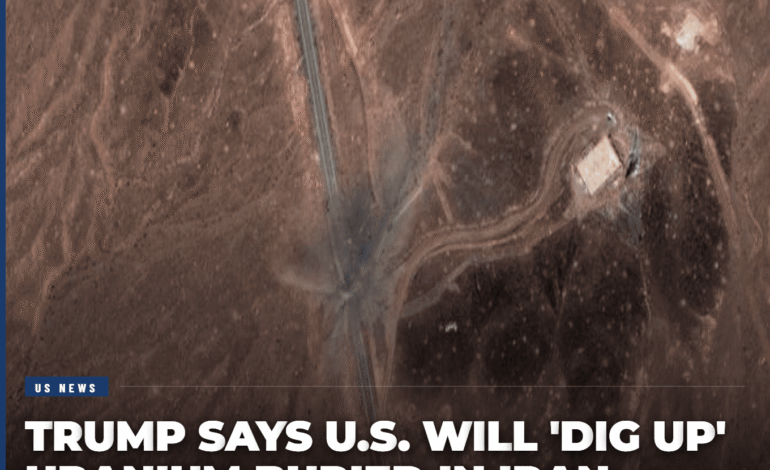

President Trump announced the U.S. will excavate Iran’s bombed nuclear sites to remove deeply buried enriched uranium. It’s one of the most technically audacious claims of the ceasefire era. Iran has said nothing. Here is a full breakdown of what’s buried, where, and what removal would actually require.
Quick Answer
On April 8, 2026, President Trump announced on Truth Social that the U.S. will “dig up and remove all of the deeply buried (B-2 Bombers) Nuclear ‘Dust'” from Iran’s bombed nuclear sites. He said Iran has undergone regime change and will no longer enrich uranium. Iran has not confirmed or denied this claim. The material in question is approximately 441 kilograms of uranium enriched to 60% purity — enough, if further enriched, to fuel roughly 9–10 nuclear weapons — believed to be buried at Fordow, Natanz, and Isfahan.
1. What Trump Actually Said — and What It Means
In an early-morning Truth Social post on April 8, 2026 — hours after a fragile US–Iran ceasefire was announced — President Trump made a sweeping claim about Iran’s nuclear future. He didn’t just say the U.S. had won. He said the U.S. would clean up.
His full post read:
“There will be no enrichment of Uranium, and the United States will, working with Iran, dig up and remove all of the deeply buried (B-2 Bombers) Nuclear ‘Dust.’ It is now, and has been, under very exacting Satellite Surveillance (Space Force!). Nothing has been touched from the date of attack.”
— President Donald J. Trump, Truth Social, April 8, 2026
Let’s break that down piece by piece, because each phrase carries major implications.
“No enrichment of Uranium” — This is Trump’s declared red line. Iran has, for years, insisted enrichment is its sovereign right. It enriched uranium up to 60% purity before the June 2025 strikes — a level just a few technical steps from weapons-grade. Trump says that’s over. Iran hasn’t agreed.
“Dig up and remove” — This is where things get technically extraordinary. When the U.S. and Israel bombed Iran’s nuclear facilities in June 2025, they didn’t vaporize the uranium stored there. The strikes collapsed facilities and buried equipment and material underground. Trump is saying the U.S. will physically excavate that material — an operation with no real precedent in nuclear history.
“B-2 Bombers” — A reference to Operation Midnight Hammer in June 2025, when seven B-2 stealth bombers dropped Massive Ordnance Penetrator (MOP) bunker-busting bombs on Fordow, Natanz, and Isfahan.
“Space Force surveillance” — Trump is claiming U.S. satellites have been monitoring the bombed sites continuously since the attacks, verifying that no material has been moved or removed.
Trump Also Added a Tariff Warning
In a follow-up post, Trump made the nuclear demands even sharper with a geopolitical stick: any country supplying Iran with military weapons would face a 50% tariff on all goods exported to the United States, effective immediately. This was aimed squarely at preventing Iran from re-arming or rebuilding its nuclear infrastructure through foreign assistance.
2. What Is Actually Buried — and Where?
To understand the scale of Trump’s claim, you need to understand what the bombs hit and what they left behind.
Before the June 2025 strikes, Iran possessed approximately 441 kilograms of uranium enriched to 60% purity, according to the International Atomic Energy Agency (IAEA). That figure comes from IAEA’s last confirmed assessment before inspections were cut off. Uranium enriched to 60% is not weapons-grade — that requires 90% — but it’s close. With advanced IR-6 centrifuges, Iran could have converted its full stockpile to weapons-grade material in weeks.
Natural uranium is about 0.7% uranium-235 (U-235), the isotope that can sustain a nuclear chain reaction. Most nuclear power plants use uranium enriched to 3–5% U-235.
60% enriched uranium is highly enriched uranium (HEU) — far beyond power plant fuel. Iran enriched to this level after the collapse of the 2015 nuclear deal (JCPOA). The IAEA calls 60% enrichment “near weapons-grade.”
Weapons-grade uranium requires 90%+ enrichment. Getting from 60% to 90% is technically simpler than getting from 5% to 60%. The IAEA estimated Iran could have produced weapons-grade material for one nuclear bomb in as little as 2–3 days using the centrifuges it had at Fordow.
“Nuclear dust” is Trump’s informal term for the radioactive debris — pulverized uranium compounds, irradiated equipment, and contaminated rock — created when facilities are bombed and collapse inward. The material is still radioactive and potentially recoverable.
The IAEA identified three primary storage locations for Iran’s highly enriched uranium before the strikes:
| Site | Location | Estimated HEU (60%) | Strike Damage (June 2025) | Current IAEA Access |
|---|---|---|---|---|
| Isfahan | ~350 km south of Tehran | ~200+ kg (in underground tunnel complex) | Surface buildings hit; tunnel complex largely intact | None since June 2025 |
| Natanz | ~250 km south of Tehran | Additional quantities stored; centrifuge halls seriously damaged | “Seriously damaging” per IAEA chief Grossi | None to bombed facilities |
| Fordow | Built inside a mountain near Qom | Smaller quantities; centrifuges destroyed | 12 MOP bombs dropped on ventilation shafts; centrifuges likely destroyed | None since June 2025 |
The most concerning site is Isfahan. IAEA Director General Rafael Grossi said in March 2026 that the tunnel complex at Isfahan — the underground facility where most of Iran’s 60% uranium was stored — appears largely undamaged from the June strikes. The bombs hit surface buildings, but the tunnels themselves may have survived largely intact.
Satellite analysis published in March 2026 by the Bulletin of the Atomic Scientists suggests Iran may have moved a significant portion of its highly enriched uranium to Isfahan from Fordow and Natanz before the June 2025 strikes. If true, that material may not be buried under rubble at all — it may be sitting in intact tunnels, still controllable by Iran.
3. The IAEA: What Nuclear Inspectors Actually Know
Here’s the uncomfortable truth at the heart of Trump’s announcement: no one outside Iran knows exactly where the uranium is right now.
The IAEA’s last confirmed physical inspection of Fordow and Natanz occurred in November 2024. Since the June 2025 strikes, Iran has refused IAEA access to the bombed facilities. In its May 2025 report — the last major assessment before the war — the IAEA said it had lost “continuity of knowledge” about Iran’s uranium stockpile, a state it called irreversible.
IAEA Director General Rafael Grossi has since worked from satellite imagery, Iran’s own declarations (which stopped), and intelligence from member states. His best assessment, stated in March 2026:
“What we believe is that Isfahan had until our last inspection a bit more than 200 kilograms, maybe a little bit more than that, of 60 percent uranium. The widespread assumption is that the material is still there.”
— Rafael Grossi, IAEA Director General, March 2026, quoted by The National
Critically, Grossi added that the IAEA would need Iran’s “full cooperation” to access the “massively damaged” nuclear facilities. He has urged repeatedly: “The only solution to Iran’s nuclear programme is diplomacy.”
The U.S. intelligence community, however, is more confident. Director of National Intelligence Tulsi Gabbard told a House hearing on March 19, 2026, that the U.S. intelligence community has “high confidence” it knows the location of Iran’s highly enriched uranium stockpiles. That’s a significantly stronger claim than the IAEA is willing to make.
4. Hegseth’s Pentagon Ultimatum: Voluntary or Else
Defense Secretary Pete Hegseth amplified Trump’s Truth Social post at a Pentagon briefing on April 8. His language was blunt — almost a dare to Iran’s new leadership.
“They will either give it to us voluntarily… or if we have to do something else ourselves, we reserve that opportunity.”
— Defense Secretary Pete Hegseth, Pentagon briefing, April 8, 2026
Hegseth confirmed the material is “deeply buried and watched 24-7 overhead,” echoing Trump’s Space Force surveillance claim. He said “under the terms, any nuclear material they should not have will be removed.” He also characterized Iran’s new leadership as fundamentally different from the old regime, saying: “It’s a new group of people who’ve seen the full capability of the United States military and has a new calculus about what it means to negotiate with us.”
The “or else” option Hegseth referenced is significant. It implies the U.S. could conduct additional military operations specifically targeting the uranium — a second strike operation aimed not at facilities but at the material itself. Whether that’s operationally feasible without spreading radioactive contamination is a major open question.
- Hegseth: Iran will “give it to us voluntarily” or face further action. The material is “buried and watched 24-7.”
- Trump: “Nothing has been touched from the date of attack.” The U.S. will work with Iran to dig it up jointly.
- Iran (public position): No official confirmation or denial. Silent on the uranium removal claim as of April 9.
- Iran (10-point plan, Farsi version): Included “acceptance of enrichment” — directly contradicting Trump’s “no enrichment” demand.
- Iran FM Araghchi (March 2026): Offered to “down-blend” enriched uranium to lower purity in exchange for sanctions relief — neither agreement nor removal.
5. Iran’s Silence: Significant and Deliberate
Iran has said nothing. That silence is itself a statement.
When Trump posted his Truth Social claims about regime change and uranium removal, Iranian state media — which runs on a 24-hour news cycle — covered the ceasefire extensively but did not address the uranium excavation claim. No Iranian official confirmed that Tehran had agreed to let the U.S. physically remove nuclear material from its soil.
This matters enormously. Sovereignty over nuclear infrastructure is not a minor issue in Iran. The nuclear program is deeply intertwined with Iranian national identity, revolutionary ideology, and decades of resistance to Western pressure. Agreeing to let a foreign power literally dig up Iranian soil and remove nuclear material would be an extraordinary concession — one that would require either a complete collapse of the old power structure, or a leadership willing to make extraordinary deals in exchange for something equally extraordinary.
The Times of Israel noted pointedly that Trump’s uranium removal assertions were “not confirmed by Iran and likely to be subject to negotiations” in the upcoming Islamabad talks. Stars and Stripes added: “Iran has not confirmed any details about Trump’s plans for the nuclear material.”
Meanwhile, Iran’s ceasefire proposal told a different story. In its publicly leaked 10-point plan, Tehran demanded the right to continue enriching uranium — the exact opposite of Trump’s position.
6. The Farsi/English Ceasefire Discrepancy — A Critical Red Flag
One of the most revealing details of the entire ceasefire negotiation emerged in the hours after it was announced: the Farsi and English versions of Iran’s peace proposal said different things on the most sensitive issue.
The Farsi version included the phrase “acceptance of enrichment” for Iran’s nuclear program. The English version — the one shared by Iranian diplomats with journalists — omitted that phrase entirely. Two documents, two audiences, two different impressions.
When Trump was confronted with the Farsi version’s enrichment language, he called it “fraudulent” without elaborating. The White House said the plan Iran shared with them was different from the one Iranian officials were circulating publicly. This contradicting-documents situation means the actual terms of any nuclear agreement are not yet established. Trump saying there will be “no enrichment” and Iran’s Farsi documents saying enrichment is accepted are not compatible positions. That gap has to be bridged in Islamabad on April 10.
7. How Hard Is It to Actually ‘Dig Up’ Buried Uranium?
Let’s step back from the politics and ask the obvious question: is this technically feasible? The short answer is: extremely difficult, and unprecedented at this scale.
The Fordow Problem
Fordow was designed to be impenetrable. It was built inside a mountain, with centrifuge halls buried under roughly 80 meters of rock. The U.S. dropped 12 Massive Ordnance Penetrator bombs — the most powerful bunker-busters in the U.S. arsenal — targeting ventilation shafts above the cascade halls. The ISIS analysis concluded that centrifuges were likely destroyed. But uranium stored in sealed cylinders may have survived the blast.
Excavating material from collapsed underground facilities requires:
- Radiological safety: The IAEA warned after initial Israeli strikes on Natanz that there was “radiological and chemical contamination” inside the facility — specifically uranium hexafluoride (UF6), a toxic and radioactive gas. Workers entering would need full hazmat protection.
- Structural instability: Facilities hit by bunker-busters have collapsed internal structures. Excavation risks further collapse and dispersal of radioactive material.
- Chain-of-custody: Any removal operation requires international verification — meaning IAEA inspectors must be present to certify what was removed and where it goes.
- Disposition of material: Where does the uranium go? It cannot simply be dumped. It would need to be down-blended, stored in a third-party country, or processed. No such arrangement is currently in place.
- Isfahan tunnel complex: The most likely intact storage location shows evidence of continued activity in satellite imagery. Its entrances were reportedly backfilled with soil before the strikes — Iran appears to have deliberately sealed it.
The Bulletin of the Atomic Scientists raised the most troubling possibility: that Iran may have moved its most sensitive uranium stockpile to Isfahan before the June strikes, specifically because Isfahan’s tunnel complex is deep enough to withstand the bombs used. If so, the material wasn’t buried by U.S. strikes at all — it’s in an intact facility that Iran controls, and “digging it up” is really a negotiation about Iran handing it over.
“If correct, this analysis would mean the enrichment vaults at Natanz and Fordow were probably empty before the June strikes, raising questions as to whether there is any enriched uranium ‘under the rubble’ at facilities the Trump administration claimed it ‘obliterated.'”
— Bulletin of the Atomic Scientists, analysis of satellite imagery, March 2026
8. Space Force Surveillance: What the U.S. Is Watching
Trump’s mention of “Space Force” surveillance was specific and deliberate. He claimed the nuclear sites have been under “very exacting satellite surveillance” since the June 2025 attacks, and that “nothing has been touched from the date of attack.”
This claim is significant for two reasons. First, it implies U.S. intelligence can verify the current state of Iran’s nuclear material remotely — without IAEA access. Second, it’s a message to Iran: we know exactly what you have, and we know you haven’t moved it.
Independent analysts partially corroborate this. Satellite imagery from commercial providers has shown ongoing activity at the Isfahan tunnel complex — including what appeared to be vehicles near tunnel entrances and evidence of backfilling. The Institute for Science and International Security (ISIS), a Washington-based nonproliferation organization, published analysis of Isfahan satellite imagery as recently as late 2025 showing “ongoing activity at two of three demolished entrances to the complex.”
But there’s an important limit to satellite surveillance: it can show activity near tunnel entrances and surface changes, but it cannot see through hundreds of meters of rock into underground storage. Whether the uranium cylinders inside Isfahan’s tunnels are intact, damaged, or still present is something that can only be verified by physical inspection.
That’s exactly why IAEA access is irreplaceable. Grossi has repeatedly said inspectors must return to verify the material’s status. No amount of satellite imagery fully substitutes for boots-on-the-ground nuclear inspection.
9. People Also Ask: Frequently Asked Questions
Trump is referring to the radioactive material — enriched uranium and debris — left underground after U.S. B-2 bombers struck Iran’s nuclear facilities at Fordow, Natanz, and Isfahan in June 2025. The bombs buried the sites but did not necessarily destroy the uranium stockpiles stored inside. Trump said the U.S. will work with Iran to physically excavate and remove that material so it cannot be used in a nuclear weapons program.
The IAEA’s last confirmed estimate was approximately 441 kilograms of uranium enriched to 60% purity — enough, if further enriched to weapons-grade (90%+), to potentially build 9–10 nuclear weapons. IAEA chief Rafael Grossi believes roughly 200 kilograms or more is stored in the underground tunnel complex at Isfahan. The rest was at Natanz and Fordow, though some may have been destroyed in the strikes.
No. As of April 9, 2026, Iran has not confirmed or denied Trump’s claim that it agreed to uranium removal. Iran’s publicly circulated 10-point ceasefire plan (in Farsi) actually includes “acceptance of enrichment” — directly contradicting Trump’s position. The gap between Trump’s assertions and Iran’s stated demands is expected to be a central issue at the Islamabad peace talks on April 10.
Iran barred IAEA access to its bombed nuclear facilities after the June 2025 strikes. Before that, Iran had already removed IAEA monitoring equipment in response to the U.S. withdrawal from the 2015 nuclear deal (JCPOA). The IAEA said it had lost “continuity of knowledge” about Iran’s uranium stockpile — meaning it cannot independently verify what Iran has, where it is, or whether any has been moved since the strikes.
Yes. “Nuclear dust” is Trump’s informal term for radioactive debris created when nuclear facilities are bombed. At Natanz, the IAEA warned of “radiological and chemical contamination” inside the facility after strikes — including dispersed uranium hexafluoride (UF6), a toxic and radioactive compound. Alpha particle radiation from uranium is dangerous if inhaled or ingested. Any excavation operation would require extensive protective equipment and careful handling protocols.
Experts say Iran’s known enrichment capabilities were severely damaged. But key uncertainties remain. Analysis suggests Iran may have moved its primary uranium stockpile to the Isfahan tunnel complex before the June 2025 strikes — a site that may be largely intact. Iran may also have undeclared centrifuge stocks or hidden enrichment facilities. U.S. DNI Tulsi Gabbard said the U.S. has “high confidence” it knows where Iran’s HEU is. The IAEA is less certain. Both agree physical inspections are essential.
Both the U.S. and Iran are expected to send delegations to Islamabad, Pakistan, where PM Sharif has invited them for “conclusive negotiations.” Uranium removal, enrichment rights, sanctions relief, and the Strait of Hormuz will be among the core issues. The talks could determine whether the fragile two-week ceasefire holds and whether a longer-term deal is possible. Iran’s position on uranium removal will be one of the clearest early signals of how serious the negotiations are.
10. Key Takeaways: What We Know and What We Don’t
- Trump declared the U.S. will “dig up and remove” Iran’s buried enriched uranium, citing B-2 bomber strikes on Fordow, Natanz, and Isfahan in June 2025. He said Iran agreed to no more uranium enrichment.
- Iran has not confirmed any of this. Its publicly circulated 10-point plan (in Farsi) includes “acceptance of enrichment.” The gap between both sides’ stated positions is large.
- The uranium is real and substantial: approximately 441 kg of 60%-enriched uranium existed before the strikes — potentially enough for 9–10 nuclear weapons if further enriched.
- The IAEA cannot verify anything: Iran has blocked inspectors from bombed facilities since June 2025. The IAEA has “lost continuity of knowledge” about the stockpile’s current location and status.
- The most likely intact storage site is Isfahan’s underground tunnel complex — which satellite analysis suggests survived the June strikes largely undamaged. Iran appears to have moved uranium there before the bombing.
- Defense Secretary Hegseth gave Iran an ultimatum: hand over the material voluntarily, or the U.S. “reserves the opportunity” to take further action.
- The Islamabad talks on April 10 will be the first real test of whether Iran’s silence on uranium removal reflects quiet acceptance or calculated ambiguity before negotiations.
The phrase “dig up” sounds simple. The reality — technically, diplomatically, and legally — is anything but. Removing hundreds of kilograms of highly enriched uranium from bombed underground facilities on foreign soil, with international verification, no existing legal framework, and a country that hasn’t confirmed it agreed — is one of the most complex denuclearization challenges ever attempted.
Whether Trump’s claim reflects a genuine concession extracted from Iran’s new leadership, or a maximalist opening position before the real negotiations begin in Islamabad, is the central question that April 10 will begin to answer.