“Drug Camp” That Trump Praised? New Reporting Shows It Was a Dairy Farm — A Stunning Revelation
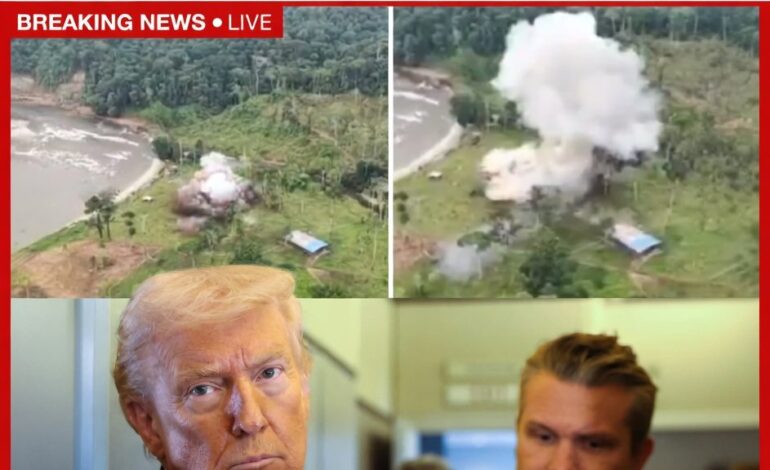

In early March 2026, as Donald Trump prepared to host right‑wing leaders at the Shield of the Americas Summit in Florida, the White House released dramatic footage of a massive explosion in rural Ecuador. Defense Secretary Pete Hegseth declared triumphantly that U.S. forces were now “bombing Narco Terrorists on land,” portraying the blast as a decisive strike against a drug trafficking training camp run by cartel operatives just across the Colombian border. (Wikipedia)
The video — part of a systematic effort by the Trump administration to show progress in its hemisphere‑wide anti‑narcotics campaign — was widely circulated by pro‑government media and conservative commentators. In the narrative advancing from Washington, this operation was evidence of a bold new policy in which the United States had moved beyond air strikes on suspected trafficker boats at sea to direct land engagements against narco‑terror networks believed to hide in the jungles of Ecuador and neighboring countries. (Wikipedia)
But what both the official spin and early news coverage failed to fully reveal is now at the center of a major controversy: according to investigating journalists and interviews on the ground, the striking site was not a hidden cartel camp at all — it was a working dairy farm. This revelation, first widely reported in The New York Times and independently confirmed by multiple news outlets, has cast serious doubt on the intelligence claims used to justify the explosion and raised fundamental questions about the transparency and accuracy of U.S.–Ecuadorian military cooperation. (The Independent)
The Official Account: A Strategic Strike
According to official statements by the governments of the United States and Ecuador, the March 6 operation targeted a compound believed to belong to Comandos de la Frontera, a dissident faction of the Revolutionary Armed Forces of Colombia (FARC) accused by Quito of engaging in drug trafficking and training. Ecuador’s defense ministry said its forces — acting with U.S. intelligence support — destroyed a “training camp” used by roughly 50 members of the group. (Gulf Times)
Hegseth publicly framed the strike as a milestone, signaling that anti‑drug efforts were expanding beyond maritime seizures into territorial hits on cartel infrastructure. A Pentagon post claimed that joint U.S.–Ecuadorian operations would send a clear message that western hemisphere narcotics networks would find no sanctuary. (Reddit)
For political audiences at home — and especially for Trump’s base — the strike was positioned as a symbolic success: it fit a narrative of decisive action against criminal networks that feed the opioid crisis and fuel violence in U.S. cities. It also dovetailed with broader messaging around Operation Southern Spear, the administration’s expanded military campaign in the Caribbean and Pacific to interdict vessels and land targets believed to be linked to cartels. (Wikipedia)
The Reality on the Ground: A Farm, Not a Camp
But when reporters from The New York Times and other outlets traveled to the site near San Martín, Ecuador, they found a very different picture. Residents, including the farm’s owner and workers, insisted there was no evidence the property was used as a drug site — instead, they described a typical agricultural operation with cows, horses, sheds, and farming supplies. (The Independent)
The farm’s owner, identified locally as Miguel, described the devastation in emotional terms. “It’s an outrage,” he told the Times, refusing to accept the claim that 50 traffickers had ever trained there. “Where are they going to train? Out here in the open? There’s no logic.” He said he had owned the 350‑acre property for years, raising livestock — cows, calves, horses — and maintaining equipment like sheds and coops. (The Independent)
Photographs accompanying the reporting showed the charred remains of animal shelters, destroyed farm equipment, and dead livestock — cows and chickens whose deaths cannot be spun easily into narratives of narcotics interdiction. (The Independent)
Even Ecuadorian soldiers’ behavior before the bombing raised alarm, according to local accounts. Workers told journalists that Ecuadorian troops arrived first, beating workers, tying them up, burning buildings with gasoline, and looting before helicopters returned days later to drop explosives on the remaining structures. (The Independent)
Human rights advocates in Ecuador have since filed complaints with the United Nations and local authorities, arguing that there has been no public verification of evidence justifying the strike — and that officials have not released documentation proving the presence of weapons, drugs, or organized criminal activity at the site. (The Independent)
Intelligence Questions and Political Fallout
One of the most striking implications of the farm revelation is what it suggests about the intelligence that led to the operation. Targeted strikes — especially once broadcast and politicized — require credible confirmation that the target is what military and civilian leaders say it is. Critics of the Trump administration’s broader anti‑drug operations argue that this on‑the‑ground misidentification points to flawed or incomplete intelligence protocols and a rush to take credit for military action without sufficient verification. (Newser)
This isn’t the first time U.S. military engagements in Latin America have drawn scrutiny over faulty intelligence, civilian harm, and questions about legal authority. Previous air strikes against suspected narco vessels in the Caribbean and Pacific have already sparked debate about legality, evidence standards, and oversight. (Wikipedia)
But striking a civilian dairy farm miles from known cartel routes — and then releasing footage that suggests a “camp” was destroyed — touches a new nerve. It raises serious ethical questions about accountability, transparency, and the cost of mistakes that can destroy livelihoods and harm innocents.
What This Means for Policy and Public Trust
The incident comes at a moment when U.S. military involvement in counter‑narcotics operations has expanded beyond traditional law enforcement cooperation into direct strikes and joint tactical action. Critics say that framing these operations as part of a war — especially one that uses lethal force — requires stringent safeguards to protect civilian lives and ensure intelligence is both accurate and accountable. (Wikipedia)
For supporters of the Trump administration’s aggressive approach, the revelation is a political setback — one that could erode credibility. For opponents, it is emblematic of how propaganda and political theater can obscure reality, with ordinary people paying the price. The optics of destroyed cows and broken barns circulating alongside celebratory statements from U.S. officials makes the gap between narrative and reality painfully clear. (The Independent)
Internationally, the episode could strain U.S.–Ecuador cooperation, as well as broader regional trust. Sovereign nations must balance fighting violent crime with protecting their citizens and property, and missteps like this — especially where human rights complaints are now being filed — undermine that balance. (The Independent)
Broader Implications for U.S. Military Engagement
The Ecuador misidentification also has reverberations for how the U.S. defines its role in anti‑drug and anti‑terror strategy. Under Trump, drug traffickers have been labeled terrorists, giving the administration broader latitude to use military force rather than law enforcement tools. This has sparked debate among legal scholars, human rights advocates, and foreign policy analysts about the implications of this shift. (Wikipedia)
An operation that kills livestock and destroys farmland — regardless of who carried it out — and is then publicly described as a triumphant blow against narco‑terrorists showcases how quickly rhetoric can outpace reality. It underscores the need for clear rules of engagement, rigorous intelligence vetting, and accountability mechanisms that do not allow political messaging to distort the truth. (Newser)
Conclusion: Truth vs. Political Spin
The fallout from the Ecuador farm incident promises to be significant. What began as a photo‑op style military narrative designed to showcase U.S. resolve has instead become a flashpoint for criticism about the reliability of government claims, the ethics of military engagement, and the human cost of misidentified targets.
In an era when public trust in institutions is already strained, stories like this — confirmed by independent investigation and eyewitness testimony — serve as a reminder that beneath political spin lies real human consequence. And when the truth emerges, the political and diplomatic fallout can be just as explosive as the event itself.