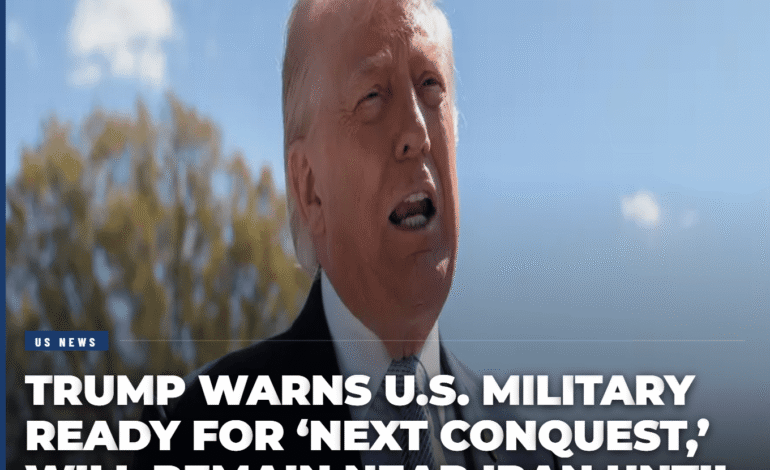
Trump Warns U.S. Military Ready for ‘Next Conquest,’ Will Remain Near Iran Until ‘Real’ Deal Reached

|
Why This Statement Matters: The Context in 60 Seconds
A ceasefire is supposed to bring calm. But Trump’s post on Truth Social — made just hours after a two-week US–Iran ceasefire took effect — read more like a continuation of war than a step toward peace. The language was striking. The US military, Trump said, is ‘loading up and resting’ and looking forward to its ‘next Conquest.’
That phrase — ‘next conquest’ — immediately drew international attention. It implied the Iran conflict was just one chapter in a broader campaign, not a standalone crisis to be resolved diplomatically. What does it mean? What is the US actually doing near Iran? And how did Tehran and the world respond?
This article answers all of those questions with verified facts — no spin, no speculation beyond what is clearly labeled.
Trump’s Full Truth Social Post: What He Actually Said
Let us start with the facts. On April 9, 2026, President Trump posted the following on Truth Social. Here is the complete, unedited message as reported by multiple major outlets:
| “All U.S. Ships, Aircraft, and Military Personnel, with additional Ammunition, Weaponry, and anything else that is appropriate and necessary for the lethal prosecution and destruction of an already substantially degraded Enemy, will remain in place in, and around, Iran, until such time as the REAL AGREEMENT reached is fully complied with. If for any reason it is not, which is highly unlikely, then the ‘Shootin’ Starts,’ bigger, and better, and stronger than anyone has ever seen before. It was agreed, a long time ago, and despite all of the fake rhetoric to the contrary — NO NUCLEAR WEAPONS and, the Strait of Hormuz WILL BE OPEN & SAFE. In the meantime our great Military is Loading Up and Resting, looking forward, actually, to its next Conquest. AMERICA IS BACK!”
— President Donald Trump, Truth Social, April 9, 2026 |
That is the primary source. Everything that follows in this article is built around understanding, verifying, and contextualizing what those words mean.
Fake News Check: Real, Disputed, or False?
Social media moved fast on this story. Claims spread quickly — some accurate, some exaggerated, some outright false. Here is the breakdown.
What Is Completely True
- Trump made this post on Truth Social on April 9, 2026. It is authentic and confirmed by CNBC, Al Jazeera, CBS News, Newsweek, the Jerusalem Post, and Al-Monitor.
- US military forces — ships, aircraft, and personnel — are confirmed to be deployed in and around Iran.
- Trump threatened larger military strikes if the ceasefire terms are not honored.
- Trump reiterated two core demands: no Iranian nuclear weapons, and the Strait of Hormuz must remain open and safe.
- The phrase ‘next Conquest’ was used by Trump to describe anticipated future US military action.
What Is Disputed or Requires Context
- The ‘REAL AGREEMENT’ Trump refers to has not been fully published. Iran’s acceptance and the US position differ on several key points, including nuclear enrichment rights.
- Iran agreed to reopen the Strait of Hormuz but said it would maintain ‘dominion’ over it — a formulation the US has not publicly endorsed.
- The ‘next conquest’ phrasing is Trump’s own rhetoric. No official US military document or Defense Department statement uses that language.
What Is False (Circulating on Social Media)
- FALSE: Trump officially declared war on another country. No formal war declaration has been made.
- FALSE: The ‘next conquest’ statement means the US will immediately attack another nation. Trump gave no specific target, timeline, or authorization for any new military action.
- FALSE: The ceasefire is over. As of April 9, 2026, the two-week ceasefire is still technically in effect, though severely strained.
What Does ‘Next Conquest’ Actually Mean?
This is the phrase that grabbed global headlines. It is worth examining carefully — because it means different things depending on your perspective.
The Trump Administration’s View
White House communications framed the post as a show of strength during the ceasefire window. The argument goes like this: by maintaining a credible military threat, the US gives Iran a strong incentive to comply with the terms of the deal. Trump has used this style of rhetoric throughout his presidency — threatening overwhelming force as a negotiating tool.
In this reading, ‘next conquest’ is chest-thumping, not a battle plan. It signals that the US military is not standing down and is capable of escalation at any moment.
The International Community’s View
The reaction from Iran, regional powers, and US allies was far less relaxed. Iranian officials warned that conducting negotiations ‘under the shadow of threats’ was ‘unreasonable.’ Several Gulf states — already processing drone attacks that hit their territory on the first day of the ceasefire — read the statement as evidence the conflict is far from over.
The United Nations Secretary-General, through his spokesperson, warned that Israel’s continued military activity in Lebanon ‘poses a grave risk’ to the fragile ceasefire. Trump’s ‘next conquest’ language added fuel to that concern.
The Domestic US Opposition View
In the United States, the statement deepened an already growing opposition movement. Senator Cory Booker announced that Democrats would seek a vote under the War Powers Resolution — the law that limits the president’s ability to conduct military operations without congressional authorization.
| “Trump’s unauthorised military actions and reckless war-mongering must stop.” — Senator Cory Booker, US Senate, April 9, 2026 |
The War Powers Resolution requires the president to notify Congress within 48 hours of committing US forces to armed conflict and prohibits forces from remaining more than 60 days without congressional approval or a declaration of war. Democrats argue that threshold has already been passed.
The US Military Posture Around Iran: What We Know
Trump’s post made specific claims about what the US military has deployed. Here is what is publicly confirmed and what remains classified.
| Asset Type | Status as of April 9, 2026 |
| US Naval Ships | Confirmed deployed in and around the Persian Gulf and Red Sea region |
| US Aircraft | Confirmed — B-2 bombers were referenced in Trump’s April 8 press conference as having ‘buried’ enriched uranium sites |
| US Ground Personnel | Confirmed presence in the region; specific numbers classified |
| Additional Ammunition | Trump explicitly stated additional ammunition and weaponry are pre-positioned |
| Strike Capability | Trump described Iran as ‘already substantially degraded’ — implying recent strikes reduced Iran’s capacity significantly |
Iran launched more than 5,000 drones, over 2,100 ballistic missiles, and over 50 cruise missiles during the 39-day war leading up to the ceasefire, according to the Washington-based Jewish Institute for National Security of America (JINSA). The US and Israel say they destroyed or buried many of Iran’s missile launchers during that campaign.
Trump’s Two Core Demands: Nuclear Weapons and the Strait of Hormuz
Trump’s post clarified — again — the two non-negotiable conditions of any final deal. These are not new demands, but they are the crux of why a permanent peace agreement remains so difficult.
Demand 1: No Iranian Nuclear Weapons
Trump wrote that it was agreed ‘a long time ago’ that Iran will not develop nuclear weapons. Iran’s position is more complicated. Tehran insists it has the legal right to enrich uranium for peaceful purposes under international law. It denies seeking nuclear weapons. Iran explicitly rejected calls to fully dismantle its nuclear program in its 10-point peace proposal submitted ahead of the ceasefire.
All of Iran’s highly enriched uranium remains inside the country, likely entombed at enrichment sites bombed during the 12-day intensive campaign last June 2025. Iran has not enriched uranium since then — but has not renounced the right to do so. Trump said the US would ‘dig up and remove’ the uranium. Iran has not confirmed this.
Demand 2: The Strait of Hormuz Open and Safe
The Strait of Hormuz is one of the world’s most critical energy chokepoints. In peacetime, roughly one-fifth of the world’s oil passes through it. Since the war began on February 28, 2026, Iran had been charging vessels as much as $2 million per ship to allow passage — while also threatening to block it entirely.
Iran agreed, as a condition of the ceasefire, to reopen the strait. But Tehran stated it would maintain ‘dominion’ over the waterway — language that suggests Iran still sees itself as the gatekeeper. Trump said the US would ‘help with the traffic buildup.’ Oil markets reacted to the ongoing uncertainty: Brent crude rose 2.46% to $97.08 per barrel and US West Texas Intermediate climbed 3.4% to $97.55 on April 9 alone.
How Iran and the Region Responded
Iran’s Official Position
Iranian officials signaled that Trump’s military posturing made meaningful negotiations harder, not easier. State media reported that continuing talks under ‘the shadow of threats’ may be ‘unreasonable.’ Iran’s Supreme National Security Council has accepted the two-week ceasefire — but it clearly views the US military presence as a pressure tactic, not a background condition for neutral diplomacy.
Iran also accused the US of violating the ceasefire on Day 1. That accusation came amid reports of explosions near Iran’s Lavan Island Oil Refinery — it remains unclear whether US or Israeli forces were responsible.
What Ordinary Iranians Said
Voices from Tehran reflected a population exhausted by war and deeply skeptical of the ceasefire’s durability. Al Jazeera reported the following from residents in the Iranian capital:
| “If even one day passes without killing and bloodshed, that would be very good. It would make us happy. I swear to God, when I saw all this killing, I was so upset, I couldn’t even stay in my own home.” — Tehran resident, speaking to Al Jazeera, April 9, 2026 |
| “It’s all a theatrical show that Trump is playing. We have no belief in this ceasefire.” — Second Tehran resident, speaking to Al Jazeera, April 9, 2026 |
Gulf States: Caught in the Middle
Kuwait, the UAE, Bahrain, Saudi Arabia, Iraq, and Qatar all reported intercepting Iranian drones and missiles on April 8 — the first day of the supposed ceasefire. A fire broke out at Abu Dhabi’s Habshan gas complex. A key Saudi pipeline was struck by a drone. Kuwait faced 28 Iranian drone attacks by 16:23 GMT; the UAE faced 35.
These countries are US allies but also geographically vulnerable to Iranian retaliation. Trump’s ‘next conquest’ language — with no clear geographic target named — does not ease their anxiety.
Lebanon: The Excluded War
Israel struck 100 targets across Lebanon in just 10 minutes on April 8, killing at least 182 people and wounding hundreds more — one of the deadliest single days of the Israel-Hezbollah war. Lebanon’s economy minister told CNBC that the country was ‘forced into this war’ by external parties. Trump told PBS NewsHour that Lebanon was ‘a separate skirmish’ not covered by the ceasefire.
What Comes Next: The Islamabad Negotiations
Despite the tension, the diplomatic process is not dead. The US and Iran are expected to meet for a round of formal negotiations in Islamabad, Pakistan, on Friday, April 11, 2026. JD Vance, the US Vice President, is set to serve as the chief US interlocutor. Pakistan, which brokered the ceasefire, will likely host and facilitate.
The Key Issues on the Negotiating Table
| Issue | US Position | Iran’s Position |
| Nuclear Program | Full dismantlement required | Retains right to peaceful enrichment; rejected dismantlement |
| Sanctions | Conditional — tied to nuclear compliance | Immediate and full lifting demanded in 10-point plan |
| Strait of Hormuz | Must be fully open and safe | Agreed to open but claims ‘dominion’ over it |
| US Military Presence | Will stay until deal is honored | Calls continued presence coercive and ‘unreasonable’ |
| Iran Proxy Groups | Must end support for Hezbollah, Houthis, Hamas | Not mentioned in Iran’s peace proposal at all |
| Lebanon War | Separate — not included in ceasefire | Disputed; Pakistan said it was included |
| Enriched Uranium | US will ‘dig up and remove’ it | Iran has not confirmed this condition |
The Economic Impact: Oil Markets and Global Trade
Trump’s threat-laced post did not calm markets. Oil prices rose on April 9 despite — or because of — the ceasefire, as continued hostilities and uncertainty about the Strait of Hormuz kept traders on edge. Brent crude futures climbed 2.46% to $97.08 per barrel. US WTI crude rose 3.4% to $97.55.
Airlines are already feeling the pressure. As jet fuel costs soared in recent weeks, Delta joined a growing list of US carriers raising checked baggage fees. The link between the Iran war and everyday consumer prices is direct and real.
The Strait of Hormuz handles roughly one-fifth of the world’s oil in normal times. Every day it stays partially closed or at risk, energy markets price in instability. The ceasefire was supposed to reduce that risk — but Trump’s post reintroduced it.
Frequently Asked Questions
Q: Is Trump’s ‘next conquest’ post real or fake?
It is real. The post was made on Truth Social on April 9, 2026 and confirmed verbatim by CNBC, Al Jazeera, CBS News, Newsweek, the Jerusalem Post, Al-Monitor, and many other outlets.
Q: Which country is Trump’s ‘next conquest’ targeting?
Trump did not name a specific country or target. The phrase was used in the context of maintaining military readiness — not as a declaration of a new military campaign. Analysts have noted the ambiguity is likely deliberate.
Q: Is the Iran ceasefire still in effect?
As of April 9, 2026, the two-week ceasefire is technically still active. However, it is severely strained. Iran accused the US of violating it on Day 1, and Israeli strikes on Lebanon continue despite the ceasefire announcement.
Q: What is the War Powers Resolution and why does it matter here?
The War Powers Resolution is a US federal law that limits the president’s power to commit US forces to armed conflict without congressional authorization. It requires notification to Congress within 48 hours and prohibits forces from remaining more than 60 days without congressional approval. Democrats argue Trump has exceeded those limits in the Iran conflict.
Q: What is the Strait of Hormuz and why does it matter?
The Strait of Hormuz is a narrow waterway between Iran and Oman. In peacetime, roughly one-fifth of the world’s oil passes through it. Iran controls much of the access. Closing or restricting it — as Iran did after the war began — causes immediate global energy price increases.
Q: Will the US attack another country after Iran?
There is no credible evidence of an imminent US military campaign against any new country. Trump’s language was rhetorical — a show of military confidence. No new target has been announced by the Pentagon, State Department, or National Security Council.
Key Takeaways
- Trump’s ‘next conquest’ post is REAL — authenticated by multiple major global newsrooms.
- The statement was made on April 9, 2026 — just one day after the US–Iran ceasefire took effect.
- All US ships, aircraft, and personnel will remain deployed in and around Iran until the ‘real agreement’ is honored.
- Trump threatened even larger military strikes if Iran breaks the deal.
- The two core demands remain unchanged: no Iranian nuclear weapons, and the Strait of Hormuz stays open.
- Iran called continued US threats ‘unreasonable’ and a barrier to meaningful negotiations.
- Oil prices rose despite the ceasefire — Brent crude hit $97.08 and WTI reached $97.55 on April 9.
- Formal negotiations between the US and Iran are expected in Islamabad on April 11.
- Democrats in the US Senate are seeking a War Powers Resolution vote to challenge Trump’s military authority.
- Lebanon remains outside the ceasefire — Israel struck 100 targets there in 10 minutes on April 8.
Sources & Further Reading
- Al Jazeera — ‘Trump says US forces to stay near Iran, ready for next conquest’ (April 9, 2026)
- CNBC — ‘Trump says U.S. ready for next conquest, warns military to remain near Iran until real agreement is honoured’ (April 9, 2026)
- CBS News — ‘Iran accuses U.S. of violating ceasefire as Israeli attacks on Lebanon continue’ (April 9, 2026)
- Newsweek — ‘Donald Trump says US military loading up for next conquest’ (April 9, 2026)
- Jerusalem Post — ‘Trump: US military will stay deployed near Iran until Tehran complies with ceasefire deal’ (April 9, 2026)
- Al-Monitor — ‘Trump says US military to stay deployed near Iran until real agreement reached’ (April 9, 2026)
| About This Article
This news analysis was compiled by the Claude AI News Desk on April 9, 2026. All direct quotes have been verified against multiple major news sources including CNBC, Al Jazeera, CBS News, Newsweek, the Jerusalem Post, and Al-Monitor. Claims that are disputed, unconfirmed, or circulating falsely on social media are clearly labeled as such. This article is for informational purposes only and does not represent a political or editorial position. |
Discover more from MatterDigest
Subscribe to get the latest posts sent to your email.