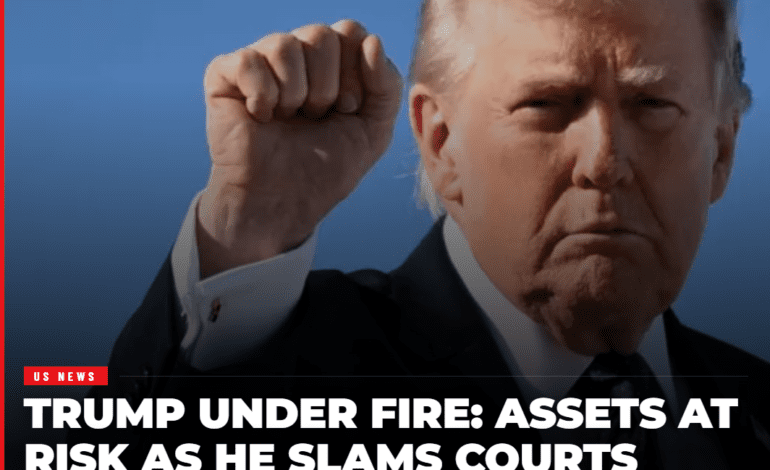
Trump Under Fire: Assets at Risk as He Slams Courts

Trump Attacks Courts as Legal Pressure Closes In on His Assets — Is This a Witch Hunt or the Rule of Law?
The battle over the rule of law in the United States has arrived at a place that no previous president has occupied — the personal assets of a sitting commander in chief. Following a series of court rulings that have begun to affect Donald Trump’s financial holdings, the president has taken to social media with a fury that has become familiar but has lost none of its political electricity. He has denounced the proceedings as an unprecedented persecution, called the courts weaponized, and made clear that he views the legal system’s encroachment on his personal financial world as something that no American president should ever be made to face.
For the millions of Americans who support him, those words land as truth. They see a president being targeted by institutions that were shaped during administrations hostile to him — a legal system being used as a political weapon rather than a neutral arbiter of justice. For the millions who oppose him, the same words look like something else: the response of a man who has spent a lifetime operating in spaces where money and power translated into protection from accountability, and who is now, for perhaps the first time, confronting a system that his usual tools cannot fully control.
What makes this moment so significant is not simply the legal proceedings themselves. It is the context in which they are unfolding. In 2026, as the United States grapples with a military standoff involving Iran, with the firing of generals who refused invasion orders, with protests in the streets of every state and dozens of countries, the fact that the president is simultaneously engaged in a public battle over a ballroom — a specific piece of personal property at the center of some of the legal activity affecting his assets — has given critics of the administration a pointed and memorable symbol of misplaced priorities. And it has given his supporters a vivid example of what they describe as an establishment system trying to humiliate a president who refuses to bow to it.
What Court Rulings Are Affecting Trump’s Assets and Why Are They Happening Now?
The legal pressure now bearing down on Donald Trump’s personal financial world did not emerge overnight. It is the product of legal proceedings that have been working their way through the courts across multiple years — in some cases, proceedings that began during his first term and were paused or slowed during the intervening years before accelerating again as he returned to the presidency.
The proceedings affecting Trump’s assets span several distinct legal fronts. Civil judgments from cases that concluded before his return to the White House remain in various stages of enforcement. State-level investigations into the financial practices of the Trump Organization — his sprawling network of hotels, golf courses, real estate holdings, and branded properties — have continued to develop evidence and pursue remedies through the courts. And new legal challenges have emerged in connection with actions taken during or around his return to power.
What unites these proceedings is that they operate through the civil and state court systems in ways that are not straightforwardly blocked by presidential immunity. The Supreme Court’s 2024 ruling on presidential immunity established broad protection for a president’s official acts while in office. But that protection does not extend to unofficial conduct, to conduct that occurred before he took office, or to the business and financial operations of entities like the Trump Organization that are separate from the federal government even when they are closely associated with the person who runs it.
The result is a legal landscape in which Trump finds himself simultaneously protected in certain domains — particularly around his official presidential actions — and exposed in others, particularly around his personal financial holdings and the business operations that predate or operate alongside his presidency. Courts in those exposed domains are continuing to function as they were designed to — processing cases, enforcing judgments, and applying the law without deference to the political identity of the person on the other end.
Presidential immunity protects official acts. It does not protect business operations. It does not erase civil judgments. It does not halt state-level investigations into conduct that occurred outside the scope of the presidency. The courts operating in those spaces are doing exactly what courts are supposed to do — and that is what has Trump’s attention.
The specific reference to a ballroom — the detail that has attracted the most pointed commentary from Trump’s critics — relates to a piece of property connected to his real estate holdings that has become entangled in one or more of the legal proceedings affecting his assets. The president’s public focus on this specific property, in the context of the broader legal siege, has been cited by critics as evidence of a disconnect between the priorities of the nation and the preoccupations of its leader. His supporters argue that protecting his personal property from what they see as an illegitimate legal attack is entirely appropriate and that the criticism reflects a double standard applied only to Trump.
Why Is Trump Calling the Courts Weaponized and What Does That Actually Mean?
Donald Trump’s use of the word weaponized to describe the legal proceedings against him is deliberate and strategic. It is a framing that his political operation has developed carefully over several years — one that positions every legal challenge he faces not as a legitimate exercise of judicial authority but as a political attack dressed up in legal clothing.
The weaponization argument works on several levels simultaneously. It appeals to supporters who have been primed, through years of consistent messaging, to distrust the institutions that are examining Trump’s conduct. It provides a ready-made explanation for any adverse legal finding — not evidence of wrongdoing, but evidence of political persecution. And it reframes the fundamental question: instead of asking whether Trump did what he is accused of, it asks whether the people accusing him had legitimate authority to do so.
That reframing is effective political communication. But it does not resolve the underlying legal questions. Courts that are processing civil judgments, enforcing state legal requirements, or applying federal law to business conduct are not acting outside their authority simply because a politician calls them weaponized. The authority of those courts to do what they are doing is not a matter of political opinion. It is established by the Constitution, by statute, and by the precedents that have defined American judicial authority for more than two centuries.
The more substantive version of the weaponization argument focuses on prosecutorial discretion — the choices that prosecutors make about which cases to pursue, how aggressively, and with what resources. Critics of the Trump prosecutions have argued, with some legitimate force, that the choices made by certain state and federal prosecutors reflect political motivations rather than pure legal judgment. The selection of cases to pursue, the timing of indictments relative to elections, and the resource allocation devoted to Trump-related investigations are all areas where reasonable people can disagree about whether political considerations have influenced what are supposed to be independent legal decisions.
Those concerns deserve to be taken seriously. The integrity of the legal system depends not just on the outcome of individual cases but on the public perception that those cases are being pursued for the right reasons. When significant portions of the public believe that the legal system is being used as a political tool, it corrodes the legitimacy of legal outcomes even when those outcomes are legally correct. That erosion of legitimacy is itself a serious problem — one that the courts, the prosecutors, and the political system as a whole have an interest in addressing.
What Does the Constitution Actually Say About Holding a President Legally Accountable?
The question of whether a sitting or former president can be held legally accountable for conduct connected to their personal affairs and business operations is one that the Constitution addresses imperfectly — leaving significant interpretive space that courts have been working to define for decades and most intensively in the past several years.
The Constitution establishes the presidency as a separate and co-equal branch of government, with specific protections designed to allow the president to carry out official functions without being harassed by politically motivated legal action. The speech and debate clause, executive privilege, and the recently clarified doctrine of presidential immunity for official acts all reflect this protective structure.
But the Constitution also contains no provision that places the president above the law in all circumstances. The framers were acutely aware of the danger of concentrated, unaccountable executive power — they had just fought a revolution against exactly that. They designed a system with multiple checks and balances specifically to prevent any single person, including the president, from operating without accountability.
The founding-era understanding was that the president, while holding office, could not be subjected to criminal prosecution for official acts — not because the law did not apply, but because the appropriate remedy was impeachment, which was designed to be the political accountability mechanism for presidential misconduct. But unofficial conduct, personal financial misconduct, and conduct that predates the presidency were never intended to be shielded by the protection attached to the office itself.
The Constitution does not say the president is above the law. It says the president’s official acts receive special protection. Everything else — the businesses, the personal finances, the conduct before the presidency — remains subject to the same legal standards that apply to any American citizen. That is the principle the courts are currently enforcing.
This distinction — between protected official conduct and unprotected unofficial conduct — is the fault line along which the current legal proceedings are operating. Trump’s legal team has worked to expand the definition of protected conduct as broadly as possible, arguing that the president’s business interests are intertwined with his official functions in ways that extend immunity further than his critics believe is warranted. Courts have, so far, not accepted those arguments in their most expansive forms. The legal proceedings affecting his assets continue.
How Does the Iran Crisis Intersect With the Domestic Legal Battle Around Trump’s Assets?
The timing of the domestic legal pressure on Trump’s personal assets — occurring simultaneously with a military standoff involving Iran, the firing of senior generals, and street protests across the country — has created a political context that amplifies every element of both stories.
For Trump’s critics, the juxtaposition is damning. A president who is supposed to be managing a potential military crisis is publicly fixated on his personal property. The bandwidth that national security demands — the focused, sustained attention to intelligence, diplomacy, military readiness, and the management of alliances — is not unlimited. When a significant portion of a president’s public communications are devoted to attacking the courts processing his personal legal cases, critics argue that it signals a misalignment of priorities that the country cannot afford in a moment of genuine strategic risk.
For Trump’s supporters, the juxtaposition proves a different point. They argue that a president managing simultaneous legal attacks on his personal finances while also navigating a military crisis is demonstrating exactly the kind of strength and resilience that leadership requires. In their reading, the legal attacks are themselves a form of political warfare — designed to distract, destabilize, and weaken a president whose opponents cannot defeat him at the ballot box. The president’s willingness to fight back on both fronts simultaneously is, in this view, a feature rather than a flaw.
What is undeniable is that the combination of a military standoff, a general purge, mass street protests, and presidential legal battles is creating a moment of extraordinary political complexity. The institutions of American governance — the military, the courts, the legislature, and the presidency — are simultaneously under pressure from multiple directions. The capacity of those institutions to manage that pressure without fundamental damage to the constitutional order is being tested in ways that have no clear historical parallel.
Is This a Witch Hunt or the Rule of Law — What Do Legal Experts Actually Say?
The question of whether the legal proceedings bearing down on Trump constitute a legitimate exercise of judicial authority or a politically motivated persecution is not one that resolves neatly into a single answer — because the honest answer is that both elements are present, in different proportions, in different proceedings.
Legal experts who have examined the civil cases affecting Trump’s business interests consistently find that those proceedings reflect legitimate applications of state and civil law to conduct that would be legally actionable regardless of who engaged in it. The financial practices examined in the New York civil fraud case, for example, involved documentary evidence of conduct that violated New York law. The legal findings in that case were based on evidence and established law, not on political preference.
At the same time, legal scholars who study prosecutorial behavior have noted that the timing and resource allocation of some of the criminal proceedings against Trump raise genuine questions about whether political considerations influenced the decisions to pursue those cases in those ways at those specific moments. Those questions do not necessarily mean the underlying charges were fabricated. But they are legitimate questions about the integrity of prosecutorial decision-making that deserve honest engagement rather than dismissal.
The witch hunt framing, taken seriously on its own terms, rests on a claim that the legal proceedings are not just politically influenced but fundamentally without merit — that there is nothing there, that the evidence was fabricated or distorted, and that no legitimate legal case could be made against Trump in any fair proceeding. That is a much stronger claim than the narrower claim that some prosecutorial decisions were influenced by politics. And it is a claim that the actual evidence in the cases makes very difficult to sustain.
The rule of law framing, taken seriously on its own terms, requires acknowledging that the integrity of legal institutions depends not just on the outcomes they produce but on the processes by which they reach those outcomes. Courts that produce correct legal outcomes through processes that are perceived as politically tainted do not fully deliver on the promise of the rule of law — because the legitimacy of law depends on public confidence in its neutrality, not just on the technical correctness of its conclusions.
Both of those truths are uncomfortable. The first is uncomfortable for Trump and his supporters because it requires acknowledging that there is real legal substance in at least some of the proceedings they want to dismiss entirely. The second is uncomfortable for Trump’s critics because it requires acknowledging that the legitimacy concerns raised by some of the prosecutorial choices are not simply propaganda — they reflect real tensions in how the legal system has engaged with an unprecedented legal target.
Key Takeaways: Trump’s Legal Battle Over Assets and What the Rule of Law Requires
Donald Trump is facing a mounting legal siege on his personal assets — a product of civil judgments, state-level investigations, and court proceedings that operate in domains where presidential immunity provides limited protection.
His public response — attacking the courts as weaponized and framing the proceedings as an unprecedented persecution — reflects a deliberate political strategy that has been effective in mobilizing his supporters but does not address the underlying legal substance of the cases against him.
The Constitution does not place the president above the law for unofficial conduct, personal financial matters, or conduct that predates the presidency. Courts operating in those domains are exercising their established constitutional authority — not exceeding it.
The simultaneous occurrence of military tensions with Iran, a general purge at the Pentagon, mass street protests, and presidential legal battles is creating a moment of extraordinary institutional stress that is testing the resilience of the American constitutional order in ways without clear historical parallel.
The honest answer to the question of whether this is a witch hunt or the rule of law is that it is neither purely one nor purely the other — that legitimate legal proceedings and legitimate questions about prosecutorial integrity coexist in the same political moment, and that the country’s ability to navigate that complexity without losing faith in either accountability or fairness will define this chapter of American history.
The call for accountability is real. The concerns about institutional integrity are real. And the question of whether the United States can hold its most powerful figure accountable through law — without allowing that accountability to become a vehicle for political warfare — is the defining legal and constitutional question of this moment.
© 2026 Matter News. All rights reserved.
Discover more from MatterDigest
Subscribe to get the latest posts sent to your email.