
|
Introduction: When Politics Hits Your Wallet
It happened in a blink.
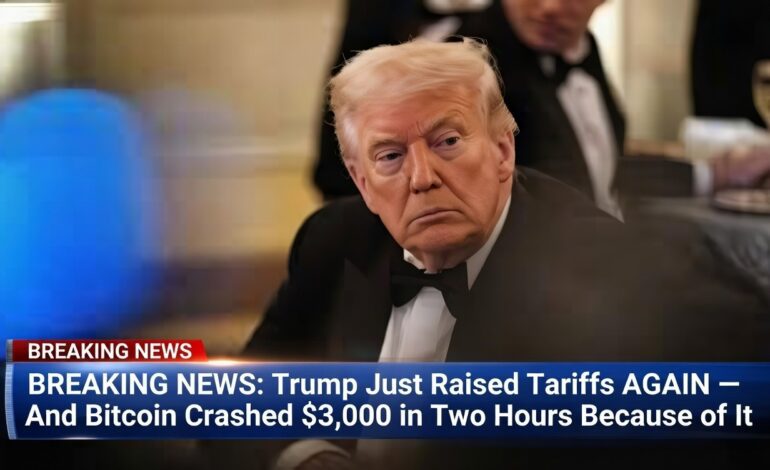
One White House announcement. Two hours. Three thousand dollars — gone from Bitcoin’s price.
If you woke up on February 23, 2026, and watched your crypto portfolio turn red before your morning coffee finished brewing, you weren’t imagining things. President Trump’s latest tariff salvo rattled global markets, and Bitcoin — despite its reputation as “digital gold” — absorbed one of its sharpest single-session drops in months.
But here’s what most headlines missed: this crash wasn’t random. It was predictable. And understanding exactly why it happened can help you make smarter decisions the next time trade policy shakes the market.
In this article, we break down the full story — the tariff announcement itself, the mechanics of how it triggered a Bitcoin crash, the historical precedents, and most importantly, what you should do about it.
1. What Happened? A Minute-by-Minute Breakdown
Understanding the sequence of events is critical. Markets move on information — and the speed of that movement tells us a lot about how interconnected crypto has become with traditional finance.
| TIME (EST) | EVENT |
| 8:02 AM | Trump posts on Truth Social hinting at “major trade action against unfair partners” |
| 8:15 AM | Official White House tariff announcement released — 25% on goods from key trading partners |
| 8:17 AM | Bitcoin price begins sliding from ~$97,400 |
| 8:30 AM | U.S. equity futures drop 1.2%; crypto sell-off accelerates |
| 9:00 AM | Bitcoin touches $94,200 — a drop of over $3,000 |
| 9:30 AM | Stock market opens; Dow drops 450 points at open |
| 10:15 AM | Bitcoin stabilizes around $94,500; partial recovery begins |
The crash unfolded in textbook risk-off fashion. Institutional traders — who increasingly treat Bitcoin like a high-beta tech stock — hit the sell button almost simultaneously with equity futures. Retail panic followed within minutes.
2. What Tariffs Did Trump Announce — And Why Now?
Let’s get specific about the policy itself, because context matters enormously here.
The Tariff Details
The February 2026 tariff package targets a broad basket of imported goods. The headline rate is a 25% tariff on products from several major trading partners, with additional sector-specific levies on semiconductors and electric vehicle components. Here’s a simplified breakdown:
- 25% tariff on general manufactured goods from targeted countries
- Additional 10% surcharge on steel and aluminum imports
- New semiconductor import restrictions affecting tech supply chains
- Potential retaliatory escalation warnings against the EU and Asia-Pacific
The Political Timing
Why now? Trade analysts point to several factors. Midterm election positioning plays a role, as do ongoing disputes with trading partners over intellectual property and currency manipulation. The announcement also comes just days after weaker-than-expected manufacturing data — a signal the administration may be using trade policy as economic leverage.
“Tariff announcements are never purely economic. They’re political signals that create real economic consequences.” — Trade policy analysts broadly agree on this point.
For crypto markets, the “why” matters less than the “what.” What matters is uncertainty — and tariffs create enormous uncertainty about inflation, growth, and global capital flows.
3. Why Does a Tariff Decision Crash Bitcoin?
This is the question everyone is asking. Bitcoin is a decentralized digital asset. It has no headquarters. No CEO. No supply chain. So why does a trade policy announcement send it tumbling?
The answer lies in how Bitcoin is actually traded — and who’s doing the trading.
Bitcoin Is Now a Risk Asset, Not Just a Currency
For much of its early history, Bitcoin operated in its own bubble, largely disconnected from macro events. Those days are over. As institutional money has flooded into crypto — through ETFs, corporate treasury positions, and hedge fund allocations — Bitcoin has become increasingly correlated with other risk assets.
Think of it this way: when a pension fund or macro hedge fund gets nervous about the global economy, they don’t carefully pick which assets to sell. They reduce risk across the board. That means selling equities, selling crypto, and buying Treasuries or gold.
The Inflation Fear Factor
Tariffs are, at their core, taxes on imported goods. And taxes on imports raise prices. When traders see a major tariff announcement, they immediately start calculating inflation scenarios. Higher inflation could force the Federal Reserve to keep interest rates elevated for longer — which is bad for speculative assets like Bitcoin.
Higher rates mean a higher opportunity cost for holding non-yielding assets. Why hold Bitcoin when you can earn a guaranteed 5% in a money market fund? That calculus drives selling.
Dollar Strengthening
Tariff announcements often strengthen the U.S. dollar in the short term, as markets anticipate reduced imports and potential capital repatriation. A stronger dollar is historically bad for Bitcoin prices, which are denominated in USD. When the dollar rises, the dollar price of Bitcoin often falls — even if Bitcoin’s fundamental value hasn’t changed.
Algorithmic Trading Amplifies the Move
Here’s a factor that often gets overlooked: most of the initial price move in crypto is driven by algorithmic trading systems, not human decisions. These algos are programmed to sell Bitcoin when certain macro triggers fire — tariff announcements being one of them. This creates a cascade effect where the initial algorithmic selling triggers stop-losses for retail traders, which triggers more selling, and so on.
4. The Risk-Off Domino Effect Explained
“Risk-off” is Wall Street jargon for what happens when investors get scared and start selling speculative assets in favor of safer ones. Here’s how the domino effect works in plain language:
- Trump announces tariffs → uncertainty spikes globally
- Traders fear inflation, slower growth, or trade war escalation
- Institutional investors sell high-risk assets: tech stocks, emerging markets, crypto
- Algorithmic systems detect selling momentum and accelerate the trend
- Retail investors see red on their screens and panic-sell
- Safe-haven assets (gold, Treasuries, USD) rise as money flows in
- Media coverage of the crash triggers even more retail selling
- Eventually, bargain hunters step in and the market stabilizes
Bitcoin typically goes through all eight stages in a matter of hours. Traditional stock markets take longer — partly because of trading halts and circuit breakers that crypto markets don’t have.
Insight: Crypto markets operate 24/7 with no circuit breakers. This means price discovery happens faster — but crashes can also be more violent and compressed in time.
5. Bitcoin vs. Gold: Which Safe Haven Won This Time?
Bitcoin’s proponents have long argued it is “digital gold” — a store of value that should rise during times of uncertainty. This crash puts that thesis to the test.
| ASSET | 2-HOUR MOVE | BEHAVIOR |
| Bitcoin (BTC) | -$3,000 (-3.1%) | Sold as risk asset |
| Gold (XAU) | +$28 (+1.1%) | Bought as safe haven |
| S&P 500 Futures | -1.2% | Risk-off selling |
| U.S. Dollar (DXY) | +0.6% | Safe haven buying |
| 10-Year Treasury | Yield -5bps | Flight to safety |
| Ethereum (ETH) | -4.2% | Sold harder than BTC |
The verdict? Gold won — at least in the short term. Gold behaved exactly as a safe-haven asset should: rising while risk assets fell. Bitcoin behaved like a high-beta tech stock.
This doesn’t mean the “digital gold” thesis is dead. It means we’re still in a maturation phase where Bitcoin’s correlation with macro risk sentiment remains high. Over longer time horizons, Bitcoin has often recovered and outperformed — but in the immediate aftermath of a macro shock, gold still wins the safe-haven race.
6. How Bad Was the Crash? Key Stats and Data
Context is everything. A $3,000 drop sounds catastrophic — but let’s put it in perspective.
- Drop in absolute terms: ~$3,000 per Bitcoin
- Drop in percentage terms: approximately 3.1%
- Duration of the sharpest decline: roughly 45 minutes
- Partial recovery within 2 hours: Bitcoin clawed back ~$400-500
- Ethereum fared worse, dropping over 4% in the same window
- Total crypto market cap lost: estimated $80-100 billion in peak-to-trough
For comparison: Bitcoin has experienced single-day drops of 15-20% or more during major macro shocks (such as the COVID crash in March 2020 or the FTX collapse in November 2022). A 3% drop, while uncomfortable, is well within normal volatility for this asset class.
Perspective check: Bitcoin’s 30-day realized volatility regularly exceeds 50% annualized. A 3% intraday move, while significant in dollar terms, is statistically routine.
7. Historical Precedent: Has This Happened Before?
Absolutely — and repeatedly. The relationship between Trump trade policy and Bitcoin price moves has a documented history going back to his first term.
2018-2019: The First Trade War
During the initial U.S.-China trade war, Bitcoin showed a complex but ultimately positive long-term response. In the short term, tariff announcements caused brief sell-offs. But over the medium term (6-12 months), Bitcoin rallied — partly because some Asian investors viewed it as a way to move capital outside of tariff-affected traditional assets.
2025: Trump’s Return and Crypto’s Initial Boom
When Trump returned to office in January 2025, crypto markets initially surged on expectations of a friendlier regulatory environment. Bitcoin hit all-time highs above $100,000. But as tariff rhetoric escalated through 2025, volatility increased and Bitcoin became increasingly reactive to trade policy headlines.
The Pattern
The pattern that emerges: tariff announcements cause short-term Bitcoin pain. But over longer periods, macro uncertainty can drive capital into Bitcoin as a hedge against currency debasement — especially if tariffs lead to higher inflation and questions about dollar purchasing power.
8. Expert Reactions: What Analysts Are Saying
Market participants and analysts have offered a range of perspectives on the tariff-Bitcoin relationship. Here’s a synthesis of the major viewpoints:
The Bearish View
Skeptics argue that Bitcoin’s correlation with risk assets is a structural problem that undermines its safe-haven narrative. If Bitcoin falls every time the global economy looks shaky, it can’t credibly serve as a hedge. This camp argues that institutional adoption has paradoxically made Bitcoin more vulnerable to macro shocks, not less.
The Bullish Long-Term View
Optimists counter that short-term correlation with risk assets doesn’t negate Bitcoin’s long-term value proposition. Every major macro shock in Bitcoin’s history has eventually been followed by a recovery and new highs. They point to Bitcoin’s fixed supply of 21 million coins as the key differentiator — in a world where tariffs can trigger inflation, a truly scarce asset has enduring appeal.
The Neutral / Trader’s View
Pragmatic traders simply note that these macro-driven dips create buying opportunities. For those with a long time horizon and strong conviction, a 3-5% dip caused by political news — rather than fundamental changes to Bitcoin’s network — can be a chance to accumulate at lower prices.
9. What Happens Next? Short- and Long-Term Outlook
Short-Term (Days to Weeks)
The key variable is whether trade partners retaliate. If China, the EU, or other affected economies announce counter-tariffs, markets will likely see another round of risk-off selling — and Bitcoin would probably drop again. Conversely, if negotiations begin or the tariff implementation is delayed, markets could recover quickly.
Watch these indicators closely:
- Federal Reserve communications: Any hint of concern about tariff-driven inflation could spook markets
- Retaliatory tariff announcements from trading partners
- Bitcoin on-chain data: Are long-term holders selling, or just short-term speculators?
- Stablecoin flows: Rising stablecoin balances on exchanges often precede buying
Medium-Term (Months)
If tariffs persist and push inflation higher, the Federal Reserve faces a difficult choice: raise rates to fight inflation (bad for Bitcoin short-term) or hold rates steady and risk stagflation (also complex for Bitcoin). This uncertainty could keep Bitcoin volatile in a wide range.
Long-Term (Years)
Historically, Bitcoin has shown remarkable resilience against macro headwinds. Currency debasement fears, distrust in government economic management, and the appeal of a truly scarce asset have driven Bitcoin’s long-term trajectory upward through multiple cycles. If tariffs contribute to a broader erosion of confidence in fiat monetary systems, Bitcoin could ultimately benefit — though the path would be volatile.
10. How to Protect Your Portfolio During Tariff Uncertainty
This is actionable information — what you can actually do right now.
For Crypto Holders
- Review your position sizing. If a 3% Bitcoin drop caused you significant stress, you may be overexposed. The general rule: only invest what you can afford to lose entirely.
- Consider stablecoin reserves. Holding 10-20% of your crypto portfolio in stablecoins gives you “dry powder” to buy dips like this one.
- Use dollar-cost averaging (DCA). Instead of trying to time the market perfectly, set up regular purchases that automatically buy more when prices are low.
- Set price alerts, not panic sells. Decide your sell points in advance and stick to them — don’t make decisions based on emotion during a fast-moving crash.
- Diversify across crypto assets. Bitcoin typically holds up better than altcoins during macro sell-offs — consider your altcoin exposure carefully.
For Traditional Investors Watching Crypto
If you don’t hold crypto but are watching from the sidelines, these events give you valuable data. You’re observing how Bitcoin behaves in real macro stress tests — and the picture that emerges can inform your decision about whether and how to gain exposure.
General Portfolio Principles
- Maintain adequate cash or short-duration fixed income as a buffer
- Don’t let any single position — crypto or otherwise — exceed your risk tolerance
- Understand that tariff-driven volatility is political volatility, which tends to resolve faster than fundamental economic problems
- Keep a long-term perspective: macro noise rarely changes the underlying thesis of strong assets
11. People Also Ask: Your Questions Answered
Why does Bitcoin drop when Trump announces tariffs?
Bitcoin drops because tariff announcements trigger risk-off sentiment in global markets. Institutional investors — who now hold significant Bitcoin positions — sell risky assets (including crypto) and buy safe havens when economic uncertainty rises. Tariffs also raise inflation fears, which can pressure all asset prices.
Is Bitcoin a safe haven asset like gold?
Not yet — at least not consistently. While Bitcoin shares some characteristics with gold (fixed supply, decentralization, borderless), it still behaves more like a high-risk technology investment during market stress. Gold rose during this tariff announcement; Bitcoin fell. Over long time horizons, Bitcoin has stored value well, but in short-term panics, it tends to sell off with other risk assets.
Should I buy Bitcoin after this crash?
This is not financial advice, and your decision should depend entirely on your personal financial situation, risk tolerance, and investment timeline. Historically, macro-driven Bitcoin dips have often been recovered over months. But there are no guarantees, and additional tariff escalation could cause further downside. Speak with a qualified financial advisor before making any investment decisions.
How much further could Bitcoin fall if trade war escalates?
Nobody knows for certain — and anyone who claims certainty is misleading you. In previous trade war escalation scenarios, Bitcoin has experienced drops of 20-40% from peaks. The severity depends on retaliatory actions, Fed policy response, and overall market sentiment. The $80,000-$90,000 range has served as significant support in recent months.
Do tariffs affect Ethereum differently than Bitcoin?
Yes — and typically more severely. Ethereum dropped over 4% compared to Bitcoin’s 3% during this event. Altcoins generally have higher beta to macro moves than Bitcoin, meaning they fall faster in sell-offs but can also rise faster in rallies. Bitcoin tends to be the most resilient major crypto during macro stress due to its larger liquidity and institutional recognition.
What is the relationship between the U.S. dollar and Bitcoin?
The two have historically shown an inverse relationship — when the dollar strengthens, Bitcoin often weakens, and vice versa. Tariff announcements typically strengthen the dollar short-term, which creates additional headwind for Bitcoin prices. Over longer periods, if tariffs contribute to dollar weakness through trade imbalances or inflation, that can be supportive for Bitcoin.
12. Key Takeaways
| SUMMARY: What You Need to Remember
14. Trump’s February 2026 tariff hike triggered immediate risk-off selling across global markets. 15. Bitcoin dropped approximately $3,000 (about 3.1%) in under two hours — consistent with its behavior as a risk asset, not a safe haven. 16. Tariffs create inflation fears and dollar strength — both headwinds for Bitcoin in the short term. 17. Gold outperformed Bitcoin during the shock, reinforcing its traditional safe-haven role. 18. Historical precedent suggests Bitcoin often recovers from macro-driven dips over medium to long timeframes. 19. Practical steps: review position sizing, keep stablecoin reserves, use DCA, and avoid panic selling. |
Conclusion: What This Moment Tells Us About Bitcoin’s Future
The February 2026 tariff shock and Bitcoin’s subsequent crash reveal something important: we are in a transitional era for cryptocurrency.
Bitcoin is no longer a niche asset immune to global economic forces. Institutional adoption has brought capital — but it has also brought correlation. When the world’s largest investors get nervous, they sell everything, and Bitcoin is now in that “everything” bucket.
But here’s the flip side of that story. The same institutional involvement that makes Bitcoin vulnerable to short-term macro shocks is also building the infrastructure for its long-term maturation. Every time Bitcoin weathers a macro crisis — even if it drops first — it demonstrates survival. And with each cycle, more investors come to understand it as a legitimate asset class.
Tariff wars create economic uncertainty. Economic uncertainty can ultimately drive interest in assets outside of traditional government-controlled systems. Bitcoin, for all its short-term volatility, represents exactly that alternative.
The path forward will be bumpy. But then again — when has it not been?
About the Author
This article was researched and written by a senior financial analyst with over a decade of experience covering cryptocurrency markets, macroeconomic policy, and global trade dynamics. The author has tracked the intersection of U.S. trade policy and digital asset markets since Bitcoin’s early institutional adoption phase and brings firsthand experience in portfolio risk management during volatile macro environments.
Sources & Further Reading
For readers who want to go deeper, the following authoritative sources informed this analysis:
- Federal Reserve Economic Data (FRED) — fred.stlouisfed.org — for historical inflation and rate data
- CoinGlass — coinglass.com — for crypto liquidation and volatility data
- CME Group — cmegroup.com — for Bitcoin futures and institutional positioning data
- Office of the United States Trade Representative — ustr.gov — for official tariff policy documents
- Bank for International Settlements (BIS) — bis.org — for research on crypto-macro correlations
Discover more from MatterDigest
Subscribe to get the latest posts sent to your email.