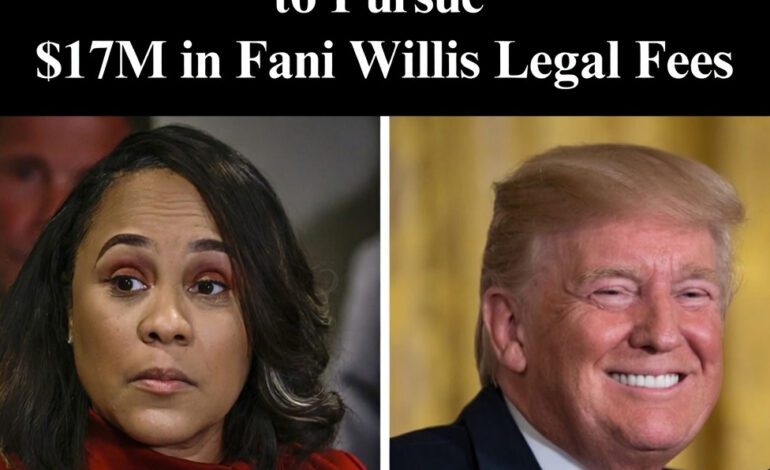
Judge Allows Trump and Co-Defendants to Pursue $17M in Fani Willis Legal Fees

What Happened: The Ruling in Plain English
Quick Answer:
On March 9, 2026, Fulton County Superior Court Judge Scott McAfee ruled that Fani Willis and her office cannot participate in litigation over nearly $17 million in attorney’s fees sought by former President Trump and 13 co-defendants. McAfee found Willis was “wholly disqualified” from the case and barred from re-entering it in any form.
The ruling doesn’t mean Trump and his co-defendants will actually receive $17 million. It means the legal fight over those fees can proceed — with Willis legally prohibited from showing up to defend against the claims.
That’s a significant distinction. Think of it like a referee ruling that one team’s coach has been ejected and can’t return to the sideline. The game isn’t over. But one side just lost its most active player in the dispute.
The decision lands as one more chapter in an extraordinarily complex legal saga — one that began with a sweeping 2023 racketeering indictment, collapsed under the weight of a disqualification scandal, and has now shifted from criminal prosecution to a financial reckoning.
Background: How the Georgia Case Collapsed
To understand this ruling, you need to understand how the original case fell apart. Here’s the condensed timeline.
August 2023: The Indictment
Fulton County District Attorney Fani Willis indicted President Trump and 18 others on racketeering charges under Georgia’s RICO statute. The indictment alleged a coordinated conspiracy to overturn Georgia’s 2020 presidential election results — including the creation of fake electors and pressure campaigns targeting state officials, including Secretary of State Brad Raffensperger.
It was the broadest of the four criminal cases facing Trump at the time, and the only one filed in state court.
Early 2024: The Conflict of Interest Emerges
The case began unraveling when it emerged that Willis had hired Nathan Wade — a private attorney with whom she was in a romantic relationship — as special prosecutor. Defense attorneys argued the relationship created a conflict of interest, particularly because Willis stood to benefit personally from Wade’s income.
After contentious hearings in early 2024, Judge McAfee declined to disqualify Willis at that stage but expressed concern about the “appearance of impropriety.” The Georgia Court of Appeals later took a harder look.
December 2024: Willis Is Removed
The Georgia Court of Appeals disqualified Willis and her entire office from the case in December 2024. The court found the situation created an “appearance of impropriety” that undermined public confidence in the prosecution — even if no direct financial benefit to Willis could be proven.
Willis was formally removed. The Prosecuting Attorneys’ Council of Georgia (PAC) was tasked with finding a replacement prosecutor.
September 2025: Georgia Supreme Court Declines Appeal
Willis appealed her removal. The Georgia Supreme Court declined to review the case in September 2025 — leaving the disqualification intact and permanent.
November 26, 2025: The Case Is Dismissed
Special prosecutor Peter Skandalakis, appointed by the PAC to replace Willis, dropped all charges. His stated reason: “the interests of justice” — a phrase that encompasses both the legal immunity of a sitting president and the practical collapse of the prosecution’s infrastructure.
With the case dismissed, the financial fight began.
What Is Georgia’s Senate Bill 244?
This is the law at the center of the entire fee dispute — and it didn’t exist when the case was first filed.
Georgia Governor Brian Kemp signed Senate Bill 244 on May 14, 2025. The law does two main things:
- Compensates wrongfully convicted people — guaranteeing $75,000 for every year of wrongful imprisonment.
- Allows defendants to recover attorney’s fees if a district attorney is disqualified from their case for “improper conduct” and the case is subsequently dismissed.
The law is widely understood to have been designed with the Willis case in mind. Republican allies of Trump in the Georgia legislature passed it after Willis’s prosecution began collapsing in 2024.
Willis’s office argued in court that SB 244 is unconstitutional. Judge McAfee declined to pause the reimbursement process at this stage, though the constitutional challenge remains live and could factor into the bench trial to come.
This is also largely uncharted legal territory. The fee battle could test the scope of Georgia’s new law allowing defendants to recover legal costs when prosecutors are disqualified — a statute that has rarely been applied since taking effect in 2025.
What the Judge Decided — and What He Didn’t
Judge McAfee’s nine-page order on March 9, 2026, addressed two questions:
Question 1: Can Willis’s office intervene in the fee litigation? Answer: No.
McAfee’s order makes clear that Fulton County District Attorney Fani Willis and her office cannot participate further in the dispute because they were previously removed from the case over conflicts of interest.
The judge’s reasoning was straightforward: because the DA’s office was “wholly disqualified” from the underlying criminal case, it cannot now re-enter the proceedings — even to defend against financial claims stemming from that case.
He also noted that the DA’s office interests are already represented. The Prosecuting Attorneys’ Council of Georgia — which took over after Willis’s removal — is present in the litigation and can adequately represent the state’s position.
Question 2: Can Fulton County itself intervene? Answer: Yes.
This is the critical nuance most coverage has underplayed. Because the county provides the “overwhelming source of funding” for the DA’s office, McAfee determined the “financial buck” for the $16.8 million demand would likely stop at the county’s desk.
Fulton County — as a separate administrative entity from the DA’s office — was granted permission to join the litigation. This matters enormously because it’s the county, not Willis personally, that would most likely be responsible for paying any judgment.
What McAfee Did NOT Decide:
- He did not rule on whether the fees are actually owed
- He did not rule on whether SB 244 is constitutional
- He did not determine whether the amounts claimed are reasonable
Those questions go to a bench trial — heard by a judge alone, without a jury — still to be scheduled.
Who Is Seeking What — and Who Might Pay?
The Claimants
Fourteen of the original 19 defendants are seeking fees. Not all of them will be seeking the same amounts — each submitted separate motions backed by their own billing records.
Fourteen former defendants, including Trump, are seeking $16.85 million in attorney’s fees under a Georgia law enacted in 2025 that allows defendants to recover legal costs if a prosecutor is disqualified from a case.
The breakdown:
| Claimant | Amount Sought |
|---|---|
| Donald Trump | $6.2 million+ |
| All other 13 co-defendants combined | $10.79 million+ |
| Total | ~$16.85 million |
Trump’s team submitted approximately 200 pages of invoices and billable hour records to support the $6.2 million figure, according to Law & Crime.
Who Pays If the Claims Succeed?
This is where it gets complicated — and politically uncomfortable.
Willis personally is not the likely source of payment. The DA’s office doesn’t have independent funds of that magnitude. And Willis herself is a public official, not a personally wealthy individual being sued in her individual capacity.
The most likely payer is Fulton County — the local government entity that funds the DA’s office. That means Fulton County taxpayers could ultimately bear some or all of the cost.
The decision to allow the reimbursement claims to move forward could have significant financial implications, potentially exposing taxpayers to substantial costs if the requests are approved.
Whether the county can recover those costs from the state, from Willis personally, or from any insurance policy is another layer of legal complexity that hasn’t been resolved.
Why Willis Was Blocked From the Proceedings
The legal principle behind McAfee’s ruling is clean, even if the politics are messy.
When a court disqualifies a prosecutor for misconduct, that disqualification is comprehensive. The prosecutor can’t continue working on the case. They can’t advise others working on the case. And — as McAfee ruled — they can’t re-enter the proceedings in a related dispute to defend their prior decisions.
Allowing Willis back in to fight the fee claims would effectively let her re-litigate her disqualification. It would mean letting a party ruled to have acted improperly defend the financial consequences of that improper conduct — while simultaneously being barred from the underlying case itself. McAfee found that logically untenable.
He also noted a practical point: the DA’s office interests are already being represented. The PAC — the state body that took over after Willis’s removal — is present in the litigation. There’s no vacuum of representation that requires Willis to fill.
Willis’s office responded by filing a motion for a “certificate of immediate review,” signaling intent to appeal the exclusion. The office argued that barring them from the litigation violates “fundamental notions of due process” — a constitutional argument that could potentially delay or complicate the bench trial.
What Fulton County’s Role Means for Taxpayers
The county’s intervention in the case is the development that has received the least attention but carries the most practical weight.
Fulton County is a party. It’s represented by its own attorneys. And it has a direct financial stake — because if a judge awards anywhere close to $17 million in fees, Fulton County residents will feel it.
The county’s annual operating budget is approximately $1.3 billion. A $17 million judgment would represent roughly 1.3% of that — not catastrophic, but significant. It could affect county services, staffing levels, or require a supplemental appropriation from the county commission.
The county’s intervention means it can now argue its own position in the bench trial — potentially challenging the amounts claimed, the law’s constitutionality, or the causal link between Willis’s disqualification and the specific legal costs incurred.
McAfee himself acknowledged the novelty of the situation. “Novelty abounds,” McAfee wrote, noting that the court must now navigate uncharted procedural waters to determine if the $16.8 million in requested fees, spanning 14 different defendants, is reasonable.
What Fani Willis Says About All of This
Willis has not been silent. Hours after McAfee’s ruling, she appeared at an International Women’s Day event at the Georgia State Capitol and delivered a pointed response — though notably not a legal one.
“They want to show you that they are powerful and strong by coming after me,” Willis said. “My crime is that I have the audacity to hold people accountable who commit crimes in my jurisdiction, no matter who they are.”
She framed the legal battles against her as political retaliation for pursuing powerful figures. She criticized state lawmakers who have investigated her conduct, describing a Senate hearing earlier this year as a “waste of taxpayers’ money” and “a clown show.”
Willis also pushed back on the framing of the case’s dismissal as a vindication of the defendants. She argued the case was not dismissed because the charges were wrong — but because of the legal immunity of a sitting president and the operational disruption caused by her removal.
Willis said after she was disqualified: “I hope that whoever is assigned to handle the case will have the courage to do what the evidence and the law” require — leaving the sentence pointedly unfinished.
Her office’s appeal of McAfee’s intervention ruling is the next immediate legal move.
What Happens Next in the Legal Fee Battle
The path forward has several stages:
1. Willis’s Appeal of the Intervention Ruling
Willis’s office filed for immediate appellate review of McAfee’s decision barring their participation. If a higher court grants review, the bench trial could be delayed while that appeal is resolved.
2. Constitutional Challenge to SB 244
Willis’s office has argued Georgia’s 2025 law is unconstitutional. McAfee declined to pause proceedings based on that argument, but the constitutional question is still alive. A ruling striking down SB 244 would eliminate the entire legal basis for the fee claims.
3. The Bench Trial on Reasonableness
If the law survives constitutional challenge and the appeal is denied, a bench trial will determine:
- Whether fees are owed under SB 244
- Whether the amounts claimed by each defendant are “reasonable”
- What portion of those fees is causally linked to Willis’s disqualification
Reasonableness is not automatic. Defense teams submitted hundreds of pages of billing records. The state — represented by the PAC and Fulton County — will challenge those records line by line.
4. Potential Payment and Appeals
Even if a judge awards fees, payment would likely be appealed further. A final resolution could be years away.
[Suggested visual: Flowchart showing the legal pathway from current ruling to potential payment]
FAQ: People Also Ask
What did Judge McAfee rule in the Fani Willis legal fee case? Judge Scott McAfee ruled on March 9, 2026 that Fani Willis and her office cannot intervene in litigation over $16.85 million in attorney’s fees sought by Trump and 13 co-defendants. Because Willis was “wholly disqualified” from the underlying case, she cannot re-enter related proceedings to oppose those claims. Fulton County itself was separately allowed to participate.
How much money is Trump seeking from Fani Willis? Trump alone is seeking more than $6.2 million in attorney’s fees under Georgia’s Senate Bill 244, passed in 2025. Combined with the other 13 co-defendants, the total sought is approximately $16.85 million. Trump’s team submitted about 200 pages of billing records to support the claim.
Will Fani Willis personally have to pay Trump’s legal fees? Almost certainly not from her personal finances. The claims are against the Fulton County District Attorney’s Office, and Fulton County — which funds the DA’s office — is the more likely source of any payment. Willis is not being sued personally in her individual capacity.
What is Georgia’s Senate Bill 244? SB 244 is a Georgia law signed by Governor Brian Kemp on May 14, 2025. It allows defendants to recover attorney’s fees if a prosecutor is disqualified for “improper conduct” and the case is later dismissed. Critics say it was designed specifically with the Willis case in mind. Willis’s office has challenged it as unconstitutional.
Why was Fani Willis disqualified from the Trump case? The Georgia Court of Appeals disqualified Willis in December 2024 because of her romantic relationship with Nathan Wade, the special prosecutor she hired to work on the case. The court found this created an “appearance of impropriety” that undermined public confidence in the prosecution, even without proof of direct financial benefit to Willis.
What happened to the Georgia election interference case against Trump? The case was dismissed on November 26, 2025, by special prosecutor Peter Skandalakis, who cited “the interests of justice.” The dismissal followed Willis’s disqualification, the Georgia Supreme Court’s refusal to review her removal, and Trump’s return to the presidency — which created legal immunity issues for a sitting president.
Who would actually pay if the court awards legal fees to Trump? Fulton County — the local government entity that funds the DA’s office — is the most likely source of payment. The county has been allowed to intervene in the litigation precisely because it would be financially responsible for any award. That means Fulton County taxpayers could ultimately bear the cost.
Can Willis appeal being excluded from the fee litigation? Yes. Willis’s office filed a motion for a “certificate of immediate review” after McAfee’s ruling, signaling plans to appeal to a higher court. If that appeal is granted, proceedings could be delayed. Her office argues that barring them from the litigation violates due process.
Key Takeaways
Here is where things stand as of March 12, 2026:
- Judge McAfee ruled Willis cannot participate in the $16.85 million legal fee litigation. Her disqualification from the underlying case bars her from re-entering related proceedings.
- Fulton County was allowed to intervene — because it funds the DA’s office and would most likely be responsible for any payment. This is the development with the most real-world financial consequence.
- No money has been awarded yet. This ruling only allows the claims to proceed. A bench trial is still needed to determine whether fees are owed and in what amount.
- Two major legal challenges remain: Willis’s appeal of her exclusion, and her office’s constitutional challenge to SB 244. Either could significantly change the outcome.
- Willis is publicly defiant. She has framed the legal battles as political retaliation, not a legitimate accountability process, and her office has moved immediately to appeal.
- This case sets legal precedent. SB 244 has never been applied at this scale. Whatever the final ruling, it will shape how Georgia handles prosecutorial misconduct and fee recovery for years to come.
What to watch next:
- Whether a higher court grants Willis’s request for immediate appellate review
- Any ruling on the constitutionality of SB 244
- The scheduling of the bench trial on fee reasonableness
- Fulton County Commission’s response to the financial exposure
- Whether any of the 14 claimants settle separately
Sources:
- CBS News Atlanta: Fani Willis defends prosecution of Trump after judge’s ruling on legal fees (March 9, 2026)
- CBS News Atlanta: Judge denies Fani Willis’ attempt to withhold payment as co-defendants seek nearly $17 million in legal fees (March 9, 2026)
- Fox 5 Atlanta: Judge blocks DA Fani Willis from $16.8M Trump compensation legal fee battle (March 9, 2026)
- Law & Crime: ‘Wholly disqualified’: Judge blocks Fani Willis from returning to Trump case in battle over nearly $17 million in legal fees (March 9, 2026)
- Newsweek: Fani Willis Suffers Legal Blow In Fight Against Trump (March 10, 2026)
Discover more from MatterDigest
Subscribe to get the latest posts sent to your email.