Trump Admits Failed Iran Weapons Plan—Regime Change Push Exposed
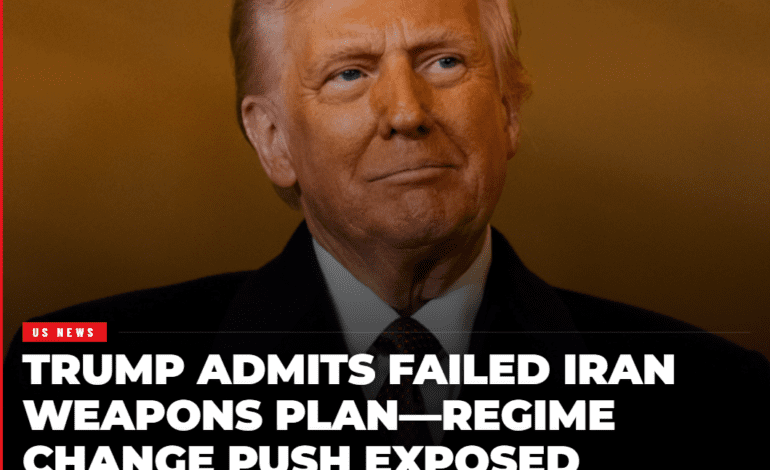

Trump Confirms Failed Weapon Shipment Operation to Iran to Spark Regime Change — A Scandal That Could Reshape American Foreign Policy
What had circulated for weeks as rumor and speculation has now been confirmed by the president himself. Donald Trump has publicly acknowledged that the United States attempted to smuggle weapons into Iran with the goal of arming dissident groups and sparking a regime-change uprising from within. The operation failed. The weapons were reportedly received by the intended recipients — but no uprising followed. The groups that took delivery of the arms kept them without launching the expected insurrection, leaving the United States strategically exposed, diplomatically isolated, and holding the consequences of a covert foreign policy gamble that went catastrophically wrong.
The implications of this admission are enormous — and they are being felt simultaneously on multiple fronts. Internationally, the confirmation that the United States conducted a covert arms-smuggling operation targeting a sovereign nation’s internal stability has triggered condemnation from allies and adversaries alike. Domestically, the admission has poured fuel onto every fire already burning inside American politics: the No Kings movement, the debate over the 25th Amendment, the question of what orders senior military commanders were asked to follow before they were fired, and the broader reckoning about who is making foreign policy decisions in this administration and on what legal authority.
For critics, this is not just a failed intelligence operation. It is a confession — a president voluntarily disclosing that his administration undertook an act of interference in the internal affairs of a sovereign nation that, if carried out by any other country against the United States, would be characterized without hesitation as an act of aggression. The question now reverberating through every corner of Washington is whether that characterization applies here — and what the consequences should be.
What Did Trump Actually Admit and What Does the Confirmation of the Iran Operation Mean?
The specifics of Trump’s admission have emerged through a combination of public statements and reporting from sources familiar with the operation. What the president confirmed, either directly or through language that leaves no serious room for alternative interpretation, is that the United States government under his direction attempted to deliver weapons to Iranian dissident groups — individuals or organizations operating inside or connected to Iran who were willing to work toward the overthrow of the current Iranian government.
The strategic logic behind such an operation, as described by administration officials and defense analysts who have commented on the report, is not without precedent in American foreign policy history. The United States has a long and complicated history of arming opposition groups in countries whose governments it opposes — from the Contras in Nicaragua during the Reagan era, to the mujahideen in Afghanistan during the Soviet occupation, to various Syrian opposition factions during the Obama years. Each of those operations produced outcomes that were, at minimum, far more complicated than the administrations that authorized them anticipated.
What makes the Iran operation different — and what makes Trump’s confirmation of it so politically explosive — is the combination of two specific factors. The first is the current strategic moment: the United States and Iran are already in a state of heightened military tension, with the Pentagon having just purged senior generals who refused to support an invasion, with active military planning reportedly underway, and with the entire region on edge. Conducting a covert arms-smuggling operation in that environment is not a low-stakes intelligence play. It is a match being struck near an open flame.
The second factor is the outcome. The operation did not just fail to achieve its objective. It failed in a way that left the United States holding all of the exposure and none of the leverage. The weapons reached their intended recipients. Those recipients took delivery and then declined to act. The administration does not know with certainty where those weapons are now, who controls them, or what they might ultimately be used for. The United States conducted a covert operation, had it go wrong in the most operationally embarrassing way possible, and then had its president confirm it publicly.
The operation failed in the worst possible way — the weapons were delivered, the uprising never came, and the president confirmed the whole thing publicly. The United States is now internationally exposed, the weapons are unaccounted for, and every ally and adversary in the world is drawing their own conclusions about American strategic judgment.
Is Arming Dissident Groups in Another Country Legal Under International Law?
The legal question at the center of the Iran arms operation is one that international law scholars, former State Department officials, and foreign policy analysts have been debating urgently since the confirmation emerged. The short answer is that what the administration appears to have done sits in deeply contested legal territory — territory where the gap between what international law prohibits and what major powers have historically done is wide, but where the specific circumstances of this case create exposure that other covert operations have not.
International law, as codified in the United Nations Charter and in the customary norms that govern state conduct, prohibits the use of force against the territorial integrity or political independence of any state. It also prohibits interference in the internal affairs of other sovereign nations — a principle known as the non-intervention norm that is foundational to the international order. Arming dissident groups inside another country for the purpose of overthrowing its government falls squarely within the category of conduct that these norms are designed to prohibit.
The counterargument that administrations engaging in such operations have historically made — and that Trump administration officials are likely to make in defending this one — is that the right of self-defense, broadly construed, permits a state to take preemptive action against threats that it assesses as serious and imminent. Under this reasoning, if the Iranian government poses a genuine threat to American security interests, arming groups positioned to destabilize that government is a form of defensive action rather than aggression.
International lawyers and courts have not generally accepted this expansive reading of the self-defense exception. The International Court of Justice ruled in the Nicaragua case in 1986 that U.S. support for the Contras violated international law — a precedent that is directly relevant to the current situation. That ruling did not stop the United States from conducting similar operations in subsequent decades. But it established a clear legal record that arming opposition groups for regime-change purposes violates international legal norms, regardless of the strategic justification offered by the state conducting the operation.
The specific question of whether the Iran operation could justify international sanctions is one that multiple allied governments are now reportedly examining. The European Union, which has worked to maintain the diplomatic frameworks around Iranian nuclear negotiations, has been particularly pointed in its concern. For U.S. allies who have spent years trying to manage the Iran situation through diplomacy and negotiation, the confirmation that Washington conducted a covert arms-smuggling operation targeting Iranian regime change without prior consultation or notification represents a profound breach of the trust and coordination that alliance relationships depend on.
How Does This Admission Connect to the General Purge and the Pentagon Crisis?
The confirmation of the failed Iran arms operation is not an isolated event. It is a piece of a larger picture that has been assembling itself over the past several weeks — a picture that, when its elements are placed together, raises questions that go to the very heart of how the Trump administration is making decisions about the use of American military and intelligence power.
The purge of senior military commanders — more than a dozen generals dismissed for refusing to support orders connected to potential military action against Iran — now looks different in light of the arms operation confirmation. If the administration was simultaneously conducting a covert operation to arm Iranian dissidents and planning a potential military invasion, the generals who refused were not simply declining a single order. They were potentially refusing to participate in a multi-track strategy targeting Iran that they assessed, in their professional judgment, as unlawful, reckless, or both.
General Randy George and his colleagues who were dismissed did not leave detailed public statements about the specific nature of the orders they refused. But the combination of what is now known — the covert arms operation, the invasion planning, the purge of those who resisted — suggests a pattern of decision-making at the highest levels of the administration that bypassed the professional military judgment that is supposed to serve as a check on executive action in exactly these situations.
The generals who refused orders were fired. The weapons operation was confirmed as a failure. The administration is now isolated internationally and under fire domestically. The question that connects all of these dots is the same question General Milley asked in his viral speech: loyalty to whom? And at what cost?
Senator Chris Murphy’s call for the Cabinet to consult constitutional lawyers about the 25th Amendment takes on additional weight in this context. If the Cabinet is aware that the administration conducted a covert operation targeting regime change in a nuclear-adjacent nation, that the operation failed and left American-supplied weapons in unknown hands, and that senior military commanders were fired for resisting the broader strategy of which that operation was a part — the question of presidential fitness for office is not an abstract constitutional exercise. It is a live question about the safety and security of the country.
What Has the International Reaction Been to Trump’s Confirmation of the Iran Operation?
The international response to the confirmation of the failed Iran arms operation has been swift, sharp, and — for an administration that has repeatedly clashed with traditional allies over foreign policy — unusually unified in its criticism.
European governments that have maintained diplomatic channels with Iran — particularly Germany, France, and the United Kingdom, the three European parties to the nuclear negotiations framework — have expressed alarm at the confirmation in terms that go beyond the usual diplomatic language of concern. The specific issue for these governments is not simply that the United States attempted to arm Iranian dissidents. It is that they were not informed, were not consulted, and were given no opportunity to raise the objections they would certainly have raised had they known what Washington was doing.
Alliance management requires trust. It requires the kind of regular, substantive consultation that allows partners to raise concerns before operations are launched rather than reading about their outcomes after they have failed. The Iran arms operation confirmation has deepened existing concerns among European allies about whether the current American administration is capable of operating as a reliable partner — and about whether information shared with Washington in confidence can be trusted to remain within the boundaries of coordinated policy rather than appearing as a variable in unilateral operations they were not aware of.
The reaction from non-allied nations has been predictably more pointed. Russia and China — both of which have existing relationships with the Iranian government — have used the confirmation to advance a narrative that they have been developing for years: that the United States is a destabilizing force in global affairs, that its intelligence operations reflect contempt for the sovereignty of other nations, and that the international order requires mechanisms to constrain American unilateralism. The failed Iran operation has given them fresh material and significant credibility in making that argument to an international audience that is already skeptical of American intentions.
Iran itself has responded with fury — although fury is a baseline condition of Iranian government statements about the United States, and the specific diplomatic and military implications of the Iranian response are still developing. What is clear is that the confirmation of an American attempt to arm regime-change forces inside Iran has significantly complicated any path toward de-escalation of the military tension that has been building between the two countries. An administration that was simultaneously planning an invasion and arming dissidents is not an administration that Iranian leaders can negotiate with from a position of good faith on either side.
What Are the Domestic Political Consequences of This Foreign Policy Disaster?
Domestically, the confirmation of the failed Iran arms operation has injected new energy and new urgency into every ongoing political debate about the Trump administration’s conduct and fitness for office.
For the No Kings movement, which has framed its opposition to the administration around concerns about authoritarian consolidation of power and reckless disregard for constitutional and international norms, the arms operation confirmation is precisely the kind of evidence that galvanizes rather than divides its coalition. The movement has consistently argued that the administration is conducting foreign policy in ways that violate both domestic legal constraints and international obligations. The confirmation of a covert regime-change operation against a sovereign nation — conducted without congressional authorization, without allied consultation, and with a failure outcome that has left American-supplied weapons in unknown hands — is exactly the kind of conduct that the movement has been warning about.
In Congress, the confirmation has prompted renewed calls for oversight hearings and for a formal accounting of what congressional leaders were told about the operation before it was conducted. The War Powers Act requires the president to notify Congress within 48 hours of introducing U.S. armed forces into hostilities or situations where hostilities are imminent. Whether the Iran arms operation constitutes an action requiring War Powers notification is a legal question that members of both chambers are now raising, along with the more fundamental question of whether Congress was consulted at all before the operation was authorized.
Republican members of Congress have been notably quiet in their public responses — a silence that reflects the impossible position that the confirmation creates for legislators who have supported the administration’s aggressive Iran posture while also representing constituents who are watching the situation deteriorate. The failure of the operation, and its public confirmation by the president himself, makes it very difficult to defend the underlying strategy without also defending the outcome.
For the broader accountability debate that has been building around the Trump administration — encompassing the general purge, the 25th Amendment discussion, the legal battles over personal assets, and the FBI’s election conspiracy probe — the Iran arms admission adds a foreign policy dimension that elevates the stakes considerably. Covert operations targeting regime change in a nuclear-adjacent nation, conducted without congressional oversight and resulting in unaccounted-for weapons, are not a domestic governance concern. They are a national security crisis with global dimensions.
What Happens Next — Can the United States Recover From This Strategic Setback?
The immediate question facing the administration following the confirmation of the failed Iran operation is whether there is a path forward that limits the damage — diplomatically, strategically, and politically — and whether that path is accessible given the current state of American domestic politics and international relationships.
On the diplomatic front, the recovery path requires something that the Trump administration has shown limited willingness to do: engage in substantive, sustained consultation with allies about a coordinated approach to the Iran situation that can command broad international support. The current moment — with allies alarmed, adversaries emboldened, and Iran more hostile than before the operation — is not a favorable starting position for that kind of diplomatic engagement. But it is the starting position the administration finds itself in.
On the strategic front, the failure of the dissident-arming operation does not eliminate the underlying problem that motivated it: the administration’s assessment that the Iranian government poses a serious threat to American security interests and that the current trajectory of Iranian behavior requires a decisive response. That assessment may or may not be correct. But it will continue to drive policy regardless of the operation’s failure. The question is whether the administration will pursue its Iran strategy through mechanisms that can command legal authority, allied support, and military compliance — or whether it will continue to pursue covert and unilateral approaches that have already produced one significant failure.
On the political front, the confirmation of the failed operation has created an accountability moment that will not be resolved by silence or deflection. Congressional oversight requests are now on record. Allied governments are asking formal questions. Legal analysts are examining whether War Powers requirements were violated. And the broader public — already mobilized by the No Kings movement, already watching the general purge and the 25th Amendment debate — now has a concrete foreign policy failure to add to the list of concerns driving their political engagement.
The administration’s response to that accountability moment will define the next chapter of one of the most turbulent periods in recent American foreign policy history. And the world — allies, adversaries, and everyone in between — is watching closely to see what that response will be.
Key Takeaways: The Failed Iran Arms Operation and Its Sweeping Consequences
President Trump has confirmed that the United States attempted to smuggle weapons into Iran to arm dissident groups and spark a regime-change uprising. The operation failed — the weapons were delivered but no uprising followed, leaving American-supplied arms in unknown hands.
The admission has triggered international condemnation, with European allies expressing alarm at being excluded from consultation and adversaries using the failure to advance a narrative of American strategic recklessness and contempt for international sovereignty.
The operation connects directly to the general purge at the Pentagon — raising the possibility that the senior commanders who were fired for refusing orders may have been resisting participation in a broader Iran strategy of which the covert arms operation was one element.
Domestically, the confirmation has intensified every ongoing accountability debate: the No Kings movement, the 25th Amendment discussion, the congressional oversight questions, and the broader reckoning about who is making American foreign policy decisions and on what legal authority.
International law experts have raised serious questions about whether the operation violates the non-intervention norm codified in the UN Charter — a norm whose violation, in the Nicaragua case precedent, the International Court of Justice found to constitute an unlawful use of force regardless of the strategic justification offered.
The path forward requires diplomatic engagement, congressional accountability, and a strategic reassessment that acknowledges the failure of the current approach. Whether the administration is prepared to undertake any of those steps is the defining question of the coming weeks.
© 2026 Matter News. All rights reserved.
Discover more from MatterDigest
Subscribe to get the latest posts sent to your email.