Toronto Patterson: The 17-Year-Old Executed at 24 for Killing 3 Family Members — The Full Truth Behind the Viral Story
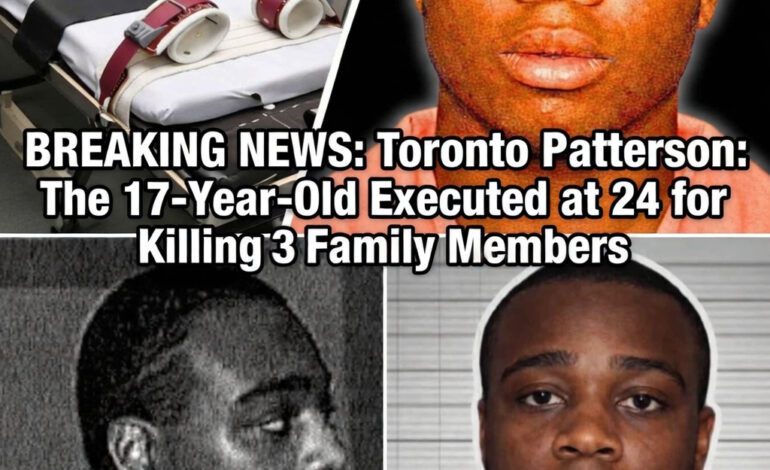

| 🚨 CRITICAL CONTEXT MISSING FROM VIRAL HEADLINE: Toronto Patterson is NOT currently on death row or awaiting execution. He was executed by the State of Texas on August 28, 2002 — more than 22 years ago. The viral ‘EXPOSED ⚠️’ headline presents his story as though it is breaking news in 2025 or 2026. It is not. This article provides the complete, verified account of what actually happened. |
The Real Story: Who Was Toronto Patterson and What Happened?
Toronto Markkey Patterson was 17 years old when he entered a home in East Dallas on June 6, 1995. When he left, three people were dead. A 25-year-old mother. Her 6-year-old daughter. Her 3-year-old daughter.
Seven years later, on August 28, 2002, Patterson — then 24 years old — was executed by lethal injection at the Texas State Penitentiary in Huntsville. He maintained his innocence to the end.
His case became one of the most debated juvenile death penalty executions in American history. The controversy surrounding it helped lay the groundwork for a landmark U.S. Supreme Court ruling just three years later that would abolish the juvenile death penalty for everyone who came after him.
This article tells the full story — the crime, the victims, the evidence, the legal battles, the final words, and why this 2002 case is still being discussed in 2026.
Toronto Patterson — Complete Case Facts at a Glance
| Detail | Information |
| Full Name | Toronto Markkey Patterson |
| Date of Birth | c. 1978 (Dallas, Texas) |
| Age at Crime | 17 years old |
| Age at Execution | 24 years old |
| Date of Execution | August 28, 2002 |
| Time of Death | 6:20 p.m. CDT |
| Execution Method | Lethal injection |
| Location | Huntsville, Texas (Texas State Penitentiary) |
| Victims | Kimberly Brewer, 25; Jennifer Brewer, 6; Ollie Brown, 3 |
| Relationship to Victims | First cousins (Kimberly was his great-aunt’s daughter) |
| Crime Date | June 6, 1995 |
| Crime Location | East Dallas, Texas |
| Motive | To steal chrome BMW wheel rims (~$2,000 value) |
| Conviction | Capital murder (three counts) |
| Maintained Innocence? | Yes — to the moment of his death |
| Last Words | Apologized but denied being the killer. Full text in article. |
| Status (2026) | Executed — August 28, 2002 (22+ years ago) |
Viral Headline Fact-Check: What Is True, False, and Misleading?
Before going deeper, here is a direct breakdown of every significant claim in the viral headline and related posts — and how each holds up against the verified record.
| Claim in Headline | Verdict | Notes |
| Toronto Patterson was sentenced to death | TRUE | Convicted in 1996; sentenced to death in Texas |
| Patterson was 24 years old at sentencing | MISLEADING | He was 17 at the crime, 18 at conviction (~1996), 24 at execution in 2002 |
| The headline implies he is alive / recent news | FALSE | Patterson was executed on August 28, 2002 — over 22 years ago |
| He killed 3 family members | TRUE | Convicted of killing cousin Kimberly Brewer, 25, and her daughters aged 6 and 3 |
| He maintained his innocence | TRUE | He denied being the killer in his final statement on death row |
| He was the ‘⚠️ EXPOSED’ subject of a new scandal | FALSE / CLICKBAIT | There is no new 2025/2026 development in this case — this is old news repackaged |
| The motive was stealing car rims | TRUE | Prosecutors proved rims worth ~$2,000 were the motive |
| His execution was controversial | TRUE | He was 17 at the time of the crime; 3 Supreme Court justices opposed the execution |
| 📌 THE BIGGEST MISLEAD: The headline uses ‘EXPOSED ⚠️’ framing to suggest a new revelation or scandal. There is no new 2025/2026 development. Patterson’s case resurfaces periodically on social media because of its historical significance to the juvenile death penalty debate — not because anything new has happened. |
Who Were the Victims? Remembering Kimberly, Jennifer, and Ollie
It is easy, in coverage of execution cases, for victims to be reduced to names in a crime summary. That would be a disservice here. Three people were murdered on a Tuesday afternoon in Dallas, and their lives mattered.
Kimberly Brewer — Age 25
Kimberly Brewer was 25 years old and the daughter of Evelyn Stiff. She was Toronto Patterson’s first cousin — Evelyn was Patterson’s great-aunt. She was at home with her two young daughters on June 6, 1995, when Patterson entered the house. Kimberly was shot in the head while seated in a living room recliner.
Jennifer Brewer — Age 6
Jennifer Brewer, Kimberly’s older daughter, was 6 years old. She was in her bedroom watching cartoons on television when she was shot. According to prosecutors, Patterson shot her to eliminate a witness who could identify him.
Ollie Brown — Age 3
Ollie Brown, the younger daughter, was 3 years old. She had sought cover in a corner of the bedroom when she was shot. Court testimony noted that she died with her hands over her ears. She was shot in the head, hand, and neck.
| “It was extremely sad. The only person who could stop him physically was Kimberly, the woman. But what does he do? He decides: ‘I’ve got to eliminate eyewitnesses.’ So he eliminates the two kids who know him. No question about thought processes there. There was no need to kill the kids otherwise.” — George West, Dallas County District Attorney |
The Crime: What Happened on June 6, 1995
In 1995 Dallas, chrome and gold BMW wheel rims were a status symbol. They were also a robbery target. That year alone, at least nine people in the Dallas area were killed over similar rims. A full set could cost $4,500. They were sold for quick cash. And for a 17-year-old drug dealer who measured worth in jewelry, cars, and cash, they were worth taking.
The Morning of the Murders
On the morning of June 6, 1995, Patterson left the home he shared with his live-in girlfriend. He told her he had a physical therapy appointment for a back injury. About four hours later, he returned. He changed his clothes and told his girlfriend he had shot someone and taken their wheel rims.
According to investigators, Patterson had gone to the home of Evelyn Stiff — his great-aunt’s house — which had a BMW car in the garage with custom chrome rims. Kimberly Brewer and her two daughters were home.
The Shooting
Using a .38-caliber pistol, Patterson shot Kimberly in the living room where she sat. He then walked to the bedroom where 6-year-old Jennifer was watching television and shot her. Three-year-old Ollie, who had curled into a corner of the room and covered her ears, was shot next. All three were shot in the head.
Patterson then went to the garage. He removed three of the four chrome rims from the BMW. He was unable to free the fourth.
The Arrest — Caught on Camera
That same afternoon, Patterson took the three rims to a dealer. He did not sell them. He brought them back to his girlfriend’s house. And then he did something extraordinary: he and his girlfriend went to observe the police and news crews gathered at the murder scene.
| 📹 HOW HE WAS IDENTIFIED: Prosecutors scanning television news footage of the crime scene spotted Patterson in the video, watching from the crowd. He was arrested that same evening. The stolen rims were found at his girlfriend’s house. He had blood on his clothing when he arrived home. |
Two Confessions — and Why Patterson Disputed Both
After his arrest, Patterson gave two written confessions to police. In the first, he admitted stealing the rims but claimed he had given them to Jamaican drug dealers who committed the murders. When detectives told him the rims were at his girlfriend’s house, he gave a second confession that included admitting the murders.
Patterson later recanted, claiming the confession was coerced. His legal team raised a significant point: the same detective who took his confession also extracted a false confession from another young capital murder suspect just one month later — a fact the jury in Patterson’s trial never heard.
Who Was Toronto Patterson? His Life Before the Murders
Understanding Patterson’s life before June 6, 1995 does not excuse what happened. But it is essential context for the juvenile death penalty debate that his case ignited.
A Life of Early Criminality
Patterson began dealing drugs at age 15. By the time of the murders, he had dropped out of high school during his sophomore year, was living with a girlfriend, and was earning money through drug sales. He was known for expensive jewelry, clothing, and cars.
- Age 15: Began dealing drugs in Dallas
- Age 16: Charged with unlawful possession of a weapon — a loaded 9mm handgun found during a traffic stop
- Age 16: Reportedly threatened to kill school authorities when they confiscated his beeper
- Age 17: Executed the murders of three family members
Prosecutors also presented evidence that Patterson was a gang member in high school. His criminal trajectory had been escalating. Still, no prior offense rose to the level of violence that occurred on June 6, 1995.
Did Toronto Patterson Have a Difficult Upbringing?
Court records and advocacy materials suggest Patterson came from an unstable home environment and was embedded in gang culture from a young age. However, this context was not highlighted in the original trial to the degree that modern courts might expect — a fact his post-conviction attorneys later argued contributed to an inadequate defense.
The Trial and Death Sentence: What Happened in the Courtroom
Patterson was tried as an adult in Dallas County. The prosecution presented physical evidence, both confessions, witness testimony, and the fingerprints found on the rims left at his girlfriend’s house.
The Verdict and the Sentence
The jury convicted Patterson of capital murder and, after hearing the penalty phase, sentenced him to death. Texas law at the time required jurors to assess whether a convicted murderer posed a ‘continuing threat to society’ — a question that advocates argued placed enormous and unfair weight on a 17-year-old’s future danger.
What the Jury Never Heard
One of the most troubling aspects of the Patterson case was what the jury did not know: the detective who obtained his confession had, just one month after Patterson’s arrest, extracted a false confession from another young capital murder suspect. This raised serious questions about the interrogation tactics used. Patterson’s trial jury had no access to this information.
| ⚖️ LEGAL SIGNIFICANCE: The suppression of evidence about the detective’s subsequent misconduct became a central argument in Patterson’s appeals. His attorneys argued it violated Brady v. Maryland — the Supreme Court rule requiring prosecutors to disclose evidence favorable to the defense. |
Seven Years of Appeals: Why Patterson’s Case Became a National Story
Between his 1996 conviction and his 2002 execution, Patterson’s legal team mounted appeal after appeal. None succeeded. But the arguments they raised resonated — and echoed for years after his death.
The Juvenile Death Penalty Argument
The central argument in Patterson’s appeals was constitutional: executing a person for a crime committed at 17 years old constitutes cruel and unusual punishment, banned by the Eighth Amendment of the U.S. Constitution.
This was not a fringe argument. It had growing support from legal scholars, neuroscientists, international bodies, and legal organizations. The American Bar Association — which takes no position on the death penalty itself — joined in calling for commutation, arguing that juvenile offenders deserve different treatment because of their developmental stage.
| “Our position is not grounded on sympathy, but on common decency and justice, and the notion that we should punish according to culpability.”
— Alfred P. Carlton Jr., President of the American Bar Association, 2002 |
The Supreme Court — 6 to 3 Against Patterson
About two hours before Patterson’s scheduled execution, the U.S. Supreme Court considered his final appeal. They denied it in a 6-3 vote. Three justices — a significant minority — believed the case deserved to be heard.
Notably, just three years later, in Roper v. Simmons (2005), the Supreme Court reversed course entirely. In a 5-4 decision, the Court ruled that executing any person for a crime committed while they were under 18 was unconstitutional. Patterson could not benefit from that ruling. He was already dead.
The Board of Pardons and Paroles
Earlier in the week of his execution, the Texas Board of Pardons and Paroles refused requests for a reprieve or clemency. No governor’s intervention came. The execution proceeded as scheduled.
Toronto Patterson’s Final Hours and Last Words — The Complete Statement
On August 28, 2002, at the Texas State Penitentiary in Huntsville, Toronto Patterson was strapped to the gurney at the scheduled time. He was given the opportunity to make a final statement.
His words were careful, sorrowful, and resolute. He did not shout. He did not accuse. He apologized — and simultaneously held to the claim he had made since his arrest: that he did not commit the murders.
| 💬 TORONTO PATTERSON’S COMPLETE LAST STATEMENT (OFFICIAL TDCJ RECORD): “I am sorry for the pain, sorry for what I caused my friends, family and loved ones. I feel a great deal of responsibility and guilt for what happened. I should be punished for the crime, but I do not think I should die for a crime I did not commit. I am sorry, but nothing can bring Kim, Ollie, and Gigi back. But I pray my death brings peace for my family that may unite the family. I ask for your forgiveness and that you will all forgive me. I have no animosity; I am at peace and invite you all to my funeral. We are still family. I love you all, Momma, Aunt Deidra, family and everybody.” |
The statement is striking in its layers. Patterson accepted responsibility for ‘a crime’ and acknowledged guilt for leading a life that brought harm. But he drew a precise line: he would not say he was the one who pulled the trigger.
After the drugs began taking effect, Patterson exhaled and then gasped. Nine minutes later, at 6:20 p.m. CDT, he was pronounced dead.
The Law That Came Too Late: Roper v. Simmons (2005)
Three years after Patterson’s execution, the U.S. Supreme Court issued a ruling that would have saved his life had it come earlier.
What Roper v. Simmons Decided
In Roper v. Simmons (2005), the Court held — in a 5-4 decision — that the Eighth and Fourteenth Amendments to the U.S. Constitution prohibit imposing the death penalty on offenders who were under 18 at the time of the crime. Justice Anthony Kennedy wrote the majority opinion, citing the ‘underdeveloped sense of responsibility’ and ‘vulnerability and comparative lack of control over their own environment’ characteristic of juvenile offenders.
The ruling immediately commuted the death sentences of every juvenile offender on death row in the United States — approximately 72 people. Toronto Patterson was not among them. He had been executed on August 28, 2002.
Patterson Among the Last Juvenile Executions in U.S. History
Patterson was the 13th Texas inmate and the 21st person in the entire United States executed since 1976 for a murder committed while under 18. He was among the last wave of juvenile executions before Roper ended the practice permanently.
- The United States was one of only a handful of countries in the world that permitted juvenile executions in 2002
- International human rights law — including treaties the U.S. had signed — already prohibited the practice
- Amnesty International formally documented his case as a violation of international law
- His execution was the third Texas juvenile execution of 2002 alone
Why Does This Case Keep Resurfacing in 2025 and 2026?
If Patterson was executed in 2002, why do viral posts about his case appear regularly in 2025 and 2026? The answer involves the mechanics of social media, the nature of crime content, and the enduring unresolved questions in his story.
The Clickbait Recycling Machine
True crime content performs exceptionally well on social media. Platforms like TikTok, Facebook, and YouTube algorithmically reward content that generates strong emotional reactions. Cases involving youth, family tragedy, and maintained innocence are particularly potent.
Low-quality content producers regularly take real historical criminal cases, strip them of context and dates, apply urgent language like ‘EXPOSED,’ ‘5 MINS AGO,’ or ‘BREAKING,’ and republish them as if they are current events. The Patterson case is a recurring target because it contains every element that drives engagement — a teenage defendant, child victims, a contested confession, and a maintained claim of innocence.
The Unanswered Questions That Keep People Searching
Beyond the clickbait, there are genuine reasons the Patterson case remains compelling to researchers, legal scholars, and death penalty observers.
- Was the confession truly coerced? The detective who took it later produced a confirmed false confession from another suspect.
- Did the jury receive complete information? Evidence about that detective was withheld.
- Would Patterson have been executed under today’s law? No — Roper v. Simmons (2005) would have barred it.
- Was he actually innocent? No court ever conclusively determined this. Physical evidence strongly supported conviction. But the confession controversy was never fully resolved.
Frequently Asked Questions About Toronto Patterson
Was Toronto Patterson actually executed?
Yes. Toronto Markkey Patterson was executed by lethal injection on August 28, 2002, at the Texas State Penitentiary in Huntsville, Texas. He was pronounced dead at 6:20 p.m. CDT. He was 24 years old at the time of his execution.
How old was Patterson when he committed the crime?
Patterson was 17 years old when he killed Kimberly Brewer, 25, and her daughters Jennifer, 6, and Ollie Brown, 3, on June 6, 1995, in East Dallas, Texas.
What were Toronto Patterson’s last words?
His final statement, preserved in Texas Department of Criminal Justice records, was: “I am sorry for the pain, sorry for what I caused my friends, family and loved ones. I feel a great deal of responsibility and guilt for what happened. I should be punished for the crime, but I do not think I should die for a crime I did not commit. I am sorry, but nothing can bring Kim, Ollie, and Gigi back. I ask for your forgiveness… We are still family. I love you all.”
Did Patterson maintain his innocence?
Yes, consistently. From the time he recanted his original confessions through his final statement at execution, Patterson denied being the person who committed the murders — while acknowledging guilt for the broader criminal lifestyle that led to the situation.
Why did Patterson confess if he was innocent?
Patterson’s legal team argued the confessions were coerced. Key evidence: the same detective who took his confession extracted a confirmed false confession from another juvenile capital murder suspect just one month later. This evidence was not presented to Patterson’s trial jury.
Would Patterson be executed today?
No. In Roper v. Simmons (2005), the U.S. Supreme Court ruled that executing anyone for a crime committed when they were under 18 is unconstitutional. Had Patterson been alive in 2005, his death sentence would have been commuted to life in prison. He was executed three years before that ruling.
How many people were executed for juvenile crimes before Roper v. Simmons?
Patterson was the 21st person executed in the United States since 1976 for a crime committed when the offender was under 18. He was the 13th from Texas.
Conclusion: The Real Story Is Both Simpler and More Complex Than Any Viral Post
Toronto Patterson was convicted of one of the most disturbing crimes imaginable — the killing of a mother and her two tiny daughters, one of whom died in a corner with her hands over her ears. The evidence against him was substantial.
He was also a 17-year-old when the crime occurred — a fact that defines the entire legal legacy of his case. His execution in 2002 came just before the Supreme Court ruled that executing juvenile offenders was unconstitutional. He was among the last.
What the viral headline and ‘EXPOSED ⚠️’ framing misses is that this is not a breaking story. It is a 2002 story that carries profound historical weight for the American justice system — one that deserves to be told accurately and in full.
When you see headlines presenting old criminal cases with manufactured urgency, ask one question: when was the execution actually carried out? In Patterson’s case, the answer is August 28, 2002. Everything that followed — including every viral post — is built on that foundation.
For accurate, current information on the death penalty and juvenile justice in the United States:
- Death Penalty Information Center: deathpenaltyinfo.org — comprehensive case records and statistics
- Texas Department of Criminal Justice: tdcj.texas.gov — official records including Patterson’s final statement
- Amnesty International USA: amnestyusa.org — international human rights documentation
- Supreme Court opinion, Roper v. Simmons (2005): supreme.justia.com — full text of the ruling that ended juvenile executions
About This Article
This article was researched and written as a comprehensive, fact-checked account of the Toronto Patterson execution case. All facts were verified against official Texas Department of Criminal Justice records, court documents, reporting by UPI, Democracy Now!, Amnesty International, the Clark Prosecutor database, and the Death Penalty Information Center. Published March 8, 2026. This article is part of a content cluster addressing viral crime headlines and death penalty misinformation.
Discover more from MatterDigest
Subscribe to get the latest posts sent to your email.