Unsealed Allegations? Pam Bondi, Jeffrey Epstein, and Ties That Are Raising Eyebrows in Washington.
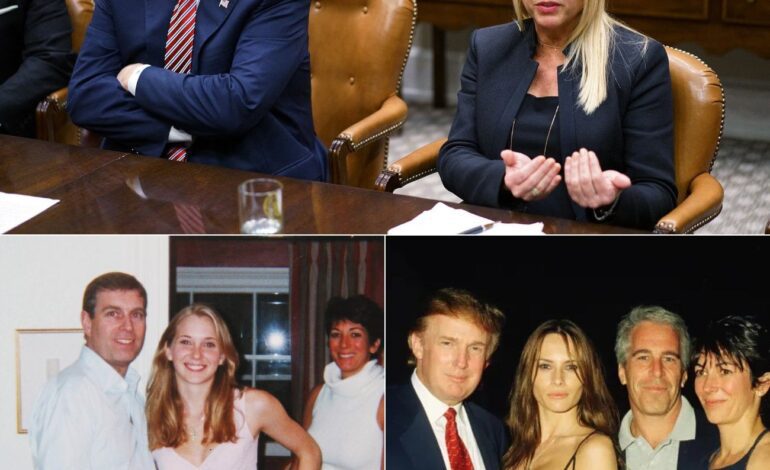

Washington, D.C. is no stranger to political controversy. But rarely does a scandal reach the level of intensity now surrounding Attorney General Pam Bondi and explosive accusations that she may have played a role in suppressing Department of Justice materials connected to the Jeffrey Epstein case. The allegations link Bondi to the broader Trump political network and have thrown the DOJ into serious turmoil. They have also reignited one of the most sensitive and deeply scrutinized cases in modern American legal history. As of March 26, 2026, no definitive proof has been made public. But the accusations have grown louder, more specific, and more politically charged with each passing day.
Who Is Pam Bondi and Why Is She at the Center of This?
Pam Bondi is the Attorney General of the United States. She was appointed to the role after a long career in Florida politics, where she served as Florida’s Attorney General from 2011 to 2019. That made her one of the most well-known Republican legal figures in the country long before she stepped into the nation’s top law enforcement role. Bondi has been a consistent and vocal supporter of Donald Trump throughout her public career. That loyalty is part of why she was selected for the position — and it is also part of why critics are now raising serious questions about whether her ties to Trump’s political network have compromised her ability to lead the DOJ impartially.
The accusations now facing Bondi are not about minor procedural errors or routine administrative decisions. They go to the core of what the Department of Justice is supposed to stand for. Critics claim she has been involved in slowing down, redirecting, or outright suppressing DOJ materials connected to the Jeffrey Epstein case. If true, those materials could potentially implicate powerful individuals with known ties to the Trump political orbit.
Bondi and her allies deny every aspect of these accusations. They describe the claims as entirely politically motivated — a coordinated effort by political opponents to damage her reputation and undermine the Trump administration by weaponizing the Epstein case. They argue the timing and framing of the accusations say more about the accusers than they do about Bondi.
The Jeffrey Epstein Case: Why It Refuses to Go Away
To fully understand why accusations involving the Epstein case carry so much explosive weight, it helps to understand what the case represents in the American public mind. Jeffrey Epstein was a wealthy financier who was charged with running a massive sex trafficking network that victimized dozens of underage girls over many years. He had connections to some of the most powerful people in the world — politicians, business leaders, celebrities, and foreign government officials — across both political parties and multiple countries.
Epstein died in a federal jail cell in August 2019. His death was officially ruled a suicide, but that ruling has been disputed by many people — including forensic experts, attorneys, and a significant portion of the public who found the official account difficult to accept. His death came just days after he was removed from suicide watch and just as the legal process was beginning to move toward a trial that could have brought many powerful names into public view.
Since his death, the case has never fully closed in the public mind. His longtime associate Ghislaine Maxwell was convicted in 2021 on sex trafficking and related charges. But the broader question of who else was involved — and whether powerful individuals have been quietly shielded from accountability — has remained open, unanswered, and intensely debated. Every new development tied to the Epstein case lands with enormous impact, sending ripples of public attention through politics, media, and institutional trust.
That is the charged environment in which the accusations against Bondi have emerged. They are not landing in a vacuum. They are landing after years of unanswered questions, years of frustration, and a public that has grown deeply suspicious of whether the most powerful people connected to Epstein will ever truly face justice.
What the Accusations Against Bondi Actually Claim
The specific accusations against Pam Bondi focus on the handling of DOJ documents and investigative materials connected to the Epstein case. Critics and legal observers claim that Bondi has been involved in decisions that have slowed the public release of key materials, narrowed the scope of active investigations, or redirected DOJ resources in ways that benefit individuals connected to the Trump power network who may have some form of exposure in the Epstein case.
These are not vague or abstract allegations. They suggest that any interference that occurred was deliberate — not the result of bureaucratic delays or resource limitations, but a conscious strategy to protect specific people from scrutiny they would otherwise face. If accurate, this would mean the nation’s highest-ranking law enforcement official was using her position to obstruct justice rather than deliver it. That is about as serious as accusations against a public official can get.
Legal experts who have weighed in on the situation are careful to draw a clear line between allegations and evidence. At this stage, no definitive proof has been made public. The accusations are built on a combination of circumstantial evidence, information from sources who have not been publicly named, and what critics describe as a visible pattern of behavior that, taken together, suggests something more troubling than coincidence. But circumstantial patterns and anonymous sources — while important in investigative journalism — are not the same as courtroom-ready proof.
That distinction matters enormously. Accusations of this type can cause significant damage even when unproven. They can destroy reputations, shake institutional confidence, and poison public trust in the legal system. That is precisely why the growing demand for a transparent and independent investigation is so important — not to assume guilt in advance, but to determine the actual truth in a setting that the public can believe in.
The Trump Power Network Connection: What Critics Are Saying
One of the most combustible elements of this controversy is the alleged connection between the Epstein cover-up accusations and the broader Trump political network. Critics argue that the DOJ under Bondi has displayed a consistent pattern of shielding individuals close to Donald Trump from serious scrutiny while aggressively pursuing his political opponents. They say the Epstein materials are especially sensitive because some of the names that reportedly appear in documents connected to the case are individuals with known or rumored connections to Trump’s political and social world.
It is critical to be precise about what has and has not been established here. Appearing in an Epstein-related document is not, by itself, evidence of criminal behavior. Epstein had an extremely wide social network that included people with no knowledge of or involvement in his criminal activities. The question critics are raising is not whether everyone connected to Epstein is guilty — it is whether the DOJ is applying the same legal standards to all names that appear in those documents, or whether some individuals are receiving a level of protection that others are not.
The suggestion that political loyalty could shape how the DOJ handles sensitive investigative materials corrodes public trust at a fundamental level. The Department of Justice is supposed to operate independently of political influence. Every decision about who gets investigated, who gets prosecuted, and what documents get released or withheld is supposed to rest on law and evidence alone — not on whether someone is an ally of the current administration. When that independence is credibly questioned, the damage goes deep.
Trump supporters have pushed back forcefully on this framing. They argue that the accusations against Bondi are themselves a form of political weaponization — that critics are using the emotional power of the Epstein case to attack the administration without the evidence to back up their claims. They say the pattern critics describe reflects the biases of the observers, not the conduct of the institution.
Calls for an Independent Investigation Are Getting Louder
As the controversy has built in intensity, calls for an independent and bipartisan investigation into the DOJ’s handling of Epstein-related materials have become impossible to ignore. Transparency advocates argue that the only way to restore credible public confidence in the justice system — whatever an investigation might ultimately find — is to conduct a thorough, genuinely independent review by people with no stake in the outcome.
The core argument for independence rests on a simple and widely accepted principle: an institution cannot credibly investigate itself on questions this sensitive. If the DOJ investigates its own leadership over potential cover-up accusations, the process will be seen — fairly or not — as compromised from the beginning. Only a review conducted by parties who have no political or institutional connection to the people and decisions being examined can produce findings that the public will actually believe.
Members of Congress on both sides of the aisle have been pressed to respond. Some have called for formal hearings. Others have expressed concern without committing to specific action. The political calculation is difficult — no politician wants to appear to be either enabling a cover-up or exploiting a serious legal matter for short-term partisan advantage. But the calls for accountability are not fading, and the silence of those with the power to act is itself becoming part of the public conversation.
Legal watchdog organizations and civil liberties groups have also begun taking formal action — filing Freedom of Information Act requests for documents, urging courts to consider whether DOJ conduct around the Epstein case warrants judicial oversight, and publicly documenting what has and has not been released. These efforts move more slowly than political investigations but tend to produce more durable and legally binding results.
What This Does to the DOJ’s Credibility
The Department of Justice draws its authority from two sources: the legal powers granted to it by law, and the public trust that makes those powers meaningful. When people believe the DOJ is fair — that it applies the law equally regardless of wealth, political connections, or party affiliation — its authority carries real weight. When that belief erodes, the damage to the institution goes far beyond any single case.
The accusations against Bondi, proven or not, are already affecting how Americans perceive the DOJ. Trust in federal institutions has been falling for years across the political spectrum. A controversy of this scale — involving the nation’s top law enforcement official and one of the most emotionally loaded cases in recent memory — accelerates that decline. It gives people who already distrust institutions new reason to distrust them, and it gives people who want to preserve institutional confidence very little to work with.
Legal scholars note that the most dangerous outcome here is not that Bondi is found guilty of wrongdoing. The most dangerous outcome is that the accusations are never properly investigated and simply become another unresolved chapter in the long and complicated story of Jeffrey Epstein’s connections to power. When credible accusations go unaddressed, they do not disappear. They calcify into a permanent layer of public cynicism.
Trust, once lost, takes a very long time to rebuild. The DOJ’s ability to function as an effective law enforcement institution — to investigate serious crimes, hold wrongdoers accountable, and serve the public interest — depends on a foundation of public belief that it is actually doing those things honestly. That foundation is under strain right now in a way that demands a serious, transparent, and credible response.
The Deeper Question: Equal Justice or Justice for the Powerful?
Underneath the specific details of the Bondi accusations and the specific history of the Epstein case lies a question that goes to the heart of what the American legal system is supposed to be: does justice work equally for everyone, regardless of power?
The honest answer has never been a simple yes. The American justice system has always carried structural disparities — in how the law is applied across racial lines, economic lines, and lines of political connection. Those disparities are extensively documented and have been the subject of decades of advocacy, litigation, and public debate. They are not a secret, and they are not new.
What makes the current moment feel different to many observers is the level and visibility of the institutions involved. When accusations of unequal treatment reach the Attorney General of the United States — when they center on one of the most watched and politically sensitive cases in the country — they raise the possibility that the problem is not a failure at the edges of the system but a feature of how justice is administered at its very top.
That is an uncomfortable possibility. It requires confronting something that democratic societies generally prefer to avoid looking at directly: that the most powerful are often protected not by any single corrupt act but by a web of relationships, loyalties, and informal understandings that works quietly alongside the formal legal structure. This is what critics mean when they describe a power network. They are not necessarily describing a visible conspiracy. They are describing something more mundane and more insidious — the way that proximity to power creates layers of protection that ordinary citizens simply do not have access to.
What Comes Next: The Path Forward in 2026
As of late March 2026, the accusations against Pam Bondi remain serious, public, and unresolved. They are not going to disappear quietly. Too many people — legal advocates, investigative journalists, congressional members, transparency organizations, and members of the public — are watching this story too closely for it to simply fade out of the news cycle without some form of meaningful accountability or clarification.
Several paths forward remain open. Congress could convene oversight hearings and put Bondi and senior DOJ officials on the record under oath. Courts could order the release of documents that have been withheld. Whistleblowers inside the DOJ, if any have direct knowledge of the conduct in question, could choose to come forward through legal whistleblower protection channels. Investigative journalists could continue building the story with more documented sourcing. Any or all of these paths could produce new information that either substantiates or refutes the accusations.
What is not in doubt is the scale of the public demand for answers. Americans have been waiting for real transparency on the Epstein case since 2019. Every delay, every redacted document, every instance of apparent protection for powerful individuals has added to a frustration that has now reached a new peak with the accusations against Bondi. The demand for accountability is real, it is broad, and it crosses political lines in a way that few issues do.
In the end, this story is about something larger than any one individual. It is about whether the foundational promise of American democracy — equal justice under the law — is truly operational or merely decorative. It is about whether the people entrusted with the most powerful legal offices in the country are willing to apply the rules honestly, even when doing so creates political discomfort for themselves and their allies. That is the question. And the country is watching for the answer.
Discover more from MatterDigest
Subscribe to get the latest posts sent to your email.