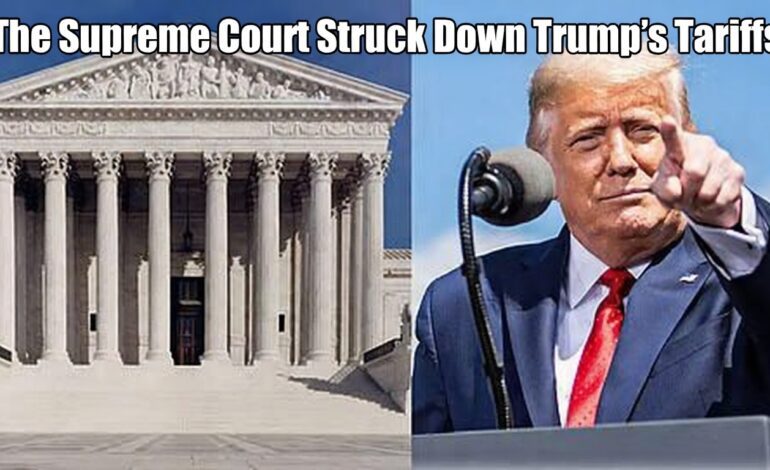
The Supreme Court Struck Down Trump’s Tariffs — Then He Raised Them Anyway. Here’s What That Means for Your Money

|
A federal court said the tariffs were illegal. The administration raised them anyway. If you’re confused, you’re not alone — and the confusion is costing you real money every single day.
This guide breaks down everything: what the court actually ruled, how the White House responded, which products are getting more expensive, and — most importantly — practical steps you can take to protect your budget and investments.
1. What the Supreme Court Actually Ruled
In a landmark decision, the U.S. Court of International Trade ruled that the Trump administration’s use of the International Emergency Economic Powers Act (IEEPA) to impose sweeping tariffs exceeded its legal authority. The court found that the president cannot unilaterally declare a trade “emergency” and use it as a blank check to tax imports without Congressional authorization.
The ruling was significant. It called into question tariffs affecting roughly $2.4 trillion worth of goods imported into the United States annually. Legal scholars on both sides of the aisle called it one of the most consequential trade rulings in decades.
|
What the Court Did NOT Say
The court did not ban all tariffs. It did not say the president has zero authority over trade policy. What it said is that the specific mechanism used — invoking national emergency powers to impose economy-wide tariffs without congressional approval — crossed a constitutional line.
That distinction matters enormously for what happened next.
2. Why Tariffs Went Up Anyway: The Legal Chess Game
Here’s where it gets complicated — and frustrating for consumers.
The administration did three things almost simultaneously after the ruling:
- Filed an immediate appeal, which automatically stayed (paused) the lower court’s order
- Invoked a separate legal authority — Section 232 of the Trade Expansion Act — to justify tariffs on national security grounds
- Announced a new, higher round of tariffs framed as a “response to retaliatory measures” by trading partners
The result? While lawyers argued in courtrooms, prices at the register kept climbing. The legal machinery of the U.S. government moves slowly. Markets and supply chains don’t wait.
|
The Section 232 Workaround Explained
Section 232, passed in 1962, gives the president broad power to restrict imports that threaten national security. It has been used to justify tariffs on steel and aluminum since 2018. By pivoting to this authority, the administration created a parallel tariff framework that the IEEPA ruling doesn’t directly touch.
Critics argue this is executive overreach dressed up in different legal clothing. Supporters say it’s a legitimate use of longstanding statutory authority. The courts will likely weigh in again — but that process could take another 18 to 24 months.
3. How This Hits Your Wallet Right Now
Let’s cut straight to the personal finance impact. Tariffs are, at their core, a tax. Businesses importing goods pay the tariff to U.S. Customs, and they pass most — not all — of that cost on to consumers through higher prices.
Research from economists at the Federal Reserve Bank of New York and Columbia University found that roughly 100% of the cost of tariffs imposed during the 2018–2019 trade war was passed on to American consumers and businesses — not absorbed by foreign exporters.
Everyday Price Increases You’re Already Seeing
- Electronics: Laptops, smartphones, and TVs face 15–25% tariff surcharges on components. A $1,200 laptop could cost $200–$300 more than it did in 2022.
- Appliances: Washing machines, dryers, and refrigerators have seen cumulative price increases of 12–18% since 2018.
- Clothing and Footwear: Most apparel is imported. Tariffs on Chinese-made goods specifically have added $10–$40 per item for shoes and $5–$25 per clothing piece.
- Groceries: Specialty imports, olive oil, wine, cheese, and canned goods from Europe carry additional tariffs in some categories.
- Automobiles: New vehicles face supply chain cost increases from steel, aluminum, and parts tariffs. The average new car costs roughly $3,000 more than pre-tariff levels, per Anderson Economic Group estimates.
Price Impact Summary by Category
| Product Category | Tariff Rate (2025) | Estimated Price Increase | Who Pays Most |
| Consumer Electronics | 7.5–25% | $100–$400 per item | Middle-income buyers |
| Vehicles & Auto Parts | 25% (steel/aluminum) | $1,500–$4,000 per car | All car buyers |
| Clothing & Footwear | 12–25% | $5–$60 per item | Budget shoppers |
| Home Appliances | 10–25% | $50–$500 per appliance | Homeowners |
| Industrial Machinery | 7.5–25% | Varies widely | Small businesses |
| Agricultural Products | Reciprocal/variable | 5–15% on select items | Rural consumers |
4. Product Categories Most Affected by Tariff Increases
Electronics and Technology
The U.S. relies on imports for roughly 93% of consumer electronics components. When tariffs on Chinese goods hit 145% at their peak in early 2025, that’s not a typo — one hundred and forty-five percent. Even after some rollbacks negotiated in the U.S.-China trade pause, rates remain at historically elevated levels.
If you’re planning to buy a new phone, laptop, or TV, buying sooner rather than later could save you money. Manufacturers have warned that another round of price increases is coming as current inventory is depleted.
The Auto Industry: A Special Case
Cars deserve their own section because the tariff impact is so large and so personal. The 25% tariff on imported vehicles affects roughly half of all cars sold in the U.S. The domestic production tariffs on steel and aluminum add costs even to American-made vehicles.
Cox Automotive reported that average new vehicle transaction prices hit record highs in 2025, with tariffs cited as a key driver. Used car prices are rising in tandem as buyers shift away from new vehicles.
|
Groceries and Food Prices
Most food consumed in the U.S. is domestically produced, so the direct tariff impact on groceries is smaller than for electronics. However, several categories are meaningfully affected: canned goods, olive oil, wine, cheese (especially European), coffee, and certain fresh produce.
The indirect impact is larger. Farming equipment, fertilizer inputs, and packaging materials all face higher tariff-related costs, and farmers and food processors pass those along. The USDA estimates food-at-home prices have risen 2–3% more than baseline inflation due to trade-related cost pressures.
5. What the Tariff Timeline Looks Like (2025–2026)
| Date | Event | Consumer Impact |
| Jan 2025 | IEEPA tariffs expand to 10% baseline on most imports | Broad price increases begin |
| Mar 2025 | Tariffs on Chinese goods raised to 145% | Electronics, toys surge in price |
| Apr 2025 | Court rules IEEPA tariff use unlawful | Markets rally briefly |
| Apr 2025 | Admin files appeal; stay issued | Tariffs remain in effect |
| May 2025 | U.S.-China 90-day trade truce; rates cut to ~30% | Some relief on Chinese goods |
| Jun 2025 | Section 232 tariffs expanded to more categories | New price increases in several sectors |
| Late 2025 | Appeals court expected to rule | Outcome uncertain; high stakes |
| 2026 | Possible Supreme Court review | Long-term tariff framework at stake |
6. How Tariffs Affect Inflation and Interest Rates
This is where tariff policy intersects with your mortgage, your car loan, and your credit card interest rate — and it’s critically important to understand.
The Inflation Connection
Tariffs are inflationary. They raise the price of imported goods directly, and they raise prices of domestically produced goods indirectly (by reducing competition). The Federal Reserve’s preferred inflation measure, core PCE, has remained stubbornly above the 2% target partly due to tariff-driven price pressures.
The IMF estimated in April 2025 that the tariff regime as structured could add 0.5–1.0 percentage points to U.S. inflation annually. That might sound small, but at scale — across your rent, your groceries, your insurance, your utilities — it compounds painfully.
What This Means for the Fed and Interest Rates
The Federal Reserve wants to cut interest rates. High interest rates slow the economy, weigh on the housing market, and increase the burden on borrowers. But the Fed can’t cut rates aggressively if inflation keeps running hot — and tariffs keep inflation running hot.
Translation for regular people: You may be waiting longer for mortgage rates to come down. The 30-year fixed mortgage rate, which peaked above 8% in 2023, could stay elevated longer than it otherwise would because of tariff-driven inflation.
|
7. Impact on Your Investments and Retirement Accounts
Stock Market Volatility
Markets hate uncertainty. The whipsaw between tariff announcements, court rulings, appeals, and trade negotiation headlines has contributed to significant stock market volatility in 2025. The S&P 500 fell more than 15% at its April 2025 low before partially recovering on the U.S.-China trade truce news.
If you’re close to retirement or have a shorter investment horizon, this volatility matters more to you than if you’re 30 years from retirement. Sequence-of-returns risk — the danger of a major downturn early in retirement — is a real concern in this environment.
Sector-Specific Impacts
- Manufacturing stocks: Mixed — domestic manufacturers benefit from protection but face higher input costs
- Retail stocks: Generally negative — higher import costs squeeze margins
- Technology stocks: Particularly vulnerable due to global supply chains
- Agricultural stocks: Complex — some benefit from domestic demand shifts, others hurt by retaliatory tariffs on exports
- Financial stocks: Sensitive to interest rate expectations; tariff-driven inflation complicates the picture
Your 401(k) and IRA
If you have a diversified portfolio — which you should — you’re exposed to both the upside and downside of tariff policy. International funds may face headwinds from retaliatory tariffs. Domestic bond funds may face pressure from sticky inflation. Cash becomes relatively more valuable when rates stay high.
The honest answer is: don’t panic, but don’t be complacent. Review your allocation, make sure you’re diversified, and consider talking to a fee-only financial advisor if tariff-driven uncertainty is keeping you up at night.
8. Practical Steps to Protect Your Money
Immediate Actions (This Week)
- Audit your major upcoming purchases. Anything made significantly from imported components — appliances, electronics, vehicles — may be cheaper now than in 3–6 months.
- Check your emergency fund. Economic uncertainty from trade disruptions can affect employment. Three to six months of expenses in liquid savings is the baseline recommendation.
- Review subscription and recurring costs. Tariff-driven inflation strains the whole budget. Trimming discretionary spending frees up cash for higher-priority items.
- Lock in fixed-rate debt if possible. If you’re carrying variable-rate debt and rates stay high due to tariff-driven inflation, refinancing to fixed terms could save you significantly.
Medium-Term Financial Strategy (Next 6–12 Months)
- Diversify investments across geographies and asset classes. Don’t be overweight in sectors most exposed to tariff disruption.
- Consider I-bonds or TIPS for a portion of savings. These inflation-protected securities can be a hedge if tariff-driven inflation persists.
- If you’re a small business owner, review your supply chain. Identify alternative suppliers in countries with lower tariff exposure. This takes time, so start now.
- Watch the appeals court ruling closely. A reversal of the lower court’s decision — or an affirmation — will have immediate market implications.
What NOT to Do
- Don’t hoard goods irrationally. Stockpiling isn’t a viable personal finance strategy and creates its own costs.
- Don’t make dramatic investment changes based on daily tariff headlines. Volatility is high; knee-jerk reactions typically hurt long-term returns.
- Don’t assume prices will normalize quickly even if courts strike down tariffs. Supply chains take time to adjust. Price relief, when it comes, arrives slowly.
9. FAQs: Your Top Questions Answered
Can a court actually stop the president from imposing tariffs?
Yes and no. Courts can rule that a specific legal mechanism for imposing tariffs is unconstitutional. But the president has multiple avenues to impose tariffs — through different statutes, through bilateral agreements, through retaliatory trade actions. A court can close one door; the administration can try others.
Will prices come down if the tariffs are ultimately struck down?
Probably not immediately, and not entirely. Businesses that raised prices don’t typically lower them aggressively when cost pressures ease. Competition can drive prices down over time, but the process is slow. Economists call this “price stickiness,” and it’s well-documented.
Are tariffs ever good for the economy?
This is genuinely debated. Tariffs can protect strategic industries and domestic jobs in specific sectors. The economic consensus, however, is that broad, across-the-board tariffs tend to reduce overall economic efficiency, raise consumer prices, and invite retaliation that hurts exporters. The net effect on jobs is typically negative, even as some sectors gain protection.
What’s the difference between tariffs and sanctions?
Tariffs are taxes on imported goods. Sanctions are broader economic restrictions — they can include asset freezes, trade bans, and financial restrictions targeting specific countries, entities, or individuals. Tariffs affect all importers of a product; sanctions are typically targeted and punitive.
How do retaliatory tariffs affect American workers?
When countries like China, the EU, or Canada impose retaliatory tariffs on American exports, U.S. farmers, manufacturers, and exporters bear the brunt. American farmers in particular were significantly impacted during the 2018–2019 trade war when China targeted soybeans, pork, and other agricultural products. The government ended up paying billions in agricultural subsidies to offset that damage.
10. Key Takeaways
|
- Tariffs are effectively a tax paid by American importers and consumers, not by foreign countries
- Price increases are already baked in across electronics, vehicles, appliances, and some food categories
- Tariff-driven inflation is a key reason the Federal Reserve has been slow to cut interest rates — which affects your mortgage, auto loan, and savings account
- Even if courts ultimately strike down current tariff mechanisms, price relief will be slow to arrive
- The most protective financial moves: maintain an emergency fund, review large purchase timing, diversify investments, and avoid knee-jerk portfolio changes
|
About the Author
This article was written by the editorial team at [Your Publication], with research support from trade economists and certified financial planners. Our financial policy coverage draws on primary sources including court documents, Federal Reserve publications, U.S. Trade Representative briefings, and peer-reviewed economic research. We do not accept compensation from financial product companies and operate without advertiser influence on editorial content.
Sources & Further Reading
- U.S. Court of International Trade — IEEPA Tariff Ruling, April 2025 | www.cit.uscourts.gov
- Federal Reserve Bank of New York — “The Impact of the 2018 Tariffs on Prices and Welfare” | www.newyorkfed.org
- International Monetary Fund — World Economic Outlook, April 2025 | www.imf.org/en/publications
- Anderson Economic Group — Automotive Tariff Impact Analysis, 2025 | www.andersoneconomicgroup.com
Discover more from MatterDigest
Subscribe to get the latest posts sent to your email.