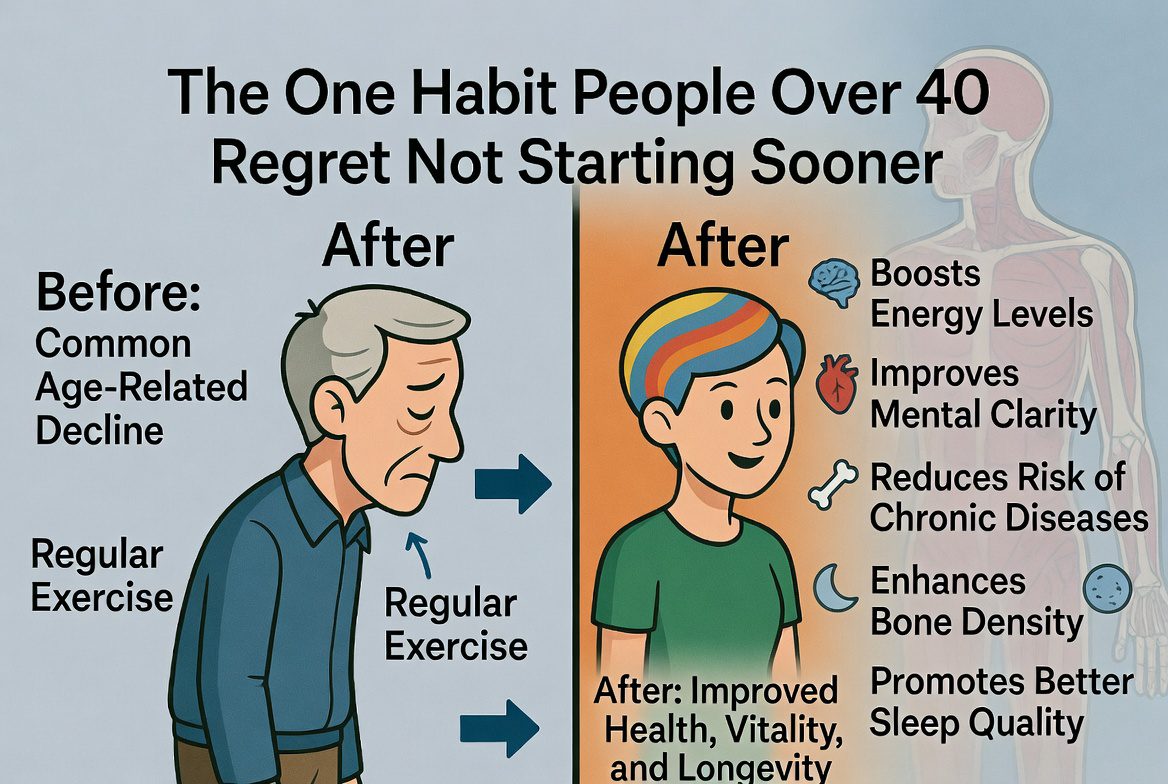
The One Habit People Over 40 Regret Not Starting Sooner

Backed by science. Proven by thousands. You can start today.
The Wake-Up Call Nobody Talks About
You hit 40. Maybe 45. Maybe 52.
And somewhere between the stiff mornings, the slower metabolism, and the realization that climbing stairs winds you more than it used to — it hits you.
Why didn’t I start sooner?
It’s one of the most common regrets people share when asked about their health in midlife. Not that they didn’t travel more. Not that they didn’t work less. The regret is almost always physical — a body that feels like it’s quietly betraying them.
But here’s the good news: the habit most people over 40 wish they’d started earlier? You can start it today. And the science says it’s never too late.
This article will walk you through exactly what that habit is, why it matters so much after 40, and how to begin — even if you’ve never done it before.
So, What Is the Habit?
Strength training. Also called resistance training, weight lifting, or muscle-building exercise.
That’s it. No complicated supplement stack. No expensive biohacking gadget. Just the consistent practice of working your muscles against resistance — whether that’s dumbbells, barbells, resistance bands, or even your own bodyweight.
Study after study, and thousands of personal testimonials, point to the same conclusion: people who build this habit early live longer, feel better, and age with far more independence and vitality than those who don’t.
|
Why Strength Training? The Science Is Undeniable
Let’s get real for a second. If you’re skeptical — if strength training feels like something for 25-year-olds with gym selfies — the data will change your mind.
Here’s What the Research Shows:
- A 2022 study in the British Journal of Sports Medicine found that muscle-strengthening activities reduced all-cause mortality risk by 10–17%, cardiovascular disease by 17%, and cancer by 12%.
- The American College of Sports Medicine recommends strength training at least twice per week for adults over 40 as a cornerstone of healthy aging.
- Harvard Health research confirms that adults lose 3–8% of muscle mass per decade after age 30 — and that rate accelerates after 60 if nothing is done.
That last stat is the quiet villain of midlife health. It’s called sarcopenia — the gradual loss of muscle tissue. And most people don’t even know it’s happening until they feel it.
What Happens to Your Body After 40 (Without It)
Think of your muscles like a savings account. In your 20s and 30s, you’re (hopefully) putting deposits in. After 40, if you’re not actively maintaining that account, withdrawals start happening automatically — whether you want them to or not.
Without regular strength training after 40, here’s what typically unfolds:
Muscle loss accelerates. You lose strength, which makes everyday tasks harder — carrying groceries, playing with kids, getting up from the floor.
Metabolism slows. Muscle is metabolically active tissue. Less muscle means fewer calories burned at rest, making weight gain easier and weight loss harder.
Bone density declines. Weight-bearing resistance exercise is one of the few proven ways to slow — and even reverse — bone loss. This matters enormously for osteoporosis risk, especially for women post-menopause.
Insulin sensitivity drops. Muscle tissue is the body’s primary glucose disposal site. Less muscle means your body handles blood sugar less efficiently, raising the risk of type 2 diabetes.
Balance and coordination suffer. Weak muscles contribute to falls, which are the leading cause of injury-related death in adults over 65, according to the CDC.
It’s a cascade. And it starts silently, well before most people notice.
The Regret Is Real — Here’s What People Say
Talk to anyone in their 50s or 60s who discovered strength training late, and they’ll almost always say some version of the same thing.
|
Personal trainers who work with older adults consistently report that their clients’ biggest regret isn’t starting too early or pushing too hard. It’s waiting.
Dr. Gabrielle Lyon, a physician specializing in muscle-centric medicine and author of Forever Strong, puts it bluntly: muscle is the organ of longevity. Protecting and building it isn’t vanity — it’s medicine.
This isn’t about looking like an athlete. It’s about being able to live independently, move without pain, and stay vital well into your 70s, 80s, and beyond.
How to Start Strength Training After 40 (Step-by-Step)
Starting is the hardest part. Here’s a clear, beginner-friendly roadmap.
Step 1: Get a Quick Health Check
If you have any existing conditions — heart issues, joint problems, osteoporosis — talk to your doctor first. Most people get a clean green light. But it’s worth the 10-minute conversation.
Step 2: Choose Your Format
You have more options than you might think:
- Gym with free weights or machines — great for structure and progression
- Home workouts with dumbbells or resistance bands — convenient and surprisingly effective
- Bodyweight training — push-ups, squats, lunges — perfect for complete beginners
For most beginners over 40, starting with 2 sessions per week is plenty. You’re not trying to become a bodybuilder. You’re trying to reverse a physiological trend.
Step 3: Learn the Foundational Movements
Focus on these five compound movements — they work multiple muscle groups at once:
- Squat (or chair squat for beginners)
- Hinge (deadlift, Romanian deadlift, or hip hinge)
- Push (push-up, dumbbell press)
- Pull (dumbbell row, lat pulldown, resistance band row)
- Carry (farmer’s carry with dumbbells)
Step 4: Start Light, Focus on Form
Ego is the enemy here. Start lighter than you think you need to. Perfect your form before adding weight. Injuries are the #1 reason people over 40 quit — and most are avoidable.
Step 5: Progress Gradually
Every 1–2 weeks, aim to add a little more weight or one more rep. This principle — called progressive overload — is what drives results. Without it, you’ll plateau quickly.
Step 6: Prioritize Recovery
After 40, recovery matters more. Aim for:
- 7–9 hours of sleep per night
- Protein intake of 0.7–1g per pound of bodyweight daily (research supports the higher end for older adults)
- Rest days between sessions targeting the same muscle group
Common Mistakes People Over 40 Make
Knowing what not to do saves you months of wasted effort.
Skipping warm-up. Cold muscles and connective tissue are far more injury-prone after 40. Spend 5–10 minutes warming up. Always.
Going too hard, too fast. The ‘all or nothing’ trap is real. Three brutal workouts in week one, followed by injury and a six-week break, helps no one. Consistency over intensity.
Ignoring protein. Most people over 40 are eating far less protein than they need to actually build or maintain muscle. If you’re not tracking, you’re probably under-eating it.
Only doing cardio. Cardio is wonderful. But it doesn’t build muscle. It doesn’t prevent sarcopenia. You need both — but strength training gives you more return on investment after 40.
Comparing yourself to your 25-year-old self. Your progress is your progress. The goal isn’t impressive — it’s consistent.
How Long Before You See Results?
Here’s what a realistic timeline looks like for someone starting strength training after 40:
| Timeframe | What to Expect |
| Weeks 1–2 | Soreness, learning movements, neural adaptations begin |
| Weeks 3–6 | Noticeable strength gains as your nervous system adapts quickly |
| Months 2–3 | Visible muscle tone changes, improved energy levels |
| Months 3–6 | Meaningful muscle growth, metabolic improvements |
| 6–12 months | Significant body composition change, functional strength |
The first gains you’ll notice won’t even be visual — they’ll be functional. Stairs feel easier. You carry things without strain. You sleep better. Your mood lifts. That’s real. That’s what keeps people going.
Strength Training vs. Cardio After 40 — Which Wins?
This is one of the most-searched questions for adults in midlife. Here’s the straight answer.
For longevity and healthy aging: Strength training edges ahead. It preserves muscle, protects bones, and improves metabolic health in ways cardio alone cannot.
For heart health and mental health: Cardio has unique benefits that shouldn’t be abandoned.
The real winner: Both. But if you’ve been doing only cardio for years and skipping resistance training, adding strength work will likely produce more noticeable improvements in how you look, feel, and function after 40.
Think of cardio as your heart’s workout. Think of strength training as your body’s structural maintenance plan.
Frequently Asked Questions
Is it safe to start lifting weights after 40?
Yes — for most people, it’s not only safe but recommended by virtually every major health organization. Starting with lighter weights and proper form dramatically reduces injury risk. A brief consultation with your doctor is a sensible first step if you have existing health conditions.
Can you build muscle after 40?
Absolutely. Muscle building after 40 is slower than in your 20s, but it’s very real and well-documented. Research shows adults in their 60s, 70s, and even 80s can build meaningful muscle with consistent training and adequate protein.
How often should I strength train after 40?
Two to three sessions per week is the sweet spot for most beginners and intermediates over 40. This allows for adequate stimulus and adequate recovery — both of which matter more as you age.
Do I need a gym to start?
No. Resistance bands, dumbbells, and bodyweight exercises done at home are genuinely effective, especially for beginners. The gym offers more equipment variety, but it’s not a requirement to get started.
What if I have joint pain or arthritis?
Many people with joint pain actually find that strength training reduces their discomfort over time by strengthening the muscles that support affected joints. Work with a physical therapist or certified trainer experienced with older adults to find appropriate modifications.
Your Next Step Starts Today
Here’s the truth no one wants to say but everyone needs to hear: the best time to start was 10 years ago. The second best time is right now.
Strength training isn’t about transforming into an athlete. It’s about keeping the life you have — staying mobile, independent, energetic, and pain-free for as many decades as possible.
The people who look back at 60 or 70 with the most pride aren’t the ones who trained the hardest. They’re the ones who started — and kept going.
| YOUR ACTION STEP
Your action step this week: Do one 20-minute beginner strength workout. Just one. Bodyweight squats, push-ups (modified if needed), and a dumbbell row. That’s your start. You don’t need to be ready. You just need to begin. |
Authoritative Sources & Further Reading
- American College of Sports Medicine — Resistance Training Guidelines: https://www.acsm.org
- National Institute on Aging — Exercise & Physical Activity: https://www.nia.nih.gov
- British Journal of Sports Medicine — Muscle Strengthening & Mortality: https://bjsm.bmj.com
- Harvard Health — Sarcopenia and Aging: https://www.health.harvard.edu
- CDC — Falls Prevention in Older Adults: https://www.cdc.gov/falls
Discover more from MatterDigest
Subscribe to get the latest posts sent to your email.