The Government Just Put Bitcoin in Its Vault Should You Do the Same?
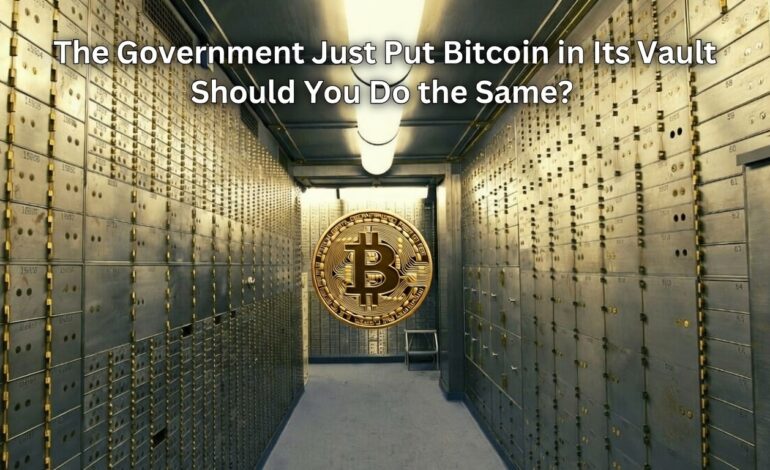

The Government Just Put Bitcoin in Its Vault. Should You Do the Same?
Imagine waking up to a headline that reads: ‘The United States Government Now Holds Bitcoin as a National Reserve Asset.’ A few years ago, that would have sounded like a conspiracy theory. Today, it is official policy.
In March 2025, President Donald Trump signed an executive order establishing the United States Strategic Bitcoin Reserve (SBR). The government stopped selling seized Bitcoin and began treating it like digital gold — a long-term store of value held on behalf of the American people.
That is a seismic shift. And it raises one very natural question for every investor: if the most powerful government in the world is buying and holding Bitcoin, should I be doing the same?
This guide breaks it all down — no jargon, no hype, no agenda. You will understand exactly what happened, why it happened, what it means for markets, and how to think clearly about your own financial decisions.
|
1. The Big News: What Actually Happened?
Let’s start with the facts. Here is a concise timeline of how we got here.
| Date | Event |
| January 2025 | President Trump signs executive order pausing all U.S. government Bitcoin sales, pending a policy review. |
| March 6, 2025 | Trump signs the formal order creating the Strategic Bitcoin Reserve and a separate Digital Asset Stockpile. |
| March 2025 | The U.S. Treasury confirms the government holds approximately 200,000 BTC — worth roughly $17–20 billion at the time. |
| March–April 2025 | Several U.S. states introduce legislation to create their own state-level Bitcoin reserves. |
| May–Dec 2025 | Other nations accelerate discussions about national Bitcoin strategies in response to U.S. action. |
| February 2026 | The Strategic Bitcoin Reserve remains active; no BTC has been sold; Bitcoin trades above $90,000. |
The government did not buy Bitcoin with taxpayer money — at least not initially. The reserve is built from Bitcoin that was already seized during criminal investigations (think Silk Road, hacks, fraud cases). The U.S. government had been auctioning this Bitcoin off for years, often at a fraction of its later value. The new policy says: stop selling. Hold it.
The White House also created a separate ‘Digital Asset Stockpile’ for other cryptocurrencies (Ethereum, Solana, XRP, Cardano) seized in forfeitures. However, the Strategic Bitcoin Reserve specifically applies only to Bitcoin — a deliberate signal about BTC’s unique status.
2. What Is a Strategic Bitcoin Reserve?
A ‘strategic reserve’ is a stockpile of a valuable asset that a government holds for long-term national security or economic stability purposes. The United States already maintains strategic reserves of oil (the Strategic Petroleum Reserve), gold (held at Fort Knox), and foreign currencies.
Now, Bitcoin joins that list. But what makes Bitcoin special enough to sit alongside gold and oil?
Bitcoin’s Core Properties as a Reserve Asset
- Scarcity — Only 21 million Bitcoin will ever exist. This is hardcoded into the protocol and cannot be changed by any government or company.
- Decentralization — No single entity controls Bitcoin. Not the U.S. government, not any corporation.
- Verifiability — Any Bitcoin transaction can be independently verified on the public blockchain.
- Portability — Billions of dollars of Bitcoin can be transferred anywhere in the world in minutes, with no intermediary.
- Censorship Resistance — Bitcoin cannot be frozen, confiscated, or blocked by traditional financial systems once properly secured.
These properties make Bitcoin fundamentally different from cash (which can be printed), gold (which is heavy and expensive to audit), or foreign currency (which is controlled by another government).
|
3. Why Did the Government Do This?
Four powerful forces pushed the U.S. government toward this decision. Understanding them helps you see whether this is a one-time policy quirk or the start of a lasting trend.
Reason 1: Dollar Dominance Is Under Pressure
The U.S. dollar’s status as the world’s reserve currency is one of America’s greatest economic advantages. But the BRICS nations (Brazil, Russia, India, China, South Africa — plus new members) have been working for years to reduce dependence on the dollar. Some economists argue that holding Bitcoin is a way for the U.S. to maintain financial relevance in a world where digital assets are increasingly important.
Reason 2: The Government Was Sitting on a Fortune — and Selling Cheap
Between 2014 and 2023, the U.S. government auctioned off more than 185,000 Bitcoin. Much of it was sold at prices ranging from $300 to $10,000. By 2024, Bitcoin had surpassed $70,000. Senator Cynthia Lummis, one of the architects of the Bitcoin reserve idea, calculated that these early sales cost American taxpayers billions of dollars in lost value.
Reason 3: Political Will and Bipartisan Interest
Bitcoin has earned genuine bipartisan support in Washington. Figures ranging from Senator Lummis (Republican) to Robert F. Kennedy Jr. (Independent) have publicly advocated for a national Bitcoin reserve. The 2024 election cycle saw more pro-Bitcoin candidates than any previous cycle in U.S. history.
Reason 4: The Institutional Flood Has Already Begun
By the time the executive order was signed, institutional adoption had already reached a tipping point. BlackRock’s Bitcoin ETF (IBIT) had accumulated over 500,000 BTC. MicroStrategy held more than 400,000 BTC on its corporate balance sheet. The government’s move was, in many ways, catching up to what major institutions had already done.
4. What Does This Mean for Bitcoin’s Price?
This is the question everyone wants answered. Let’s be clear about what we know and what is uncertain.
The Supply Shock Argument
Bitcoin’s total supply is capped at 21 million coins. Roughly 19.8 million have already been mined. If governments and large institutions are buying and holding — refusing to sell — the available supply shrinks. Basic economics: when supply falls and demand holds steady or rises, prices go up.
Senator Lummis’s Bitcoin Act proposes that the U.S. government eventually acquire 1 million Bitcoin over five years. If passed, that would represent roughly 5% of all Bitcoin that will ever exist — purchased by a single buyer.
Historical Price Context
| Year | BTC Price (Approx.) | Key Driver |
| 2017 | $20,000 peak | Retail speculation, ICO boom |
| 2020 | $29,000 year-end | Institutional entry (MicroStrategy, PayPal) |
| 2021 | $69,000 peak | ETF speculation, DeFi growth |
| 2022 | $16,000 low | FTX collapse, macro tightening |
| 2024 | $73,000 peak | Bitcoin ETF approval (BlackRock, Fidelity) |
| 2025 | $106,000 peak | Strategic Bitcoin Reserve announcement, ETF inflows |
| Feb 2026 | $90,000+ range | SBR policy ongoing, global adoption expanding |
What Could Push Bitcoin Higher?
- More countries announce strategic Bitcoin reserves (El Salvador, Bhutan, and several others already hold BTC).
- S. Congress passes Senator Lummis’s Bitcoin Act, authorizing government purchases.
- Bitcoin ETF inflows continue to accelerate — BlackRock’s IBIT alone was pulling in $500M+ per day at peak.
- The Bitcoin halving in April 2024 cut new supply issuance in half; the full effect typically takes 12–18 months to materialize.
What Could Push Bitcoin Lower?
- Regulatory crackdowns in major economies.
- A severe global recession reducing risk appetite.
- A major security exploit or protocol-level failure (considered extremely unlikely but worth noting).
- Government policy reversal after a change in administration.
|
5. Should Individual Investors Follow the Government’s Lead?
Here is the honest answer: it depends entirely on your financial situation, goals, and risk tolerance. But let’s think through this carefully.
The Case For Adding Bitcoin to Your Portfolio
Think about what the government’s decision actually signals. The United States Treasury — the most conservative financial institution in the world — decided that Bitcoin was worth holding rather than selling. That is a legitimacy signal unlike anything Bitcoin has received before.
Diversification is the cornerstone of modern portfolio theory. Adding an asset with low correlation to stocks and bonds can reduce your overall portfolio risk, even if the asset itself is volatile. Several academic studies published between 2021 and 2025 found that a 1–5% Bitcoin allocation actually improved risk-adjusted returns in traditional 60/40 portfolios.
The Case Against Rushing In
Bitcoin remains one of the most volatile assets in history. Drops of 50–80% have occurred multiple times. If you cannot stomach watching your investment fall by half — temporarily or permanently — Bitcoin is not right for you regardless of what governments are doing.
Additionally, the government’s reserve is built from seized assets, not purchased from tax revenue. The U.S. government is not betting its retirement savings on Bitcoin. You should not either — at least not an amount that would genuinely hurt you to lose.
The 1-5% Rule: A Starting Framework
| Portfolio Size | 1% Allocation | 3% Allocation | 5% Allocation |
| $25,000 | $250 | $750 | $1,250 |
| $100,000 | $1,000 | $3,000 | $5,000 |
| $250,000 | $2,500 | $7,500 | $12,500 |
| $500,000 | $5,000 | $15,000 | $25,000 |
| $1,000,000 | $10,000 | $30,000 | $50,000 |
Most financial advisors who are supportive of Bitcoin recommend starting at 1–3% of your total portfolio. This gives you meaningful exposure to the upside while keeping your risk contained. You can always increase the position over time as you become more comfortable.
|
Who Should Probably NOT Buy Bitcoin Right Now?
- Anyone with high-interest debt (credit cards, personal loans above 8%).
- Anyone without 3–6 months of emergency savings fully funded.
- Anyone within 5 years of retirement who cannot absorb significant portfolio volatility.
- Anyone who would panic-sell during a 40–60% drawdown.
6. How to Buy and Store Bitcoin Safely: A Step-by-Step Guide
If you have decided that Bitcoin makes sense for your situation, here is exactly how to get started safely.
Step 1: Choose a Reputable Exchange
For U.S. investors, regulated exchanges are the safest starting point. Look for exchanges that are registered with FinCEN, have FDIC-insured U.S. dollar accounts, carry SOC 2 compliance, and have a proven track record. Coinbase (publicly traded on NASDAQ), Kraken, and Fidelity Crypto are among the most widely trusted options as of early 2026.
Step 2: Complete Identity Verification (KYC)
Regulated exchanges require you to verify your identity. This typically takes 5–15 minutes and requires a government-issued ID and sometimes a selfie. This is a legal requirement, not optional.
Step 3: Fund Your Account
Connect your bank account via ACH transfer (cheapest, 3–5 business days) or use a debit card (faster, higher fees). Wire transfers are available for larger amounts. Start small — even $50 is a legitimate way to learn the process.
Step 4: Make Your Purchase
Bitcoin trades 24/7, unlike stock markets. You can buy a fraction of a Bitcoin — there is no requirement to buy a whole coin. One Bitcoin is divisible into 100 million units called ‘satoshis’ (or ‘sats’).
Step 5: Decide How to Store Your Bitcoin
| Storage Method | Security Level | Convenience | Best For |
| Exchange wallet | Medium | High | Beginners, small amounts (<$1,000) |
| Software wallet (app) | Medium-High | Medium | Regular users, medium amounts |
| Hardware wallet | Very High | Low | Long-term holders, larger amounts (>$5,000) |
| Multi-sig cold storage | Extremely High | Very Low | Institutions, very large amounts |
For amounts above $1,000–5,000, most security experts recommend a hardware wallet — a physical device (like a Ledger or Trezor) that keeps your private keys completely offline.
|
Step 6: Dollar-Cost Average (DCA)
Rather than investing a lump sum at once, consider buying a fixed dollar amount every week or month regardless of price. This strategy — dollar-cost averaging — reduces the impact of volatility and removes the temptation to try timing the market. It is the same principle behind 401(k) contributions.
7. Risks You Cannot Afford to Ignore
Any honest guide to Bitcoin must spend serious time on risk. Here are the major ones.
Volatility Risk
Bitcoin has lost 50–80% of its value in multiple drawdowns. Between November 2021 and November 2022, Bitcoin fell from $69,000 to $15,700 — a 77% drop. Investors who bought at the peak and panic-sold at the bottom crystallized massive losses. This will happen again in some form. The question is whether you can hold through it.
Regulatory Risk
While the current U.S. administration is pro-Bitcoin, future administrations might not be. Congress could pass restrictive legislation. Other major economies (China has already banned Bitcoin trading) could tighten restrictions, affecting global price and sentiment. Always invest knowing the rules could change.
Custody Risk
Losing access to your Bitcoin is a real and permanent risk. An estimated 3–4 million Bitcoin (roughly 15–20% of all coins mined) are considered permanently lost — forgotten passwords, damaged hardware, lost seed phrases. There is no bank to call. There is no password reset. Custody requires real responsibility.
Scam and Fraud Risk
The crypto space is rife with scams. Fake exchanges, phishing emails, impersonators, rug pulls, and ‘guaranteed return’ schemes have cost investors billions. The FBI reported $5.6 billion in cryptocurrency fraud losses in 2023 alone. Always verify you are on the correct website. Never share your seed phrase with anyone — for any reason.
Tax Risk
In the United States, Bitcoin is treated as property for tax purposes. Every sale, trade, or purchase using Bitcoin is a taxable event. You must track your cost basis. Failure to properly report gains can result in significant penalties. Use tax software like Koinly, TaxBit, or CoinTracker, or work with a CPA experienced in crypto taxation.
8. Bitcoin vs. Gold vs. Cash: The Strategic Reserve Showdown
How does Bitcoin actually compare to the traditional reserve assets governments have relied on for centuries?
| Property | Bitcoin | Gold | U.S. Dollars (Cash) |
| Supply limit | 21 million (hard cap) | Unknown (mining continues) | Unlimited (can be printed) |
| Portability | Excellent — global transfer in minutes | Poor — heavy, expensive to move | Excellent — digital transfer easy |
| Verifiability | Perfect — public blockchain | Difficult — requires assay testing | Good — established systems |
| Seizure resistance | High — with proper custody | Low — physically seizable | Low — accounts can be frozen |
| Inflation protection | Strong — fixed supply | Moderate — supply grows ~1.5%/year | Weak — supply grows without limit |
| Track record | 15 years | 5,000+ years | 250+ years (as fiat) |
| Volatility | High | Low-Medium | Low (vs. itself) |
| Yield/income | None (base layer) | None | Interest-bearing instruments |
No asset wins every category. Bitcoin’s strengths are its hard cap, portability, and censorship resistance. Gold’s strength is its multi-millennium track record and lower volatility. Cash’s strength is universal acceptance and stability for short-term needs. A balanced portfolio might include elements of all three.
9. What Experts and Economists Are Saying
The expert community remains divided, but the conversation has shifted dramatically.
Voices Bullish on the Strategic Reserve
- Senator Cynthia Lummis (R-WY): Has advocated for the U.S. to acquire up to 1 million Bitcoin over five years, arguing it would help reduce the national debt over time.
- Larry Fink, CEO of BlackRock: Called Bitcoin ‘digital gold’ and ‘a legitimate financial instrument’ in multiple public statements in 2024 and 2025.
- Michael Saylor, Chairman of MicroStrategy: Has been one of the most prominent institutional Bitcoin advocates; MicroStrategy’s Bitcoin holdings exceed 400,000 BTC as of early 2026.
Voices Skeptical or Critical
- Peter Schiff, economist and gold advocate: Argues that Bitcoin has no intrinsic value and that the SBR is a ‘government endorsement of speculation.’ He remains one of Bitcoin’s most prominent long-standing critics.
- Paul Krugman, Nobel-winning economist: Has repeatedly called Bitcoin a ‘bubble’ and questioned why it deserves reserve status; sees the SBR as a political gesture rather than sound economic policy.
- Nouriel Roubini (‘Dr. Doom’): Has called Bitcoin a ‘mother of all scams’ and argues reserve status lends undeserved legitimacy to a speculative asset.
What is notable is that even many skeptics have shifted their language from ‘Bitcoin will go to zero’ to ‘Bitcoin is too volatile for reserve use.’ That is a significant evolution in the mainstream economic conversation.
|
10. Frequently Asked Questions (FAQ)
Is the U.S. government buying Bitcoin with taxpayer money?
Not currently. The Strategic Bitcoin Reserve is built from Bitcoin seized in criminal forfeiture cases. However, Senator Lummis’s Bitcoin Act, if passed, would authorize the Treasury to acquire up to 1 million Bitcoin over five years — funded by revaluing gold certificates held by the Federal Reserve, not by raising taxes.
Is Bitcoin legal in the United States?
Yes, absolutely. Bitcoin is legal to buy, sell, hold, and use in all 50 U.S. states. It is regulated as property by the IRS and as a commodity by the CFTC. The SEC has approved multiple spot Bitcoin ETFs, making it accessible through traditional brokerage accounts.
Can I buy Bitcoin through my IRA or 401(k)?
Through a standard 401(k), direct Bitcoin investment is usually not available. However, a growing number of employers are adding Bitcoin ETF options to their plans. Self-directed IRAs can hold Bitcoin directly. Bitcoin ETFs (like IBIT or FBTC) are available through most standard brokerage accounts and many IRAs.
What happens to Bitcoin when quantum computers become powerful enough to break encryption?
This is a legitimate long-term concern. Bitcoin’s cryptography would be vulnerable to a sufficiently powerful quantum computer. However, the Bitcoin developer community is actively researching quantum-resistant cryptographic updates. The same quantum threat applies to most of the internet’s security infrastructure, so this is a broader societal challenge, not unique to Bitcoin.
How is Bitcoin different from other cryptocurrencies?
Bitcoin was the first cryptocurrency (launched 2009) and has the longest track record. It is the only cryptocurrency explicitly included in the U.S. Strategic Bitcoin Reserve. Bitcoin’s development is deliberately conservative — changes are slow and require overwhelming community consensus. Most other cryptocurrencies are controlled by foundations or companies and have very different risk profiles.
What is a Bitcoin ETF and should I use one instead of buying Bitcoin directly?
A Bitcoin ETF (Exchange-Traded Fund) is a regulated financial product that tracks Bitcoin’s price. You buy shares through a regular brokerage account — no crypto exchange, no wallets, no seed phrases required. The tradeoff is that you pay annual management fees and you do not actually own the Bitcoin. For retirement accounts or investors who prefer simplicity, ETFs are a sensible option. For those who value self-custody and maximum control, buying Bitcoin directly is better.
11. Key Takeaways and Your Next Steps
Let’s bring it all together. Here is what you have learned:
- The U.S. government established the Strategic Bitcoin Reserve in March 2025, treating Bitcoin as a long-term national financial asset for the first time in history.
- This decision was driven by Bitcoin’s unique properties (fixed supply, decentralization, portability), political will, and the recognition that previous Bitcoin sales were costly mistakes.
- The government’s move is a significant legitimacy signal — but it does not mean Bitcoin is a risk-free investment. Volatility remains very real.
- Bitcoin may deserve a place in your portfolio, but only as a small allocation (1–5%) that you can afford to hold through significant drawdowns.
- Prioritize emergency savings and high-interest debt elimination before investing in Bitcoin.
- If you buy Bitcoin, do it methodically: choose a regulated exchange, use dollar-cost averaging, and for significant amounts, move to self-custody with a hardware wallet.
- Understand the tax implications before you start. Every transaction is a taxable event in the U.S.
- Ignore the hype — on both sides. Neither ‘Bitcoin will save the world’ nor ‘Bitcoin will go to zero’ is a useful framework for making sound financial decisions.
Your Next Steps — Choose Where You Are:
| Your Situation | Recommended Next Step |
| Curious but not ready to invest | Read Satoshi Nakamoto’s original Bitcoin whitepaper (bitcoin.org). It is 9 pages and surprisingly readable. |
| Ready to invest a small amount | Open an account on Coinbase or Kraken, complete KYC, and set up a $25/week automatic purchase. |
| Have $5,000+ to allocate | Consider a Bitcoin ETF through your existing brokerage. Consult a fee-only financial advisor before committing. |
| Serious about self-custody | Research hardware wallets (Ledger Nano X, Trezor Model T). Learn seed phrase best practices before you buy. |
| Tax guidance needed | Find a CPA with crypto experience at cryptotaxdirectory.com or consult TaxBit or Koinly for automated tracking. |
Sources and Further Reading
- White House Executive Order on Digital Assets, March 2025 — whitehouse.gov
- S. Treasury Department — Cryptocurrency and Digital Assets Policy
- BlackRock Bitcoin ETF (IBIT) Prospectus — sec.gov
- Senator Cynthia Lummis — Bitcoin Policy Institute and official Senate website
- org — Original Bitcoin whitepaper by Satoshi Nakamoto (2008)
- FBI Internet Crime Report 2023 — ic3.gov
- IRS Virtual Currency Guidance — irs.gov/virtualcurrency
| ABOUT THIS ARTICLE: This guide was researched and written to provide balanced, factual information about U.S. Bitcoin reserve policy and its implications for individual investors. All statistics are sourced from government documents, publicly available financial disclosures, and established financial research. This article is for informational purposes only and does not constitute financial or investment advice. Always consult a qualified financial professional before making investment decisions. |
Discover more from MatterDigest
Subscribe to get the latest posts sent to your email.