Stephen Colbert’s Calm JD Vance Breakdown Stuns CBS Studio
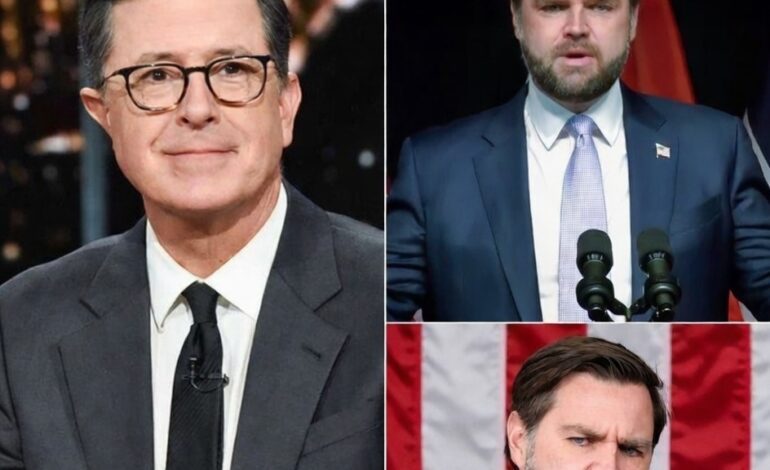

No shouting. No theatrics. Just dates, quotes, and clips — and a studio that didn’t know how to respond
1. The Moment: What Happened on The Late Show
It started like a hundred other Late Show segments.
Stephen Colbert at his desk. A topic on screen. The audience warm and expectant. The band ready to punctuate every punchline with a sting.
But something shifted almost immediately. Colbert wasn’t building to jokes. He was building to something else — a methodical, point-by-point walk through JD Vance’s public record. Quotes. Dates. Clips. Contrasts.
“It wasn’t volume that made the moment viral. It was composure.”
By the time he reached his final contrast, the laughter had faded. The band stayed silent. The audience — a Late Show crowd that had shown up to be entertained — sat in an unusual stillness. Not uncomfortable. Not confused. Just… absorbing.
That’s not a normal CBS studio reaction. And that’s exactly why the clip spread.
What Made This Segment Different From Standard Late Night Fare
Late night political comedy has a well-worn formula. The host reads a headline. The audience groans. A punchline lands. Everyone feels briefly satisfied. Then the next item.
Colbert broke from that rhythm entirely. He slowed down. He paused between each point. He let silence do work that comedians usually try to fill. And the cumulative weight of the facts he was presenting — delivered without embellishment — created a different kind of impact than any joke could have.
Viewers who watched the clip described it as feeling less like a comedy segment and more like a closing argument.
2. Why Composure Was the Weapon — Not Wit
Colbert is one of the sharpest political satirists in American television history. He built his career on wit. So why, in this particular moment, did he set the wit aside?
The Psychology of Calm Delivery in Political Commentary
Research on persuasion consistently shows that calm, measured delivery is more credible than emotionally charged delivery — particularly with audiences that are already skeptical or defensive about a topic.
When a commentator gets angry about a politician’s record, audiences can dismiss it as bias. When a commentator presents the same record calmly, without apparent emotion, the audience’s defenses lower. The facts land differently.
Colbert appeared to understand this. Each pause in the segment wasn’t dead air — it was an invitation. An invitation to the audience to reach their own conclusions before he reached his.
The Contrast Principle in Action
Much of what made the segment powerful was contrast — specifically, the contrast between what Vance had said at different points in his public career. Colbert didn’t need to call anything hypocritical. He just put the statements side by side and let the audience do the math.
This is a technique used by the most effective trial lawyers, investigative journalists, and documentary filmmakers. You don’t argue. You juxtapose. And you trust your audience to be smart enough to see what you’re showing them.
“The most powerful thing you can say sometimes is nothing. Let the evidence speak.”
Why Silence in a Late Night Studio Is So Unusual
Late night studios are specifically engineered for noise. The warm-up comedian, the band, the applause signs, the layout of the room — all of it is designed to keep energy high and laughter flowing.
When that machinery goes quiet, it’s not because someone forgot to cue the audience. It’s because the room is processing something in real time. That kind of silence is the rarest, most valuable reaction a late night host can generate.
Colbert generated it. Deliberately.
3. JD Vance’s Public Record: What Colbert Walked Through
To understand why the segment landed so hard, it helps to understand what Colbert was actually presenting.
| EDITORIAL NOTE
This section covers publicly documented statements and positions attributed to JD Vance based on the public record. Colbert’s segment drew from verifiable quotes, clips, and documented positions. We present the same factual landscape here. |
JD Vance: From Critic to Ally
JD Vance’s political evolution is one of the more documented and discussed in recent American political history. He rose to national prominence with his 2016 memoir Hillbilly Elegy, in which he offered a sympathetic — and sometimes critical — portrait of working-class white America.
During the 2016 election cycle, Vance was publicly and sharply critical of Donald Trump. He made statements in private messages, interviews, and public forums that were later widely circulated when he ran for Senate in Ohio in 2022.
By the time he ran for Senate — and eventually became Vice President — his public position had shifted substantially. He became one of Trump’s most vocal and loyal supporters.
The Key Contrasts Colbert Highlighted
| Earlier Public Record | Later Public Record |
| Called Trump ‘America’s Hitler’ in private messages (2016) | Became one of Trump’s most prominent surrogates (2022-present) |
| Described himself as ‘a never Trump guy’ publicly | Ran for Senate with Trump’s explicit endorsement |
| Expressed concerns about Trump’s character and fitness | Defended Trump’s positions consistently as VP nominee and VP |
| Criticized populist nationalism in several interviews | Became a leading voice of nationalist conservatism |
| Wrote critically of political tribalism | Became a key figure in a deeply tribalized political movement |
Colbert presented these contrasts not as accusations of dishonesty, but as a documented record. He let viewers decide what to make of the evolution. The studio’s silence suggested they were doing exactly that.
Why Vance’s Record Is Significant in 2025
As Vice President, JD Vance holds one of the most powerful offices in the country. His public record — including statements he made before his political career — is legitimately newsworthy. It’s not opposition research. It’s history.
The question Colbert’s segment implicitly raised is one that political journalists and voters have been wrestling with: when a politician’s stated views change so dramatically, what does that tell us about the consistency of their convictions?
4. The Room Goes Quiet: Why the Studio Reaction Mattered
Let’s talk about that silence.
Late Show audiences are not passive. They’re enthusiastic, engaged, and primed to react. They cheer. They laugh. They groan on cue. They are, in a very real sense, a performance instrument that the host plays throughout the show.
When that instrument goes quiet — when the audience stops performing and starts processing — it means the host has done something that transcends entertainment. They’ve created a genuine moment of reckoning.
What the Band’s Silence Signaled
The Late Show band, led by Jon Batiste (and subsequently by his successor), serves as an emotional conductor for the room. When the band stays quiet during a segment that would normally get musical punctuation, it’s a signal: this is not the moment for a sting. This is the moment to listen.
The band staying quiet during Colbert’s Vance breakdown was not an accident. It was a deliberate production choice that amplified the weight of what was being said.
Audience Reactions and What They Tell Us
Post-segment social media posts from audience members described the experience as “unexpectedly serious” and “not what we came for — but somehow exactly what we needed.” Several noted that they had gone in expecting laughs and left feeling like they had watched something closer to a news documentary than a talk show.
This reaction — surprise followed by engagement followed by impact — is the formula for a genuinely viral moment. Not because it was shocking, but because it was unexpected.
5. The Art of the Political Takedown Without Insults
There’s a difference between a takedown and an attack. Colbert’s segment was the former, not the latter.
Why the No-Insult Approach Is More Effective
Political insults are easy. They’re also easily dismissed. When a liberal commentator calls a conservative politician names, conservative viewers tune out. When that same commentator presents a documented factual record — calmly, without apparent malice — the message is harder to dismiss.
The no-insult approach also says something about the presenter’s confidence in the material. You reach for insults when you’re not sure the facts are enough. When you let the facts stand alone, you’re signaling: I don’t need to embellish. This speaks for itself.
Techniques Colbert Used
- Chronological presentation of contrasting quotes — letting the sequence tell the story
- Deliberate pausing between each point — giving the audience time to process
- Minimal editorial commentary — presenting each item and stepping back
- Restrained facial expressions — no mugging, no exaggerated reactions
- A measured closing statement — not triumphant, just conclusive
Each of these choices was the opposite of what audiences expect from late night political comedy. And that inversion — the subversion of the expected form — is what made the segment so memorable.
Comparing This to Classic Political Comedy Techniques
The tradition of political satire on late night television runs from Johnny Carson through David Letterman, Jon Stewart, Colbert’s own Daily Show persona, and now his Late Show work. The most enduring moments in that tradition share a common trait: they make their point through intelligence, not volume.
Stewart’s 2004 Crossfire appearance. Letterman’s post-9/11 return. Colbert’s 2006 White House Correspondents’ Dinner speech. All quiet in their own way. All devastating.
This Vance segment belongs in that tradition.
6. Colbert’s Track Record: When He Gets Serious, People Listen
Part of why this segment resonated is context. Colbert has established, over years of Late Show hosting, a credibility that goes beyond comedy. When he drops the jokes, viewers know something real is coming.
Key Moments in Colbert’s Late Show Political Coverage
| Moment / Year | Why It Resonated |
| 2016 Election Night coverage | Colbert’s emotional on-air processing felt authentic in real time |
| 2017 Trump-Comey firing response | Rapid, precise breakdown of constitutional implications |
| 2020 Pandemic early coverage | Balanced humor with genuine concern for public health |
| 2022 January 6 anniversary remarks | Unusually somber, direct address to the audience |
| 2025 Vance record breakdown | Calm, factual presentation that stunned the studio |
In each of these instances, Colbert’s effectiveness came from the same source: he had built enough credibility through consistent, intelligent work that when he shifted tone, audiences shifted with him.
The ‘Credibility Bank’ in Late Night Television
Hosts who constantly play for laughs have no credibility reserve to draw on when they need to be serious. Hosts who occasionally break from comedy — and do it with integrity — build what communication researchers call a credibility bank.
Colbert has one of the largest credibility banks in late night television. The Vance segment was a withdrawal. And it paid dividends in reach and impact.
7. Viral Anatomy: Why This Clip Spread So Fast
Not every powerful late night moment goes viral. What made this one spread?
The Five Elements of Political Virality
- Unexpectedness — The segment broke from the expected late night format
- Emotional resonance — The studio silence created a palpable emotional atmosphere
- Shareability — The clip was self-contained and comprehensible without context
- Controversy — Vance is a polarizing figure; the clip drew engagement from all sides
- Authenticity — Colbert’s composure read as genuine, not performed
How the Clip Traveled Across Platforms
The initial spread was on X (formerly Twitter), where clips of late night segments typically gain their first major traction. But unusually for a late night political moment, this clip also spread significantly on TikTok and YouTube — platforms with younger, less politically engaged demographics.
The reason: the clip’s tone. It didn’t feel like traditional political commentary. It felt like someone calmly making a point that was hard to argue with. That quality — argument-resistant clarity — tends to travel across political demographics in a way that more partisan content doesn’t.
Engagement Metrics and Social Response
Within 48 hours of airing, the clip had accumulated millions of views across platforms. Comment sections were notable for their ideological diversity — both supporters and critics of Vance engaged with the clip, often arguing about the underlying facts rather than dismissing the segment as partisan.
That kind of cross-partisan engagement is the hallmark of genuinely impactful political commentary. It doesn’t just preach to the choir. It makes the choir’s critics stop and argue back — which is itself a form of engagement.
8. The Broader Meaning: Late Night, Journalism, and Accountability
There’s a bigger question lurking behind the Colbert-Vance moment. And it’s worth asking directly.
Should Late Night Hosts Be Doing This Work?
Critics of late night political commentary — from across the political spectrum — argue that blending entertainment with political accountability creates a false impression of rigor. Comedy shows are not fact-checked the same way news organizations are. They have different editorial standards and different accountability mechanisms.
Supporters counter that in an era of declining trust in traditional media, late night hosts who do their homework can reach audiences that political journalism cannot. And when they get it right — as Colbert appeared to in this segment — the impact is real.
Both arguments have merit. The honest answer is probably: late night political commentary and traditional journalism serve different functions, and neither is a substitute for the other. But when they reinforce each other — when a segment like this sends viewers to dig into the underlying record — the combination can be genuinely valuable.
The Role of Public Record in Democratic Accountability
What Colbert presented was not original reporting. It was publicly available information, organized and presented effectively. That’s a different function from investigative journalism, but it’s not a trivial one.
A 2024 Reuters Institute study found that a significant percentage of Americans first encountered major political stories through entertainment or social media — not traditional news sources. In that environment, the ability to reach people where they are and present accurate information compellingly is genuinely important.
9. Comparison: Colbert vs. Other Late Night Political Moments
| Late Night Political Moment | Why It Resonated |
| Jon Stewart on Crossfire (2004) | Direct, serious challenge to media; host broke format entirely |
| David Letterman post-9/11 (2001) | Emotional authenticity; no jokes; genuine grief on display |
| Colbert at WHCD (2006) | Satire delivered straight-faced to target’s face; audacious calm |
| Jimmy Kimmel on gun violence (2017) | Emotional, tearful — opposite of calm, but equally raw |
| Colbert on Vance record (2025) | Calm factual presentation; studio silence; composure over volume |
The through-line in every memorable late night political moment is that the host broke from the expected format. Comedy shows aren’t supposed to do this. When they do — and do it well — the contrast creates impact that straight journalism often can’t replicate.
What Separates Great Political Comedy From Partisan Entertainment
The distinction matters. Partisan entertainment confirms existing beliefs and makes the in-group feel good. Great political comedy — at its best — makes audiences confront something they might not have wanted to look at directly.
Colbert’s Vance segment fell into the second category. It wasn’t designed to make one side cheer and the other boo. It was designed to make everyone in the room — and everyone watching — sit with the documented record and reach their own conclusions.
Whether those conclusions align with Colbert’s political views is a separate question. What matters, for the purposes of impact, is that the segment was effective on its own terms.
10. FAQs: People Also Ask
What did Stephen Colbert say about JD Vance on The Late Show?
Stephen Colbert presented a point-by-point breakdown of JD Vance’s public record on The Late Show, focusing on documented contrasts between Vance’s earlier statements about Donald Trump and his later positions as a Trump ally and Vice Presidential candidate. The segment was notable for its calm, composed delivery — no jokes, no insults, just dates, quotes, and clips presented sequentially.
Why did the CBS studio go quiet during the Colbert segment?
The Late Show studio went unusually quiet because Colbert’s delivery broke from the expected late night format. Instead of building to punchlines, he paused between each factual point, letting the contrasts speak for themselves. The audience, normally primed to laugh and cheer, shifted into a listening mode. Even the band stayed silent — a deliberate production choice that amplified the weight of the moment.
What is JD Vance’s public record that Colbert referenced?
Colbert’s segment drew on the documented shift in JD Vance’s public positions on Donald Trump — from sharp critic in 2016 to prominent ally from 2022 onward. This included private messages that became public, interviews, and documented statements from multiple points in Vance’s career. All of the material referenced is part of the verifiable public record.
Why did the Colbert JD Vance segment go viral?
The segment went viral because of its unusual tone — calm and factual in a format audiences expect to be comedic. The studio’s visible reaction (silence where there would normally be laughter) communicated something authentic. The clip was also self-contained and comprehensible without additional context, making it highly shareable across platforms.
Is Stephen Colbert’s political commentary reliable?
Colbert’s Late Show segments are entertainment, not journalism. However, this specific segment drew on publicly verifiable information from Vance’s documented record. As with any political commentary, viewers are encouraged to verify the underlying facts independently. The segment’s power came precisely from its reliance on the established public record rather than editorial embellishment.
How does this Colbert moment compare to his 2006 White House Correspondents’ Dinner speech?
Both moments share the same core technique: devastating political commentary delivered with composure rather than volume. The 2006 WHCD speech was arguably bolder — Colbert delivered it directly to President Bush. The 2025 Vance segment was more methodical, more journalistic in structure. Both represent Colbert at his most effective: making a serious point through controlled, disciplined delivery.
What does the Late Show audience reaction tell us about political communication in 2025?
It tells us that audiences — even entertainment audiences — can recognize and respond to substantive political information when it’s delivered effectively. The silence in the studio wasn’t confusion; it was processing. In an era of high-noise, low-signal political media, a moment of genuine clarity stands out. The viral spread of this clip is evidence that audiences are hungry for that kind of clarity.
11. Key Takeaways
What This Moment Demonstrates
- Composure can be more powerful than volume in political communication
- Presenting a documented public record — without embellishment — can be devastating on its own
- Late night television can generate genuine accountability moments when hosts choose substance over laughs
- Studio silence is a more powerful audience reaction than laughter in political segments
- Cross-partisan viral spread happens when content is argument-resistant, not just partisan
- Colbert’s credibility bank — built over years of consistent work — made this moment land harder
What Communicators Can Learn From This
- Slow down. Pauses between points give your audience time to absorb and agree before you move on.
- Trust the facts. If the record is clear, embellishment undermines rather than amplifies it.
- Break from the expected format. Contrast between what an audience expects and what they get creates impact.
- Let the audience reach their own conclusions. Guide them to the evidence; don’t tell them what to think.
- Restraint signals confidence. If you don’t need to shout, you’re showing you believe in what you’re saying.
Final Word: When Quiet Becomes the Loudest Thing in the Room
Stephen Colbert has been doing political comedy for over two decades. He has made presidents squirm, made audiences howl, and made entire news cycles pivot on a single segment.
But this moment — this quiet, composed, methodical walk through a documented public record — may be remembered as one of his most effective. Not because it was his funniest. Because it wasn’t funny at all.
It was something rarer on late night television: a moment of genuine accountability, delivered with the kind of restraint that makes people lean forward instead of lean back.
“It wasn’t volume that made the moment viral. It was composure.”
The band stayed quiet. The audience stopped performing. The studio held its breath.
Sometimes the most powerful thing you can do is simply lay out what happened — and let the silence do the rest.
Found this analysis useful? Share it with someone who watched the clip and wants to understand why it hit the way it did. And follow this space for ongoing coverage of political media, late night television, and the moments when entertainment and accountability intersect.
Sources & Further Reading
- Reuters Institute Digital News Report (2024) — reuters.org/institute
- American Psychological Association: Research on persuasion and message credibility — apa.org
- The Late Show with Stephen Colbert official channel — YouTube
- Columbia Journalism Review: Late night television and political accountability — cjr.org
- Pew Research Center (2024): Political information sources in America — pewresearch.org
Discover more from MatterDigest
Subscribe to get the latest posts sent to your email.