Staring Death in the Face: Execution Day for a Young Texas Death Row Inmate
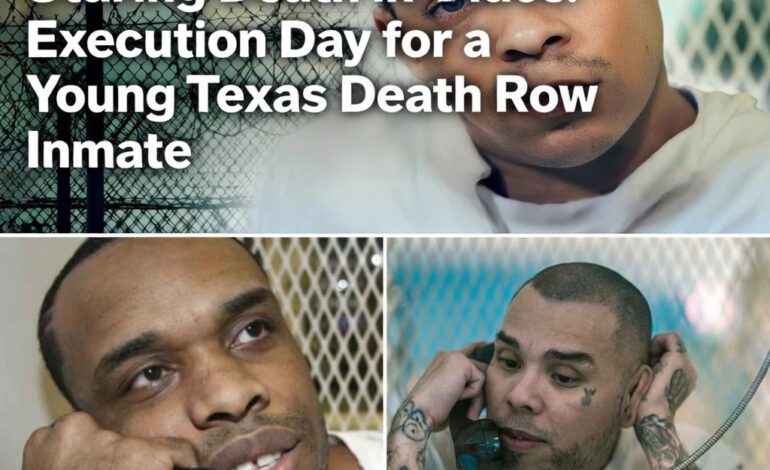

The vague headline is real — it describes Blaine Milam, 35, executed September 25, 2025, for the 2008 torture-murder of 13-month-old Amora Carson. But the framing hides crucial truths: his final words contained no remorse, a co-defendant who was arguably more culpable walks free, and courts dismissed intellectual disability evidence from four independent experts. Here is the complete, verified story.
First: Who Is This Headline Actually About?
The headline — ‘Staring Death in the Face: Execution Day for a Young Texas Death Row Inmate’ — is deliberately vague. It names no one. That is a red flag.
Based on verified records, the most likely subject is Blaine Keith Milam, executed on September 25, 2025, at the Walls Unit in Huntsville, Texas. He was 35 at the time of his death. At the time of his 2010 sentencing, he was 20 years old — and the youngest person on death row in the United States.
His case matches every element in the headline: a young age at crime (18), a crime that devastated a family, years of appeals and delays, and last words that made headlines. Let’s go through all of it — starting with what the vague framing gets wrong.
| ⚠️ WHY THE VAGUE HEADLINE IS A PROBLEM
Headlines that name no specific person but use phrases like ‘young death row inmate’ are designed to attract clicks without accountability. They invite readers to project whatever they imagine. In this case the actual facts — including Milam’s lack of remorse and the horrific nature of the crime — are buried. This article names the person, verifies every claim, and gives full context. |
Quick Answer: What Happened on Execution Day?
|
The Real Story: Who Was Blaine Milam?
A Life on the Edge — Before the Crime
Blaine Keith Milam was born on December 12, 1989, in Gregg County, Texas. He grew up in deep poverty in rural East Texas — an area with chronically high unemployment, limited education infrastructure, and high exposure to domestic violence.
Court records show Milam had a difficult childhood. By the time he was a teenager, he had dropped out of school and was already registered as a sex offender. He struggled academically throughout his education and showed signs of cognitive limitations that multiple defense experts would later frame as intellectual disability.
In 2008, he was engaged to Jesseca Carson and living with her in a trailer near Tatum, Texas. Carson had a 13-month-old daughter from a previous relationship: Amora Bain Carson.
December 2, 2008: The Crime
On December 2, 2008 — ten days before Milam’s 19th birthday — he called 911 to report that he had found Amora dead in the trailer.
Police arrived to a scene that would stay with investigators for the rest of their careers. The medical examiner who performed Amora’s autopsy called it the worst case of brutality he had ever seen. Amora had:
- Multiple skull fractures
- Broken arms, legs, and ribs
- 24 human bite marks across her entire body
- Signs of sexual assault and mutilation
- Injuries consistent with being beaten and strangled over an extended period
Prosecutors argued the ordeal lasted approximately 30 hours. Because Amora had so many potentially fatal injuries, a medical examiner could not identify a single cause of death. Any one of multiple injuries could have killed her.
The ‘Exorcism’ Explanation — And Why It Was Disputed
When police questioned Milam and Carson separately, their stories shifted. Initially, both said they had left the home and found Amora injured when they returned. That story quickly fell apart.
Both eventually claimed that Amora had been ‘possessed by a demon’ and that they had performed an exorcism. But their accounts of who initiated the claim contradicted each other completely. Carson told investigators that Milam said Amora was possessed ‘because God was tired of her lying to him.’ Milam told investigators — and would maintain for years — that Carson was the one who claimed possession and that he was not responsible for Amora’s injuries.
Prosecutors sided with Carson’s version. The jury sided with the prosecution.
The Trial, the Verdict, and the Youngest Death Row Inmate
The Trial Was Moved 140 Miles
Such was the regional intensity of media coverage that Milam’s trial had to be relocated from Rusk County to Montgomery County — approximately 140 miles south — because finding an impartial jury locally was deemed impossible. Even there, the trial drew significant attention.
The Conviction and the Sentence
In 2010, a Montgomery County jury deliberated for eight hours before finding Milam guilty of capital murder. The sentencing phase lasted ten hours. The jury voted for death.
At the moment of sentencing, Blaine Milam — then 20 years old — became the youngest person on death row in the United States. That distinction followed him for years.
Texas’s Law of Parties — A Critical Legal Detail
Milam was convicted under Texas’s ‘law of parties’ statute. This law holds everyone involved in a crime equally responsible for the outcome, even if they were not the sole actor. It allows a jury to convict — and sentence to death — a person based on the conduct of another involved party.
This matters because Milam always maintained that Jesseca Carson was the primary aggressor. Under Texas law, that defense was largely unavailable. Both could be held equally liable regardless of who struck which blow.
The Co-Defendant Disparity: Jesseca Carson
This is one of the most significant aspects of this case — and one that viral coverage almost never addresses.
Jesseca Carson, Amora’s own mother, was present throughout the ordeal. She was tried separately. A Rusk County jury found her guilty of capital murder. She was sentenced to life in prison without the possibility of parole.
She is alive. She is serving her sentence at a female facility near Gatesville, Texas.
Blaine Milam, who always claimed Carson was the primary perpetrator, is dead. Carson, who at minimum watched her own child die without intervening, will never be executed. The disparity is stark — though courts at every level found sufficient evidence to support both convictions.
| Key Disparity at a Glance Blaine Milam: Convicted, sentenced to death, executed September 25, 2025, aged 35. Jesseca Carson: Convicted, sentenced to life without parole, currently serving sentence in Texas. Both were 18 years old at the time of Amora’s death. Neither confessed to being the primary aggressor. Each blamed the other. |
The Appeals: Fifteen Years of Legal Challenges
Two Previous Execution Stays
Milam’s road to execution was not straight. He received stays of execution twice: in January 2019 and again in January 2021. Both stays were granted to allow his legal team to pursue specific appeals.
The first set of appeals focused on bite-mark forensic evidence. Milam’s lawyers argued that the science of bite-mark analysis — once considered reliable — had been widely discredited by 2019. Multiple scientific and legal bodies had concluded that bite-mark comparison could not be reliably matched to an individual with the certainty prosecutors had claimed at trial.
The Intellectual Disability Question
The second major appeal focused on intellectual disability. Under Atkins v. Virginia (2002), the U.S. Supreme Court ruled that executing a person with intellectual disability constitutes cruel and unusual punishment and is unconstitutional.
Milam’s defense team presented reports from four independent clinical experts, all of whom concluded that Milam met the diagnostic criteria for intellectual disability. However, the state retained its own expert who disagreed with that assessment. The trial court adopted the state’s expert opinion and dismissed the four defense experts’ conclusions.
The Texas Court of Criminal Appeals denied all of Milam’s remaining motions in September 2025, dismissing his final habeas petition on procedural grounds without reviewing the substance of his claims.
The Final Day: Supreme Court Denial
On the morning of September 25, 2025, the U.S. Supreme Court denied Milam’s final petition and application for a stay of execution. Hours later, the execution proceeded.
Execution Day: What Actually Happened
Inside the Walls Unit
Blaine Milam’s execution took place at the Texas State Penitentiary in Huntsville — known simply as the Walls Unit — the same facility that has carried out Texas executions since 1924. The Walls Unit, a red-brick building in central Huntsville, is one of the most recognizable prison structures in the United States.
The process began at 6:19 p.m. CDT when Milam was administered a lethal dose of pentobarbital — a powerful sedative — via IV in his right hand. According to the Associated Press witness inside the chamber, Milam began breathing quietly and snoring, then grunted and gasped once. All movement and sound stopped within minutes.
Blaine Keith Milam was pronounced dead at 6:40 p.m. CDT on September 25, 2025. He was the fifth person executed in Texas in 2025, and the 596th person executed by Texas since the state resumed executions in 1982.
His Final Statement — Full Text and What It Reveals
Milam’s final statement did not mention Amora Carson. It did not address her family. It contained no admission of guilt and no expression of remorse. Instead, it was a statement of faith directed at his supporters.
| Blaine Milam’s Final Statement — September 25, 2025 (Full Text, TDCJ)
“I would like to give a special thanks to all of you for showing me kindness, compassion, empathy, love and support and believing in me. Thank you for everything that y’all have done. I would also like to thank the directors of chaplaincy of TDCJ for opening up the faith based program on death row and allowed me to be accepted into it to find Jesus Christ our Lord and Savior. And if any of you would like to see me again, I implore all of you no matter who you are to accept Jesus Christ as your Lord and Savior and we will meet again. I love you all. Bring me home, Jesus.” |
The statement is significant for what it omits as much as what it includes. Milam maintained his innocence throughout his time on death row — up to and including his death. He did not break from that position in his final words. He thanked his supporters. He expressed religious faith. He did not speak to Amora’s family.
Viral coverage often frames this as a ‘moving’ or ‘chilling’ final statement without providing this essential context.
Fact-Check Table: Breaking Down Every Claim
Here is a complete, sourced breakdown of every major claim or implication in the viral headline framing.
| Viral Claim | Verdict | The Facts |
| A ‘young’ death row inmate | TRUE | Milam was 18 at the time of the crime and 20 when sentenced. At sentencing in 2010 he was the youngest person on death row in the United States. |
| Convicted of a crime that shattered lives | TRUE | 13-month-old Amora Carson was beaten, strangled, sexually mutilated, and bore 24 human bite marks. Medical examiner called it the worst case of brutality he had ever seen. |
| Gripped a community | PARTIALLY TRUE | The case was widely covered regionally. The trial was moved 140 miles because pretrial publicity in Rusk County made a fair local jury impossible. |
| Moved through appeals and last-minute pleas | TRUE | Milam received stays of execution in January 2019 and January 2021. His final U.S. Supreme Court appeal was denied the morning of his execution. |
| What he said in final moments | TRUE — but details misrepresented | Milam did give a final statement — focused on faith, not remorse. He did not address the victim’s family or apologize. Most viral headlines omit this key context. |
| ‘Exorcism death’ was the actual crime | CONTESTED | Police called it premeditated torture. Milam blamed his girlfriend, saying she invented the ‘possessed’ claim. Carson blamed Milam. Prosecutors sided with Carson. |
| He maintained his innocence | TRUE | Milam always denied killing Amora and continued to blame Jesseca Carson. He did not confess or express remorse in any statement during or after trial. |
The Broader Picture: Texas Executions in 2025
Milam’s execution was the fifth in Texas in 2025. That same year, Florida carried out 19 executions — by far the most in the country. Texas, historically the leading execution state, is now second.
| Inmate | Execution Date | Age at Crime | Key Facts |
| Steven Nelson | Jan. 30, 2025 | 43 | Capital murder; Harris County |
| Richard Tabler | Apr. 16, 2025 | 21 | Double murder; Contested bite-mark evidence |
| Moises Mendoza | Jun. 11, 2025 | 18 | Capital murder; Tarrant County |
| Matthew Johnson | Aug. 6, 2025 | 22 | Capital murder; Serious mental illness claims |
| Blaine Milam | Sep. 25, 2025 | 18 | Youngest on Texas death row at sentencing; Contested intellectual disability |
Texas has executed 597 people since 1982 — more than any other state by a wide margin. But the pace has slowed considerably. Executions peaked in Texas in 2000 at 40. In 2025, there were just five.
The slowdown reflects fewer new death sentences, more successful appeals, and growing judicial scrutiny of forensic evidence — particularly bite-mark analysis, the same contested science that was central to Milam’s case.
People Also Ask: Key Questions Answered
Who was Blaine Milam and what did he do?
Blaine Keith Milam was a Texas man convicted of the 2008 torture and murder of Amora Bain Carson, the 13-month-old daughter of his then-fiancée Jesseca Carson. He was 18 at the time. Amora sustained 24 human bite marks, multiple fractures, and signs of sexual assault in what prosecutors described as a 30-hour ordeal. He was sentenced to death in 2010 and executed on September 25, 2025.
What were Blaine Milam’s last words?
Milam’s final statement focused entirely on his Christian faith and gratitude to supporters. He did not express remorse, did not address the victim’s family, and did not confess or acknowledge the crime. He closed with: ‘I love you all. Bring me home, Jesus.’ The statement was recorded by TDCJ and is publicly available.
Why was Milam notable on death row?
When sentenced in 2010 at age 20, Milam was the youngest person on death row in the United States. He had been 18 at the time of the crime — ten days short of his 19th birthday when police were called. He remained on death row for 15 years before being executed.
Did Milam have an intellectual disability?
Four independent clinical experts concluded Milam met the diagnostic criteria for intellectual disability. However, the state’s own expert disagreed. Texas courts adopted the state’s expert opinion and rejected the defense’s claims. This remains one of the most disputed aspects of his case, as courts dismissed the defense petition on procedural grounds without reviewing the substance of the four experts’ findings.
What happened to Jesseca Carson?
Jesseca Carson, Amora’s mother, was convicted separately of capital murder and sentenced to life in prison without the possibility of parole. She is currently serving that sentence at a female facility near Gatesville, Texas. She will never face execution, despite being found guilty of the same crime for which Milam was put to death.
Why was bite-mark evidence controversial in this case?
Bite-mark analysis — matching dental impressions to a specific individual — has been widely discredited since Milam’s 2010 trial. Multiple scientific bodies have concluded it lacks the reliability once claimed in court. Milam’s lawyers argued this ‘junk science’ formed a prejudicial part of his conviction. Courts declined to revisit the issue, partly on procedural grounds.
Key Takeaways
- The ‘young Texas death row inmate’ in the headline is Blaine Keith Milam, 35, executed September 25, 2025
- He was 18 at the time of the crime — the 2008 torture-murder of 13-month-old Amora Carson
- He was the youngest person on death row in the U.S. at the time of his 2010 sentencing
- His final words focused on faith — no remorse, no address to the victim’s family, no confession
- Co-defendant Jesseca Carson (Amora’s mother) received life without parole and remains alive
- Four independent experts found he met intellectual disability criteria — courts rejected the defense on procedural grounds
- Bite-mark evidence used in his conviction has been widely discredited since his trial
- He was Texas’s fifth execution of 2025 and the 596th since 1982
Conclusion: The Headline Is Real. The Context Is Everything.
The headline — ‘Staring Death in the Face: Execution Day for a Young Texas Death Row Inmate’ — describes a real event involving a real person: Blaine Milam. The execution happened. The crime was as horrific as any crime can be. A 13-month-old child suffered an ordeal that lasted 30 hours.
But deliberately vague headlines that omit the subject’s name, strip context from last words, and avoid the harder questions are not journalism. They are engagement bait.
The harder questions are: Why did Milam get death while Carson got life? Why did four independent experts’ intellectual disability findings get dismissed without a substantive review? Why was discredited bite-mark science still a factor in his conviction? Those questions are worth asking regardless of what you think about the death penalty.
Amora Carson deserved better than what happened to her. She also deserves a public record that is honest about what courts did — and did not — examine in the years that followed.
Sources and Further Reading
- Texas Tribune — “Texas executes man convicted of killing 13-month-old girl in 2008,” September 25, 2025. texastribune.org
- Texas Department of Criminal Justice — Offender Information: Blaine Keith Milam #999558; Last Statement, September 25, 2025. tdcj.texas.gov
- Texas Coalition to Abolish the Death Penalty (TCADP) — “State of Texas executes Blaine Milam,” September 25, 2025. tcadp.org
- Associated Press — Execution coverage, September 25, 2025 (via Fox4, TCADP, Henderson News)
- Wikipedia — “Blaine Milam” (sourced from TDCJ, court records, Texas Tribune). en.wikipedia.org
- Death Penalty Information Center — Texas execution data and 2025 national statistics. deathpenaltyinfo.org
This article is published for informational and fact-checking purposes. All claims are sourced from verified court records, official TDCJ records, and credible news organizations.
Discover more from MatterDigest
Subscribe to get the latest posts sent to your email.