Sierra Nevada Avalanche Kills Skiers: What We Know About the Tragedy
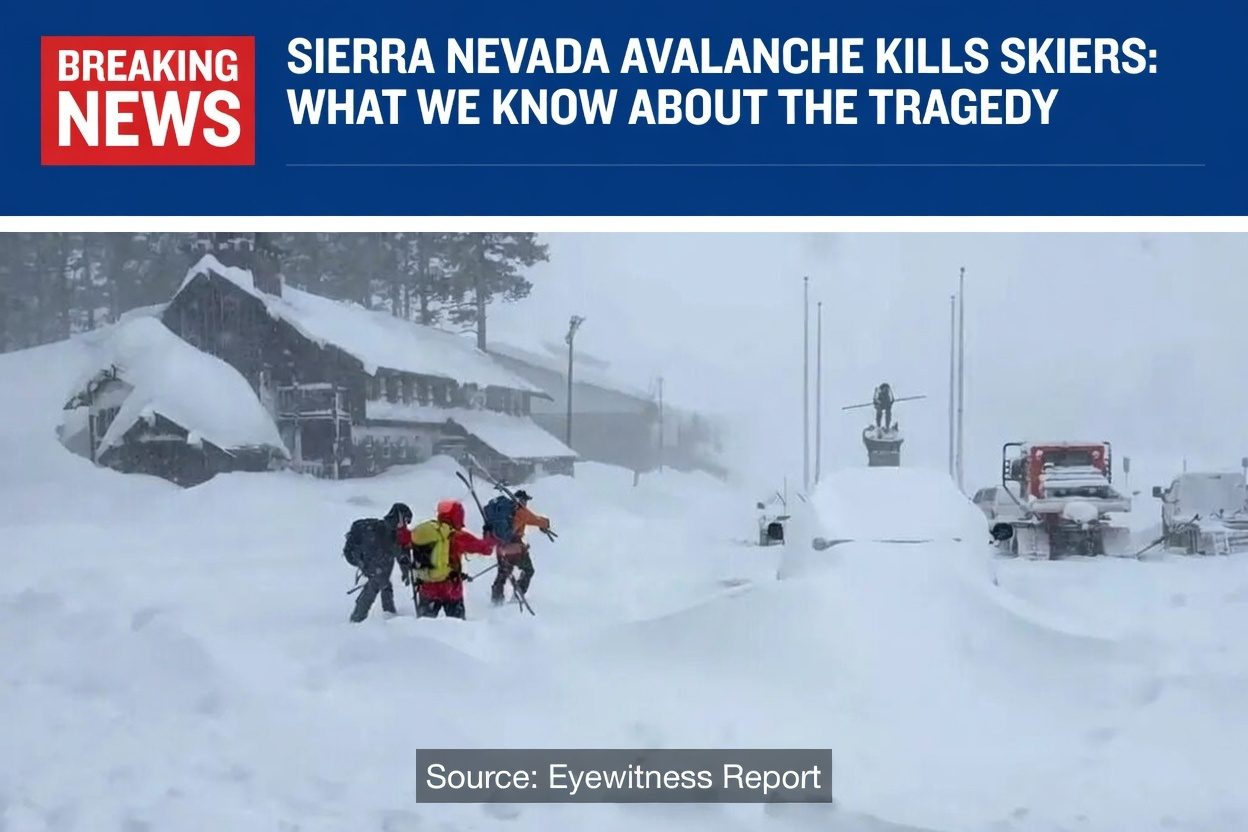

A Community Shattered on the Slopes
They went up the mountain as parents — most of them mothers. They didn’t come back down the same way.
A deadly avalanche swept through California’s Sierra Nevada Mountains on a Tuesday, killing several skiers in a tragedy that has left a tight-knit school community reeling. According to a source involved in the search and rescue effort, and a statement from the school itself, the group caught in the avalanche was made up largely of parents of students at a local school and ski academy.
This wasn’t a group of strangers on a random ski trip. These were people who knew each other. Parents who cheered at the same games, dropped kids off at the same gates, and shared the same love of the mountains.
Here is everything we know — the facts, the rescue efforts, the science behind the disaster, and what it means for mountain safety going forward.
1. What Happened: The Sierra Nevada Avalanche
On a Tuesday in February 2026, an avalanche struck a group of skiers in California’s Sierra Nevada Mountains. The exact location within the Sierra Nevada range has not been fully disclosed out of respect for ongoing rescue operations and the families involved.
Avalanches in this region are not unheard of. The Sierra Nevada receives some of the heaviest snowfall in North America. But that doesn’t make this tragedy any less shocking.
The avalanche appears to have caught the group off-guard. Witnesses and rescue personnel described a fast-moving wall of snow that left little time to react. At least some members of the group were buried, triggering a large-scale emergency response.
|
2. Who Were the Victims? Parents and the School Community
According to a source directly involved in the search and rescue effort, and confirmed by a formal statement from the school, the group of skiers was composed primarily of parents of students at a local school and ski academy.
Most of the adults in the group were mothers. They were not professional skiers or extreme athletes. They were parents who loved the outdoors — the kind of people who show up for their kids and for each other.
The school released a statement expressing profound grief and offering support to affected families. The statement confirmed the connection between the victims and the school community but did not release individual names pending family notification.
This detail matters. It shifts the story from a generic outdoor accident to a community catastrophe. When you lose a parent, you lose a world.
The Role of Ski Academies in These Communities
Ski academies are specialized schools that blend traditional academics with elite ski training. They’re common in mountain communities across California, Colorado, Utah, and Vermont.
Parents of ski academy students often ski themselves. They’re active in mountain culture. Many are experienced recreationally, if not professionally. This makes the tragedy both understandable in context and deeply painful — these were not reckless novices.
3. How the Search and Rescue Operation Unfolded
Emergency services responded rapidly. Search and rescue teams — including avalanche dogs, trained rescuers with probes and shovels, and helicopter support — were deployed to the site.
Avalanche rescues operate on a brutal timeline. Survival rates drop sharply after 15 minutes of burial. After 45 minutes, the survival rate falls below 30%. Time is everything.
Rescuers worked in dangerous conditions. Afterslides — secondary avalanches triggered by the instability left behind by the first slide — posed a constant threat to rescue teams.
Avalanche Rescue Survival Statistics
| Time Buried | Approx. Survival Rate |
| Under 15 minutes | ~90% |
| 15–30 minutes | ~50% |
| 30–45 minutes | ~30% |
| Over 45 minutes | Under 10% |
Source: American Avalanche Association / International Commission for Alpine Rescue
4. What Is an Avalanche? A Simple Explanation
An avalanche is a rapid flow of snow down a slope. It can be triggered by natural forces — like new snowfall or wind loading — or by human activity like skiing over an unstable snowpack.
There are two main types. A slab avalanche occurs when a cohesive layer of snow breaks away as a unit. These are the most deadly. A loose snow avalanche starts at a single point and fans outward. Slab avalanches account for the vast majority of avalanche fatalities.
The Sierra Nevada’s snowpack is notorious for developing weak layers. Warm and cold cycles create a layered structure that can become dangerously unstable, especially after heavy new snowfall loads on top of weakened older layers.
5. Why the Sierra Nevada Is Especially Dangerous
The Sierra Nevada runs roughly 400 miles along California’s eastern edge. It includes peaks over 14,000 feet and receives some of the deepest snowpack in the United States.
The region’s maritime climate creates a specific avalanche problem. Wet, heavy snow from Pacific storms piles on top of earlier layers. When temperatures fluctuate, weak layers of faceted crystals or depth hoar form within the snowpack. These layers act like ball bearings under the weight of new snow.
According to the Colorado Avalanche Information Center (a leading resource even for California terrain), wet slab and storm slab avalanches are the most common killers in Sierra-type snowpacks.
This is not a rare danger. It’s a known, recurring risk — which is why avalanche education is so critical for anyone venturing into the backcountry or even lift-accessed sidecountry terrain.
6. Avalanche Safety: What Every Skier Must Know
This section is not about assigning blame. It’s about making sure fewer people face what this community is facing right now.
Essential Avalanche Safety Gear
- Avalanche transceiver (beacon) — worn on the body, not in the pack
- Avalanche probe — for locating buried victims precisely
- Avalanche shovel — for rapid, efficient digging
- Airbag backpack — deploys to keep you near the surface during a slide
Before You Go: Checking Avalanche Conditions
- Check the Sierra Avalanche Center forecast every single day before skiing
- Look for recent avalanche activity — natural avalanches are a red flag
- Understand the danger scale: Low (1) to Extreme (5). Most fatalities happen at Considerable (3) or High (4)
- Never travel alone in avalanche terrain
- Take an avalanche safety course — AIARE Level 1 is the gold standard
What to Do If Caught in an Avalanche
- Try to ski or run to the side of the slide path
- If you can’t escape, ditch poles and try to stay near the surface
- As the snow slows, create an air pocket in front of your face
- Try to get a hand to the surface as the snow sets
- Stay calm — panic uses oxygen faster
7. How Schools and Ski Academies Are Responding
The school connected to the victims released a statement expressing deep sorrow and offering counseling and support resources to students, staff, and families. The statement did not provide details on the identities of those involved, citing respect for families during the notification process.
Ski academies across California and the broader mountain West will likely review their parent engagement policies in backcountry and high-risk terrain. While this group appears to have been skiing independently rather than on a school-organized outing, the connection to the school community makes institutional reflection inevitable.
Schools in mountain communities often walk a fine line — celebrating skiing culture while also promoting safety. This tragedy will force difficult conversations about how those values coexist.
8. The Emotional Toll on the Community
The loss of parents — especially multiple parents from the same community — sends shockwaves that go far beyond the immediate families. Children lose mothers. Classrooms lose familiar faces. A school community loses part of its heart.
Grief researchers describe the phenomenon of “communal trauma” — when a disaster affects not just individuals but the social fabric that holds a community together. This is that.
If you are part of an affected community, reach out. Let people talk. Don’t rush grief. Children, especially, need adults who can sit with discomfort and model healthy mourning.
Mental health resources, including the SAMHSA National Helpline (1-800-662-4357), are available 24/7 for those struggling with trauma and grief.
9. Key Takeaways
- A deadly avalanche struck a group of skiers in California’s Sierra Nevada Mountains in February 2026
- The victims were mostly parents — predominantly mothers — of students at a local school and ski academy
- Search and rescue teams responded immediately, operating under intense time pressure
- The Sierra Nevada’s snowpack is uniquely prone to dangerous slab avalanches
- Avalanche survival drops sharply after 15–30 minutes of burial
- Every backcountry and sidecountry skier should carry a beacon, probe, and shovel — and know how to use them
- This tragedy will have lasting emotional effects on the school community involved
10. Frequently Asked Questions (FAQs)
Where exactly did the Sierra Nevada avalanche happen?
The precise location has not been fully disclosed as of publication, out of respect for ongoing rescue operations and family notifications. It occurred in the Sierra Nevada mountain range in California.
How many people were killed in the avalanche?
The exact death toll has not been officially confirmed as of early reporting. Multiple fatalities have been reported. Check local California news outlets for the most current figures.
Were the skiers part of an official school trip?
No. Based on available information, the group appears to have been skiing independently. However, most members were connected to a local school and ski academy as parents of enrolled students.
What should you do if you’re skiing in avalanche terrain?
Always carry an avalanche beacon, probe, and shovel. Check the local avalanche forecast daily. Never ski alone in avalanche terrain. Take an AIARE avalanche safety course before entering the backcountry.
Is the Sierra Nevada a high-risk area for avalanches?
Yes. The Sierra Nevada is one of the most active avalanche regions in the United States due to its heavy snowpack, storm frequency, and the formation of dangerous weak layers within the snowpack.
Sources & References
- American Avalanche Association — avalanche.org
- Sierra Avalanche Center — sierraavalanchecenter.org
- Colorado Avalanche Information Center — avalanche.state.co.us
- International Commission for Alpine Rescue (ICAR) — survival statistics
- SAMHSA National Helpline: 1-800-662-4357 (grief and trauma support)
Discover more from MatterDigest
Subscribe to get the latest posts sent to your email.