Should Congress Go Unpaid During a Government Shutdown? The Debate America Can’t Stop Having
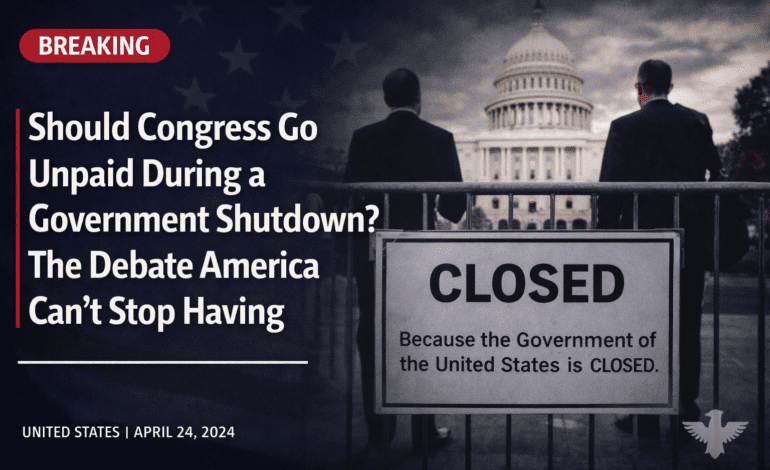

Every time the federal government shuts down, millions of Americans feel it right away. Workers stop getting paychecks. Federal offices close their doors. Families who depend on government services are left waiting and wondering. And throughout it all, one uncomfortable truth stays front and center: the members of Congress who couldn’t agree on a budget are still getting paid.
That reality has sparked a growing conversation across the country. If everyday Americans have to suffer the consequences of a shutdown, why don’t the people who caused it?
A bold proposal has been picking up steam in Washington: no work, no pay. If Congress fails to pass a budget on time and the government shuts down, members of Congress should not receive their salaries. It sounds simple. But like most things in politics, the full picture is a lot more complicated.
Shutdowns Are No Longer Rare — They’re a Pattern
Government shutdowns used to be unusual events. Today, they feel almost routine. Over the past several decades, the United States has experienced dozens of funding gaps and full shutdowns. Some last only a few days. Others stretch on for weeks, creating serious problems for millions of people.
When a shutdown happens, hundreds of thousands of federal employees are either furloughed — meaning they’re sent home without pay — or forced to keep working without knowing when their next paycheck will arrive. Essential workers like air traffic controllers, border patrol agents, and prison guards must report to work anyway. They do their jobs, keep the country safe, and wait.
Meanwhile, their bills don’t wait. Rent is due. Groceries still cost money. Car payments don’t pause because Washington can’t get its act together. Many federal workers live paycheck to paycheck, just like millions of other Americans. A two- or three-week shutdown can push a family into real financial hardship.
And yet, through all of it, the members of Congress who failed to pass a budget on time keep collecting their $174,000-a-year salaries. That number isn’t lost on Americans who earn a fraction of that amount and still feel the shutdown’s pain.
The “No Work, No Pay” Idea Explained
The proposal is straightforward: if a government shutdown happens because Congress failed to pass a spending bill on time, lawmakers should not be paid during that shutdown. Their pay would be withheld for every day the government stays closed.
Some versions of the proposal go even further. They suggest that back pay — the money owed to furloughed federal workers once the shutdown ends — should come before any congressional salaries are restored. In other words, the people who actually showed up and did the work would get made whole first.
The idea has been introduced in Congress in different forms over the years. It tends to get attention whenever a shutdown is looming or already underway. And it consistently gets strong support from the public — most polls show that a large majority of Americans think members of Congress should lose pay during shutdowns.
But popular support and actual law are very different things. So far, the proposal has never made it through the full legislative process and been signed into law.
Why Supporters Think It’s a Smart Idea
Those who back the no-work, no-pay proposal make several strong arguments in its favor.
First and most obvious: fairness. When federal employees and government contractors lose income during a shutdown, Congress feels none of that pain. Lawmakers can return to their comfortable offices in Washington, meet with lobbyists and donors, and conduct other political business — all while drawing a full paycheck. Supporters of the proposal argue that closing this gap between lawmakers and the people they represent is long overdue.
Second: accountability. Right now, there are very few real consequences for Congress when a shutdown happens. Yes, approval ratings dip. Yes, voters might be angry. But that anger often fades by the next election, and in many cases, incumbents still win re-election without much trouble. Tying congressional pay directly to government function could create a more immediate, more personal incentive to compromise.
Third: a message to the public. Trust in government is at historic lows. Poll after poll shows that Americans don’t believe their elected officials are working in their best interests. Passing a law that says Congress doesn’t get paid when it fails to do its job could help restore at least a small amount of faith in the system. It sends a clear signal: leaders should be held to the same standards as everyone else.
Fourth: the private sector precedent. In most jobs in America, if you fail to deliver results, there are financial consequences. Companies don’t pay employees who don’t show up. Workers who miss deadlines often face discipline or termination. Why should lawmakers be any different? Supporters argue that subjecting Congress to the same basic rules most workers live by is not a radical idea — it’s just common sense.
The Arguments Against It
Not everyone thinks withholding congressional pay is a good idea. Critics raise several objections — some practical, some constitutional.
The biggest legal hurdle is the 27th Amendment to the U.S. Constitution. It states that any law changing the compensation of members of Congress cannot take effect until after the next election. This amendment was specifically designed to prevent lawmakers from quickly voting themselves pay raises or punishments. Legal scholars debate whether a shutdown pay suspension would fall under this restriction, but the constitutional uncertainty is a real obstacle.
There’s also a practical concern: Congress already has a salary. Under current law, lawmakers will receive back pay after a shutdown ends, even if they were furloughed along with their staff. Changing that structure involves legal complexities that go beyond simply cutting a check.
Another argument is that cutting congressional pay could actually make things worse. Here’s the logic: only wealthy individuals could afford to serve in Congress if there’s a risk of losing income during political standoffs. People of modest means — teachers, small business owners, nurses — might be less likely to run for office if the salary comes with that kind of financial risk. Critics say the proposal could inadvertently make Congress even more of a club for the rich.
Some analysts also point out that shutdowns aren’t always caused by individual laziness or bad intentions. They’re often the result of deep political disagreements that genuinely can’t be resolved quickly. In those situations, withholding pay might not speed up a deal — it might just add pressure that leads to worse, more rushed compromises.
What Happens Behind Closed Doors: How Shutdowns Really Start
To understand why some people are skeptical of the no-pay proposal, it helps to understand how government shutdowns actually happen.
Congress is supposed to pass twelve separate spending bills each year by October 1, the start of the federal fiscal year. In practice, Congress almost never meets that deadline. Instead, lawmakers frequently rely on “continuing resolutions” — temporary funding measures that keep the government running at existing spending levels while negotiations continue.
When even a continuing resolution can’t pass — because of a standoff over spending levels, policy riders, or partisan battles — the money runs out and the government shuts down.
These breakdowns usually happen because of structural problems: two parties with very different visions for government, a deeply divided Congress, and a system that requires broad agreement to move forward. No single member of Congress “causes” a shutdown in the same way a lazy employee might miss a deadline. The dysfunction is often systemic.
That doesn’t excuse the outcome. But it does complicate the idea that tying pay to performance will automatically fix the problem.
The Real Human Cost of Shutdowns
While the debate over congressional pay continues in Washington, the effects of shutdowns on real people are concrete and well-documented.
During the longest shutdown in American history — a 35-day closure in late 2018 and early 2019 — about 800,000 federal workers missed at least one paycheck. Many were forced to take out loans, apply for food assistance, or rely on their families for financial help. Some reported skipping medications they couldn’t afford. Others scrambled to find part-time work just to keep the lights on.
Beyond individual workers, shutdowns affect entire communities. Small businesses near federal facilities lose customers. Local economies take a hit. Services that vulnerable Americans depend on — nutrition programs, housing assistance, medical research — get paused or delayed.
National parks close. Tax returns get delayed. Court cases get postponed. The ripple effects of a shutdown spread far beyond the federal workforce.
All of this happens because Congress couldn’t agree on a budget. And all of this happens while the people responsible for that failure keep getting paid.
Has Any State Tried This?
The federal government isn’t the only government that deals with budget standoffs. State governments face similar problems — and some states have experimented with consequences for their legislators.
California, for example, passed a law in 2010 that prevents state legislators from receiving pay if they fail to pass a budget on time. The results were notable: for years before the law passed, California was routinely late with its budget. After the law took effect, the state began passing budgets on time with much greater consistency.
That’s not a perfect comparison — state legislatures operate differently than Congress, and California’s budget dynamics are unique. But it does offer some evidence that financial accountability for lawmakers can change behavior.
Other states have looked at similar measures with varying results. The idea that legislators should share in the consequences of their own failures is not limited to federal politics.
Public Opinion: Where Do Americans Stand?
Public support for the no-work, no-pay idea has consistently been high. Surveys taken during and after government shutdowns typically show that large majorities of both Democratic and Republican voters think members of Congress should not be paid during a shutdown.
That’s a rare thing in American politics today: genuine bipartisan agreement. People who disagree on almost everything — immigration, taxes, healthcare — tend to agree that Congress should not be exempt from the consequences of its own failures.
Yet despite that public pressure, Congress has not passed this kind of legislation at the federal level. Critics say that’s no surprise — it would require members of Congress to vote to cut their own pay, and self-interest is a powerful force in any institution.
Several members of Congress have voluntarily returned their salaries during past shutdowns as a gesture of solidarity. But voluntary gestures are very different from a binding legal requirement.
Is the Problem Deeper Than Pay?
Some political scientists and budget experts argue that focusing on congressional pay misses the bigger picture. Shutdowns, they say, are a symptom of a broken budget process — not just a result of individual laziness or greed.
The current system requires Congress to pass spending bills through a complicated process every single year. That process involves multiple committees, two chambers, and intense political negotiations — all under strict deadlines. When one side uses the budget as a bargaining chip for unrelated policy goals, the whole system can seize up.
Some reformers suggest more structural changes: automatic continuing resolutions that kick in if Congress misses its deadline, or a two-year budget cycle that reduces the frequency of these high-stakes standoffs. Others argue for rules that make it harder to attach policy riders — unrelated political demands — to spending bills.
These ideas don’t carry the same emotional punch as “Congress shouldn’t get paid.” But they might do more to actually prevent shutdowns in the first place.
The no-pay proposal, in this view, treats the headline while the disease runs deeper. It makes for a great slogan. Whether it makes great policy is another question.
A Question of Fairness and Leadership
At its heart, this debate is about something that goes beyond budgets and paychecks. It’s about what Americans expect from their leaders — and whether those leaders are truly held to any standard of accountability.
In most areas of life, people are held responsible for the results of their decisions. A coach whose team keeps losing faces consequences. A manager whose department underperforms gets reviewed. An employee who misses too many deadlines gets let go. Why should elected officials — among the most powerful decision-makers in the country — be shielded from that same basic principle?
Supporters of the no-pay proposal say the answer is simple: they shouldn’t be. Leaders should lead. And leading means accepting the same consequences your decisions create for others.
Critics say the answer is more complicated — that governance isn’t the same as a job, that constitutional protections exist for good reasons, and that simple solutions to complex problems can sometimes backfire.
Both sides have points worth considering. But as shutdowns continue to happen — and as real Americans continue to pay the price — the pressure to do something is not going away.
The Conversation America Needs to Keep Having
Whether or not a no-work, no-pay law ever passes at the federal level, the debate itself is valuable. It forces a conversation about fairness, accountability, and the relationship between elected officials and the people they serve.
Americans are not wrong to ask these questions. They’re not wrong to expect their leaders to feel some version of the pain their decisions create. And they’re not wrong to push back against a system that seems to protect the powerful while leaving everyone else to absorb the cost.
A government that works for the people should look like it works for the people. It should not be a place where the people at the top are insulated from the consequences that fall on everyone below them.
The no-work, no-pay debate may be complicated. The legal hurdles are real. The counterarguments have merit. But the underlying demand — that Congress be accountable, that leaders feel the weight of their choices — is not complicated at all.
That demand is just fair. And in a democracy, fairness should never be too much to ask for.
Discover more from MatterDigest
Subscribe to get the latest posts sent to your email.