Sheriff Chris Nanos Snaps Back in the Nancy Guthrie Case — What He Actually Said, What He Admitted, and Why It Matters
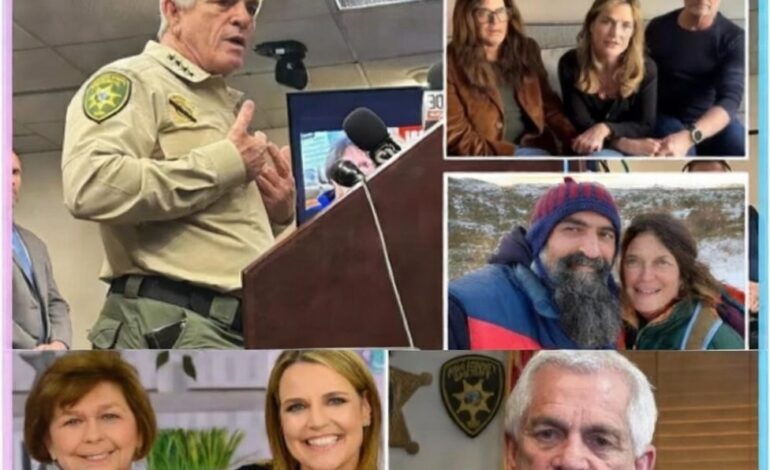

The headline is real but exaggerated. Here is a complete, sourced breakdown of every statement Nanos made, every criticism he faced, and every documented misstep in one of 2026’s most-watched investigations.
VERDICT: The underlying story is REAL. Sheriff Chris Nanos did push back hard against critics across multiple documented interviews in February 2026. He also made genuine admissions of missteps. However, the headline’s language — “snaps,” “changes everything,” and “haunting confession” — is sensationalized clickbait that overstates the drama. This article replaces the hype with documented facts.
Introduction: Why a County Sheriff Became a National Story
Most county sheriffs spend their careers outside the national spotlight. Tucson’s Pima County Sheriff Chris Nanos is not one of them — at least not since February 1, 2026.
That is when Nancy Guthrie, the 84-year-old mother of NBC Today show anchor Savannah Guthrie, vanished from her Catalina Foothills home under circumstances investigators immediately treated as a crime. Within days, Nanos was running one of the most-watched missing persons investigations in recent American history — with every decision dissected by journalists, retired FBI agents, true crime podcasters, and millions of viewers worldwide.
By mid-February, the criticism had grown louder than the leads. Nanos pushed back — repeatedly, publicly, and sometimes combatively. This article documents exactly what he said, what his critics said, and what the record actually shows.
SECTION 1: The Case — Essential Background
What Happened on February 1, 2026
Nancy Guthrie, 84, was last seen on the evening of Saturday, January 31, 2026, when her son-in-law Tommaso Cioni dropped her off at her home at approximately 9:50 p.m. The next morning she failed to appear for a scheduled church service livestream. Family members went to her home around 11 a.m., found no trace of her, and called 911 at noon.
Deputies responding to the scene found Nancy’s phone and personal belongings still inside. Bloodstains confirmed to belong to Nancy were found on the porch. A masked suspect had been captured on her doorbell camera attempting to dismantle it in the early hours of February 1. The Pima County Sheriff’s Department declared the home a crime scene and brought in homicide investigators the following day.
Key physical evidence identified included a black Ozark Trail 25-liter backpack (sold exclusively at Walmart), a black glove found two miles from the home, and DNA that returned no match in the FBI’s CODIS database. Multiple ransom notes with cryptocurrency demands were sent to TMZ, with two deadlines passing without contact.
STATUS: As of March 4, 2026 — more than 30 days since her disappearance — Nancy Guthrie has not been found. No arrests have been made. A dedicated homicide team remains assigned to the case. The investigation is active.
SECTION 2: The Criticism — What Was Said and Who Said It
The criticism of Sheriff Nanos was not confined to social media. It came from within his own department, from fellow Democrats, from retired law enforcement professionals, and from national media. Here is the documented record.
The Deputies’ Union — Criticism From Inside the Department
Sgt. Aaron Cross, president of the Pima County Deputies Organization and a past political opponent of Nanos, gave one of the sharpest assessments. He told the New York Post:
“It is a common belief in this agency that this case has become an ego case for Sheriff Nanos.”
— Sgt. Aaron Cross, President, Pima County Deputies Organization
Cross also told AZPM that the FBI should have taken the lead from the beginning, saying the department simply does not have the resources or expertise that a large federal agency can provide. This is a significant charge — it came not from partisan critics, but from a senior officer inside Nanos’s own department.
The Reuters Report — FBI Tension Over Evidence
On February 12, 2026, Reuters published a report describing escalating tension between local and federal investigators. The core allegation: Nanos had refused the FBI’s request to send key physical evidence — including the black glove and DNA samples from Guthrie’s home — to the FBI’s national crime laboratory in Quantico, Virginia. Nanos instead directed the evidence to a private lab in Florida.
Multiple former FBI agents publicly criticized this decision. Retired Special Agent Steve Moore said that handling evidence at multiple labs could potentially degrade it. Former FBI Agent Robin Drake, speaking on a podcast, said on a high-profile case of this nature, the standard practice would be to use the FBI’s own accredited facility from day one.
The Former Department Chief — 46 Years of Perspective
Richard Kastigar Jr., who served as the department’s chief for 46 years before retiring in 2023, spoke to the Daily Mail:
“All the evidence should have gone to Quantico from the beginning. Chris is keeping this tight inner circle and not letting anyone in because he’s unwilling to turn the investigation over to the FBI so he can tightly control it himself.”
— Richard Kastigar Jr., Former Pima County Sheriff’s Department Chief
Kastigar called Nanos a “quintessential micromanager” who is “not effective.” These are unusually blunt words from someone who spent nearly five decades in the same organization.
The Basketball Game
Early in the investigation, photographs showed Nanos attending a University of Arizona basketball game. The optics drew immediate criticism. Dr. Matt Heinz, a Democrat serving on Pima County’s governing board and therefore a political ally of Nanos, was not forgiving.
“That does not look good. I mean, dude, watch the game at home. Read the room.”
— Dr. Matt Heinz, Democrat, Pima County Board of Supervisors
The Crime Scene Release — and Return
Another documented point of criticism: Nanos released Nancy Guthrie’s home back to the family before investigators returned the following day to re-examine it. In the interim, journalists had walked up to the front door and photographed blood droplets on the porch — evidence that should have been protected. Nanos later acknowledged this was a misstep.
The FBI Frustration — Federal Sources on Record
Federal sources cited by the New York Post described growing frustration within the FBI. One source said: “Over two whole weeks into this, the police have made no leads, no progress.” A Daily Mail report cited sources saying the FBI felt it was being “stonewalled” and was uncertain why.
SECTION 3: Nanos Responds — Every Statement, Documented
Beginning around February 13, Nanos launched an intensive campaign of one-on-one media interviews. Rather than holding general press conferences, he chose individual sit-downs — a strategy itself criticized as a way to control his message. Here is what he said.
The AZPM Interview — February 13, 2026
In a sit-down with AZPM’s Katya Mendoza, Nanos addressed the Reuters report directly and forcefully:
“To suggest the sheriff blocked evidence is just crazy.”
— Sheriff Chris Nanos, AZPM interview, February 13, 2026
He said local law enforcement and the FBI had been strongly united throughout the investigation and that accusations of blocking FBI partners were wrong. He confirmed that his department would share all available data to get the case solved.
His Explanation for the Private Florida Lab
On the decision to use a private Florida lab rather than Quantico, Nanos offered a specific justification: he wanted to keep related evidence together for consistency. He argued that splitting the evidence chain between labs would create complications in any future prosecution.
This explanation was noted — but not warmly received — by retired FBI agents who spoke publicly on the case. Former Agent Robin Drake told podcaster Brian Entin that the FBI lab at Quantico is the gold standard precisely because it is equipped to handle complex, mixed-DNA evidence exactly like what was found in this case.
The Fox 10 Interview — February 17, 2026
In a 13-minute interview with FOX 10 Investigator Justin Lum, Nanos provided the most complete defense of his decisions to date. He reiterated that the FBI and his department were cooperating, pushed back on characterizations of tension, and specifically addressed the crime scene controversy:
“Right now, our focus is on this investigation and serving the victims and this community. Internal or political commentary distracts from this active investigation, and it is very unfortunate. My focus remains on justice and transparency.”
— Sheriff Nanos, official statement issued February 19, 2026
The Misstep Admission — His Most Significant Concession
In what the AP described as a notable acknowledgment, Nanos admitted he should have waited longer before releasing the crime scene to the family. He told the Green Valley News, in response to questions about his department’s pace:
“It’s never fast enough for the sheriff. I want it like you. Come on, guys, let’s go. Let’s go, let us find her. But the reality is, I also know that sometimes things take time.”
— Sheriff Chris Nanos, NBC Nightly News interview
On the basketball game, he was less apologetic. He told reporters that no one — not even a sheriff — can work around the clock, and said he would “have to live with that image.”
The NewsNation Confrontation — Turning the Tables
Perhaps Nanos’s most combative media moment came during a NewsNation interview. When journalist Brian Entin presented a list of criticisms of the investigation, Nanos challenged each one directly:
“Every single one of those can be disputed. They’re completely without any factual basis to them. And that inaccuracy I would think your team — your producers and network — would want to resolve.”
— Sheriff Nanos, NewsNation interview
The Hollywood Reporter noted that Nanos’s confrontational posture, while understandable given the pressure he was under, was not well-received in media circles. As the Reporter put it, he was arguably in over his head — and what county sheriff in America wouldn’t be?
Warning to Online Sleuths — February 25, 2026
One of Nanos’s most pointed public remarks came in a context many people missed. On February 25, the New York Times published a story about Dominic Evans — an Arizona fifth-grade teacher who had been falsely identified as a suspect by online amateur investigators. Evans was doxxed, his home address was leaked, and dozens of people showed up outside his house overnight, forcing his children to be sent away for their safety.
When asked about Evans’s situation, Nanos delivered a striking statement that doubled as a warning to the true crime community:
“He’s going through hell and it is horrible. And I don’t know what to tell him except he probably should be speaking with some attorneys and sue some of these people for libel.”
— Sheriff Chris Nanos, February 25, 2026
This was not a manufactured controversy. It was a documented call for legal accountability for online vigilantism — and one of the few moments where Nanos received broadly positive coverage.
SECTION 4: The Headline — What Is Real and What Is Exaggerated
Now that we have the documented record, let’s evaluate the original headline against it.
| Headline Claim | Reality | Rating |
| Nanos has been “accused of botching the case” | TRUE — documented criticism from his own deputies’ union, a former department chief, federal sources, and fellow Democrats | Accurate |
| He “fired back at critics” | TRUE — he gave multiple combative one-on-one interviews disputing specific charges | Accurate |
| He made a “haunting confession” | OVERSTATED — he admitted he should have held the crime scene longer. That is a documented misstep, not a haunting confession | Exaggerated |
| His warning “changes everything” | FALSE FRAMING — his libel warning to online sleuths is significant, but it changed nothing about the investigation itself | Misleading |
| “Weeks of silence” | FALSE — Nanos gave extensive media interviews throughout the investigation, sometimes criticized for talking too much | Inaccurate |
| The Nanos-FBI tension is real | TRUE — Reuters, Daily Mail, New York Post, and AZPM all documented the conflict independently | Accurate |
SECTION 5: The Broader Context — Is Nanos Unusual or Just Under a Microscope?
To be fair to Chris Nanos, the critics making the harshest assessments have their own interests. Sgt. Aaron Cross ran against him in a previous election. Some sources in national media are ideologically opposed to Nanos as a Democrat. That does not make their specific claims false, but it is context worth understanding.
What Defenders Say
Retired chief U.S. Marshal Tom Morrissey, a Republican, declined to criticize Nanos. He pointed out the genuine difficulty of informing the public while simultaneously protecting information from suspects who are watching the investigation closely. That is a real tension in any high-profile case.
Dr. Heinz, despite his “read the room” comment, also acknowledged that law enforcement leaders face impossible demands during high-profile investigations — and that the pressure to hold constant press briefings can sometimes harm, not help, an investigation.
What the DNA Delay Reveals
The most substantive documented concern remains the DNA evidence timeline. Nanos confirmed in his NBC Nightly News interview that the private Florida lab had found mixed DNA — meaning DNA from multiple individuals — which creates a more complex analysis challenge. He acknowledged this could take months to resolve.
Retired FBI agent Steve Moore said on the Brian Entin Investigates podcast that this is exactly why the FBI’s Quantico lab should have handled the evidence: it is equipped for precisely these complex, mixed-profile scenarios, and has the fastest turnaround time for priority cases.
KEY QUESTION: Every day of DNA processing delay is a day that could matter for an 84-year-old woman who requires daily medication for a pacemaker condition. Whatever the merits of Nanos’s lab decision, the consequence of delay in a case like this is not abstract.
SECTION 6: The Investigation Status as of March 4, 2026
What Investigators Have Confirmed
- Nancy Guthrie has been missing since February 1, 2026 — more than 30 days.
- A dedicated homicide team is assigned, though investigators are still operating under the assumption she may be alive.
- A man was detained in Rio Rico on February 10, questioned extensively, and released without charges.
- A SWAT operation was conducted at a residence two miles from the Guthrie home on February 13; two individuals were removed and the area sealed for several hours.
- A black glove found two miles from the home was DNA-tested; results are inconclusive due to mixed DNA profiles.
- The Guthrie family has been cleared as suspects. Nanos called them victims and urged media to stop speculating about them.
- The reward stands at over $200,000, including $100,000 from the FBI.
- Google was brought in on February 18 to attempt to extract additional footage from home camera systems.
- Investigators are pursuing investigative genetic genealogy as a potential path forward.
What Remains Unknown
- Nancy Guthrie’s whereabouts and condition.
- The identity of the masked suspect captured on the doorbell camera.
- Whether the ransom notes received by TMZ are genuine or opportunistic.
- Whether the investigation will shift entirely to FBI control.
SECTION 7: People Also Ask — Answered Directly
Has Sheriff Nanos botched the Nancy Guthrie investigation?
Multiple documented sources — including his own deputies’ union president, a former department chief, federal sources, and a fellow Democrat — have raised serious criticisms of specific decisions: the private lab choice, the premature crime scene release, and the management of FBI cooperation. Nanos has disputed each of these characterizations. Whether they amount to “botching” is a judgment call, but the underlying criticisms are real and on the record.
Why did Nanos send DNA to a private lab instead of the FBI’s lab in Quantico?
Nanos said he wanted to keep related evidence together in one location for consistency, and that splitting evidence between labs could complicate a future prosecution. Former FBI agents have publicly disagreed, arguing the FBI lab at Quantico is better equipped to handle complex mixed-DNA profiles and is the standard choice in federal-level cases.
What did Sheriff Nanos admit was a mistake?
Nanos acknowledged he should have waited longer before releasing Nancy Guthrie’s home to the family. Before investigators returned to re-examine the property, journalists had walked up to the front door and photographed blood evidence on the porch. Nanos accepted that this was handled poorly.
What is the “haunting confession” referenced in viral headlines?
The phrase is clickbait exaggeration. The only documented admission Nanos made was about the premature crime scene release. His acknowledgment that the DNA analysis “could take months” was a factual update, not a confession. No dramatic revelation or haunting disclosure has been documented in any verified news source.
Who is Dominic Evans in the Nancy Guthrie case?
Dominic Evans is an Arizona fifth-grade teacher who was falsely identified as a suspect by online amateur sleuths. He was doxxed, his home address was leaked, and people showed up outside his house overnight, forcing his family to send their children away. Sheriff Nanos publicly empathized with Evans and said he should consider suing online investigators for libel.
Has Nancy Guthrie been found?
No. As of March 4, 2026, Nancy Guthrie has not been located. The investigation remains active. Tips can be submitted to the FBI at 1-800-CALL-FBI or tips.fbi.gov.
Key Takeaways
- The headline’s core claim is real: Sheriff Nanos did push back against mounting criticism across multiple documented interviews in February 2026.
- The language of the headline — “snaps,” “haunting confession,” “changes everything” — is sensationalized. These phrases overstate what Nanos actually said.
- The Nanos-FBI tension is REAL and multiply sourced: Reuters, Daily Mail, New York Post, AZPM, and the Hollywood Reporter all documented it independently.
- Nanos’s most significant admission — that he should have held the crime scene longer — is a documented misstep, not a haunting confession.
- His most notable statement — encouraging Dominic Evans to sue online sleuths for libel — is the closest thing to a genuine “warning,” and it addressed online vigilantism, not the investigation itself.
- The DNA delay remains the most substantive documented concern: a private Florida lab is handling complex mixed-DNA profiles that multiple former FBI agents said should have gone to Quantico.
- Nancy Guthrie is still missing. If you have information, contact the FBI: 1-800-CALL-FBI or tips.fbi.gov.
Sources: AZPM (February 13, 2026), FOX 10 Phoenix, Parade, Hollywood Reporter, AP via AZPM, Reuters (February 12, 2026), Daily Mail, New York Post, Fox News Digital, Men’s Journal, Wikipedia: Disappearance of Nancy Guthrie (updated March 2026). All quotes and facts verified against published, attributed reporting as of March 4, 2026.
Discover more from MatterDigest
Subscribe to get the latest posts sent to your email.