She Spent Her Life Saving Cancer Patients—Then Doctors Told Her She Had It Too
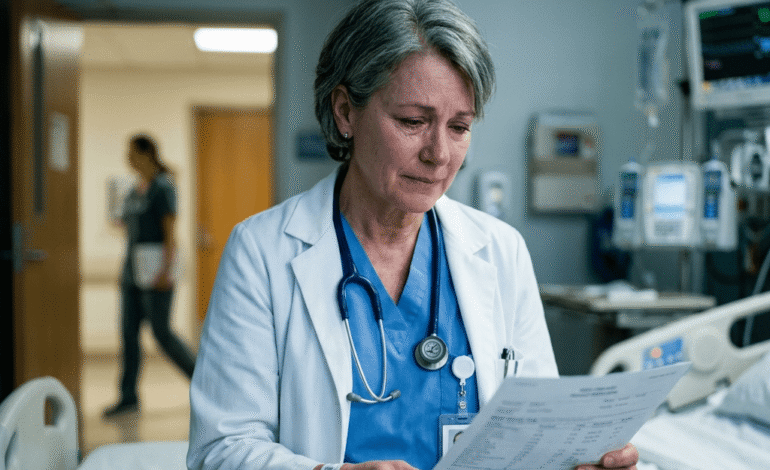

She Spent Her Career Saving Cancer Patients. Then She Became One.
There are moments in life that arrive without warning and rearrange everything. A phone call that changes the air in a room. A sentence from a doctor that makes the world go quiet. A symptom so subtle, so easy to brush off as nothing, that most people would never have thought twice about it.
Dr. Rebecca Jane Brown almost didn’t think twice about it either.
She was thirty years old. She was in the middle of her oncology training — the specialty dedicated to understanding, fighting, and treating cancer. Every day, she sat with patients navigating one of life’s most terrifying diagnoses. She knew what cancer looked like. She knew its language, its behavior, its cruelty and its occasional mercy.
And then, on an ordinary night out with friends in the summer of 2023, something happened that would set in motion a chain of events her medical training had never truly prepared her for.
Not because she didn’t know the science. But because nothing prepares you for the moment you stop being the doctor and become the patient.
The Night Everything Changed
It started with something so mundane it barely registered as a symptom.
After a night out in June 2023, Becca — as her family and friends called her — realized she couldn’t urinate. It was uncomfortable, confusing, the kind of thing that makes you wonder if you’re just dehydrated or overtired. But Becca, with the clinical instincts of someone trained to take the body’s signals seriously, didn’t dismiss it.
She went to the emergency room. Not just any emergency room — the one at the hospital in Poole, the seaside town in southern England where she worked. The hospital where she knew the corridors, the staff, the rhythms of shift changes. She walked into that building not as Dr. Brown, but as a worried thirty-year-old who knew just enough medicine to be more afraid than the average person in that waiting room.
The immediate concern was treated, but over the days that followed, something else emerged. Her abdomen began to swell. Noticeably. Persistently. Her sister Sophie later described it in a video for the charity Stand Up To Cancer: Becca noticed the distension and knew it wasn’t normal.
This time, her consultant ordered a scan.
What it revealed was a large ovarian cyst — approximately 5.5 inches across. Significant, but not immediately alarming. Ovarian cysts are common. Many are benign. Many are removed without complication and the story ends there. Surgery was scheduled. The cyst was taken out.
And yet. The symptoms didn’t go away.
When “Normal” Results Aren’t Reassuring Enough
This is where Becca’s story enters its most quietly devastating chapter — the one that happens in the space between a first diagnosis and the truth.
Most of her cancer markers came back normal. To the outside world, to family and friends hoping for the best, this was reassuring news. Her mother, Monica, later reflected that the early signs hadn’t seemed ominous. On paper, the numbers looked manageable. The situation appeared to be resolving.
But her father, Martin, said something that cuts to the heart of what made Becca both an exceptional doctor and an impossible patient to deceive: “I think she knew things still weren’t right.”
She knew. Not because the tests told her. But because she was living inside the body that the tests were measuring, and she understood, with the knowledge of someone who had trained in oncology, that numbers on a page don’t always capture the full story.
A second surgery was performed, this time to try to identify what was still causing her symptoms. Her family held onto hope. In those peculiar, suspended hours of waiting for surgical results, families tell themselves the best possible version of the outcome. They replay reassuring conversations. They remind each other of the normal markers, the competent surgeons, the young age of the patient.
The doctors — her colleagues, people she had worked beside in the oncology unit — delivered the news themselves.
Becca had a rare, aggressive form of ovarian cancer. And it had not stayed in one place. It had spread to her lungs, her breasts, and her lymph nodes. It had moved through her body quietly, doing what the most dangerous cancers do — using time against the people trying to stop it.
She was transferred to the oncology ward.
The same one where she had been a doctor.
The Other Side of the Bed
There is a particular kind of heartbreak in Sophie’s words when she described what happened next.
“The ward she was on, being looked after — she’d worked with them. They were her colleagues. She was the patient. They were the carers. She’d been on the other side of that.”
Try, for a moment, to truly imagine it. To walk into a unit you know intimately — where you’ve stood at the foot of beds delivering difficult news, where you’ve reviewed charts and discussed treatment plans and offered reassurance to people who were terrified — and to be guided to a bed yourself. To watch the people you’ve worked alongside adjust from colleague to caregiver. To be on the receiving end of the kindness you once gave.
It’s a role reversal that has no real precedent. Most people who receive a devastating diagnosis do so in a place that is foreign to them — an institutional space they’re encountering for the first time, filled with strangers in scrubs. Becca knew every corner of that ward. She knew the names of the nurses, the routines of the day shifts, probably the specific way the light came through the windows in the afternoon.
And she knew, with a precision that no amount of hope could blunt, exactly what her diagnosis meant.
Because here is the truth about rare, aggressive ovarian cancers that have metastasized to multiple organ systems: the medical community has made remarkable strides in treating many forms of cancer, but metastatic ovarian cancer — particularly fast-moving, treatment-resistant variants — remains one of the most formidable opponents in oncology. Becca would have known the survival statistics. She would have understood what “spread to the lungs, breasts, and lymph nodes” meant for her prognosis.
She smiled anyway.
The Smile That Never Left
Her family had a nickname for Becca that began before she had any idea what oncology was, before she knew what a lymph node was or what a cyst looked like on a scan.
“Our nickname for Becca, as a small baby, was Smiler,” her mother said.
Her father added, simply: “People, I don’t think, ever saw Becca not smiling.”
It would be easy to interpret this as the kind of thing families say about people they’ve lost — a warm, gentle idealization driven by grief. But the details of Becca’s story suggest something more specific and more remarkable. This wasn’t a woman in denial. She had too much medical knowledge for denial to have been a comfortable refuge. She knew what was happening inside her body. She understood the odds.
And she chose, consciously, repeatedly, and apparently with genuine consistency, to remain herself. To keep the quality that had defined her since before she could articulate her own name.
This is not a small thing. For anyone who has spent time around people facing terminal illness — as Becca had, professionally, before her own diagnosis — the emotional labor of maintaining warmth in the face of that kind of knowledge is extraordinary. It is a choice made fresh every morning. Sometimes every hour.
She had grown up, in part, in the United States, spending her earliest years there before her family returned to the UK. She had chosen one of the most emotionally demanding specialties in medicine. She had built a career around sitting with people in their hardest moments. And when the hardest moment arrived in her own life, she did not seem to abandon the instincts that had defined her.
The Cruelest Chapter
Chemotherapy began. And with it, something that families of cancer patients know as one of the most fragile and precious things in medicine: hope.
The first round of treatment brought it. The way that first rounds of chemotherapy sometimes do — a brief, beautiful window where the disease appears to respond, where the body seems to be fighting back, where it feels possible to imagine a future on the other side of all of this.
And then Becca mentioned, almost in passing, that her stomach felt “a bit swollen.”
Those words. That small, familiar phrase. The same category of symptom that had started everything — a distension, a discomfort that could have been nothing. But by now, everyone in Becca’s world had learned that symptoms like these were not nothing.
The cancer had reached her bowel.
When a metastatic cancer advances despite treatment and finds new territory in the body, the medical options narrow rapidly. The conversation shifts from “how do we stop this” to “how do we make whatever time remains as full and as comfortable as possible.” It is one of the most difficult conversations in medicine to have — and one that Becca had been part of, professionally, many times before.
Now it was her family sitting in those chairs.
There were no remaining treatment avenues that could change the outcome. What remained was something medicine can offer but cannot manufacture: presence. Time. The company of the people who loved her most.
How She Left
Becca spent her final days surrounded by her family — her mother Monica, her father Martin, her sister Sophie, the people who had given her the nickname Smiler before she even knew how to walk.
Seven months. That was the full span between the night she couldn’t go to the toilet after a night out with friends and the morning her life ended. Seven months from an unusual symptom to a funeral. In that timeframe, she had been diagnosed, operated on twice, transferred to the ward where she had worked, undergone chemotherapy, watched the cancer advance despite treatment, and somehow — somehow — maintained the warmth that had defined her since she was an infant.
Her mother described the end with words that will stay with anyone who reads them.
“She lay into my shoulder. When she came into this world, I held her, and as she left this world, I held her too.”
There are sentences that contain entire universes. That is one of them. The image of a mother holding her daughter at both the beginning and the end of her life — bookending thirty years of love, laughter, medical school, oncology wards, patients helped, nicknames earned, and smiles given freely — is almost too much to hold.
Almost. But not quite.
What Becca’s Story Is Really Asking Us to Hear
It would be possible to read Becca’s story purely as a tragedy. And it is a tragedy — a profound, unnecessary, heartbreaking one. A brilliant young doctor who dedicated herself to fighting a disease that then claimed her own life, with a ferocity and speed that even her medical training couldn’t fully prepare her for.
But Becca’s family shared her story publicly, through Stand Up To Cancer, for a reason. Not only to honor her, though they do that too. But because there are things embedded in this story that the rest of us need to sit with.
The first is about symptoms. Becca’s presenting symptom — the inability to urinate following a normal night out — is not one that most people would recognize as a potential cancer warning sign. It isn’t on the standard lists. It doesn’t appear in the awareness campaigns. And yet, for Becca, it was the thread that, when pulled, revealed everything. Ovarian cancer in particular is notorious in medical circles for producing vague, easily dismissed early symptoms: bloating, urinary changes, pelvic discomfort, a feeling that something is simply “not right.” These symptoms are frequently attributed to stress, digestive issues, or the general noise of a busy life.
Becca noticed. She acted. And even with her medical knowledge, even with immediate access to diagnostic tools and specialist colleagues, the cancer had already spread.
This is what makes ovarian cancer so dangerous, and why awareness of even its quietest signals is so urgent. Not because early detection is always possible. But because it is sometimes possible — and every time it is, it matters.
The second thing Becca’s story asks us to hear is harder to articulate but no less important. It’s something about how a person chooses to exist inside circumstances they didn’t choose. Becca didn’t choose her diagnosis. She didn’t choose to be thirty years old and lying in the oncology ward where she had once stood on the other side of the bed. She didn’t choose to have seven months instead of seven decades.
But she chose, apparently every day, to be herself. To smile. To remain.
The Questions She Left Behind
Becca Brown was thirty years old when she died. She had already done more than many people do in twice that time — not in terms of accolades or accomplishments, but in terms of the quality of presence she brought to her work, her patients, and the people who loved her.
Her story raises a question that doesn’t have a clean answer, but deserves to be asked out loud:
How many people right now are brushing off a symptom that their body is trying to use to tell them something important? How many are waiting — for the right moment, for it to go away on its own, for a sign that it’s serious enough to bother a doctor about?
Becca was a doctor. She had every reason and every ability to take her symptom seriously, and she did. Her story is not a cautionary tale about what happens when people ignore warning signs. It’s something more complex and more painful than that — a reminder that even when we do everything right, some cancers move faster than medicine can follow.
But it is also a reminder that the people we share our lives with — even briefly, even across a hospital ward, even in the form of a thirty-year-old doctor who smiled at everyone she met — leave something behind that doesn’t end when they do.
Monica held her daughter when she arrived in this world. She held her again when she left it.
In between those two moments, Becca Brown lived fully, loved genuinely, and faced the worst with more grace than most of us will ever be called upon to demonstrate.
That is not a small life. That is an extraordinary one.
Discover more from MatterDigest
Subscribe to get the latest posts sent to your email.