Senate Chaos Erupts Rand Paul and Markwayne Mullin Clash So Hard the Hearing Was Forced to Stop

Rand Paul vs. Markwayne Mullin: The Senate Showdown That Stopped a Confirmation Hearing Cold
What Happened at the Senate Hearing?
Picture this: a confirmation hearing for the next Secretary of Homeland Security grinds to a halt — not over immigration policy, not over national security strategy — but over a years-old comment about a violent assault. That’s exactly what unfolded in Washington on March 18, 2026.
Senator Rand Paul (R-KY) used his role as chair of the Senate Homeland Security Committee to confront Senator Markwayne Mullin (R-OK) — Trump’s nominee to lead the Department of Homeland Security — face to face, on the record, and on camera.
The first 15 minutes of the hearing had virtually nothing to do with border enforcement or agency oversight. Instead, they were consumed by one of the most personal and charged exchanges seen in a Senate committee in years. Paul accused Mullin of endorsing political violence. Mullin refused to apologize. And the American public watched two Republican senators air their deep-seated grievances in front of the entire country.
This article covers the full story — what was said, what it means, and why it matters beyond the political drama.
Quick Answer: At Markwayne Mullin’s March 18, 2026 DHS confirmation hearing, Senator Rand Paul publicly challenged Mullin to defend past comments in which Mullin called Paul a “freaking snake” and said he “understood” why a neighbor attacked Paul in 2017, leaving him with six broken ribs and a damaged lung. Mullin never apologized.
Background: The 2017 Assault on Rand Paul
To understand why this confrontation matters, you need to know what happened in 2017.
In November of that year, Rand Paul was mowing his lawn at his Bowling Green, Kentucky home when his neighbor, Rene Boucher, attacked him from behind without warning. The assault was swift, brutal, and unprovoked. Paul suffered six broken ribs and a damaged lung. The recovery was long and painful — Paul later described the sensation as feeling like “1,000 knives.”
This wasn’t a minor scuffle. Broken ribs can puncture lungs, cause internal bleeding, and lead to serious long-term complications. Paul was a physician before entering politics, so he understood, better than most, exactly how serious his injuries were.
Boucher was later sentenced to 30 days in jail and fined $10,000 after pleading guilty to assaulting a member of Congress.
The attack reportedly stemmed from a neighbor dispute, but the details don’t change the core fact: a sitting U.S. senator was seriously assaulted in his own yard. That’s not something anyone in public life should need to defend. Or so you might think.
What Did Markwayne Mullin Actually Say?
Here’s where it gets complicated.
According to Senator Paul, Mullin made inflammatory remarks in the years following the 2017 attack. Paul alleged that when constituents confronted Mullin about his voting record — specifically, votes to continue welfare programs for refugees — Mullin deflected by attacking Paul personally rather than defending his own policy positions.
“You told the media that I was a ‘freaking snake’ and that you completely understood why I had been assaulted.”
— Sen. Rand Paul, opening statement, March 18, 2026
Paul further alleged that Mullin had boasted about telling Paul this to his face — a claim Paul flatly denied, saying Mullin had never had the courage to say it directly.
Mullin, for his part, did not deny making the comments. At the hearing, he clarified his wording slightly: “I said I could understand, because of the behavior you were having, that I can understand why your neighbor did what he did.” He also referenced historical precedents for physical confrontation in politics — such as caning and dueling — a comment that only added fuel to the fire.
The distinction Mullin drew — between “understanding” and “supporting” — did not satisfy Paul, who pressed him repeatedly on whether he believed political violence was acceptable.
The Face-to-Face Confrontation: A Blow-by-Blow Account
Paul’s Opening Salvo
Paul opened the hearing not with pleasantries or procedural remarks, but with a direct personal challenge to the man sitting before him.
He recounted the details of the 2017 assault. He described his injuries. He talked about the impact on his family. And then he turned the spotlight squarely on Mullin.
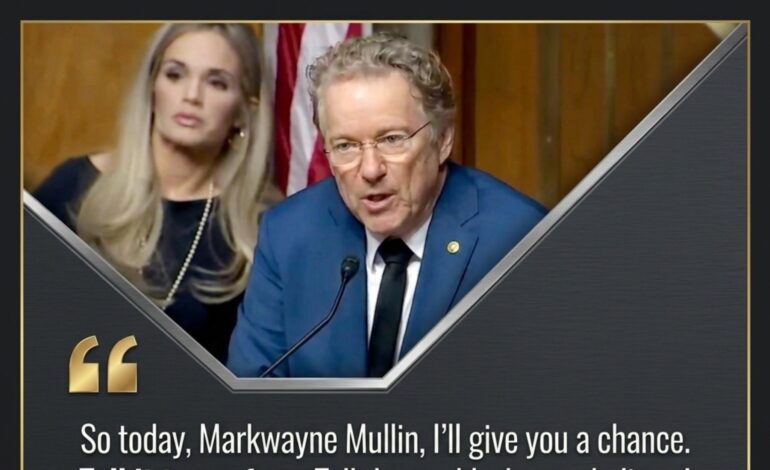
“You have never had the courage to look me in the eye and tell me that the assault was justified, so today you’ll have your chance. Tell it to my face, if that’s what you believe. Tell it to me today. Tell the world why you believe I deserve to be assaulted from behind.”
— Sen. Rand Paul
Paul also raised a broader, pointed question: Is a man with Mullin’s record of inflammatory rhetoric the right person to lead an agency like DHS — one that oversees more than 250,000 federal employees, including ICE agents and Border Patrol officers?
Paul Questions Mullin’s Temperament
Paul didn’t stop at the 2017 comments. He also brought up a notorious 2023 incident in which Mullin — then a senator on the Senate Health, Education, Labor and Pensions Committee — challenged Teamsters President Sean O’Brien to a physical fight during a hearing.
At the time, Mullin told O’Brien to “stand your butt up” before committee chairman Bernie Sanders stepped in to defuse the situation. Paul played a video clip of the exchange during the DHS hearing.
Paul’s argument was clear: this is a pattern, not a one-time slip of the tongue.
“Explain to the American public how a man who has no regrets about brawling in a Senate committee can set a proper example for over 250,000 men and women who work at the Department of Homeland Security.”
— Sen. Rand Paul
Mullin Fires Back
Mullin was not intimidated. He addressed Paul directly in his opening remarks, pointing out that Paul has opposed him in his political campaigns and characterizing Paul as someone who fights Republicans more than he works with them.
“I have to address the remarks the chairman made, calling me a liar,” Mullin said. “I don’t speak about people behind their backs.”
Mullin offered a kind of conditional olive branch — suggesting he could set aside their personal differences if Paul was willing to do the same — but he stopped far short of an apology for his past remarks.
“I have a job to do, and I don’t like to fail at anything at all. So I can set it aside if you’re willing to set it aside. Let me earn your respect.”
— Sen. Markwayne Mullin
Mullin’s Response and Non-Apology
Paul was direct about what he noticed — and what he didn’t hear.
“You offered no apology, and you offer no apology today, and no regrets,” Paul said during the questioning portion of the hearing. “Haven’t heard the word apologize. Haven’t heard the word regret. Haven’t heard ‘I misspoke and it was heated and I made a mistake.'”
Mullin confirmed this characterization, in a sense. He maintained that his comments were about understanding the context of the attack — not endorsing it. “I don’t believe in political violence,” he said. “I’ve made that very clear.”
But Paul wasn’t buying the distinction. His position: if Mullin understood why someone would physically assault a political opponent, that’s tacit endorsement. The semantics didn’t matter.
This standoff is notable because it highlights something rarely seen: a committee chair using a confirmation hearing to demand a personal accounting from the nominee — and receiving no satisfaction.
The Teamsters Incident: A Pattern of Behavior?
The 2023 Teamsters confrontation is important context here, and Paul made sure the committee didn’t forget it.
During that hearing, Mullin and Teamsters President Sean O’Brien had a verbal exchange that escalated rapidly. Mullin stood up and goaded O’Brien to fight him. Chairman Bernie Sanders had to intervene.
What makes this unusual — and what Paul emphasized — is that Mullin and O’Brien later became friends. O’Brien was actually present at the DHS confirmation hearing in a show of support for Mullin.
Paul’s point wasn’t necessarily that the O’Brien confrontation was unforgivable. It was that a man who responds to disagreement with threats of physical confrontation — and who tells the press he “understands” why a colleague was beaten — raises legitimate questions about temperament and judgment.
DHS is one of the largest federal agencies in the country. It oversees immigration enforcement, border security, disaster response, and cybersecurity. The tone set by its secretary filters down through a massive bureaucracy. Paul’s argument: character matters.
What This Means for Mullin’s DHS Nomination
Despite the explosive hearing, Mullin’s path to confirmation remained largely intact. Here’s why.
- Paul announced he would vote against Mullin — but Paul represents just one vote on the committee.
- Senator John Fetterman (D-PA), a Democratic committee member, said he would support Mullin, praising his “consistent kindness and professionalism.”
- Fetterman’s support is pivotal. It means Mullin can likely advance out of committee even without Paul’s vote.
- A simple majority is all that’s needed for full Senate confirmation.
Paul did threaten to delay the committee vote if Mullin refused to brief senators in a classified setting (SCIF) about an overseas trip Mullin took in 2015. Mullin agreed to that briefing, and Paul ultimately committed to holding the Thursday vote as planned.
So what’s the bottom line? The confrontation generated headlines, but it probably won’t derail the nomination.
Why Political Leaders Must Disavow Violence
Paul kept returning to one central theme throughout the hearing: elected officials carry a special responsibility to condemn political violence clearly and without qualification.
This isn’t a partisan point. In an era of elevated political tensions — when threats against members of Congress have increased significantly — the standards leaders set matter enormously.
“I think it’s imperative that the leaders in our country disavow violence and lead by example.”
— Sen. Rand Paul
Paul’s argument extends beyond his personal grievance. If the person leading DHS — an agency whose agents carry weapons and enforce the law — normalizes or shrugs at political violence, that has real downstream consequences.
Critics of Paul might point out that his own conduct and rhetoric haven’t always been above reproach. But the underlying principle he’s articulating is sound: leaders should model restraint, not aggression.
Whether you like Paul, dislike Mullin, or hold no opinion on either, the question he raised is a legitimate one for any Senate committee to consider.
People Also Ask: Key Questions Answered
What did Markwayne Mullin say about the Rand Paul assault?
Mullin reportedly called Paul a “freaking snake” and said he understood why Paul’s neighbor attacked him in 2017. At the confirmation hearing, Mullin clarified that he understood the context, not that he endorsed the violence — a distinction Paul rejected.
What injuries did Rand Paul suffer in the 2017 attack?
Paul suffered six broken ribs and a damaged lung when his neighbor, Rene Boucher, attacked him from behind at his Bowling Green, Kentucky home. He described the pain as feeling like “1,000 knives” during the confirmation hearing.
Did Mullin apologize to Rand Paul at the confirmation hearing?
No. Mullin did not apologize during the March 18, 2026 hearing. He said he “could understand” the context of the attack but did not use the words “apologize” or “regret,” which Paul noted explicitly on the record.
Will Markwayne Mullin be confirmed as DHS Secretary?
As of March 2026, Mullin’s confirmation appeared likely to proceed despite Paul’s opposition. Senator John Fetterman (D-PA) announced his support, which provides enough votes to advance the nomination out of committee.
What was the Teamsters incident involving Mullin?
During a 2023 Senate HELP Committee hearing, Mullin challenged Teamsters President Sean O’Brien to a physical fight, telling him to “stand your butt up.” Committee chairman Bernie Sanders intervened. Paul cited this episode at the DHS hearing as evidence of a troubling pattern.
Paul vs. Mullin: Key Positions at a Glance
| Issue | Rand Paul’s Position | Mullin’s Response |
| 2017 Assault Comments | Constitutes endorsement of violence | He “understood” context, not violence |
| Apology | Demanded a clear apology | Refused to apologize |
| Mullin’s nomination | Voting against; questions DHS fitness | “Let me earn your respect” |
| Teamsters incident | Evidence of anger issues, disqualifying | O’Brien now a friend; resolved |
Discover more from MatterDigest
Subscribe to get the latest posts sent to your email.