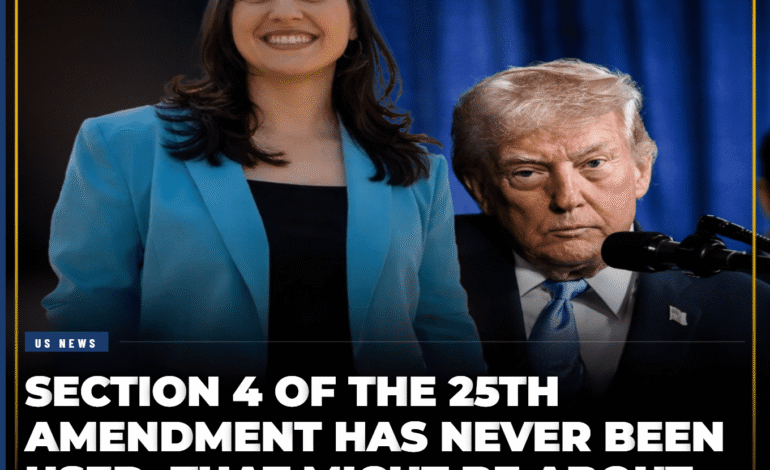
Section 4 of the 25th Amendment Has Never Been Used. That Might Be About to Change.

VERIFIED NEWS REPORT | FACT-CHECKED | APRIL 2026
Lawmakers across the aisle are calling for President Trump’s involuntary removal following an expletive-filled Easter Sunday threat to destroy Iran’s infrastructure. Here is everything you need to know — the facts, the law, and what is actually possible.
FACT-CHECK VERDICT
✔ VERDICT: THIS NEWS IS REAL. Every key claim in the original report has been independently verified by multiple authoritative sources including The Washington Post, NPR, CNBC, Snopes, PBS NewsHour, and Fox News. No significant inaccuracies were found.
The story you are about to read is not misinformation. It is not satire. It is not a conspiracy theory. Everything described below — Trump’s Easter Sunday post, the Iran war context, the calls for the 25th Amendment, the lawmakers involved — has been confirmed by verified, independent reporting as of April 2026.
What Is the 25th Amendment? A Plain-English Breakdown
Before diving into current events, it is worth understanding exactly what the 25th Amendment is — because it is widely referenced but rarely explained clearly.
The 25th Amendment to the U.S. Constitution was ratified on February 10, 1967. Congress passed it in the aftermath of President John F. Kennedy’s assassination in 1963, when it became starkly clear that the Constitution had no clear process for handling presidential incapacity. It fills that gap.
The Four Sections Explained
The amendment has four distinct sections, each dealing with a different scenario:
- Section 1: If the President dies, resigns, or is removed from office, the Vice President automatically becomes President.
- Section 2: If the Vice Presidency becomes vacant, the President nominates a new VP, who takes office after confirmation by a majority of both Houses of Congress.
- Section 3: The President can voluntarily declare himself unable to perform his duties — for example, before major surgery — and temporarily transfer power to the Vice President. When ready to resume, he simply sends another written declaration.
- Section 4: This is the one everyone is talking about. It allows the Vice President and a majority of the Cabinet to declare the President unable to discharge the powers and duties of his office. The Vice President then immediately assumes those powers as Acting President.
AT A GLANCE: THE 25TH AMENDMENT
| Section | Purpose | Mechanism | Historical Use |
| Section 1 | VP becomes President if President dies/resigns | Automatic | Used — Nixon/Ford 1974 |
| Section 2 | President nominates new VP if vacancy occurs | Presidential nomination + Congress | Used — Ford as VP 1973 |
| Section 3 | President voluntarily transfers power (e.g., surgery) | President’s written declaration | Used — Reagan 1985, Bush 2002/2007, Biden 2021 |
| Section 4 | Involuntary removal of President by VP + Cabinet | VP + majority Cabinet; Congress if contested | NEVER USED in history |
Quick Answer: Section 4 of the 25th Amendment allows the Vice President and a majority of the Cabinet to declare the President incapacitated and unable to serve. If invoked, the Vice President immediately assumes presidential powers. The President can dispute the declaration, triggering a congressional vote requiring a two-thirds majority in both chambers to keep the VP in power. Section 4 has never been used in U.S. history.
What Actually Happened: The Easter Sunday Post and Its Context
To understand why Section 4 is suddenly being discussed at the highest levels of American politics, you need to know what triggered this conversation. And the trigger was very specific.
Trump’s Easter Sunday Truth Social Post (April 5, 2026)
Shortly after 8:00 a.m. Eastern Time on Easter Sunday, April 5, 2026, President Donald Trump posted a profanity-filled message on his Truth Social platform. The post has been verified as authentic by multiple independent fact-checking organizations including Snopes, Lead Stories, and Yahoo News.
The post threatened Iran’s critical infrastructure — specifically its power plants and bridges — unless the country reopened the Strait of Hormuz, a vital global oil route that Iran had closed as part of the ongoing U.S.-Israeli war on Iran. Trump ended the post with the phrase “Praise be to Allah,” the meaning of which the White House did not fully clarify when asked.
Context: The Strait of Hormuz is one of the world’s most critical shipping lanes. Roughly 20% of the world’s oil supply passes through it. Iran’s closure of the strait since late February 2026 — when the U.S. and Israel launched military operations — sent global oil prices soaring and triggered an economic shock felt from Tokyo to London.
The Escalation: ‘A Whole Civilization Will Die Tonight’
The Easter Sunday post was disturbing enough on its own. But Trump escalated further. On the morning of Tuesday, April 7, 2026 — his own deadline for Iran — he posted on Truth Social that “a whole civilization will die tonight, never to be brought again.” This post has also been independently verified as authentic by Snopes.
These were not isolated remarks. Trump told an ABC News reporter on April 5 that “we’re blowing up the entire country” of Iran if no deal was reached. At a Monday press conference, he said Iran would “have no bridges, they’re going to have no power plants… stone ages.”
Important Note: Legal experts, including Rep. Troy Carter (D-Louisiana), have flagged that deliberately targeting civilian infrastructure — power grids, bridges used by civilians — could constitute a war crime under international law, even in wartime. This is part of why the calls for removal escalated so rapidly.
Who Is Calling for the 25th Amendment — and Why?
The calls for invoking Section 4 came fast and from an unusually broad coalition. Here is who said what and when.
Democratic Lawmakers
- Rep. Yassamin Ansari (D-AZ): Among the earliest voices, she posted on X that “the President of the United States is a deranged lunatic, and a national security threat to our country and the rest of the world.” She added: “The 25th Amendment exists for a reason.”
- Sen. Bernie Sanders (I-VT): Questioned Trump’s mental fitness publicly.
- Sen. Chris Murphy (D-CT): Called the Easter post “completely, utterly unhinged” and urged the Cabinet to consider the 25th Amendment.
- Rep. Melanie Stansbury (D-NM): Posted, “Just because a President announces he’s agreed to a two-week ceasefire moments before he threatened to commit war crimes, does not mean he is suddenly fit to serve.”
- Rep. Ro Khanna (D-CA): Said in a video on X that “every member of Congress and senator must be calling for Trump’s removal today based on the 25th Amendment.”
- Former Speaker Nancy Pelosi (D-CA): Stated that “if the Cabinet is not willing to invoke the 25th Amendment and restore sanity, Republicans must reconvene Congress to end this war.”
Republicans and Former Trump Allies
This is where things got truly extraordinary. Opposition to Trump’s rhetoric was not limited to Democrats.
- Rep. Marjorie Taylor Greene (R-GA): The former Trump loyalist posted “25TH AMENDMENT!!! Not a single bomb has dropped on America. We cannot kill an entire civilization.” She called his post “evil and madness.”
- Alex Jones (conservative radio host): Called for Trump’s removal.
- Candace Owens (conservative commentator): Joined the chorus against Trump’s Iran threats.
- Tucker Carlson (podcaster): Called on the Cabinet to reject any plan that would lead to the deaths of Iranian civilians.
Other Officials and Organizations
- Illinois Gov. JB Pritzker: Called Trump “a deranged man threatening to wipe out an entire country” and said, “It’s past time. The 25th Amendment must be invoked.”
- Common Cause (advocacy group): Published a formal call for the Cabinet to invoke the 25th Amendment.
- Ty Cobb (former Trump White House counsel): Said on The Jim Acosta Show that Trump is “clearly insane” and described his late-night social media posts as evidence of “his insanity and depravity.”
- Adam Cochran (professor, Mesa State College): Argued that failing to invoke the 25th Amendment “is a violation of their own oaths to this country.”
Has Section 4 Ever Been Used Before? The Full Historical Record
Here is a fact that puts everything in context: Section 4 of the 25th Amendment has never been invoked in U.S. history. Not once in nearly 60 years. Other sections have been used, but not Section 4.
Times Section 4 Nearly Happened
There are two notable near-misses in modern history:
- After January 6, 2021: Following the Capitol riot, some Cabinet members reportedly discussed invoking Section 4 against Trump. Vice President Mike Pence ultimately declined to pursue it. Trump himself said at the time he was at “zero risk” of removal this way.
- During the Biden administration: Some Republicans called for invoking the 25th Amendment against President Biden, citing his debate performance in June 2024 and Special Counsel Robert Hur’s report about his memory. None of those calls led to action either.
Times Other Sections Were Used
- Section 1 (1974): Gerald Ford became President after Richard Nixon’s resignation.
- Section 2 (1973): Gerald Ford was appointed Vice President after Spiro Agnew’s resignation.
- Section 3 (1985): President Reagan temporarily transferred power to VP George H.W. Bush during cancer surgery.
- Section 3 (2002, 2007): President George W. Bush transferred power to VP Dick Cheney during colonoscopies.
- Section 3 (2021): President Biden transferred power to VP Kamala Harris for 85 minutes during a colonoscopy.
Could Section 4 Actually Be Invoked Against Trump?
This is the question everyone wants answered. The short, honest answer is: legally, yes. Practically, almost certainly no — at least not in the current political environment.
The Legal Threshold
Section 4 does not require proof of mental illness or physical incapacity. The constitutional standard is simply that the President is “unable to discharge the powers and duties of his office.” The framers intentionally left that language open-ended because they could not predict every scenario.
University of North Carolina law professor Michael J. Gerhardt has noted, however, that “the 25th Amendment has a limited focus on whether a president is physically or mentally incapable of doing his job. It is not a remedy for misconduct.” In other words, making controversial decisions — even extreme ones — does not automatically meet the bar for incapacity.
The Political Reality
Here is the hard truth about the current situation. To invoke Section 4, you need:
- Vice President JD Vance to agree — and he has publicly praised Trump and shown no sign of supporting removal.
- A majority of the 15-member Cabinet to agree — Trump hand-picked these Cabinet members for loyalty.
- If Trump contests the declaration, a two-thirds vote of both the House and Senate to keep the VP in power.
None of those conditions are remotely close to being met. While dozens of Democrats and a handful of Republicans have called for removal, the actual mechanism requires people already inside the Trump inner circle to act against the President. None of them have shown any inclination to do so.
As Newsweek reported, “Calls from Trump’s opponents to invoke the 25th Amendment can be seen in the context of political maneuvering and there is no indication that they would be supported by Vice President JD Vance or any other member of a cabinet that has backed the war in Iran.”
⚠ REALITY CHECK: While the calls for invoking Section 4 are real and historically notable, the actual probability of it happening remains very low given the makeup of Trump’s Cabinet and VP Vance’s continued public support for the President.
What Would the Process Look Like? Step-by-Step
For those wanting to understand exactly how Section 4 would work if it were ever invoked, here is the full step-by-step process:
- VP Vance and a majority of the Cabinet (8 or more of the 15 members) send a written declaration to the President pro tempore of the Senate and the Speaker of the House stating that the President is unable to discharge his duties.
- The Vice President immediately assumes the powers and duties of the presidency as Acting President.
- The President can fight back. He sends his own written declaration to the same congressional leaders stating no inability exists. This restores his powers immediately — unless the VP and Cabinet push back.
- If the VP and Cabinet file an objection within four days, Congress must convene within 48 hours.
- Congress then has 21 days to make a final determination.
- A two-thirds majority vote in both the House and Senate is required to keep the VP in the acting president role and effectively strip the President of his powers.
- If Congress does not reach two-thirds, the President resumes his duties.
Note: This process is deliberately designed to be extremely difficult. Stephen Vladeck, a constitutional law professor at the University of Texas at Austin, has called it “an extraordinary remedy” for an extraordinary situation — one that is more difficult to execute than impeachment because it requires the President’s own Cabinet to initiate it.
What Has Trump Said in Response?
The White House has not addressed the 25th Amendment calls directly at length. When asked about the Easter Sunday post, Trump was unapologetic about the language, saying he used profanity “only to make my point.”
A White House spokesperson, Anna Kelly, said in an email that “President Trump’s TRUTH was very clear — the Iranian regime can make a deal with the United States or suffer grave consequences.”
Another spokesperson, Davis Ingle, said: “President Trump is working tirelessly on behalf of the American people to fulfill his commonsense America First agenda that nearly 80 million people elected him for.”
Trump has previously dismissed 25th Amendment speculation — after the January 6, 2021 Capitol riot, he said he was at “zero risk” of removal via the amendment. He has made similar boasts about his physical and mental stamina throughout his presidency.
What Happened Next: The Iran Ceasefire
The dramatic escalation did not end in the catastrophic strikes that Trump threatened. On Tuesday, April 7, 2026 — the very day of his deadline — Trump announced a two-week suspension of planned attacks on Iranian infrastructure, subject to Iran agreeing to the reopening of the Strait of Hormuz.
The announcement came after Pakistani Prime Minister Shehbaz Sharif publicly called on both sides to pause for two weeks, and after intense diplomatic activity involving regional mediators. Trump accepted Iran’s 10-point proposal as a “workable basis” for negotiations, though exactly what changed his mind was not immediately clear.
The news sent global markets sharply higher. Japan’s Nikkei rose more than 2,600 points. Senate Minority Leader Chuck Schumer described Trump as “desperately searching for any sort of exit ramp from his ridiculous bluster.”
Critically, the ceasefire has not ended the calls for removal. Rep. Stansbury’s post — “Just because a President announces he’s agreed to a two-week ceasefire moments before he threatened to commit war crimes, does not mean he is suddenly fit to serve” — captures the position of many Democratic lawmakers, who say the underlying pattern of behavior is the issue regardless of Tuesday’s outcome.
Expert Opinions: Constitutional Scholars Weigh In
The Legal Case Against Invocation
Most constitutional scholars agree that Section 4 was not designed as a tool for policy disagreements — even extreme ones. The standard is incapacity, not bad judgment.
“The 25th Amendment has a limited focus on whether a president is physically or mentally incapable of doing his job. The 25th Amendment is not a remedy for misconduct that the president might have committed.” — Michael J. Gerhardt, University of North Carolina law professor, speaking to PolitiFact
The Legal Case For
“Given the fact that the Cabinet will not invoke the 25th Amendment for a man who is clearly insane — this war highlights that and these screeds that come out nightly, you know, at 2 a.m. or 4 a.m., or whatever time Trump decides to vent without oversight — it highlights the level of his insanity and depravity.” — Ty Cobb, former Trump White House counsel
The Structural Problem
Law professor Stephen Vladeck of the University of Texas at Austin put it plainly: Section 4 is harder to execute than impeachment because any House member can introduce articles of impeachment, but only the VP and Cabinet can trigger Section 4. The amendment requires buy-in from the very people most loyal to the President.
People Also Ask: Your Questions Answered
What is Section 4 of the 25th Amendment?
Section 4 allows the Vice President and a majority of the Cabinet to declare the President “unable to discharge the powers and duties of his office,” immediately transferring those powers to the Vice President as Acting President. The President can dispute the declaration, but Congress can override the dispute with a two-thirds vote in both chambers. Section 4 has never been used in U.S. history.
Has the 25th Amendment ever been used?
Yes — but only Sections 1, 2, and 3. Section 3 (voluntary transfer) has been used multiple times by Presidents Reagan, George W. Bush, and Biden during medical procedures. Section 4 (involuntary removal) has never been invoked.
Who has the power to invoke the 25th Amendment?
Only the Vice President AND a majority of the Cabinet acting together can invoke Section 4. Congress can also create an alternate body for this purpose, but it has never done so. No individual lawmaker or senator can invoke it — only the VP and Cabinet collectively.
What did Trump post on Easter Sunday?
On April 5, 2026, Trump posted a profanity-filled message on Truth Social threatening to destroy Iran’s power plants and bridges if Iran did not reopen the Strait of Hormuz by Tuesday, April 7. The post has been verified as authentic by Snopes, Lead Stories, Yahoo News, The Washington Post, NPR, and others.
What is the Strait of Hormuz?
The Strait of Hormuz is a narrow waterway between Iran and Oman that connects the Persian Gulf to the broader ocean. Roughly 20% of the world’s oil supply passes through it. Iran closed the strait after the U.S.-Israeli military operations began in late February 2026, triggering a global oil price shock.
Key Takeaways
- THIS STORY IS REAL. Trump’s Easter Sunday post threatening Iran has been verified by multiple independent fact-checkers and major news organizations. It is not satire or misinformation.
- Section 4 of the 25th Amendment has never been used in U.S. history. The current wave of calls is historically unprecedented in its breadth — spanning Democrats, Republicans, former Trump allies, and even far-right commentators.
- Practically speaking, invocation is extremely unlikely. VP JD Vance and Trump’s Cabinet have not shown any sign of supporting removal. The mechanism requires their participation.
- The ceasefire does not end the debate. Many lawmakers argue that Trump’s pattern of behavior — not just individual posts — demonstrates unfitness for office.
- This is part of a broader constitutional conversation. Debates about Section 4 in this administration go back to Trump’s first term, and they reflect deeper questions about what “unable to discharge” really means in the modern era.
- Watch for: Whether any Cabinet members break ranks; whether Congress moves toward impeachment as an alternative; and whether the Iran negotiations hold.
SOURCES & AUTHORITATIVE REFERENCES
The following sources were consulted and verified in preparing this report:
- The Washington Post — “Trump threatens Iran with ‘Hell’ over Strait of Hormuz in profane post” (April 5, 2026)
- NPR — “Trump unleashes curse-filled social media rant at Iran after U.S. rescues colonel” (April 5, 2026)
- CNBC — “Trump faces calls for removal over threats to wipe out ‘whole civilization’ in Iran” (April 7, 2026)
- Snopes — “Did Trump share Easter post threatening Iran?” / “Did Trump say ‘a whole civilization will die tonight’?” (April 6–7, 2026)
- Newsweek — “Trump Critics Urge Cabinet to Invoke 25th Amendment” (April 6, 2026)
- PBS NewsHour — “Could the 25th Amendment be invoked against Trump?” (April 7, 2026)
- Time Magazine — “What to Know About the 25th Amendment as Lawmakers Call for Trump’s Removal” (April 6, 2026)
- WBEZ Chicago — “Gov. Pritzker wants 25th Amendment invoked” (April 7, 2026)
- Fox News Live Updates — Trump/Iran/Hormuz coverage (April 7, 2026)
- U.S. Constitution Center — 25th Amendment full text
- Wikipedia — Twenty-fifth Amendment to the United States Constitution
- International Bar Association — “Comment and analysis: President Trump and the 25th Amendment” (December 2025)
This article was fact-checked against multiple independent sources as of April 8, 2026. All claims are based on verified public reporting. This report is intended for informational purposes and does not constitute legal or political advice.
Discover more from MatterDigest
Subscribe to get the latest posts sent to your email.