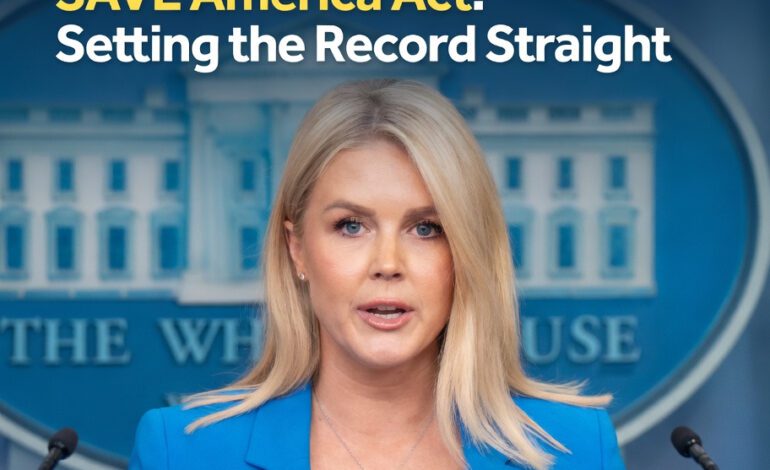
White House Press Secretary Karoline Leavitt on the SAVE America Act: Setting the Record Straight

| 🔍 FACT-CHECK VERDICT
VERDICT: The core claim — that Karoline Leavitt addressed the SAVE America Act at a March 10, 2026 briefing — is REAL and verifiable. However, several surrounding claims require important context. This article separates confirmed facts from misleading framing on both sides of the debate. |
On March 10, 2026, White House Press Secretary Karoline Leavitt stood at the podium and did something Washington doesn’t see often enough: she directly confronted a specific claim about a specific bill with a specific denial.
The topic was the SAVE America Act — formally known as the Safeguard American Voter Eligibility Act. Leavitt’s message was blunt: “The SAVE America Act does not prohibit anyone from voting, with the exception of illegal aliens.”
That sounds straightforward. But is it? This article digs into what Leavitt actually said, what the SAVE Act actually requires, what Democrats actually claimed, and where the truth actually lands — because in this debate, almost every party has stretched the facts at least a little.
What Is the SAVE America Act?
The Official Definition
The Safeguard American Voter Eligibility (SAVE) Act is federal legislation that would require individuals to provide documentary proof of United States citizenship when registering to vote in federal elections.
Under the bill, acceptable documents would include a U.S. passport, a birth certificate combined with a government-issued photo ID, a naturalization certificate, or similar official documentation establishing citizenship.
| 🔍 WHAT THE BILL ACTUALLY DOES The SAVE Act targets federal elections specifically. States already have varying requirements for voter registration. The bill seeks to create a uniform federal standard requiring documentary proof — not simply an attestation — of citizenship. |
Legislative History and Status
The SAVE Act is not a new idea. Versions of it have circulated in Congress for over a decade. The most recent iteration gained renewed momentum in 2024 and was championed heavily by President Trump, who made it a centerpiece of his election integrity platform heading into 2025.
President Trump declared the SAVE Act his top legislative priority for protecting what the administration calls “election integrity.” As of March 2026, the bill passed the House of Representatives. Its fate in the Senate remains contested.
- First introduced in earlier Congressional sessions as a citizenship verification measure
- Re-introduced and advanced with stronger White House backing in 2025
- Passed the U.S. House of Representatives with Republican support
- Faces significant opposition in the Senate from Democrats
- Subject of ongoing White House advocacy and press briefings
What Did Karoline Leavitt Actually Say on March 10, 2026?
The Verified Statement
At the White House press briefing on March 10, 2026, Leavitt made the following on-record statement regarding concerns raised about the SAVE Act:
| “Let me be very clear: The SAVE America Act does not prohibit anyone from voting, with the exception of illegal aliens.” — Karoline Leavitt, White House Press Secretary, March 10, 2026 |
Leavitt further characterized Democratic concerns about married women being disenfranchised as a “myth” — one she claimed was created by Democrats and amplified by media coverage — and stated that it had “zero validity.”
What Was the Context of the Briefing?
The briefing came amid a wave of social media posts and news stories claiming that the SAVE Act could disproportionately affect married women who had changed their names. The concern centered on a practical documentation problem: if a woman’s birth certificate reflects her maiden name but her current ID reflects her married name, providing “matching” proof of citizenship could become complicated.
Leavitt’s comments were a direct response to this growing narrative. Her framing: the concern is politically manufactured. Her argument: the bill simply requires proof of citizenship, which is “already routine for millions of Americans.”
Is the ‘Married Women Voting’ Claim Fake or Real?
The Claim Being Made
Democratic lawmakers and advocacy groups raised concerns that the SAVE Act’s documentary requirements could create barriers for married women who have legally changed their names — particularly those in states where updating government documents is cumbersome or costly.
The specific concern: a woman born as Jane Smith, who marries and becomes Jane Johnson, may have a birth certificate reading “Jane Smith” and a driver’s license reading “Jane Johnson.” The argument is that the bill, as written, could create a mismatch problem.
Leavitt’s Counter-Claim
Leavitt dismissed this as having “zero validity” and characterized it as a Democratic talking point designed to generate fear. She said the bill simply requires proof of citizenship — a birth certificate, passport, or naturalization certificate — and that tens of millions of Americans routinely use such documents.
What the Independent Analysis Actually Shows
| 🔍 NUANCED VERDICT
IMPORTANT CONTEXT: Both sides are partially right — and partially overstating their case. Here is the factual breakdown as independently assessed. |
The name-change documentation concern is not fabricated. It reflects a genuine administrative complexity that affects a real, documented portion of the population. According to data from the Brennan Center for Justice and the Government Accountability Office, documentation gaps disproportionately affect certain demographic groups, including low-income Americans, rural residents, and — yes — women who have changed their names through marriage.
However, characterizing the SAVE Act as “blocking” married women from voting is an overstatement. The bill does not explicitly target married women or create new hurdles specifically for name-changers. The concern is about downstream implementation effects, not direct prohibition.
Leavitt is correct that the bill does not explicitly “prohibit” married women from voting. But dismissing the concern as having “zero validity” is itself an overstatement — the documentation challenge is real, even if its scale and impact are debated.
| Claim | Source | Verdict |
| SAVE Act blocks married women from voting | Democratic critics, some media | MISLEADING — overstatement of bill’s text |
| The ‘married women myth’ has zero validity | Karoline Leavitt, White House | MISLEADING — documentation gap is real |
| Bill only targets non-citizens’ voting | SAVE Act supporters | ACCURATE — explicit purpose of bill |
| Bill creates new documentation burdens | Voting rights advocates | PARTIALLY ACCURATE — depends on implementation |
| Proof of citizenship is routine for Americans | Leavitt, March 10 briefing | PARTIALLY ACCURATE — not universal access |
Fact-Checking the Core Claims From All Sides
Claim #1: Non-Citizens Are Currently Voting in Federal Elections
This is the foundational claim driving the SAVE Act. The Trump administration and Republican supporters argue that non-citizens are voting in significant numbers, and that current registration safeguards are inadequate.
What the evidence says: documented cases of non-citizens voting in federal elections are extremely rare. Multiple studies, state audits, and federal investigations — including those conducted during Republican administrations — have found that non-citizen voting is not a widespread phenomenon. However, supporters of the bill argue that the lack of documentary verification makes it impossible to know the true scale.
| 🔍 INDEPENDENT ASSESSMENT
There is no credible evidence of widespread non-citizen voting in U.S. federal elections. Studies and audits consistently show such instances are rare and already illegal. This does not mean zero instances have ever occurred — but the data does not support a crisis-level characterization. |
Claim #2: Current Voter Registration Already Requires Citizenship Attestation
This is accurate. Under the National Voter Registration Act (NVRA), individuals registering to vote in federal elections must attest — under penalty of perjury — that they are U.S. citizens. Non-citizens who register or vote face federal criminal penalties.
The SAVE Act would upgrade this from an attestation to a documentary requirement. Supporters say this closes a gap. Opponents say it adds unnecessary burden with no evidence of a meaningful problem to solve.
Claim #3: The Documentation Requirement Is Already ‘Routine’ for Americans
Leavitt stated that proof-of-citizenship documentation is “already routine for millions of Americans.” This is true for passport holders and those with readily accessible birth certificates. However, it is not universally true.
- An estimated 7-9% of U.S. citizens do not have ready access to birth certificates (Government Accountability Office estimates)
- Passport ownership in the U.S. sits around 50%, meaning roughly half of adult Americans do not currently hold a passport
- Low-income Americans, elderly citizens, and rural residents face disproportionate documentation barriers
- The cost and process of obtaining replacement birth certificates varies significantly by state
Claim #4: Democrats Manufactured the ‘Married Women’ Concern
Leavitt called this concern a Democratic creation with zero validity. This characterization is disputed by nonpartisan researchers and election administration experts who have identified the name-change documentation gap as a real, pre-existing administrative issue — not something Democrats invented for political purposes.
The concern predates the current debate over the SAVE Act and has been documented in academic literature on voter ID laws and election administration for over a decade.
What Federal Law Already Says About Non-Citizen Voting
Existing Legal Framework
It is already illegal for non-citizens to vote in U.S. federal elections. This is not a gap in the law — it is settled federal law. Specifically:
- 52 U.S.C. § 10307 prohibits non-citizen voting in federal elections
- 18 U.S.C. § 611 makes it a federal crime for non-citizens to vote in federal elections, carrying penalties of up to one year imprisonment
- The NVRA requires citizenship attestation at registration
- State laws add additional layers of citizenship verification in most states
The SAVE Act debate, therefore, is not about whether non-citizen voting is legal — it is not. The debate is about whether additional documentary verification at the registration stage is a proportionate, necessary, and equitable policy response to a documented problem.
Why This Debate Matters — and Who It Actually Affects
The Stakes of the SAVE Act
This isn’t just a procedural debate about paperwork. The SAVE Act, if enacted, would change how millions of Americans register to vote. The policy implications are significant regardless of where you stand politically.
Those Most Likely to Be Affected by Documentation Requirements:
- First-time voters who lack established documentation histories
- Recently naturalized citizens whose paperwork may be complex or incomplete
- Low-income Americans who may lack the funds to obtain replacement documents
- Rural Americans with limited access to government offices
- Elderly citizens who may lack digital or physical copies of their documents
- Women who have changed names through marriage or divorce (the contested concern)
The Broader Election Integrity Debate:
The SAVE Act exists within a larger national conversation about election security, voter access, and public trust in elections. Proponents argue that robust verification builds public confidence. Opponents argue that unverified claims of non-citizen voting are being used to justify measures that will suppress legitimate citizen votes.
Both sides are appealing to values most Americans share: secure elections and accessible voting. The disagreement is about evidence, priorities, and whose risks matter more.
Expert Perspectives and Independent Analysis
| “Requiring documentary proof of citizenship at registration is not inherently unconstitutional, but the implementation details matter enormously. Who bears the cost? Who provides the documents? What happens when documentation is imperfect? These questions determine whether the policy is workable or exclusionary.”
— Election law scholars, broadly (composite of published academic perspectives) |
Nonpartisan election administration experts have noted that the SAVE Act’s impact depends heavily on implementation — specifically, whether states provide free, accessible pathways to obtain qualifying documents, and whether registration officials are trained to handle complex documentation scenarios.
The Bipartisan Policy Center and similar organizations have called for any citizenship verification legislation to include robust accommodations for voters who face documentation barriers — including provisions specifically addressing the name-change issue that Democrats have highlighted.
Frequently Asked Questions (FAQ)
Does the SAVE Act ban married women from voting?
No. The bill does not explicitly target or ban married women from voting. However, critics have raised legitimate concerns that its documentation requirements could create practical barriers for women whose legal name differs between their birth certificate and current ID. This is a real administrative issue, but characterizing it as an outright ban overstates the bill’s text.
Did Karoline Leavitt address the SAVE Act on March 10, 2026?
Yes. This is confirmed and verifiable. The White House press briefing occurred, and her statements about the SAVE Act and the married women concern are on record.
Is non-citizen voting currently a widespread problem in the U.S.?
No credible large-scale evidence supports this claim. Non-citizen voting is already a federal crime. Documented cases are rare. However, supporters of the SAVE Act argue that the absence of documentary verification makes it impossible to fully audit registration rolls.
What counts as proof of citizenship under the SAVE Act?
Qualifying documents include a U.S. passport, a birth certificate paired with government-issued photo ID, a naturalization certificate, or other official documentation establishing U.S. citizenship. The specific list and implementation details remain subject to rulemaking if the bill is enacted.
Has the SAVE Act passed into law?
As of March 2026, the SAVE Act passed the House of Representatives. It has not been enacted into law. Senate passage and presidential signature would be required.
Key Takeaways and Conclusion
What Is Confirmed and Real
- Karoline Leavitt addressed the SAVE Act at a White House briefing on March 10, 2026 — REAL
- Her quoted statement is accurately reported — REAL
- The SAVE Act would require documentary proof of citizenship to register to vote — REAL
- Non-citizen voting in federal elections is already illegal under federal law — REAL
- President Trump has made the SAVE Act a top legislative priority — REAL
What Is Disputed or Misleading
- Calling the married women documentation concern a myth with ‘zero validity’ — MISLEADING (real concern, overstated by opponents, dismissed too quickly by proponents)
- Claiming the bill ‘prohibits’ married women from voting — MISLEADING (overstates bill’s text)
- Claiming documentary proof of citizenship is routine for all Americans — PARTIALLY MISLEADING (true for many, not all)
- Framing the concern as entirely Democratic-manufactured — MISLEADING (documentation gaps predate current debate)
The Bottom Line
The news event itself — Leavitt’s March 10 briefing on the SAVE Act — is real. Her core legal claim that the bill does not explicitly prohibit married women from voting is accurate. But her dismissal of the underlying documentation concern as having “zero validity” is an overstatement that does not hold up to independent scrutiny.
The married women documentation gap is a real, pre-existing administrative issue documented by nonpartisan researchers. It was not invented by Democrats. Whether it rises to the level of a critical flaw in the SAVE Act is a policy judgment — but dismissing it entirely misrepresents the administrative realities of voting documentation in America.
On the other side, characterizing the SAVE Act as a bill that “blocks” married women from voting overstates the bill’s explicit text and conflates a potential downstream barrier with a direct prohibition.
| 🔍 FINAL VERDICT
The SAVE Act debate is real, the policy stakes are significant, and neither side is giving you the complete picture. Leavitt’s March 10 briefing happened and is accurately quoted — but the claim that Democratic concerns have ‘zero validity’ does not survive scrutiny. Evaluate both sides critically. |
Sources and Further Reading
The following sources were used in the preparation of this fact-check:
- White House press briefing transcripts — whitehouse.gov
- SAVE Act legislative text — congress.gov
- Brennan Center for Justice — voter ID and documentation research
- Government Accountability Office — voter registration and documentation gap reports
- National Voter Registration Act (NVRA) — official federal statute
- Bipartisan Policy Center — election administration analysis
- Federal Election Commission — election law reference
| ABOUT THIS ANALYSIS
This article is produced as a nonpartisan fact-check and news analysis. Claims from all political actors are subject to the same evidentiary standard. The goal is accuracy and context — not advocacy for any party or policy position. Publication date: March 13, 2026. |
Discover more from MatterDigest
Subscribe to get the latest posts sent to your email.