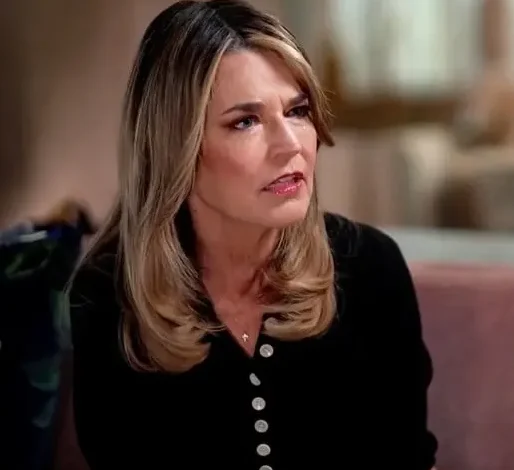

Savannah Guthrie Returns to the TODAY Show in Tears — Her Message About Her Missing Mother Left Millions Speechless
For years, Savannah Guthrie has been the steady voice that millions of Americans wake up to every morning. Calm under pressure. Composed in chaos. A trusted presence in living rooms and kitchens across the country, delivering the news of the day with the kind of professional control that makes the hardest stories feel manageable.
But on the morning she walked back onto the set of TODAY, everything was different. Behind the composed exterior that viewers know so well, a storm had been building — one that no script, no teleprompter, and no amount of professional training could prepare her for. Her mother, Nancy Guthrie, was missing. The investigation had stalled. Leads had gone cold almost as quickly as they appeared. And Savannah had spent days in the particular kind of darkness that only descends when someone you love has vanished and no one can tell you where they went.
She chose to return anyway. Not because she had to. Not because the show required it. But because she refused to let fear define her — and because she had something she needed to say, not just to her colleagues and her audience, but to the world that had been watching and waiting and hoping alongside her.
What Did Savannah Guthrie Say When She Returned to TODAY?
Colleagues who watched Savannah walk back onto the set described the moment as unlike anything they had witnessed in years of working in live television. There was no dramatic entrance. No music swelled. No carefully staged setup. She simply walked in, took her seat, and faced the camera with the quiet weight of everything she had been carrying.
When she spoke, she did not ask for sympathy. She did not break down in a way that needed to be managed or recovered from. What she delivered instead was a message — clear, direct, and more powerful for its simplicity.
She spoke about her children. She spoke about what it means to be their mother and what that role demands of her, not just professionally but personally. She spoke about the fear that comes with not knowing where your own mother is — and about the determination she had found, in the middle of that fear, to keep going. And she made one statement that cut through everything else in the room and traveled across the internet within minutes of the broadcast.
He won’t take my children’s mother from them. Whatever is happening, whatever comes next — I will not be broken by it. My children need their mother standing. And I am standing.
The room went still. In the studio, colleagues who have spent careers maintaining professional composure in front of cameras found themselves unable to hold it together. The silence that followed her words lasted only a few seconds in real time. But people who were there described it as one of the longest and most meaningful silences they had ever experienced on a live set.
What struck people most was not the emotion. It was the strength underneath it. Because when she finished speaking, she did not retreat. She did not ask for a commercial break. She turned back to the work — back to the broadcast, back to the anchor desk — and she kept going. Just as she had promised she would.
Who Is Savannah Guthrie and Why Does Her Story Connect With So Many People?
Savannah Guthrie has been the co-anchor of NBC’s TODAY show since 2012. In that time, she has become one of the most recognized and trusted faces in American morning television. She has covered presidential elections, natural disasters, breaking news, and the full range of human experience that a live daily news program brings across her desk. She has conducted some of the most memorable interviews of the past decade. And she has done it all with a style that feels simultaneously professional and genuinely warm — as if she is talking directly to you, not at you.
But her audience’s connection to her goes deeper than television familiarity. Over the years, Savannah has shared aspects of her personal life that most public figures keep carefully hidden. She has spoken openly about her faith — about the role that Christianity plays in how she approaches both her work and her private life. She has talked about the experience of becoming a mother later than she expected, about the joy and the terror of parenthood, about the way her children have changed what matters to her and why.
She has also been honest about difficulty. About the experience of being a woman in a high-pressure career while also trying to be fully present as a wife and mother. About the moments when those demands conflict and there is no clean resolution. About the fact that strength does not mean the absence of struggle — it means continuing despite it.
All of that history, built up over years of watching her on screen and hearing her speak in her own voice about her own life, is what made her return to the TODAY set so emotionally powerful. Her audience did not just see a news anchor coming back to work after a difficult time. They saw someone they felt they knew — a woman they had watched grow, struggle, succeed, and love her family in public — now standing in the most painful moment of her life and refusing to fall.
What Has the Investigation Into Nancy Guthrie’s Disappearance Revealed So Far?
The disappearance of Nancy Guthrie — Savannah’s mother — remains one of the most perplexing missing persons cases currently under active investigation. Despite weeks of work by investigators committed to the case, the picture of what happened remains incomplete in ways that continue to frustrate both the family and the law enforcement professionals working to find answers.
The investigation is ongoing. Sources familiar with the case have confirmed that resources remain committed and that work is continuing behind the scenes, even when that work is not visible to the public. Leads have been pursued. Physical evidence has been analyzed. Witnesses have been interviewed. And yet the most fundamental question — where is Nancy Guthrie and what happened to her — remains unanswered.
The days leading up to Savannah’s return to the broadcast were described by people close to the family as filled with uncertainty. Investigators were continuing to follow leads that seemed to vanish almost as quickly as they emerged. Family members and friends were holding on to hope while bracing for the worst. And Savannah herself was navigating something that very few people ever have to face — the experience of being a very public figure in the middle of a very private nightmare, with millions of people watching and waiting alongside her.
The lack of answers has been painful in its own specific way. When someone you love is missing and the investigation has not produced resolution, you are left in a state of suspended grief — unable to fully grieve because you do not know that the person is gone, and unable to fully hope because the evidence does not give you grounds for optimism. It is a psychological place without a name, and it is one of the cruelest experiences that loss can impose on a human being.
Savannah Guthrie chose to face that experience in public — not because it was required, but because she refused to disappear from her own life while waiting for answers about someone else’s.
How Did the Public and Savannah’s Colleagues React to Her Return?
The reaction to Savannah’s return was immediate, overwhelming, and came from directions that crossed every usual boundary of politics, demographics, and opinion.
Social media responded within minutes of the broadcast. Clips of her statement spread across platforms at a speed that social media analysts noted was unusual even by the standards of viral television moments. Hashtags began trending. Messages of support poured in from around the world — from longtime TODAY viewers, from people who had never watched the show in their lives, from public figures and private citizens, from people who disagreed with her politics and people who had no idea what her politics were.
What united all of it was not the celebrity. It was the humanity. Because in those few seconds on live television, people did not see a news anchor. They saw a daughter. They saw a mother. They saw a human being facing the same kind of fear and uncertainty and desperate love that connects every person who has ever had someone they could not afford to lose.
Her colleagues on the TODAY set did not try to hide their own reactions. Some wiped tears. Others reached for her hand. The kind of careful professional distance that television sets usually maintain broke down entirely in that moment — replaced by something more honest and more real than most live broadcasts ever achieve.
And outside the studio, the response from the broader public continued to build through the day. Mental health advocates pointed to Savannah’s decision to return to work as an example of the complicated, non-linear nature of grief and crisis — and pushed back gently against the idea that going back to work while in the middle of an unresolved family emergency is somehow a betrayal of the seriousness of the situation. For many people, continuing to function — to show up, to do the work, to keep going — is not a sign that you are okay. It is a way of fighting for the life you refuse to let be destroyed.
What Does Savannah Guthrie’s Defiant Return Say About Strength and Faith?
The language Savannah used in her statement — and the language that people who know her have used to describe how she is navigating this period — is threaded through with faith. Not in the abstract, decorative way that public figures sometimes invoke religion as a kind of social shorthand. But in the specific, personal way of someone who has actually built her sense of identity and resilience on a foundation that goes deeper than professional success or public reputation.
She has spoken about her Christian faith many times over the years — about what it means to her, how it shapes her approach to her work and her relationships, and how it grounds her when the pressures of public life create turbulence that would otherwise be destabilizing. For Savannah, faith is not a performance. It is the thing she actually goes to when the situation is beyond what professional training or personal willpower alone can handle.
The statement she made on her return — that whatever is happening, whatever comes next, she will not be broken — is the kind of declaration that only makes sense if it is coming from something real. Strength of that kind is not manufactured. It does not come from a script or a publicist’s talking points. It comes from a place deep enough to hold steady when everything external is unstable.
For the millions of people watching who have faced their own versions of this kind of loss — a missing loved one, a family crisis that refuses to resolve, the experience of having to keep functioning in the middle of something that feels unsurvivable — Savannah’s words offered something that public figures rarely give their audiences: the honest testimony of someone who is in it, not someone who has come out the other side.
She was not telling her audience that everything was going to be okay. She was telling them that she was going to keep standing, even without that guarantee. And that distinction — between false reassurance and genuine defiance — is what made the moment land so hard.
Why Does Savannah Guthrie’s Situation Resonate Far Beyond the Headlines?
Savannah Guthrie’s story has become something larger than a celebrity news item or a human interest sidebar. It has become a mirror that millions of people are holding up to their own lives — a reflection of the gap between the faces we show the world and the storms we carry privately.
Everyone watching Savannah on their television screens every morning sees a version of her that is composed, capable, and in control. That image is real — it reflects genuine skill and genuine character. But it is also incomplete, because no human being is only the face they show in public. Behind every composed exterior is a private interior that does not photograph.
What Savannah did by returning to the set and speaking honestly about what she was going through was collapse that gap — briefly, deliberately, and on her own terms. She let people see the interior. And in doing so, she gave permission to everyone watching to acknowledge their own interiors: the fear, the uncertainty, the love that makes loss so devastating, and the stubborn refusal to be defined by what is happening to them.
That is a rare thing in public life. Most public figures manage their image too carefully to allow that kind of genuine exposure. The result is a media environment that often feels polished, performed, and disconnected from the actual texture of human experience. When something breaks through that gloss — when a real person appears inside the carefully managed frame — people respond to it with an intensity that reflects how hungry they are for authenticity.
Savannah’s morning was that kind of moment. Not because she is a television anchor. But because she is a daughter, a mother, a woman of faith, and a human being who chose to keep standing in public when the most understandable thing in the world would have been to stay home and fall apart in private. That choice — visible, deliberate, and deeply personal — is what the world responded to.
Key Takeaways: Savannah Guthrie’s Return and the Family Nightmare That Continues
Savannah Guthrie returned to the TODAY show amid the ongoing and unresolved disappearance of her mother, Nancy Guthrie, delivering a statement that moved her colleagues, her audience, and millions of viewers around the world.
Her central declaration — that whatever is happening will not take her children’s mother from them — was received not as a performance but as a genuine act of defiance rooted in love, faith, and the refusal to be defined by circumstances she cannot control.
The public response crossed every usual demographic and political line, with millions of people sharing clips and messages of support that reflected not just celebrity sympathy but genuine human recognition — of grief, of strength, and of the specific courage it takes to keep functioning in the middle of an unresolved nightmare.
The investigation into Nancy Guthrie’s disappearance remains open and active, with investigators continuing to work the case despite the absence of the resolution that the family — and the millions of people who have followed the story — are desperately waiting for.
Savannah’s return was not just a moment in television history. It was a reminder that strength does not always look like power. Sometimes it looks like showing up — even when your world is falling apart — and refusing to let love be the thing that loses.
© 2026 Matter News. All rights reserved.
Discover more from MatterDigest
Subscribe to get the latest posts sent to your email.