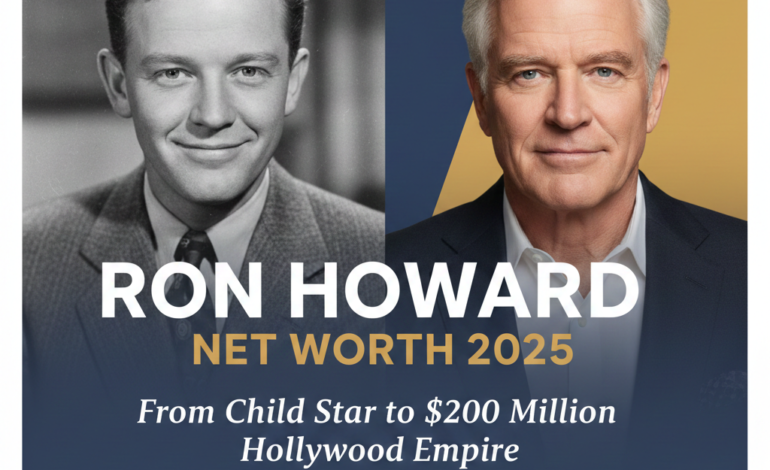

What Is Ron Howard Net Worth in 2025?
Ron Howard has an estimated net worth of $200 million as of 2025. This impressive fortune comes from his six-decade career as an actor, Oscar-winning director, producer, and co-founder of Imagine Entertainment. His wealth reflects earnings from directing blockbuster films, producing hit TV series, real estate investments, and ongoing royalties from past work.
Table of Contents
-
Ron Howard’s Financial Journey Overview
-
Early Acting Career and Initial Earnings
-
Transition to Directing: The Game-Changer
Ron Howard’s Financial Journey: Six Decades of Success
Ron Howard’s path to $200 million didn’t happen overnight. It’s a story of strategic career moves, artistic integrity, and business savvy.
Born on March 1, 1954, in Duncan, Oklahoma, Howard grew up in a show business family. His father, Rance Howard, was an actor and director. His mother, Jean Speegle Howard, was an actress. This early exposure gave young Ron an insider’s view of Hollywood—both the glamorous side and the business side.
The Three Phases of Wealth Building:
-
Child Actor Era (1959-1980): Building name recognition and earning steady income
-
Director Emergence (1977-2001): Learning the craft and establishing credibility
-
Hollywood Powerhouse (2001-Present): Major paydays and production company profits
What sets Howard apart? He never relied on just one income stream. While many child actors fade away, Howard reinvented himself. While many directors stay behind the camera, Howard built a production empire. This diversification protected his wealth and allowed it to grow consistently.
From Opie to Richie: Ron Howard’s Acting Foundation
The Andy Griffith Show (1960-1968)
At just six years old, Ron Howard was cast on what would become the iconic sitcom “The Andy Griffith Show”. Playing Opie Taylor gave Howard steady work and national recognition during his formative years.
During the 1960s, child actors weren’t paid like they are today. However, the consistent work provided financial stability for the Howard family and invaluable on-set education for young Ron.
Happy Days Success (1974-1980)
In 1974, he landed a second soon-to-be-iconic television role, that of Richie Cunningham on “Happy Days”. This role made Howard a household name and significantly increased his earning power.
By the late 1970s, Howard was one of TV’s most recognizable faces. But he had bigger ambitions. He wanted to direct.
Why Did Howard Leave Acting at His Peak?
In 1980, Howard made a bold decision. He left “Happy Days” before its eighth season to pursue directing full-time. Many thought he was crazy to walk away from a guaranteed paycheck. But Howard saw the long-term picture. Directors had more creative control and, if successful, could earn significantly more than actors.
The Directing Pivot That Changed Everything
Grand Theft Auto (1977): The Beginning
Howard made his directorial debut in 1977 with the low-budget comedy “Grand Theft Auto”. It wasn’t a masterpiece, but it showed promise. More importantly, it opened doors.
Building Momentum Through the 1980s
Howard didn’t immediately direct major studio films. He worked his way up:
-
Night Shift (1982): His breakthrough, starring Michael Keaton and Henry Winkler
-
Splash (1984): A commercial hit that launched Tom Hanks’ film career
-
Cocoon (1985): Critical and commercial success
-
Parenthood (1989): Box office hit earning over $100 million domestically
Each success gave Howard more leverage to negotiate better deals and bigger budgets.
The 1990s: Establishing Director Credibility
The ’90s saw Howard cement his reputation:
-
Backdraft (1991): Thrilling firefighter drama
-
Apollo 13 (1995): Massive critical and commercial success, grossing over $335 million
A Beautiful Mind (2001): The Career-Defining Moment
Howard’s historical drama “A Beautiful Mind” won him the Academy Award for Best Director. This Oscar win transformed Howard from a successful director into an A-list filmmaker who could command top dollar.
The film earned over $313 million worldwide and won four Academy Awards, including Best Picture and Best Director. This achievement significantly boosted Howard’s market value and opened doors to even bigger projects.
Imagine Entertainment: The Real Wealth Multiplier
Co-Founding a Production Powerhouse
In November 1985, producer Brian Grazer and director Ron Howard founded Imagine Entertainment. This decision would prove to be Howard’s smartest financial move.
Why is owning a production company so lucrative? When you just direct a film, you get paid once. When you produce through your own company, you earn:
-
Upfront production fees
-
Backend profits from box office success
-
Ongoing royalties from streaming and TV rights
-
Ownership stake in successful franchises
Imagine’s Most Profitable Productions
Films:
-
8 Mile (2002) – Eminem’s breakout film
-
The Da Vinci Code (2006) – $758 million worldwide
-
American Gangster (2007)
-
Angels & Demons (2009)
Television:
-
24 – Long-running hit series
-
Arrested Development – Cult classic
-
Friday Night Lights – Critical darling
-
Empire – Ratings juggernaut
Current Valuation
In 2022, Imagine discussed selling a majority stake for $600-800 million. While that deal didn’t happen, it demonstrates the company’s substantial value. At that time, Imagine earned about $30 million in cash yearly.
As co-founder, Howard owns a significant equity stake. This ownership represents a major portion of his overall net worth and provides ongoing passive income.
Ron Howard’s Highest-Grossing Films
Understanding Howard’s biggest commercial successes helps explain his wealth accumulation:
1. The Da Vinci Code (2006)
-
Worldwide Gross: $758 million
-
Why It Matters: Launched a lucrative franchise and proved Howard could handle blockbuster material
2. How the Grinch Stole Christmas (2000)
-
Worldwide Gross: $345 million
-
Why It Matters: Showed Howard’s versatility beyond dramas
3. Apollo 13 (1995)
-
Worldwide Gross: $355 million
-
Why It Matters: Critical and commercial success that elevated Howard’s reputation
4. Angels & Demons (2009)
-
Worldwide Gross: $485 million
-
Why It Matters: Sequel success meant ongoing franchise value
5. A Beautiful Mind (2001)
-
Worldwide Gross: $313 million
-
Why It Matters: Oscar wins = higher directing fees forever
6. Inferno (2016)
-
Worldwide Gross: $220 million
-
Why It Matters: Completed the Robert Langdon trilogy
7. Solo: A Star Wars Story (2018)
-
Worldwide Gross: $393 million
-
Why It Matters: Major payday despite production challenges
How Much Does Ron Howard Make Per Film?
Standard Director Fees
According to industry reports, Ron Howard typically earns between $10 million and $20 million per film as his base directing fee. However, the real money comes from backend deals.
Backend Profit Participation
Top-tier directors like Howard often negotiate deals where they receive:
-
A percentage of gross box office revenue (usually 5-10%)
-
A share of streaming rights sales
-
Royalties from home video and TV rights
For a blockbuster film earning $500 million worldwide, even a 5% backend deal means an additional $25 million on top of the upfront fee.
Comparison to Other Directors
For his work directing “Hugo,” Martin Scorsese earned $10 million. Howard commands similar rates for major studio projects.
Christopher Nolan earned a $20 million upfront salary for “Oppenheimer” plus 15% of first dollar gross, resulting in massive earnings. While Howard’s deals may not reach these heights, he consistently earns in the top tier.
Monthly Income Estimate
Howard reportedly pulls in about $2 million every month from his filmmaking, directing, and various business ventures. This includes directing fees, Imagine Entertainment profits, royalties from past work, and real estate income.
Real Estate Investments: Building Tangible Wealth
Howard has diversified his portfolio with strategic real estate investments across premium locations.
New York City Properties
Eldorado Building Apartment: In 2004, Ron and Cheryl paid $5.6 million for a 3,000-square-foot apartment in New York City’s uber-exclusive Eldorado Building. They invested millions more in renovations. They listed this apartment for sale in 2017 for $12.5 million, demonstrating significant appreciation.
Second NYC Apartment: They own a second NYC apartment, purchased in 2002 for $712,000.
Connecticut Estate
In 2014, the couple sold their 33-acre estate on a lake in Greenwich, Connecticut, for $27.5 million. This sale alone represented a major liquidity event.
California Property
In 2006, they paid $2.75 million for an ocean-view apartment in Santa Monica, California.
Total Real Estate Value
Howard’s real estate portfolio is reportedly worth over $27 million, though this figure may be conservative given property appreciation in premium markets.
Why Real Estate Matters for Net Worth:
Real estate provides several benefits for wealthy individuals:
-
Tangible asset appreciation
-
Tax advantages
-
Portfolio diversification
-
Liquidity options when needed
-
Generational wealth transfer
How Does Ron Howard Net Worth Compare?
Directors in the $200 Million Range
Ron Howard, Martin Scorsese, Todd Phillips, and Taylor Sheridan all have estimated net worths of $200 million.
This places Howard solidly in the upper tier of Hollywood directors, though below the billionaire directors like George Lucas and Steven Spielberg.
What Makes Howard Different?
Consistency: Howard has been working steadily for 60+ years without major career gaps.
Versatility: He’s comfortable directing dramas, comedies, thrillers, and documentaries. This versatility means more opportunities.
Business Acumen: Imagine Entertainment provides passive income that other directors don’t have.
Longevity: Starting as a child actor gave Howard decades more to accumulate wealth than directors who started in their 30s.
2025 and Beyond: Ron Howard’s Ongoing Revenue Streams
Current Projects
The Shrinking of Treehorn: In 2022, Netflix acquired “The Shrinking of Treehorn” from Paramount Pictures, which is set to be Howard’s first time directing an animated feature. This represents Howard expanding into new territory at age 70.
Eden: Howard has another film project in development, showing he’s not slowing down.
The Studio (2025): Most recently, Howard made a comedic cameo as himself in “The Studio” (2025), a satirical Apple TV+ series.
Streaming Era Opportunities
Imagine Entertainment signed a first-look deal with Amazon MGM, ensuring consistent project flow and revenue.
The streaming boom has been particularly good for established producers like Howard. Platforms need content, and they’re willing to pay premium rates for experienced filmmakers who can deliver quality products on time and on budget.
Documentary Work
Howard has increasingly focused on documentaries:
-
“Rebuilding Paradise” (2020)
-
“Thirteen Lives” (2022)
-
Various Apple TV+ and Netflix projects
Documentaries may not have blockbuster budgets, but they provide:
-
Creative fulfillment
-
Prestige
-
Steady work between major film projects
-
Lower risk for studios
Key Takeaways: Ron Howard’s Path to $200 Million
What We Can Learn From Howard’s Financial Success
1. Reinvention Beats Reputation
Howard could have coasted on his acting fame. Instead, he risked everything to become a director. This willingness to start over at the bottom of a new field multiplied his earning potential.
2. Ownership Creates Wealth
Imagine Entertainment transformed Howard from a well-paid director into a wealthy entertainment mogul. Owning the means of production—not just working for studios—builds lasting wealth.
3. Diversification Provides Stability
Howard doesn’t rely on one income source. He earns from:
-
Directing fees
-
Production company profits
-
Real estate appreciation
-
Royalties and residuals
-
Backend deals
4. Longevity Compounds Success
Starting at age 5 gave Howard a 65-year career. Compound that with smart decisions and consistent work, and you get generational wealth.
5. Strategic Relationships Matter
His partnership with Brian Grazer at Imagine Entertainment lasted nearly 40 years. This stability allowed both to build something bigger than either could alone.
Is $200 Million a Lot in Hollywood?
For context, here’s where Howard ranks:
-
Billionaire Directors: George Lucas ($5.5B), Steven Spielberg ($4B), James Cameron ($800M)
-
$200M+ Directors: Ron Howard, Martin Scorsese, Christopher Nolan, Peter Jackson
-
$100M+ Directors: Most successful mainstream directors
-
Under $100M: The majority of working directors
Howard’s wealth places him in the top 1% of directors, though below the absolute titans who created massive franchises (Star Wars, Indiana Jones, Avatar).
Frequently Asked Questions
What is Ron Howard net worth in 2025? Ron Howard net worth is estimated at $200 million as of 2025, earned through directing, producing, acting, and his ownership stake in Imagine Entertainment.
How much does Ron Howard make per movie? Howard typically earns $10-20 million per film as his base directing fee, plus backend profit participation that can add millions more depending on box office performance.
What is Ron Howard’s most successful film? Financially, “The Da Vinci Code” (2006) grossed $758 million worldwide. Critically, “A Beautiful Mind” (2001) won four Academy Awards including Best Director for Howard.
Does Ron Howard still earn money from Happy Days? Yes, Howard receives residual payments from “Happy Days” reruns and streaming, though these are modest compared to his directing income.
How much is Imagine Entertainment worth? Imagine Entertainment was valued between $600-800 million in 2022 discussions about a potential sale. As co-founder, Howard owns a significant equity stake.
Is Ron Howard richer than other directors? Howard’s $200 million places him in the top tier of directors, comparable to Martin Scorsese and Todd Phillips, though below billionaires like George Lucas and Steven Spielberg.
What real estate does Ron Howard own? Howard owns properties in New York City, Santa Monica, and has sold major estates in Connecticut. His real estate portfolio exceeds $27 million in value.
Conclusion: The Ron Howard Financial Blueprint
Ron Howard’s journey from child actor to $200 million Hollywood powerhouse offers lessons beyond the entertainment industry. His success wasn’t accidental—it was the result of strategic decisions, calculated risks, and business acumen.
The Howard Formula:
-
Start early and build name recognition
-
Reinvent yourself before you have to
-
Learn the business side, not just the creative side
-
Build ownership stakes, don’t just work for others
-
Diversify income streams
-
Maintain relationships for decades, not just projects
-
Stay relevant by adapting to industry changes
-
Never stop working, even after financial success
At 70 years old in 2025, Howard continues directing, producing, and building his legacy. His net worth will likely continue growing as Imagine Entertainment produces new hits and his catalog generates ongoing royalties.
For aspiring filmmakers and entrepreneurs, Howard proves that sustainable wealth comes not from one big hit, but from consistent excellence, smart partnerships, and the courage to reinvent yourself when necessary.
Ready to learn more about Hollywood’s wealthiest? Check out our comprehensive guides on director salaries, production company valuations, and entertainment industry wealth-building strategies.
Did this article help you understand Ron Howard’s financial success? Share it with fellow film enthusiasts and aspiring directors who want to understand the business side of Hollywood.
Discover more from MatterDigest
Subscribe to get the latest posts sent to your email.