Reporter Hits the Beach, What These Spring Breakers Said Left Him Speechless

Beaches, Blackouts, and Blank Stares:
A Deep Dive Into America’s Most Clueless Spring Break Season Yet
Every year, when the calendar flips to mid-March, something predictable happens along the sun-soaked coastlines of Florida. The beaches fill up. The music gets louder. The drinks start flowing before noon. And somewhere between the sunscreen and the selfies, a significant number of college students seem to quietly forget everything they ever learned in a classroom.
Spring break is an American tradition that goes back decades. What began as a small gathering of swimmers in Fort Lauderdale in the 1930s has grown into a multi-billion-dollar cultural event — one that now draws hundreds of thousands of young people to beach towns across the country every single year. Cities like Fort Lauderdale, Daytona Beach, Panama City Beach, and South Padre Island brace themselves for the annual wave of visitors, knowing that the season brings a complicated mix of tourism dollars and public safety headaches.
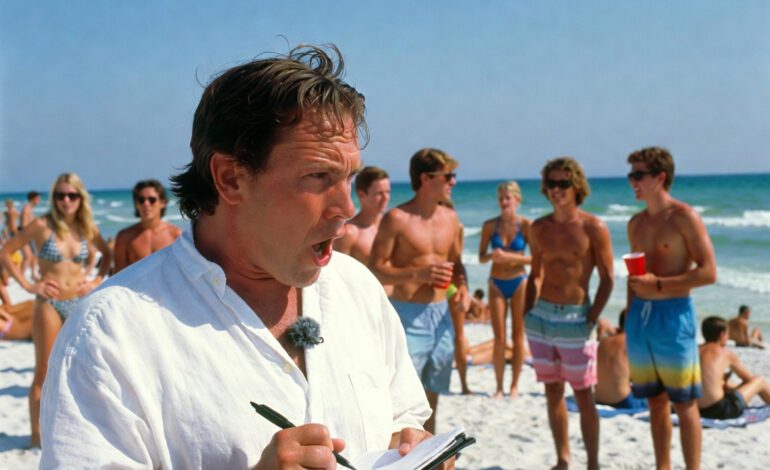
But in the spring break season of 2026, one video cut through the noise like nothing else. A Fox News producer named Johnny Belisario walked the beaches of Fort Lauderdale with a microphone and a camera, asking vacationing college students some very basic questions about current events, world news, and the issues facing the United States today.
The answers he got back were, to put it gently, surprising. Some were funny. Some were embarrassing. And a few were genuinely jaw-dropping — the kind of responses that make you wonder what, exactly, is happening inside American classrooms.
The video aired on “Jesse Watters Primetime” on Monday and quickly spread across social media, racking up massive engagement and sparking a national conversation about young Americans, civic knowledge, and the purpose of higher education.
The Questions That Left Everyone Speechless
Belisario did not ask complicated questions. He was not quizzing anyone on the finer points of tax law or the details of international trade agreements. He asked the kinds of questions that most people — including people who do not follow the news closely — might be expected to know something about.
For example: What is the biggest issue facing the United States right now? What has President Trump been doing recently? Is the US at war, and if so, with whom? And who is Ayatollah Ali Khamenei — the Supreme Leader of Iran, whose death earlier this year sent shockwaves through the Middle East and dominated global news coverage for days?
The answers ranged from vague to comically wrong. When asked what the most important issue facing America was, two young women in bikinis offered responses that became instant highlights of the clip. One said the most pressing concern in her life right now was getting a tan on the beach. The other — apparently after some thought — said her top priority was figuring out which bikini she would wear next.
These answers are funny, of course. But they also point to something worth paying attention to: a significant number of young Americans who are enrolled in universities — and paying serious money for those educations — appear to be largely disconnected from the world happening around them.
On Foreign Policy: Creative Solutions and Confident Ignorance
One of the most talked-about moments in the clip involved questions about Iran. Khamenei, who had served as Iran’s Supreme Leader since 1989 and was one of the most powerful figures in the Middle East, died earlier this year. His death was major international news — covered by every major media outlet around the world for days.
When Belisario mentioned the word “Ayatollah” and asked what the beachgoers knew about him, the responses were striking. Several people admitted they had never heard the word before. One person said they had no idea who or what an ayatollah was. Another person, speaking bluntly, said they had no clue — though they used considerably more colorful language to express that point.
One young woman gave what might be the most memorable answer of the entire segment. When asked about Khamenei, she said she had not heard that news yet — but that she had just found out about the death of Hollywood action star Chuck Norris, and that had been far more devastating to her personally. Norris passed away at the age of 86 the previous week.
It is a response that is hard to know whether to laugh at or feel sad about. On one hand, it is understandable that a celebrity’s death might feel more personal and emotionally real than a foreign political figure. On the other hand, Khamenei’s death has genuine consequences for global stability, oil prices, regional security, and potentially the safety of American military personnel stationed throughout the Middle East. That feels like something a college student might want to at least be aware of.
When asked how they would handle Iran if they were in charge of US foreign policy, the responses got creative. One young man suggested a strategy involving sending groups of women in bikinis across the battlefield to distract enemy soldiers — at which point, he explained, they could be attacked. Another woman, laughing, simply offered the word “flirt” as her preferred diplomatic approach.
These answers are easy to mock. But they also reveal something real: for a large number of young Americans, geopolitics and foreign affairs feel completely abstract and irrelevant to their daily lives. The question is whether that is something to shrug at — or something to take seriously.
On Domestic Affairs: Gulf of America and Other Updates
The gaps in knowledge were not limited to foreign policy. When asked what President Trump had been doing recently, one tan brunette paused and thought carefully before landing on her answer: “The Gulf of America. That’s the last thing I kept up with.”
For context: earlier this year, President Trump signed an executive order directing federal agencies to refer to the Gulf of Mexico as the “Gulf of America” in all official US documents. The move was largely symbolic and sparked considerable debate. It was also heavily covered in the news. Whether or not you agree with the decision, it is at least something that happened — and something that this particular interviewee had actually heard of, making her arguably one of the more informed people in the clip.
Another young woman confidently announced that the United States was going to war with Iraq. Not Iran — Iraq. Two different countries, with different governments, different histories, and different relationships with the United States. The confusion between the two, while understandable given their similar names, was not a reassuring sign of geopolitical awareness.
On the topic of immigration enforcement, one young man showed a flash of self-awareness. When asked about ICE — Immigration and Customs Enforcement — and whether it was a concern to him, he said it was not a personal issue because he was in the country legally. Then he held up his cup toward the camera and smiled. It was honest, at least.
Perhaps the most geographically startling moment came when Belisario asked the group what they knew about Venezuela. One person responded by asking whether Venezuela was in Spain. Venezuela is, of course, a country in South America — roughly five thousand miles from Spain. It has been the subject of ongoing international news coverage for years, due to its political crisis, mass emigration, and complex relationship with the United States.
The Schools Behind the Answers
One detail that quickly became a talking point online was where these students said they went to school. The interviewees came from a range of institutions: the University of Tennessee at Chattanooga, Florida Atlantic University, Sacred Heart University in Connecticut, and Ohio State University, among others.
These are real universities with real academic programs. Some of them are large, well-respected public institutions. The fact that students from these schools are unable to identify the Supreme Leader of Iran, cannot locate Venezuela on a mental map, and confuse Iraq with Iran raises genuine questions — not necessarily about the schools themselves, but about what is being absorbed and retained.
It is worth noting that a video like this is not a scientific survey. A producer with a camera is not going to find the student council president or the political science major and ask them about world events. They are going to find the person with the loudest laugh and the most outrageous answer, because that makes for more compelling television.
Still, the clip lands because it feels true to something. Most people who have spent time around college students in recent years have had experiences that feel at least a little like what this video shows. The disconnection from current events, the narrow focus on personal and social concerns, the sense that world news is something that happens to other people — these are real patterns, not just media inventions.
The Party Priorities: What They Did Know About
To be fair, the spring breakers interviewed were crystal clear about one thing: what they were there to do.
When asked about their game plans for the week, one young woman summed up her goals with memorable directness, stating that she planned to black out with her rack out. Another said she aimed to make out with at least one new person each night — a goal she claimed to have already been successfully meeting for the past ten days of her vacation.
When asked for the names of her recent make-out partners, she drew a complete blank. She could not recall a single name.
Several male interviewees shared similar objectives, focused largely on meeting as many women as possible during their time in Florida. One young man, who looked like he had wandered off the set of a reality TV show, offered a pre-emptive apology to his mother, acknowledging that he had been getting significantly drunk almost every single day of the trip.
Other interviewees described their spring break activities in terms that would make a parent’s hair turn white: pole dancing, skinny dipping in the ocean, and witnessing drug use happening openly on the public beach. The level of candor with which these students spoke about their behavior — apparently unaware or unconcerned that they were on camera for a national news program — was its own kind of remarkable.
When Fun Turns Dangerous: The Bigger Picture in Florida
The viral interview clip was funny to many people and alarming to others — but it aired during a spring break season that had a genuinely serious edge to it. The same week the video was released, Florida law enforcement was dealing with a string of violent incidents that cast a darker shadow over the annual celebration.
In Daytona Beach, police were pushed to the limit dealing with large, unruly crowds. Authorities locked down sections of the beach following multiple shootings and a large-scale disturbance that organizers had billed as a beach “takeover” event. The situation escalated rapidly, ending in a mass stampede of high school and college students running for safety as gunshots rang out nearby. Multiple people were injured in the chaos.
Florida law enforcement agencies have been increasingly vocal about the challenges of managing spring break crowds, which have grown larger and, in some cases, more dangerous in recent years. The combination of large numbers of young people, alcohol, open beaches, and limited police resources creates conditions where situations can escalate very quickly.
Some beach communities have tried to push back against the most extreme elements of spring break culture. Fort Lauderdale, which was once the undisputed capital of spring break chaos in the 1980s, deliberately shifted its image years ago by increasing enforcement and reducing the kind of activities that drew the rowdiest crowds. The city worked to rebrand itself as a family-friendly destination, and the strategy was largely successful — though it pushed the more raucous celebrations to other locations.
The broader question that comes up every year is one that does not have an easy answer: how do you manage a tradition that is deeply embedded in American youth culture, that brings significant economic benefits to local communities, but that also consistently generates public safety problems and, apparently, a great deal of civic unawareness?
The Real Problem: Young Americans and Civic Knowledge
It would be easy — and honestly, a little lazy — to simply laugh at the answers in this video and move on. But there is a more serious conversation worth having here, one that educators, parents, and policymakers have been wrestling with for years.
Study after study has found that young Americans score poorly on tests of basic civic and geographic knowledge. Research from organizations that track this kind of data consistently shows that large percentages of Americans — not just young people, but adults of all ages — cannot name the three branches of government, cannot identify where major world events are taking place, and cannot correctly describe the basic functions of the political system they live under.
This is not a new problem. But it may be a growing one. The rise of social media has created environments where young people can consume enormous amounts of content every single day without ever encountering a piece of actual news. Algorithms are designed to show people more of what they already enjoy — and for most teenagers and young adults, that means entertainment, humor, and lifestyle content, not geopolitical analysis.
At the same time, the number of required civics courses in American high schools has declined significantly over the past few decades. Where students once spent meaningful classroom time studying government, history, and current events, many schools have cut or reduced these requirements to make room for other priorities. The result, some educators argue, is a generation of young people who simply have not been given the tools to understand the world they are part of.
None of this excuses not knowing that Venezuela is not in Spain. But it does help explain how you can go through twelve or sixteen years of schooling and still arrive at a Florida beach without a basic grasp of world geography or international news.
Is This Fair? The Limits of Man-on-the-Street Journalism
Before we finish, it is worth taking a moment to consider the format of the video itself and what it can and cannot tell us.
Man-on-the-street interviews — where a reporter walks up to random people and asks them questions — have been a staple of television news for decades. They are popular because they can be funny, relatable, and revealing. But they are also inherently selective. The producer chooses who to talk to. The editor chooses which answers make it into the final clip. The funniest, most embarrassing, and most shocking responses are the ones that get airtime. The thoughtful, accurate, well-informed answers often end up on the cutting room floor.
This does not mean the video is fake or that the answers shown did not happen. They clearly did. But it is a reminder that a two-minute clip of the worst answers from a day of interviewing cannot be taken as a complete and accurate portrait of what all college students know or think. Somewhere on that same beach, there were almost certainly students who could have given perfectly intelligent answers to every one of those questions. They just did not make for as entertaining a segment.
That said, the popularity of the video — the speed with which it spread, the strong reactions it generated — suggests that it touched a nerve because it felt recognizable to a lot of people. The specific answers may have been selected for maximum impact, but the underlying phenomenon they represent is real.
Spring Break Will Go On — But the Questions Should Too
Spring break is not going anywhere. Young people have been heading to the beach every March for generations, and they will continue to do so long after this particular video has been forgotten. The rituals of spring break — the parties, the sunshine, the freedom — are a deeply ingrained part of American college culture, for better or worse.
But the video from Fort Lauderdale offers an opportunity — if anyone wants to take it — to think more seriously about some uncomfortable questions.
Are American universities doing enough to ensure that students who graduate have a basic understanding of the world they live in? Are high schools adequately preparing young people to be informed citizens? Are social media platforms contributing to a generation of young people who are deeply engaged with entertainment and culture but almost completely disengaged from news and public affairs?
These are not comfortable questions. And the answers are more complicated than any two-minute beach interview can capture.
But they are worth asking. Even if the people we are asking them about are currently on a Florida beach, working out which bikini they are going to wear next.