Pope Leo XIV Sets Off a Global Firestorm With Unfiltered Live TV Comments on Trump and the Born-In-America Act
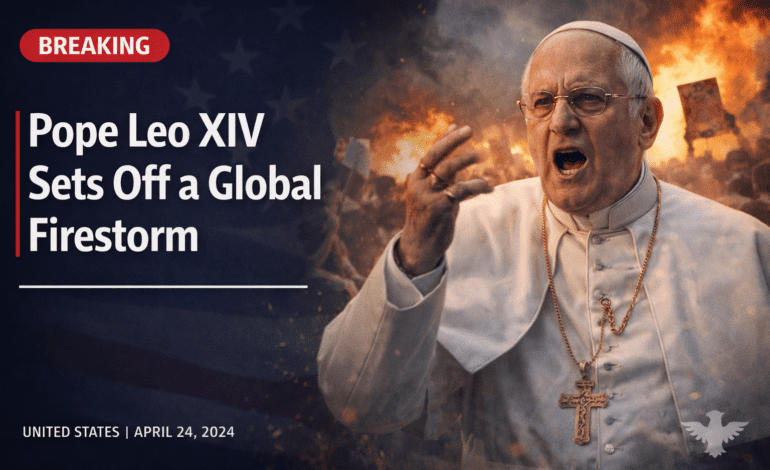

VATICAN CITY — When Pope Leo XIV sat down in front of live television cameras last week, the world expected a standard message of faith and unity. What it got instead was something far more unusual: a sitting pope speaking plainly and pointedly about American immigration law, a sitting U.S. president, and what he called the slow erosion of human dignity in modern politics. Within hours, his words had ricocheted around the globe, igniting fierce debate in Washington, Rome, and nearly every major city in between.
The moment came during a live broadcast that was originally intended to focus on poverty and the role of the church in modern society. But when a journalist asked the Pope a pointed question about the Born-In-America Act — a controversial piece of U.S. legislation that has divided legal scholars, civil rights groups, and lawmakers — Leo XIV did not dodge it. He answered directly, calmly, and without the diplomatic hedging most people expect from religious leaders of his stature.
His remarks were not a rant or a political speech. They were measured and clear. But in today’s charged political climate, even measured and clear can feel like a bomb going off.
What the Pope Actually Said
Pope Leo XIV addressed the Born-In-America Act with a level of directness that left viewers stunned. He said the law raised serious questions about what it means to value human life and that its consequences for real families — particularly immigrant families — could not be ignored by any person of conscience. He did not endorse a political party. He did not tell Americans how to vote. But he made it clear that he believed policies that strip people of protections based solely on where they were born represent a failure of moral leadership.
When the conversation turned to President Donald Trump, the Pope’s tone remained steady. He said he respected the office of the presidency and would always pray for those who hold great power. But he also said that leadership which divides rather than unites — his words — carries a cost that societies often do not fully understand until it is too late. He did not name Trump by name in every instance, but the context made the reference unmistakably clear to everyone watching.
The broadcast studio reportedly went very quiet at several moments. Co-hosts exchanged glances. Producers, according to sources familiar with the broadcast, briefly debated whether to cut away. They did not. The Pope continued, speaking about the responsibility of powerful nations to set an example for the world — not just in military strength or economic might, but in how they treat the most vulnerable people within their borders.
The Born-In-America Act: A Quick Breakdown
To understand why the Pope’s words carried such weight, it helps to understand what the Born-In-America Act actually does — and why it has proven so controversial since it was introduced.
The legislation, which has been championed by conservative lawmakers and backed by the Trump administration, seeks to narrow the scope of birthright citizenship in the United States. Under the 14th Amendment to the U.S. Constitution, nearly everyone born on American soil is automatically a citizen, regardless of their parents’ immigration status. The Born-In-America Act challenges this long-held interpretation by arguing that children born to undocumented immigrants or non-permanent residents should not receive automatic citizenship.
Supporters of the act say it is a necessary correction to what they see as an outdated loophole. They argue that automatic birthright citizenship encourages illegal immigration and places unfair burdens on public services. They point to the fact that most countries in the world do not grant citizenship purely based on location of birth, and say that the United States should align itself with those international norms.
Opponents, including constitutional lawyers, civil rights advocates, and now — apparently — the head of the Catholic Church, argue that the act is unconstitutional on its face and morally wrong in practice. They say it would create a two-tiered system in which some American-born children grow up as full citizens while others do not, simply because of who their parents are. Critics also warn that the act could be used as a stepping stone toward broader restrictions on immigration and civil rights.
The act has been tied up in legal challenges since it was first introduced. Several federal courts have issued rulings blocking or limiting its implementation, and the matter is widely expected to eventually reach the U.S. Supreme Court. In the meantime, it remains one of the most emotionally charged pieces of legislation in recent American political history.
Reactions Pour In From Around the World
The response to Pope Leo XIV’s comments was immediate and global. Social media platforms lit up within minutes of the broadcast. By the following morning, his remarks were trending in more than thirty countries. The reactions split largely along predictable lines, though the intensity on both sides was striking.
Among Catholic communities in the United States — a country with a large and politically diverse Catholic population — the response was deeply divided. Some American Catholics praised the Pope for speaking truth to power and said his moral clarity was exactly what the church needed in an age of political cowardice. They shared clips of the broadcast widely and called his words a wake-up call for a nation that has lost its way on questions of human dignity.
Other American Catholics, particularly those who support Trump and back the Born-In-America Act, expressed anger and disbelief. Some said the Pope was overstepping his role by wading into American domestic politics. Several prominent conservative commentators accused him of being influenced by liberal political forces within the Vatican. A few called for formal protests to be lodged with the Holy See.
In Latin America, where the Catholic Church holds enormous influence and where many families have been directly affected by U.S. immigration policy, the reaction was overwhelmingly positive. Religious leaders across Mexico, Guatemala, El Salvador, and other nations issued statements supporting the Pope’s remarks. Some described them as long overdue. Community organizations that work with immigrants and deportees said the Pope had given a voice to millions of people who feel invisible in the current political debate.
In Europe, political commentators viewed the episode through the lens of a broader conversation about the rise of nationalism. Several European newspapers ran front-page stories not just about what the Pope said, but about what it means when one of the most powerful religious figures in the world feels compelled to speak out about the policies of a democratic government. Some asked whether this signaled a new, more activist era for the papacy under Leo XIV.
The White House Responds
The Trump administration did not take long to fire back. A spokesperson for the White House released a statement saying that the President respects all religious leaders but that the Pope’s remarks represented an inappropriate interference in American sovereignty. The statement said that immigration policy is the exclusive domain of the American people and their elected representatives, and suggested that foreign leaders — religious or otherwise — should be careful about inserting themselves into U.S. domestic affairs.
Trump himself commented on the matter at a press event the following day, calling the Pope’s remarks unfair and uninformed. He said his administration’s immigration policies were designed to protect American workers and that anyone who criticized them simply did not understand the scale of the challenge at the southern border. He also suggested, without elaborating, that the Vatican had its own immigration problems it should deal with first.
Congressional Republicans offered a mixed bag of responses. Some echoed the White House line and criticized the Pope for overreaching. Others tried to distance themselves slightly, saying they respect the Pope’s spiritual authority while disagreeing with his political commentary. A handful of Republicans said nothing publicly, apparently unwilling to either defend the administration against the Pope or side with the Pope against the administration.
Democrats, meanwhile, largely welcomed the Pope’s comments. Several members of Congress cited his remarks in floor speeches and public statements. Some pointed out that past popes — including Pope Francis — had spoken about immigration and the rights of migrants on multiple occasions, and that Leo XIV was simply continuing a long tradition of Catholic social teaching that emphasizes the dignity of all people regardless of national origin.
Who Is Pope Leo XIV — And Why Does His Voice Carry Such Weight?
Pope Leo XIV is still a relatively new figure on the world stage, having been elected to the papacy earlier in 2025. But he has moved quickly to establish himself as a pope who is not afraid to speak on difficult topics. Before his election, he was known within the Church as a theologian with a strong background in social ethics — a field deeply concerned with questions of justice, poverty, and human rights.
His choice of the name Leo — echoing Pope Leo XIII, who in the late 1800s wrote Rerum Novarum, one of the most important documents in the history of Catholic social teaching — was widely seen as a signal of his priorities. Rerum Novarum was a landmark encyclical that addressed the rights of workers and the responsibilities of governments toward the poor. By taking the name Leo, the new pope was seen as signaling a commitment to continuing that tradition of speaking up on issues of justice and dignity.
He leads a church of approximately 1.4 billion people worldwide, making Catholicism the largest single religious denomination on the planet. While the church’s influence varies enormously from country to country, in many parts of the world — including large swaths of Latin America, Africa, and Southern Europe — the Pope’s words carry immense practical weight. When he speaks on a political issue, it is not just a religious statement. It is a statement that reaches into the everyday lives of over a billion people.
The Bigger Question: Should Religious Leaders Speak on Politics?
The episode has revived a debate that never fully goes away in democratic societies: should religious leaders comment on political matters, and if so, how far should they go?
Those who say yes argue that religion and ethics are inseparable, and that moral questions — about how we treat the poor, the immigrant, the marginalized — are by their very nature political. They point to a long history of religious leaders who changed the world precisely by speaking out: from Martin Luther King Jr. to Archbishop Desmond Tutu to Pope John Paul II’s role in challenging communist rule in Eastern Europe. In each of these cases, mixing religion and politics was not seen as a failure of propriety — it was seen as an act of moral courage.
Those who say no argue that religious leaders wield a kind of influence that is fundamentally different from elected politicians, and that they can easily cross the line from moral witness into partisan manipulation. They worry that when a pope or pastor takes sides in a political debate, it can pressure followers — sometimes unfairly — to align their votes and beliefs with the views of a religious authority rather than their own considered judgment. In a democracy, they argue, that dynamic is troubling.
What makes Pope Leo XIV’s comments interesting is that he seemed genuinely aware of this tension. He did not tell Catholics how to vote. He did not endorse a candidate or a party. He spoke in terms of principles — dignity, justice, the treatment of the vulnerable — and left the political conclusions to his listeners. Whether that counts as appropriate restraint or clever influence by another name is a question reasonable people can disagree about.
Immigration, Faith, and the American Identity
At the heart of this entire episode is a question that Americans have been wrestling with for generations: what does it mean to be American, and who gets to belong?
The United States has always been a nation defined in large part by immigration. Its history is inseparable from the stories of people who came from elsewhere, often under desperate circumstances, and built new lives within its borders. Many of the country’s most celebrated cultural, scientific, and business figures were either immigrants themselves or the children of immigrants. The Statue of Liberty stands in New York Harbor as one of the most recognized symbols in the world precisely because it represents a promise — the idea that America is a place where the tired, the poor, the huddled masses can find a home.
The Born-In-America Act represents a direct challenge to that idea — or at least to one particular legal expression of it. Its supporters say they are not against immigration but against illegal immigration, and that enforcing clear rules about citizenship is simply good governance. Its opponents say the act is the latest in a series of moves to make America less welcoming, less diverse, and less true to its founding ideals.
Pope Leo XIV, by wading into this debate, has essentially argued that the question is not just a legal or political one — it is a moral one. And he has suggested, without much ambiguity, which side of that moral argument he stands on.
What Happens Next
The immediate political fallout from the Pope’s remarks is still playing out. Diplomatic channels between the Vatican and the United States have reportedly been active since the broadcast, with both sides seeking to manage the relationship carefully. Neither the Pope nor the White House appears interested in a prolonged public conflict, but neither side seems willing to fully back down either.
On the legal front, the Born-In-America Act continues to make its way through the courts. Legal analysts expect the constitutional questions at the heart of the legislation to eventually be resolved at the Supreme Court level, though the timeline for that remains uncertain. In the meantime, the human stories behind the policy — families separated, children left in legal limbo, communities living in fear — continue to unfold across the country.
As for Pope Leo XIV, his unscripted television moment has cemented his reputation as a pope who is willing to say uncomfortable things in uncomfortable settings. Whether that turns out to be a strength or a liability — for him, for the Church, and for the global conversation about immigration and human dignity — remains to be seen.
What is clear is that his words have not faded quietly into the news cycle. They have stuck. They have been argued over, praised, condemned, shared, and dissected across languages and continents. In a world overloaded with information, that kind of staying power is itself a kind of statement.
Sometimes the most political thing a person can do is simply tell the truth, out loud, on live television, and let the world decide what to do with it.
— Matter News Staff