“It Started as a Political Jab… Then Pope Leo XIV Delivered Words That Stunned the World”
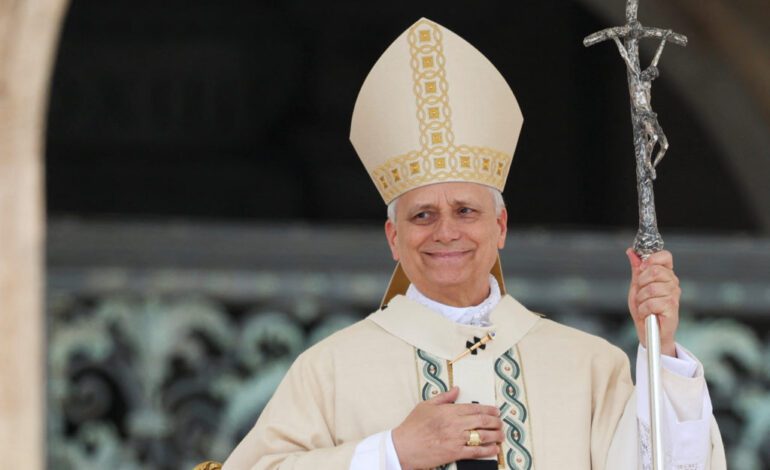

It Was Supposed to Be a Routine Political Jab — Instead Pope Leo XIV Delivered a Sermon the Whole World Will Remember
It was supposed to be another routine political attack. A headline. A soundbite. A quick hit designed to rally supporters, dominate the news cycle for a day, and move on. Donald Trump had targeted religious figures before. He had used sharp words to put opponents on the defensive and shift the frame of a news story in his favor. The formula was familiar. The result was supposed to be predictable.
But this time, something went wrong with the formula. Or perhaps something went exactly right — depending on where you stood when Pope Leo XIV stepped up to the podium, looked out at a room full of journalists and political observers, and began to speak.
What followed was not a rebuttal. It was not a press statement. It was not the kind of careful, measured, diplomatically worded response that institutions typically produce when attacked by political leaders. It was something older than any of that. It was a sermon. And it echoed worldwide within hours — not because it was designed to go viral, but because it said something that an enormous number of people had been waiting, without quite knowing it, to hear someone say out loud.
What Was Trump Trying to Accomplish With His Attack on Pope Leo XIV?
To understand what happened in that room, you first have to understand what Trump was trying to do — and why the strategy made sense on paper.
Trump’s public criticism of Pope Leo XIV followed a pattern that has served him well throughout his political career. When a public figure — whether a political opponent, a media organization, or an institution — challenges his policies or his leadership, he responds by going on offense. He reframes the conversation around the challenger rather than the challenge. He uses sharp, direct language designed to put the target on the defensive. And he trusts that his supporters will respond to the aggression with the kind of energized approval that feeds his political coalition.
The specific attack — calling the Pope an insult to America and suggesting that he had gone beyond order — was calibrated to position Trump as a defender of American dignity against what he was framing as foreign religious overreach. It was a message designed to resonate with supporters who view criticism of American policy from international institutions and figures as a form of interference rather than a legitimate moral challenge.
On the surface, it was a sound political calculation. Pope Leo XIV had been publicly critical of administration policies on immigration, war, and economic inequality. He had spoken about these issues in the direct, values-based language of his faith — a language that implicitly indicts policies that produce suffering among vulnerable populations. Attacking him gave Trump a way to energize his base, reframe the Pope’s moral criticism as political interference, and shift the public conversation away from the substance of what Leo had said.
What Trump did not anticipate — or perhaps underestimated — was what Pope Leo XIV would choose to do with the platform that attack created.
What Was the Moment That Changed the Room?
The room where Pope Leo XIV delivered his response was already tense when he walked in. Word of Trump’s attack had spread quickly. The journalists, observers, and clergy present all knew what had been said. Most of them expected the Pope to respond with the careful, measured language of institutional diplomacy — acknowledging the attack without engaging it too directly, expressing commitment to dialogue, and preserving the kind of studied neutrality that religious institutions typically maintain in the face of political pressure.
He did none of that. He walked to the podium. He looked out at the room. And he spoke in the quiet, steady voice of someone who has already decided exactly what needs to be said and is no longer concerned with whether saying it will be comfortable.
He acknowledged Trump’s attack directly. He did not soften it or reframe it. He repeated the accusation — that he had insulted Jesus — and then he paused. And in that pause, the room began to understand that what was about to happen was not going to follow the usual script.
Do you want to know what insults Jesus?
He let the question land. And then he answered it. Not with the kind of abstract theological language that allows listeners to nod in agreement without feeling personally implicated. But with specific, concrete, policy-level examples — drawn directly from the world his audience was living in.
It is sending young men and women into endless wars without purpose. It is choosing silence when truth demands courage. It is cutting health care for the sick while reducing the tax burden of the very wealthy. It is turning away the stranger, separating children from their mothers, and calling it law.
The room did not erupt. It went still. And that stillness — the particular quality of silence that falls over a space when something has been said that everyone present knows they will be thinking about for a long time — was the first signal that this was not going to be a moment that faded by morning.
What Were the Words That Hit Like Thunder — and Why Did They Land So Hard?
Every public speech has a turning point — the moment when the audience shifts from listening with their ears to listening with something deeper. For the people in the room where Pope Leo XIV spoke, that turning point came when the tone dropped and the words became slower and more deliberate.
He had been building through the specifics — the wars, the silence, the health care, the immigration policy. Each example was a step down from the abstract into the concrete. Each one forced the audience to confront not a theological principle but a real-world consequence of real-world decisions made by real people with real power. By the time he reached the end of that list, the room was completely silent.
And then came the line that traveled worldwide.
I am not a perfect Christian. There has only ever been one — and He was crucified on a cross 2,000 years ago.
The silence after those words was absolute. And within that silence, something happened that is difficult to fully capture in a news article but that everyone who witnessed it described the same way: the room shifted. Not politically. Not institutionally. Something more fundamental — a collective recognition that what had just been said was not a talking point, not a rebuttal, not a political move. It was the truth. Delivered simply. And it cut through every layer of noise and spin that surrounds the conversation it was part of.
He did not claim to be above the fray. He placed himself inside it — as imperfect as everyone else — and then asked why the standard of perfection was being applied selectively to the vulnerable and never to the powerful.
The words echoed because they did something that almost no public statement in the contemporary political environment manages to do: they refused the terms of the existing debate. Trump had framed his attack as a question of national dignity and political overreach. Leo XIV did not engage those terms. He replaced them entirely — with a different question, a different frame, and a different standard by which to evaluate who was right and who was wrong.
How Did the Battle of Narratives Unfold After the Speech?
Within hours of the speech, two competing narratives had taken shape — and the speed at which they hardened into opposed camps revealed how deeply the moment had struck at something real in American public life.
The first narrative, advanced by Trump’s supporters and allies, was that the Pope had overstepped. That a religious leader has no business directly engaging the policies of a democratically elected president. That Leo XIV had effectively declared himself a political opponent of the administration and should be treated as such. That his words, however eloquent, were fundamentally an act of political interference by a foreign institution dressed up in the language of faith.
There is something to this argument that deserves to be engaged seriously rather than dismissed. Religious institutions that enter directly into partisan political debates can lose the kind of moral authority that makes their voice meaningful. When the Church begins to sound like a political party, people who do not share its political preferences stop hearing its moral claims. The risk of politicizing religious speech is real, and it is one that thoughtful defenders of the Pope’s approach acknowledge.
But the second narrative — the one that spread far more widely and far more quickly — drew a different distinction. It argued that there is a difference between political partisanship and moral clarity. That a religious leader who speaks about war, poverty, immigration, and the treatment of vulnerable populations is not doing politics. They are doing exactly what religious leaders are supposed to do — holding power accountable to values. And that when the leader of the world’s largest Christian denomination responds to an accusation that he insulted Jesus by explaining precisely what, in his view, actually insults Jesus, he is not making a political move. He is making a theological one.
That distinction — between partisan politics and moral accountability — is one that Americans have been wrestling with for decades. The Pope’s speech dropped directly into the center of that long-running argument and refused to resolve it neatly. Which is perhaps part of why it generated such intense and sustained engagement.
What Were the Shockwaves Beyond the Room — and How Far Did They Travel?
The speech did not stay contained within the political and religious circles that first received it. It traveled — in clips, in quotes, in written summaries and audio recordings — to communities that rarely engage directly with papal statements or with the fine-grained details of the relationship between American politics and Catholic moral teaching.
It traveled to working-class communities where people dealing with health care costs, military deployments, and immigration anxiety heard themselves named — not as political abstractions but as the specific populations whose experiences the Pope had cited as evidence of what actually insults the values that American politicians so frequently invoke.
It traveled to churches — not only Catholic churches but Protestant, evangelical, and non-denominational congregations where pastors and congregants found themselves in conversations about whether the speech reflected the obligations of their own faith traditions. The line about the only perfect Christian being crucified 2,000 years ago crossed denominational lines in a way that purely Catholic theological statements rarely do.
It traveled internationally — to countries where the intersection of American political power and American religious rhetoric is watched closely and sometimes with concern. The response in many European countries was one of recognition: the sense that someone had finally said, in a setting that required genuine moral courage to say it, what many outside the United States had been thinking for some time.
Truth is not always comfortable. But it is always necessary. The Pope said it. The world heard it. And the silence that followed those words lasted longer than any applause could have.
And it traveled to people who do not identify as religious at all — who have no particular stake in papal authority or Christian theology — but who responded to the specific moral claims about war, poverty, and the protection of the vulnerable with the kind of recognition that cuts across belief systems. You do not have to be Catholic to understand what it means to send young people into endless wars without purpose. You do not have to be Christian to recognize the moral weight of separating children from their parents.
What Is the Cost of Speaking Out — and Why Does It Matter That Leo Paid It?
Speaking moral truth to political power has never been without cost. The history of religious leaders who have chosen to do it — from early Christian martyrs to Martin Luther King Jr. to Archbishop Romero — is a history of people who accepted significant personal risk in exchange for the possibility of significant moral impact.
Pope Leo XIV is not facing martyrdom. But the decision to respond to Trump’s attack the way he did carries real institutional costs. It has drawn the Catholic Church more directly into American political controversy than many of its leaders would prefer. It has created a new set of political enemies for an institution that relies on good relationships with governments around the world to carry out its charitable and pastoral work. And it has put Leo XIV personally in the crosshairs of a political movement that has shown a consistent willingness to use the full weight of its institutional resources against figures who challenge it publicly.
Leo has not stepped back from any of it. He has not softened his language in subsequent statements. He has not sought to reframe his remarks as being less pointed than they sounded. He has simply continued to speak — about war, about poverty, about the treatment of the vulnerable — in the same direct, values-based language that drew Trump’s attack in the first place.
That consistency is itself a form of moral communication. In a public environment where almost everyone eventually retreats, qualifies, or walks back statements that generate significant political pressure, the refusal to do so carries a specific kind of weight. It says: I said what I meant. I meant what I said. And the pressure you are applying has not changed either of those things.
Will the Moment Fade — or Will It Force Something to Change?
The question that political analysts, religious observers, and ordinary Americans are now asking is whether the moment Pope Leo XIV created in that room has any lasting consequence — or whether it will be absorbed into the relentless churn of the news cycle and forgotten within weeks.
The honest answer is that most moments do not last. The media environment moves fast. Public attention is finite. And moments that feel world-historical on the day they happen often look smaller in retrospect — part of a continuous flow of controversy and countercontoversy that produces more heat than light.
But some moments do linger. And the ones that linger tend to share a specific quality: they say something that people already believed but had not yet heard said clearly, publicly, and with the kind of moral authority that makes it impossible to simply dismiss. They give language to a feeling that had been present but unnamed. And that naming — precise, simple, and honest — creates a new reference point that is harder to forget than most public speech.
Whether Leo XIV’s sermon becomes that kind of moment depends on what happens next. If it produces nothing — no policy reflection, no public reckoning, no sustained conversation about the moral questions it raised — then it will fade as most moments do. But if it becomes a reference point — a moment that people return to when they are trying to articulate something about the relationship between political power and moral accountability — then it will have done something that most political speech never manages to do.
It will have lasted. Not because it was loud. But because it was true. And truth, as Leo himself said in a statement to aides after the moment had passed, is not always comfortable. But it is always necessary.
Key Takeaways: Pope Leo XIV, Trump, and the Sermon the World Will Not Forget
What began as a routine political attack by Donald Trump on Pope Leo XIV became one of the most widely discussed moments of moral clarity in recent American public life.
The Pope’s response — calm, direct, and built on specific moral examples drawn from current policy debates — dismantled the terms of Trump’s attack and replaced them with a different and more fundamental question about what actually insults the values that political leaders claim to represent.
His statement that there has only ever been one perfect Christian, and He was crucified 2,000 years ago, drew a worldwide response that traveled across denominational lines, national borders, and the divide between the religious and the secular.
The moment has generated two competing narratives — one that sees the Pope’s response as political overreach, one that sees it as exactly the kind of moral accountability that religious leadership is supposed to provide — and the tension between them reflects a long-running American argument about the relationship between faith, power, and political life.
Whether this moment fades or lingers will depend on what happens next — and on whether the questions it raised find their way into the sustained public conversation they deserve.
© 2026 Matter News. All rights reserved.
Discover more from MatterDigest
Subscribe to get the latest posts sent to your email.