Pennsylvania Just Passed a Historic Same-Sex Marriage Bill — The 127–72 Vote Is Making Headlines Nationwide
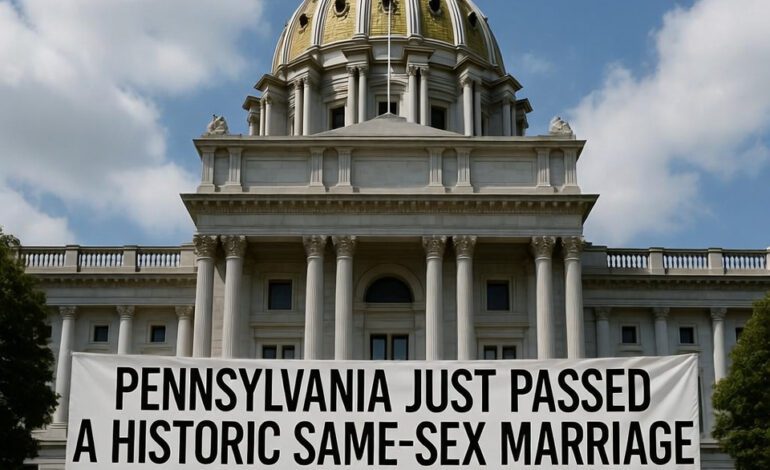

Pennsylvania Protects Same-Sex Marriage With Historic HB1800 — What the 127–72 Vote Means for LGBTQ Families
QUICK ANSWER
On March 25, 2026, the Pennsylvania House of Representatives passed House Bill 1800 by a vote of 127 to 72. The bill rewrites the state’s legal definition of marriage from “one man and one woman” to “two individuals,” formally codifying same-sex marriage into Pennsylvania state law. The bill now moves to the Republican-controlled Senate, where its fate remains uncertain.
For more than a decade, same-sex couples in Pennsylvania have lived with an uncomfortable truth. Their marriages were legal. But buried inside Pennsylvania’s law books was a statute that still defined marriage as “a civil contract by which one man and one woman take each other for husband and wife.”
Federal court rulings and U.S. Supreme Court decisions had rendered that language unenforceable. But it was still there. And in a political climate where federal protections have faced serious challenges, “unenforceable” began to feel less reassuring.
On March 25, 2026, Pennsylvania’s House voted 127 to 72 to finally change that. House Bill 1800 rewrites the definition of marriage in state law and repeals the dormant same-sex marriage ban that has sat on the books since 1996. It is the most significant piece of LGBTQ legislation to pass the Pennsylvania House in the state’s history.
Table of Contents
- 1. What HB1800 Does: The Exact Legal Change
- 2. Why This Bill Was Needed in 2026
- 3. The History of Same-Sex Marriage in Pennsylvania
- 4. Who Sponsored the Bill and Who Voted How
- 5. The Bigger LGBTQ Legislative Package
- 6. Reactions: What Lawmakers and Advocates Are Saying
- 7. What the Respect for Marriage Act Already Did (And What It Didn’t)
- 8. What Happens Next: The Senate and Governor
- 9. People Also Ask: Your Questions Answered
- 10. Key Takeaways and How to Stay Engaged
1. What HB1800 Does: The Exact Legal Change
House Bill 1800 is precise and deliberate. It does two specific things:
- It amends Title 23 (Domestic Relations) of the Pennsylvania Consolidated Statutes, changing the definition of marriage from “a civil contract by which one man and one woman take each other for husband and wife” to “a civil contract between two individuals.”
- It repeals Section 1704, the part of Pennsylvania’s existing law that specifically invalidates and refuses to recognize same-sex marriages.
That second point matters enormously. Section 1704 has been a legal landmine for over a decade. Courts have stopped enforcing it. But it remained in the statute. If a federal court or the U.S. Supreme Court ever weakened or reversed the protections established in Obergefell v. Hodges (2015), Section 1704 could theoretically be revived.
HB1800 removes that risk entirely at the state level. It makes Pennsylvania’s recognition of same-sex marriage independent of whatever happens at the federal level.
2. Why This Bill Was Needed in 2026
You might reasonably ask: if same-sex marriage has been legal since 2014, why does this bill matter now?
The answer comes down to a word: fragility.
The Federal Safety Net Has Weakened
In June 2022, the U.S. Supreme Court’s decision in Dobbs v. Jackson Women’s Health Organization overturned Roe v. Wade. Justice Clarence Thomas wrote separately that the Court should reconsider other substantive due process rights — citing specifically Obergefell v. Hodges, the decision that established marriage equality nationwide.
Thomas’s concurrence was not binding. But it was a clear signal that the Court’s composition had shifted in ways that could, in theory, affect same-sex marriage protections.
35 States Still Have Dormant Bans
Pennsylvania is one of 35 U.S. states that still had dormant same-sex marriage bans on the books as of early 2026. These bans are currently unenforceable — but they exist. They are a legal time bomb waiting for a political trigger.
The Pennsylvania co-sponsorship memo for the companion Senate Bill 434 put it plainly: “Legislation is still needed at the state level to update our marriage statutes and prevent the outlaw of same-sex marriage in Pennsylvania should both state and federal court rulings be overturned.”
The Trump Administration Context
Democratic sponsors of HB1800 were also explicit about their urgency. President Trump’s second administration has rolled back numerous federal protections primarily targeting transgender people. While same-sex marriage has not been directly targeted, the broader rollback created understandable anxiety in LGBTQ communities about the durability of existing rights.
State-level protection removes that anxiety — at least for Pennsylvanians.
3. The History of Same-Sex Marriage in Pennsylvania
| Year | Event | Significance |
| 1996 | PA statutory ban enacted | One-man, one-woman definition added to state law; passed 177–16 in the House |
| 2006 | Constitutional ban proposed | GOP-led effort to write ban into PA Constitution; reached Rules Committee, no further action |
| 2014 | Federal court strikes ban | Whitewood v. Wolf: U.S. District Court rules ban unconstitutional; PA becomes 18th state to legalize |
| 2015 | Obergefell v. Hodges | U.S. Supreme Court rules marriage is a fundamental right under U.S. Constitution; nationwide legalization |
| 2022 | Dobbs decision | SCOTUS overturns Roe; Justice Thomas suggests revisiting Obergefell; renewed urgency for state protection |
| Dec 2022 | Respect for Marriage Act | Congress passes federal RFMA, providing some protection but not fully replacing Obergefell |
| July 2024 | HB passes House (133–68) | Earlier version passes House but dies in Republican-controlled Senate |
| Aug 2025 | Bill reintroduced | HB1800 reintroduced; gains 53 Democratic co-sponsors and 1 Republican |
| Mar 10, 2026 | Judiciary Committee passes | House Judiciary advances HB1800 with two bipartisan Republican votes |
| Mar 25, 2026 | HB1800 passes House | Final vote: 127–72. Bill now moves to Senate. |
The pattern across three decades is clear. Democrats have introduced versions of this legislation repeatedly. Republicans have blocked or tabled it at nearly every turn. The 2026 vote represents the furthest the effort has ever gotten.
4. Who Sponsored the Bill and Who Voted How
Prime Sponsor: Rep. Malcolm Kenyatta (D-Philadelphia)
Rep. Malcolm Kenyatta is the primary sponsor of HB1800. He is openly gay and married his husband in 2022. He has been the leading voice for LGBTQ rights in the Pennsylvania House for several sessions.
“I know some folks in this building have never had to refresh a computer screen to see if a court has given you access to a fundamental right, but that’s where I was when Obergefell v. Hodges came up — and the court voted correctly.”
— Rep. Malcolm Kenyatta, March 25, 2026
The Vote Breakdown
- 127 Yeas, 72 Nays, 1 Abstention
- The bill passed almost entirely along party lines
- Two Republicans crossed the aisle: Rep. Timothy Bonner (R-Mercer) and Rep. Brenda Pugh (R-Luzerne)
- All 53 Democratic co-sponsors supported the bill
The bipartisan support — while small — is notable. In the 2024 version of the bill, a similar small number of Republicans voted yes. The bill is slowly pulling limited support from across the aisle.
5. The Bigger LGBTQ Legislative Package
HB1800 did not move alone. It was part of a sweeping eight-bill package that passed the House Judiciary Committee on March 10, 2026, and moved to the House floor. The package includes:
- The Fairness Act — Would extend Pennsylvania’s nondiscrimination laws to explicitly protect LGBTQ people in housing and education. Rep. Dan Frankel has sponsored versions of this bill for over 20 years.
- Expanded hate crime penalties — Broadens the definition of “ethnic intimidation” to include acts targeting people based on sexual orientation, gender identity, or gender expression.
- Law enforcement hate crime training — Requires additional training for police to identify and investigate hate crimes.
- Legal name change reform — Removes the public notice requirement for legal name changes; adds automatic sealing for name changes affirming gender identity.
- HIV sentencing reform — Eliminates sentencing enhancements for people with HIV who commit prostitution-related offenses.
- LGBTQ panic defense ban — Removes the legal defense that allows defendants to argue a revelation about a victim’s sexual orientation or gender identity provoked them to violence.
HB1800 was the most bipartisan of the eight bills. The others advanced almost entirely on Democratic votes.
6. Reactions: What Lawmakers and Advocates Are Saying
“The idea that we do not deserve to be discriminated against because of who we are and who we love should not be seen as controversial. We understand, and most Pennsylvanians believe, that our commonwealth is better when it’s fairer.”
— Rep. Jessica Benham (D-Allegheny), co-chair, LGBTQ Caucus
“You weren’t invited. We had a wonderful time. We want the government out of our business. Pretty libertarian view, actually.”
— Rep. Malcolm Kenyatta, responding to Republican opposition to his marriage
Republican opposition centered on concerns that the broader LGBTQ package — particularly the Fairness Act — would affect school sports, locker rooms, and shelters. Kenyatta and Benham both emphasized that HB1800 and the Fairness Act address neither of those issues.
A 2024 poll from the Public Religion Research Institute found that 68% of Pennsylvania residents support legal recognition of same-sex marriage. That figure has climbed steadily since 2015 and is now higher than the national average.
7. What the Respect for Marriage Act Did — And What It Didn’t
In December 2022, Congress passed the federal Respect for Marriage Act (RFMA). It was a significant step. But it’s important to understand exactly what it did and did not do.
| What RFMA DID | What RFMA Did NOT Do |
| Formally repealed the 1996 Defense of Marriage Act (DOMA) | Does not require states to issue new same-sex marriage licenses if Obergefell is overturned |
| Requires the federal government to recognize any same-sex marriage valid in the state it was performed | Does not require states with dormant bans to recognize marriages performed elsewhere |
| Protects interstate recognition of same-sex marriages | Does not remove the 35 dormant state-level same-sex marriage bans still on the books |
| Provides some religious liberty carve-outs to build bipartisan support | Does not guarantee equal protection if the Supreme Court revisits Obergefell |
The gap the RFMA left is exactly what HB1800 fills at the Pennsylvania level. Where federal law stops short, state law can step in.
8. What Happens Next: The Senate and Governor
The Senate: A Steep Climb
The Pennsylvania Senate is Republican-controlled. No version of this legislation has ever received a Senate vote. As of this writing, Senate Bill 434 — the companion bill — has no scheduled committee hearing.
Philadelphia Inquirer reporting from March 11, 2026 noted that the bill is “unlikely to ever reach Gov. Josh Shapiro’s desk to become law” in its current legislative session. Senate Republican leadership has not commented publicly on HB1800.
The Governor: Ready to Sign
Gov. Josh Shapiro (D) has expressed general support for LGBTQ rights throughout his tenure. If the bill reached his desk, he would almost certainly sign it into law.
What to Watch For
- Whether Senate Republicans schedule SB434 for any committee hearing.
- Whether any bipartisan momentum builds in the Senate after the House passage.
- Whether the broader political environment — including any federal legal changes — accelerates pressure on the Senate.
- Whether advocates use the 68% public support figure to campaign in competitive Senate districts.
9. People Also Ask: Key Questions Answered
What does Pennsylvania House Bill 1800 do?
HB1800 changes Pennsylvania’s legal definition of marriage from “one man and one woman” to “two individuals” and repeals Section 1704, the state’s dormant same-sex marriage ban that has been on the books since 1996. It passed the Pennsylvania House on March 25, 2026, by a vote of 127 to 72.
When did same-sex marriage become legal in Pennsylvania?
Same-sex marriage has been legally recognized in Pennsylvania since May 20, 2014, when the U.S. District Court for the Middle District of Pennsylvania struck down the state’s statutory ban in Whitewood v. Wolf. Governor Tom Corbett declined to appeal the ruling. Pennsylvania was the 18th state and the last in the northeastern U.S. to legalize same-sex marriage.
Is HB1800 now law in Pennsylvania?
No. As of March 26, 2026, HB1800 has passed the Pennsylvania House of Representatives but has not yet been voted on by the Republican-controlled Senate. It must pass both chambers and be signed by the governor to become law.
Why does Pennsylvania still have a same-sex marriage ban in its law books?
Pennsylvania’s 1996 statutory ban on same-sex marriage was rendered unenforceable by federal court rulings in 2014 and 2015. However, the language was never officially removed from state law. HB1800 would repeal it. As of early 2026, 35 states still have similar dormant bans on the books.
What is the Respect for Marriage Act and does it protect same-sex couples in Pennsylvania?
The Respect for Marriage Act, signed by President Biden in December 2022, repealed the federal Defense of Marriage Act and requires federal recognition of same-sex marriages valid in the state where they were performed. It provides important protection but does not require states to issue new licenses if Obergefell is overturned, leaving a gap that state legislation like HB1800 is designed to fill.
Who is Rep. Malcolm Kenyatta?
Rep. Malcolm Kenyatta is a Democratic member of the Pennsylvania House of Representatives from Philadelphia. He is openly gay, married his husband in 2022, and has been the prime sponsor of same-sex marriage codification bills in multiple legislative sessions. He is also the prime sponsor of Pennsylvania’s Fairness Act.
How do Pennsylvania residents feel about same-sex marriage?
A 2024 poll from the Public Religion Research Institute found that 68% of Pennsylvania residents support the legal recognition of same-sex marriage — a figure that has grown significantly since 2015.
10. Key Takeaways and How to Stay Engaged
- HB1800 passed the Pennsylvania House 127–72 on March 25, 2026 — the furthest any same-sex marriage codification bill has gone in Pennsylvania history.
- The bill changes the legal definition of marriage to “two individuals” and repeals the dormant 1996 same-sex marriage ban.
- 68% of Pennsylvania residents support same-sex marriage, according to a 2024 PRRI poll.
- The bill now moves to the Republican-controlled Senate, where its passage is uncertain.
- Federal protections exist but have gaps — state-level codification is the most durable form of protection.
- Two Republican lawmakers — Reps. Bonner and Pugh — crossed the aisle to vote yes, a sign of slow bipartisan movement.
- HB1800 is part of a broader 8-bill LGBTQ protection package, though it has the most cross-party support of any bill in the package.
Same-sex marriage has been a legal reality in Pennsylvania for twelve years. But the statute that called it illegal was still sitting in the books like a bad ghost — harmless today, but potentially dangerous if the political winds shifted.
HB1800 isn’t just a symbolic gesture. It’s legal housecleaning with real consequences. It removes a weapon that could have been used against same-sex couples if federal protections eroded. It sends a clear signal that Pennsylvania’s legislature recognizes the dignity and legal equality of LGBTQ families.
The Senate is the next hurdle. And it is a real one. But the 127 votes for HB1800 represent more than a number. They represent a decade’s worth of advocacy, legal fights, and political change finally reaching a turning point.
Sources & Authoritative References
- WPXI / Associated Press: “Pennsylvania House passes bill to codify marriage equality into law,” March 25, 2026 — wpxi.com
- Philadelphia Inquirer: “Pa. House panel advances proposals to enshrine same-sex marriage,” March 11, 2026 — inquirer.com
- WESA (NPR Pittsburgh): “Pa. House panel advances bills to codify LGBTQ protections,” March 2026 — wesa.fm
- Wikipedia: “Same-sex marriage in Pennsylvania” — en.wikipedia.org/wiki/Same-sex_marriage_in_Pennsylvania
- LegiScan: Pennsylvania HB1800 full bill text and vote record — legiscan.com/PA/bill/HB1800/2025
- Pennsylvania General Assembly co-sponsorship memo for SB434 — palegis.us/senate/co-sponsorship/memo?memoID=43742
- PRRI 2024 American Values Atlas: Pennsylvania same-sex marriage support polling — prri.org