NY Woman Hit for $43 million on the slot machine: The Casino Claims it was a Malfunction

Katrina Bookman couldn’t stop staring at the screen.
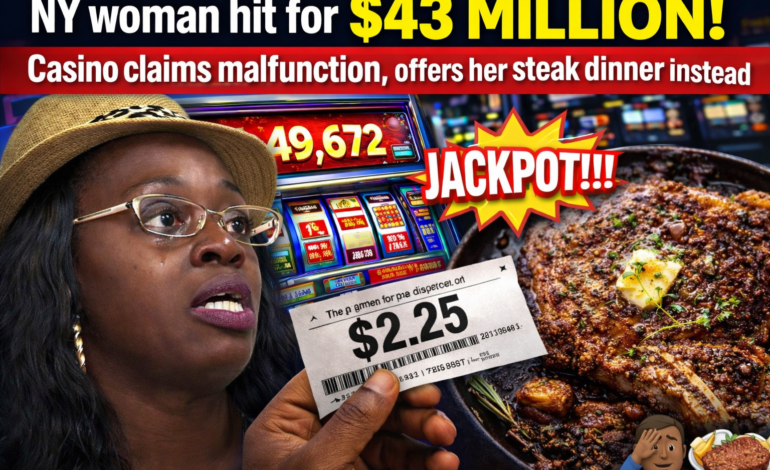
The slot machine at Resorts World Casino in Queens, New York had frozen. Numbers climbed across the display, higher and higher, until they settled on an amount that made her heart stop.
$42,949,672.76.
Forty-three million dollars.
It was August 2016. Katrina had been playing penny slots, just passing time on an ordinary night. She wasn’t a high roller. Just a single mother hoping for a small win to make the week a little easier.
This wasn’t a small win.
This was life-changing.
Her hands trembled as she pulled out her phone. She had to document this. Had to prove it was real before the moment disappeared.
The selfie she took shows everything. Pure joy. Disbelief. The face of a woman who thinks her struggles are finally over.
Behind her, the slot machine glows with that impossible number.
She flagged down a casino employee.
“I think I just won,” she said, barely able to speak. “I think I won big.”
The employee looked at the machine. Then at Katrina. Then back at the machine.
Something shifted in their expression. Not excitement. Something else.
“Congratulations,” they said carefully. “We need to verify this. Can you come back tomorrow?”
Tomorrow.
Katrina wanted to argue. Wanted answers right then. But when you’ve just won $43 million, you don’t make demands. You cooperate. You do whatever they ask.
She went home that night and didn’t sleep.
She told her family. Started making plans. Finally, after years of working hard and never catching a break, something good had happened.
She could pay off debts. Help her children. Stop worrying about every single bill.
Her life had changed forever.
Or so she thought.
The next day, Katrina returned to Resorts World Casino. She dressed nicely. Came prepared to discuss payment arrangements, taxes, and all the logistics of sudden wealth.
A casino manager met her in a private office. Professional. Polite.
Too polite.
“Ms. Bookman, we’ve reviewed the machine,” the manager said. “There was a malfunction.”
Katrina felt the room tilt.
“What?”
“The machine glitched. The display was incorrect. You didn’t actually win $43 million.”
“But the screen clearly said—”
“We understand this is disappointing. But it was a malfunction. The machine’s maximum possible payout is $6,500. It’s physically impossible for it to display $43 million as a legitimate win.”
Katrina’s mind raced. “Okay. Then what did I actually win?”
The manager shifted uncomfortably.
“$2.25.”
Silence filled the room.
“I’m sorry, what?”
“Your actual winnings from that spin were $2.25. However, as a gesture of goodwill, we’d like to offer you a complimentary steak dinner.”
Katrina stared at him, waiting for someone to admit this was a joke.
No one did.
She’d thought she’d won forty-three million dollars.
They were offering her a steak dinner.
She refused. Walked out of that casino angrier than she’d ever been in her life. She wasn’t going to sit in their restaurant and pretend any of this was acceptable.
Within hours, her story went viral.
News outlets across the country picked it up. Social media exploded with outrage, sympathy, and debate.
Some people supported Katrina. Argued that the casino should honor what the machine displayed. That a glitch wasn’t her fault and she shouldn’t be punished for the casino’s faulty equipment.
Others said she was being unrealistic. That she should have known immediately that no penny slot pays out $43 million. That she was embarrassing herself by fighting for money that was never really hers.
But the people saying that had never stood in front of a machine that told them they’d won. Had never felt that surge of hope. Had never experienced their entire future changing in an instant, only to have it ripped away.
The New York State Gaming Commission launched an investigation.
Their findings supported the casino. The machine had malfunctioned. The displayed amount was impossible. And critically, there was a disclaimer printed directly on the machine: “Malfunctions void all pays and plays.”
A disclaimer Katrina had never noticed. Never thought to look for.
But ignorance of the rule didn’t make it invalid.
Katrina wasn’t ready to accept that. She hired a lawyer and filed a lawsuit against Resorts World Casino, its parent company Genting New York, and the slot machine manufacturer, IGT.
She sued for negligence, breach of contract, and emotional distress.
If they wouldn’t pay the $43 million, fine. But they should at least pay the machine’s actual maximum payout: $6,500. That seemed reasonable. That seemed fair.
The casino fought back aggressively.
They had teams of lawyers. Unlimited resources. Everything Katrina didn’t have.
The case dragged on for years. Legal delays piled up. Court dates were postponed. The process became exhausting and expensive.
Katrina couldn’t afford to keep fighting indefinitely. But she also couldn’t let this go. This wasn’t just about money anymore. It was about principle. About accountability. About what happens when a massive corporation makes a mistake and a regular person pays the price.
Finally, years after that August night in 2016, a Queens court delivered its ruling.
The casino won.
The malfunction clause was legally valid and enforceable. Katrina had no grounds for her lawsuit.
She received nothing.
Not the $43 million she’d seen on the screen. Not the $6,500 maximum she’d fought for in court. Not even the $2.25 she’d actually won.
Not even the steak dinner she’d refused years earlier.
Nothing.
The casino faced no penalties. No fines. No requirement to fix their machines or change their policies.
They simply continued operating as if nothing had happened.
Katrina walked away with legal bills, a photo that would follow her for the rest of her life, and a story that became a cautionary tale.
The selfie still circulates online. Still gets shared thousands of times. Still generates comments from people who say “can you imagine?” or “that poor woman” or “she should have known better.”
Gaming law experts weighed in after the ruling. Most agreed the casino was legally protected. Malfunction clauses are standard in the industry. They exist precisely for situations like this.
But some questioned whether the law was just. Whether it was right that casinos could profit from faulty equipment while customers absorbed all the risk.
“These machines are programmed, tested, and maintained by the casinos,” said one consumer rights attorney who wasn’t involved in the case. “When they malfunction in the casino’s favor—when they take someone’s money—there’s no refund. But when they malfunction in the player’s favor, suddenly it doesn’t count. That asymmetry is troubling.”
Others pointed out that Katrina’s case, while extreme, wasn’t unique. Slot machine malfunctions happen regularly. Most involve smaller amounts and never make headlines. But the pattern is the same: the casino has legal protection. The player has nothing.
Years later, Katrina remains philosophical about what happened.
“I’m not the first person this happened to, and I won’t be the last,” she said in a later interview. “But maybe my story will make people think twice. Maybe they’ll read the fine print. Maybe they’ll understand that these machines aren’t really giving you a fair chance.”
The incident didn’t just affect Katrina personally. It sparked broader conversations about gambling regulation, consumer protection, and the power imbalance between casinos and players.
Some states reviewed their malfunction policies after Katrina’s story went viral. A few considered requiring casinos to pay out at least the machine’s maximum when a glitch occurs, arguing that customers shouldn’t be penalized for equipment failures.
None of those proposals passed.
The casino industry lobbied hard against any changes. They argued that paying out for malfunctions would encourage fraud and technical manipulation. That the existing system, while imperfect, was necessary to maintain integrity.
The system remained unchanged.
Katrina’s photo remains one of the most famous gambling images in recent history. It’s been featured in articles about casino law, used in discussions about gaming regulation, and shared countless times by people who see it as a perfect illustration of broken dreams.
Some casinos now use her story in employee training. A reminder of how to handle similar situations. How to de-escalate. How to enforce the malfunction policy while maintaining customer relations.
The irony isn’t lost on anyone. The woman who lost everything became a teaching tool for the industry that took it from her.
Resorts World Casino still operates in Queens. Still has slot machines. Still has that same malfunction disclaimer printed in small text that most players never read.
And people still play there. Still hope that maybe tonight will be different. Maybe tonight they’ll hit it big.
They probably won’t notice the fine print either.
Because when you’re playing, you’re not thinking about legal disclaimers. You’re thinking about possibility. About what you’d do if you won. About how your life would change.
Just like Katrina did on that August night in 2016.
Before she learned that sometimes winning isn’t enough.
Sometimes the house doesn’t just have an advantage. Sometimes it has all the power.
And sometimes, when a machine tells you that you’ve won $43 million, what you’ve really won is a lesson about how little protection you actually have.
Katrina Bookman’s story isn’t just about a slot machine malfunction.
It’s about hope and disappointment. About power and helplessness. About a system designed to protect corporations while leaving individuals to fend for themselves.
It’s about a woman who, for one brief, beautiful moment, thought her struggles were over.
And about how quickly that moment can be taken away.
The photo remains. The story endures. The lesson persists.
And somewhere, right now, someone is sitting at a slot machine, pressing a button, hoping their life is about to change.
They probably haven’t read the fine print either.
Discover more from MatterDigest
Subscribe to get the latest posts sent to your email.