NPR Criticized for Michigan Synagogue Coverage – Missing Victims’ Voices Sparks Debate

Introduction
A recent media controversy has ignited debate over journalistic priorities, balance, and responsibility in the aftermath of violent events. Following a shocking attack on a synagogue in Michigan, critics have accused NPR of overlooking the voices of victims while focusing attention elsewhere.
At the center of the controversy is a report that, according to critics and even NPR’s own public editor, failed to include a single voice from the affected Jewish community. Instead, the coverage highlighted perspectives from the attacker’s hometown thousands of miles away.
The situation has raised serious questions:
- What responsibilities do media organizations have in representing victims?
- How should journalists balance humanizing stories without distorting reality?
- And what happens when key voices are left out?
This in-depth analysis explores the full timeline, reactions, and implications of the unfolding debate.
Why was NPR criticized for its Michigan synagogue attack coverage?
NPR was criticized for not including voices from the Michigan synagogue victims while focusing on the attacker’s hometown in Lebanon, raising concerns about imbalance and missing perspectives in its reporting.
The Attack: What Happened in Michigan?
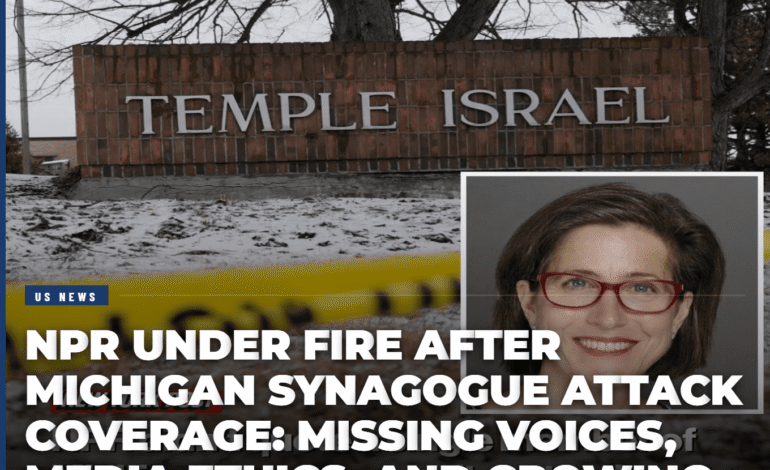
The controversy stems from a violent incident at Temple Israel, a synagogue located in West Bloomfield Township, Michigan.
According to reports:
- A 41-year-old suspect drove a vehicle into a Jewish preschool facility associated with the synagogue
- The attack placed dozens of children and community members at risk
- A confrontation followed, ending with the suspect’s death after a firefight with a security guard
Authorities later confirmed that the attack was inspired by Hezbollah, an Iran-backed militant organization.
The incident quickly drew national attention due to its nature, location, and the targeting of a religious institution.
NPR’s Coverage: A Different Focus
Shortly after the attack, NPR aired a segment on its flagship program All Things Considered.
However, instead of focusing primarily on:
- Survivors
- Witnesses
- Synagogue leadership
- Families affected
The report took a different direction.
Reporting From Lebanon
NPR sent a reporter to the attacker’s hometown in Lebanon—approximately 6,000 miles away—to explore the impact of the incident on his community.
The segment emphasized:
- Grief and fear within the attacker’s hometown
- Emotional responses from people who knew him
- Context about his background and environment
The story was headlined in a way that highlighted the Lebanese community’s reaction rather than the victims in Michigan.
Immediate Backlash: Critics Speak Out
The response from audiences and commentators was swift and intense.
Many critics argued that:
- The victims were effectively sidelined
- The coverage appeared to humanize the attacker
- The framing risked distorting public perception of the event
Some commentators expressed frustration that a violent attack targeting Jewish children was not centered in the narrative.
Public reactions emphasized a key concern: journalistic balance had been lost.
The Role of FBI Confirmation
Further intensifying the issue was the confirmation by the FBI that the attack was inspired by Hezbollah.
Additional details revealed:
- The attacker had ideological motivations tied to the militant group
- His family connections included links to individuals associated with the organization
- The attack was not random but ideologically influenced
Critics argued that these factors should have been more prominently featured in coverage rather than overshadowed by human-interest storytelling abroad.
NPR’s Public Editor Responds
Amid growing criticism, NPR’s public editor, Kelly McBride, issued a response addressing the concerns.
Defense of Editorial Intent
McBride explained that the purpose of the report was to:
- Explore connections between the attacker and his background
- Provide context on how events resonate globally
- Humanize individuals without justifying actions
She emphasized that documenting emotional responses in the attacker’s hometown did not equate to endorsing or excusing the attack.
Admission of Shortcomings
Despite defending the intent, McBride acknowledged significant gaps in NPR’s overall coverage.
She noted:
- The absence of voices from the synagogue community
- A lack of interviews with rabbis, families, or congregation members
- Insufficient focus on those directly affected
Her statement included a key admission:
When important voices are missing from coverage, it distorts the audience’s perception.
This acknowledgment became a central point in the ongoing discussion.
The Missing Voices: Why It Matters
One of the most critical aspects of journalism—especially in the aftermath of violence—is representation.
Victims’ Perspectives
Including voices from affected communities serves multiple purposes:
- Provides firsthand accounts
- Humanizes those impacted
- Ensures accurate storytelling
- Builds public understanding
In this case, critics argue that the absence of such voices created an imbalance.
Media Ethics and Editorial Judgment
The controversy has reignited broader discussions about media ethics.
Key Questions Raised:
- What should be the primary focus after an attack?
Victims, perpetrators, or broader context? - How much humanization is appropriate?
Can it unintentionally shift sympathy? - What defines balanced reporting?
Equal coverage or proportional emphasis? - When does context become distraction?
Does exploring background overshadow core facts?
These questions are not unique to this case but are increasingly relevant in modern journalism.
Comparative Coverage: Local vs National Media
Interestingly, local Michigan outlets reportedly provided more comprehensive coverage of the synagogue community.
They included:
- Interviews with congregation members
- Statements from religious leaders
- Accounts from families affected by the attack
This contrast highlighted a gap between national narrative framing and local reporting priorities.
Public Trust and Media Credibility
At its core, the controversy touches on an essential issue: trust in media institutions.
When audiences perceive:
- Bias
- Omission of key perspectives
- Imbalanced storytelling
It can erode confidence in journalism as a whole.
For organizations like NPR, which rely on public trust and funding, such criticisms carry significant weight.
The Broader Context: Reporting on Terrorism
Coverage of terrorism presents unique challenges.
Journalists must navigate:
- Sensitivity toward victims
- Avoiding glorification of attackers
- Providing necessary context
- Maintaining factual accuracy
In this case, critics argue that the balance tipped too far toward contextual storytelling at the expense of immediate impact.
Lessons for Journalism
The incident offers several important takeaways for media organizations:
1. Prioritize Primary Impact
Victims and affected communities should remain central to initial coverage.
2. Context Should Complement, Not Replace
Background reporting is valuable—but not at the cost of core narratives.
3. Transparency Builds Trust
Acknowledging gaps, as NPR’s public editor did, is a step toward accountability.
4. Audience Perception Matters
Even well-intentioned reporting can be misinterpreted if not carefully framed.
The Ongoing Debate
The controversy continues to fuel discussion across media, political, and public spheres.
Some defend NPR’s approach as:
- Nuanced
- Globally aware
- Context-driven
Others see it as:
- Misplaced priorities
- Insensitive framing
- A failure to center victims
The divide reflects broader tensions in how news is consumed and interpreted in today’s polarized environment.
Conclusion
The Michigan synagogue attack was a tragic event that demanded careful, balanced, and compassionate reporting.
While NPR aimed to provide a broader perspective, the absence of voices from Temple Israel became a defining issue.
The result was a wave of criticism, an internal acknowledgment of shortcomings, and a renewed conversation about what responsible journalism looks like in moments of crisis.
As media organizations continue to navigate complex stories, one principle remains clear:
Who gets a voice in the narrative can shape how the story is understood.
Discover more from MatterDigest
Subscribe to get the latest posts sent to your email.