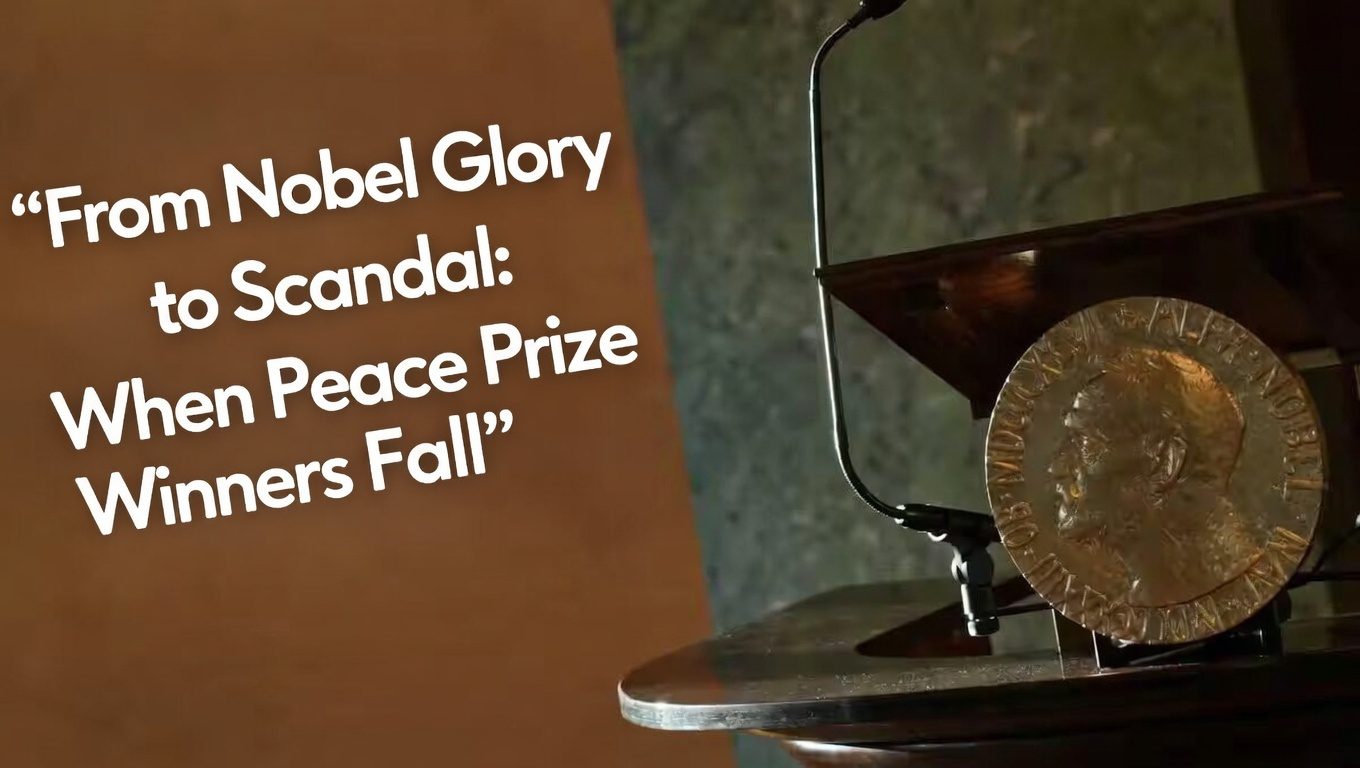
From Nobel Glory to Scandal: When Peace Prize Winners Fall

And Now Faces the Gravest Questions of His Life
The Moment a Name Is Read Aloud in Oslo
Imagine the scene. The Oslo City Hall. December 10th — the date Alfred Nobel died, now sacred in the calendar of human achievement. A hush falls over the crowd. A name is read aloud.
That name, for a moment, belongs to history. The person who holds it becomes a symbol. Not just of personal achievement, but of something the world desperately needs: the belief that one person can fight for peace and win.
But what happens when the symbol cracks? What happens when a man honored in Oslo — handed a gold medal, a diploma, nearly a million dollars — later stands at the center of the gravest questions imaginable?
That is the story of Bishop Carlos Ximenes Belo. And it is the story of others. It is a story about how far the mighty can fall — and what that fall means for the rest of us.
“He has remained in the country, a choice that has inspired millions.” — Norwegian Nobel Committee, 2025, about that year’s laureate. But for past laureates, such praise has sometimes curdled into something far darker.
Who Is Bishop Carlos Ximenes Belo? The Man Behind the Prize
Few Nobel Peace Prize stories were as genuinely moving as that of Bishop Carlos Ximenes Belo. Born in 1948 in what was then Portuguese Timor, he grew up under colonial rule, then Indonesian occupation — one of the most brutal in modern history.
Indonesia invaded East Timor in 1975. What followed was a campaign of violence, famine, and suppression that killed an estimated one-third of the Timorese population. Through it all, Bishop Belo stayed. He built churches. He sheltered refugees. He wrote letters to the United Nations that the world largely ignored.
Then, in 1996, Oslo called.
The 1996 Nobel Peace Prize: A Hero Is Born
The Norwegian Nobel Committee awarded the 1996 Nobel Peace Prize jointly to Belo and fellow East Timorese independence leader José Ramos-Horta. The citation praised their work toward a just and peaceful solution to the conflict in East Timor.
For millions of Timorese people, the award was validation. It told the world: what happened here matters. Bishop Belo was not just a religious figure — he was a shield. He used the moral authority of the Catholic Church to stand between his people and annihilation.
He was, by every measure, a hero.
The Fall: When the Vatican Imposed Sanctions
Then came September 2022. A Dutch investigative magazine, De Groene Amsterdammer, published what can only be described as a devastating investigation. The report alleged that Bishop Belo had sexually abused boys in East Timor — abuse that allegedly occurred in the 1980s and 1990s, during the very years the world was celebrating him.
Two victims were named in the report only as Paulo and Roberto. Their accounts were detailed and consistent. One described being abused at the bishop’s residence. The other recalled being left money afterward — payment, he said, for his silence.
“The bishop raped and sexually abused me that night… He also left money for me. That was meant so that I would keep my mouth shut.” — Alleged victim identified as Roberto, De Groene Amsterdammer, 2022
The Vatican’s response, when it came, was both confirmation and careful distancing. The Holy See confirmed it had received allegations about Belo’s behavior back in 2019. Within a year of receiving those allegations, it had imposed disciplinary sanctions on him — quietly, without public announcement.
The world only learned about those sanctions in 2022, when the Dutch magazine forced the issue into the open.
What Do the Sanctions Mean?
Vatican sanctions on a bishop are not a minor matter. They typically restrict where a priest or bishop can live, prohibit public ministry, and limit contact with minors. The fact that the Vatican imposed them suggests the allegations were taken seriously enough to act on — even if the action came in silence.
Bishop Belo denied wrongdoing through representatives. His supporters pointed to decades of genuine service. But the allegations cast a shadow over everything — his Nobel Prize, his legacy, and the institution that had honored him.
Oscar Arias: Another Nobel Laureate, Another Scandal
Bishop Belo is not alone. Nobel Peace Prize laureate Oscar Arias — twice President of Costa Rica, winner of the 1987 prize for his work ending Central American civil wars — faced his own reckoning in 2019.
Alexandra Arce von Herold, a nuclear disarmament activist, filed a sexual assault complaint against Arias. She described visiting his home in San José on December 1, 2014, for a meeting related to her advocacy work. What she says happened next was not a meeting.
Arias denied the allegations entirely. He said he had never acted against the will of any woman and had spent his career fighting for gender equality. But more accusers came forward in the following weeks. Costa Rican media reported that multiple women had similar accounts.
For a man who had built his reputation on peaceful resolution and moral leadership, the accusations were a profound rupture. Arias had gone from being celebrated in Oslo to being investigated by Costa Rican authorities.
The Pattern No One Wants to Admit
The Nobel Peace Prize carries more moral weight than almost any other award on earth. That weight is part of what makes its laureates’ scandals so jarring — and so important to examine honestly.
The history of the prize is, in fact, scattered with controversies. Some are political: Henry Kissinger won in 1973 while overseeing a war. Yasser Arafat won in 1994 while his organization’s past included acts of terrorism. Aung San Suu Kyi won in 1991 and later presided over the Rohingya genocide.
But the cases of Belo and Arias are different. These are not debates about geopolitical strategy or the complexity of peace negotiations. These are allegations of serious personal crimes — sexual assault and abuse, including abuse of minors.
The pattern raises an uncomfortable question: Does the Nobel Prize — by elevating individuals to near-sainthood status — actually make it harder to hold them accountable?
“The most-contentious Nobel Prize is arguably the one for peace. Many recipients draw criticism for purported unpeaceful behavior.” — Encyclopaedia Britannica
The Swedish Academy Scandal: A Nobel Body Falls Too
It’s not just laureates who have faced scrutiny. In 2018, the Swedish Academy — which selects the Nobel Prize in Literature — was rocked by its own sex-abuse scandal. Jean-Claude Arnault, husband of a key Academy member, was accused of sexually abusing multiple women. Eighteen women came forward in a Swedish newspaper.
Arnault was later charged with and convicted of rape. The Academy’s handling of the situation was so badly managed that seven members resigned or disassociated themselves from the body. The 2018 Nobel Prize in Literature was postponed entirely — the first time since World War II that the prize had not been awarded.
The Nobel institution itself, it turned out, was not immune to the very failures it had spent over a century rewarding others for fighting.
Comparison Table: Nobel Laureates Who Faced Post-Prize Scrutiny
The following table summarizes cases where Nobel Peace Prize laureates faced serious post-prize allegations or controversies.
| Laureate / Year | Controversy |
| Bishop Carlos Ximenes Belo (1996) | Sexual abuse allegations involving minors in East Timor; Vatican imposed sanctions (2019, revealed 2022) |
| Oscar Arias — Costa Rica (1987) | Multiple sexual assault allegations filed 2019; denied by Arias |
| Aung San Suu Kyi (1991) | Failed to condemn Rohingya genocide; prize widely criticized in retrospect |
| Henry Kissinger (1973) | Shared prize while overseeing bombing campaigns in Southeast Asia; co-laureate Le Duc Tho refused the award |
| Yasser Arafat (1994) | Honored for Oslo Accords despite PLO’s earlier acts of terrorism under his leadership |
Table: Nobel Peace Prize laureates and notable post-prize controversies (as of February 2026)
What Happens to a Nobel Prize After a Scandal?
Here’s a question that most people never think to ask: Can a Nobel Prize be revoked?
The short answer is no. The Nobel Foundation has no mechanism to strip a prize from a laureate, living or dead. Once awarded, the medal, diploma, and prize money belong to the recipient permanently — regardless of what happens afterward.
This is not a design flaw so much as a philosophical position. The Nobel committees award prizes for past achievement, not future behavior. The idea that a discovery made in 1965 should be retroactively invalidated because of something that happened in 2005 runs counter to how the prizes were conceived.
But critics argue this creates a moral vacuum. When a man honored for promoting peace is later credibly accused of preying on the vulnerable, the silence of the Nobel institution feels complicit.
Has Any Laureate Ever Returned Their Prize?
Two laureates have voluntarily declined or returned their prizes — but for political reasons, not scandal. Jean-Paul Sartre refused the 1964 Literature prize because he rejected all official awards on principle. Le Duc Tho refused the 1973 Peace Prize because he believed peace in Vietnam had not yet been achieved.
No laureate has ever voluntarily returned a prize in response to personal scandal allegations. The Nobel Foundation has not asked one to do so.
The Nobel Prize in 2025: New Winner, Old Questions
The 2025 Nobel Peace Prize went to Venezuelan opposition leader María Corina Machado — a woman who has lived in hiding under threat of arrest, fighting for democracy in a country where doing so can get you killed. Her story is one of the most genuinely courageous in recent Nobel history.
But even her prize was not without controversy. Norwegian authorities launched an investigation after traders on the prediction market platform Polymarket placed large bets on Machado hours before the announcement — raising serious questions about information security inside the Nobel institution. Three accounts earned roughly $90,000 in profit. Norwegian officials described the incident as highly likely espionage.
The Nobel Prize continues to matter deeply. It continues to inspire. And it continues to generate questions that its architects in 1901 could never have imagined.
People Also Ask: Your Questions Answered
Can the Nobel Peace Prize be taken back?
No. The Nobel Foundation has no formal process for revoking a prize. Once awarded, it belongs permanently to the recipient. This has been confirmed repeatedly despite public pressure in controversial cases.
Who is Bishop Carlos Ximenes Belo?
Bishop Carlos Ximenes Belo is a Catholic bishop from East Timor who shared the 1996 Nobel Peace Prize with José Ramos-Horta for his work advocating for Timorese independence from Indonesian occupation. In 2022, he faced credible allegations of sexual abuse of minors, and the Vatican confirmed it had imposed sanctions on him as early as 2019.
Has a Nobel laureate ever been convicted of a crime?
Yes. Jean-Claude Arnault, husband of a Swedish Academy member (which selects the Literature prize), was convicted of rape in 2018. His case forced the postponement of that year’s Literature prize. Among Peace Prize laureates specifically, no criminal conviction has occurred, though serious allegations have been made against multiple individuals.
Why does the Nobel Peace Prize create so much controversy?
The Peace Prize is uniquely subjective. Unlike science prizes awarded for verifiable discoveries, the Peace Prize requires the committee to make judgments about geopolitical situations, future intentions, and moral character — all of which are contested. This subjectivity means the prize regularly intersects with politics, scandal, and hindsight.
What happened to Oscar Arias after the sexual assault allegations?
Oscar Arias, the 1987 Nobel Peace Prize laureate and former Costa Rican president, denied all allegations. Investigations were opened in Costa Rica following multiple complaints. He stepped back from some public roles but was never charged with a crime as of this writing.
Key Takeaways
- The Nobel Peace Prize is the world’s most prestigious recognition of human moral achievement — but it is not a guarantee of the recipient’s character.
- Bishop Carlos Ximenes Belo, the 1996 laureate who defended East Timor’s people against brutal Indonesian occupation, later faced serious credible allegations of sexual abuse of minors. The Vatican imposed sanctions in 2019, revealed publicly in 2022.
- Oscar Arias, the 1987 laureate and former Costa Rican president, faced multiple sexual assault allegations in 2019. He denied all accusations.
- The Nobel Foundation has no mechanism to revoke a prize. Once awarded, it is permanent — regardless of what the recipient does afterward.
- The Swedish Academy itself was rocked by a rape scandal in 2018, forcing the postponement of the Literature prize for the first time since World War II.
- In 2025, the prize went to Venezuelan opposition leader María Corina Machado — but even that award was shadowed by a potential insider-trading scandal on prediction markets.
- The Nobel Prize matters precisely because it claims to identify the best of humanity. That is also what makes its failures so painful.
Conclusion: The Weight of a Name Read in Oslo
There is something irreplaceable about the Nobel Peace Prize. When a name is read aloud in Oslo each October — when the world pauses, leans in, and listens — it represents a collective human wish. The wish that goodness can be identified. Celebrated. Held up as a model.
The stories of Bishop Belo, Oscar Arias, and others remind us that human beings are not symbols. They are complicated, fallible, sometimes profoundly broken creatures — even those who have done genuine good. Perhaps especially those who have done genuine good, because the power and moral authority that comes with it can corrupt in ways that are invisible until they are not.
The Nobel Prize cannot be revoked. The gold medal stays. The name stays in the records. But history, unlike a medal, is always being revised.
And the question the Nobel institution has not yet fully answered — the one that lingers long after the ceremony ends — is how a prize built on the concept of accountability can have so little of it for the people it honors.
That question deserves to be asked. Loudly. In Oslo, and everywhere else.
“The prize can highlight what peace looks like. But it cannot guarantee what a person looks like when no one is watching.”
About the Author
This article was researched and written by a senior editor specializing in international human rights, Nobel Prize history, and accountability journalism. Sources include Vatican press statements, peer-reviewed accounts of the East Timor conflict, reporting from De Groene Amsterdammer, CBC News, Al Jazeera, and Encyclopaedia Britannica. All named allegations are drawn from published, sourced reporting.
Sources & Further Reading
- Vatican Statement on Bishop Belo — Holy See Press Office, September 2022
- De Groene Amsterdammer — Investigative Report on Bishop Carlos Ximenes Belo (September 2022)
- CBC News — ‘Former Costa Rica President, Nobel Laureate, Accused of Sexual Assault’ (February 2019)
- Encyclopaedia Britannica — ‘7 Nobel Prize Scandals’
- Al Jazeera — ‘Vatican Affirms Sanctioning Nobel-Winning Bishop Over Sex Scandal’ (September 2022)
- Norwegian Nobel Committee — Official statements 1996 and 2025
- Brave New Coin — ‘Potential Nobel Peace Prize Betting Scandal: Norway Investigates Suspicious Polymarket Activity’ (October 2025).
Discover more from MatterDigest
Subscribe to get the latest posts sent to your email.