


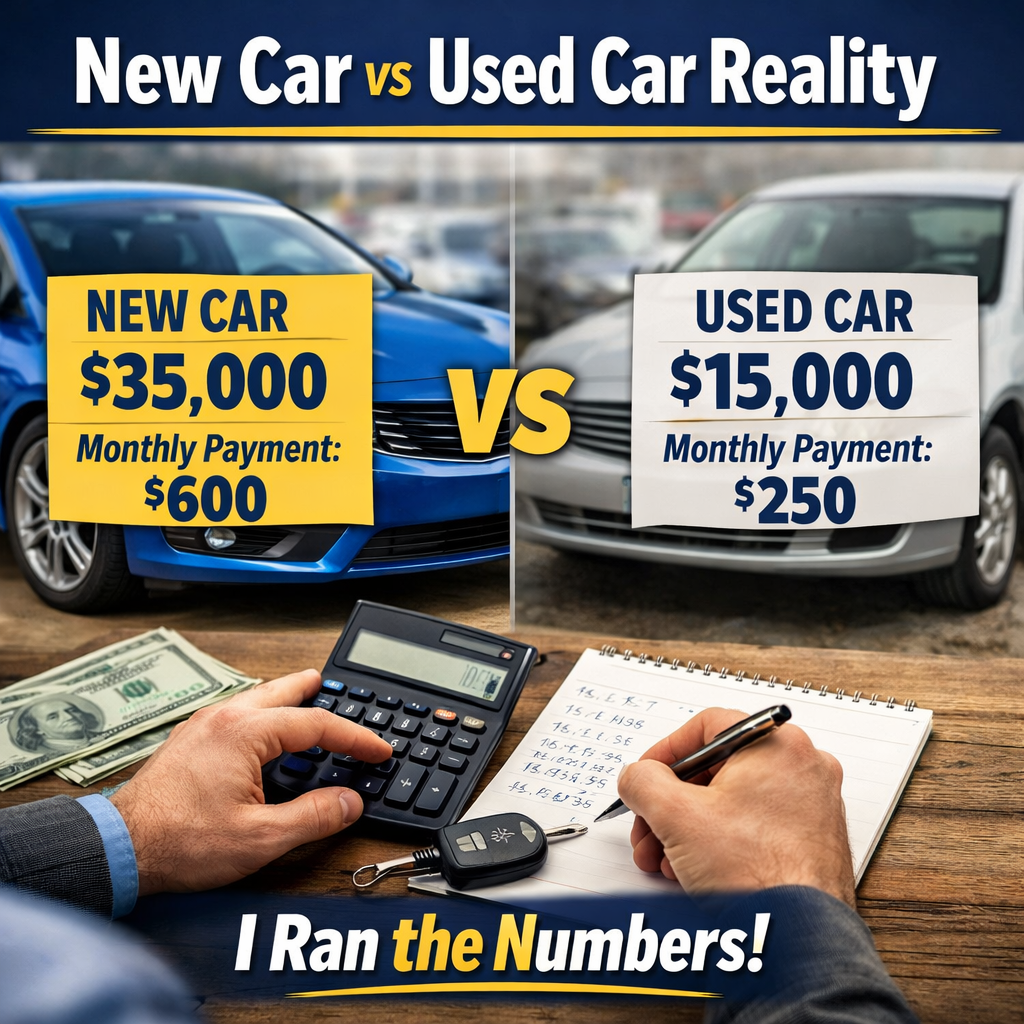
That kitchen table moment forced me to confront something I’d been avoiding: I didn’t actually know how to compare new and used cars financially. I knew the conventional wisdom—used cars are cheaper, new cars lose value the moment you drive them off the lot, buying used is always smarter unless you have money to burn. I’d repeated these ideas to friends. I believed them myself.
But when I started building out a real ownership cost analysis, the conventional wisdom started to crack. Yes, used cars have lower purchase prices. But they also have higher interest rates, shorter or no manufacturer warranties, higher insurance costs in some cases, and a greater likelihood of needing repairs during your ownership period. New cars depreciate faster in percentage terms, but they start from a higher base, and the depreciation curve isn’t as simple as most people think.
What I realized is that almost nobody explains the new versus used decision in terms of total ownership cost. We focus on the purchase price because it’s the biggest single number, but it’s not the only number that matters. In this article, I’ll walk through the real cost comparison I built for myself, the variables that actually matter, and how to think about this decision based on your specific situation rather than generic advice that may or may not apply to you.
The Situation
I’d been driving a 2014 Civic with 140,000 miles. It was paid off, ran fine, but I could feel it aging. Small repairs were becoming more frequent—a window regulator here, a wheel bearing there. Nothing catastrophic, but enough to make me think about what came next. I wanted something reliable, fuel-efficient, and comfortable for a daily commute. The Accord seemed like the right choice.
My initial plan was simple: buy a used Accord around three years old, save a chunk of money on depreciation, and drive it for another five to seven years. That’s what financially smart people do, right? Let someone else take the depreciation hit, then buy the car when it’s stabilized in value.
I started shopping and found a 2021 Accord Sport with 38,000 miles listed at $24,000. Clean history, single owner, well-maintained. For comparison, a brand-new 2024 Accord Sport was priced at $32,000. The $8,000 difference felt significant—that’s real money. But before I committed, I wanted to understand what that $8,000 gap would look like over the course of ownership.
The Common Assumption
Most buyers assume that used cars are cheaper in every meaningful way. The purchase price is lower, so the total cost of ownership must also be lower. It’s simple math, or so it seems.
This assumption exists because it’s often true in the most straightforward scenarios. If you pay cash for both vehicles, drive them both for the same amount of time, and neither needs major repairs, the used car will cost less overall because you paid less to begin with. The depreciation you avoid by buying used is the entire justification for the strategy.
Financial advice columns reinforce this. They point out that new cars lose 20-30% of their value in the first year. They show charts demonstrating that a three-year-old car has already absorbed the steepest part of the depreciation curve. They conclude, reasonably, that buying used is the smarter financial move for most people. And in many cases, that conclusion is correct.
But it’s not universally correct, and the assumptions it rests on—that you’ll pay cash, that both cars will have similar reliability, that financing costs are negligible, that insurance is the same—don’t always hold in the real world.
The Turning Point
I was filling out a loan application for the used Accord when I noticed the interest rate: 6.8%. Out of curiosity, I checked what rate I’d qualify for on a new car loan. The answer was 4.2%. That’s a 2.6 percentage point difference, which sounded small until I calculated what it meant over a five-year loan.
On a $24,000 loan at 6.8% for 60 months, I’d pay about $4,400 in interest. On a $32,000 loan at 4.2% for 60 months, I’d pay about $3,500 in interest. The cheaper car was going to cost me more in interest than the expensive car. That didn’t make sense at first, but then I realized: lenders see used cars as higher risk, so they charge higher rates. The purchase price gap was $8,000, but the interest gap narrowed that advantage by nearly $900.
That made me wonder what else I was missing. I started listing every cost I could think of: insurance, registration, maintenance, repairs, fuel, depreciation over my ownership period. I built a spreadsheet comparing the two options across five years of ownership. The results surprised me.
What Most People Miss
The specific thing most buyers don’t account for is that the total cost of ownership includes multiple variables that move in opposite directions depending on whether you buy new or used, and those variables don’t cancel out evenly.
Let’s break this down with the real numbers I calculated.
Purchase price and depreciation: The used Accord cost $24,000. Based on typical depreciation curves, I estimated it would be worth around $15,000 after five years. That’s $9,000 in depreciation. The new Accord cost $32,000. I estimated it would be worth around $19,000 after five years. That’s $13,000 in depreciation. Advantage used car: $4,000.
Financing costs: As I mentioned, the used car would cost me about $4,400 in interest over five years at 6.8%. The new car would cost me about $3,500 in interest over five years at 4.2%. Advantage new car: $900.
Insurance: I called my insurance company and got quotes for both. The used car would cost me about $1,320 per year. The new car would cost me about $1,450 per year because of its higher replacement value. Over five years, that’s $6,600 for the used car and $7,250 for the new car. Advantage used car: $650.
Maintenance and repairs: This is where it gets tricky. The new car came with a three-year/36,000-mile bumper-to-bumper warranty and a five-year/60,000-mile powertrain warranty. The used car had no manufacturer warranty remaining—it was out of coverage. For the new car, I’d only pay for routine maintenance like oil changes and tire rotations for the first three years, then start paying for things like brake jobs and other wear items. For the used car, I’d be paying for everything from day one, and statistically, a car with 38,000 miles is more likely to need repairs than a car with zero miles.
I estimated about $3,000 in maintenance and repairs for the new car over five years—mostly routine stuff. For the used car, I estimated about $5,500, accounting for the higher likelihood of needing brake work, tires, suspension components, and potentially a battery or other items that wear with age and mileage. Advantage new car: $2,500.
Registration and fees: Registration fees vary by state, but in many states, they’re based on the vehicle’s value. The new car would cost me more to register each year. Over five years, I estimated about $200 more for the new car. Advantage used car: $200.
Fuel costs: Both cars had the same engine and fuel economy, so this was a wash.
Now let’s add it up. Starting with the purchase price difference of $8,000 in favor of the used car:
-
Financing costs: -$900 (narrows the gap)
-
Insurance: -$650 (narrows further)
-
Maintenance and repairs: -$2,500 (narrows significantly)
-
Registration: -$200 (minor)
Total narrowing: $4,250
So the real gap wasn’t $8,000—it was closer to $3,750 over five years. That’s about $62 per month. Still an advantage for the used car, but much smaller than it appeared on the surface.
But here’s the part that changed my decision: the new car would still be under warranty for the first three years, meaning zero uncertainty about repair costs during that period. The used car could need a $1,200 repair in month six, and I’d have no recourse. The new car also had newer safety features, a better infotainment system, and would be three years younger when I went to sell it, potentially commanding a better resale price than I estimated.
When I factored in risk, convenience, and peace of mind, the $62 per month difference didn’t feel like enough to justify the used car.
Consequences of Ignoring It
In the short term, focusing only on purchase price means you might underestimate your monthly expenses. If you finance both cars and only look at the payment difference, you’re missing insurance, maintenance, and the reality that a used car might need unexpected repairs that blow your budget.
In the medium term, it affects your financial stability. If you buy a used car to save money, but then spend $800 on a repair in year two and another $1,100 on a repair in year three, those savings evaporate. And if you financed the car, you’re still making payments while also paying for repairs. That’s a double hit to your monthly cash flow.
In the long term, it changes your resale value. A well-maintained car with a full service history and no deferred maintenance commands a better price than a car that’s been nickel-and-dimed. If you buy a used car and skip maintenance to save money, you’re setting yourself up for a lower resale value when it’s time to sell.
Financially, the biggest consequence is opportunity cost. If you save $8,000 buying used but spend $4,000 of that on repairs, higher insurance, and financing costs, you only truly saved $4,000. If that $4,000 savings came at the expense of reliability, warranty coverage, and stress, was it worth it? For some people, yes. For others, no.
How to Check or Think About This Properly
Here’s the process I now use to compare new versus used cars in a meaningful way.
Step one: Identify comparable vehicles. Don’t compare a new base model to a used luxury trim. Compare similar trim levels, features, and equipment. The comparison only works if the cars are genuinely equivalent.
Step two: Calculate the purchase price difference. This is your starting point, but not your ending point.
Step three: Get financing quotes for both. Used car loans almost always have higher interest rates. Calculate the total interest you’d pay over the life of the loan for each option. Subtract the difference from your purchase price gap.
Step four: Get insurance quotes for both. Call your insurance company and ask for real numbers, not estimates. Some used cars are cheaper to insure, but not always. Multiply the annual difference by the number of years you plan to own the car.
Step five: Research typical maintenance and repair costs for both. Use resources like Consumer Reports, Edmunds, or RepairPal to estimate annual maintenance costs for the specific make, model, and year you’re considering. Factor in that a used car has already accumulated wear and is statistically more likely to need repairs.
Step six: Account for warranty coverage. If the new car has a manufacturer warranty and the used car doesn’t, that’s real value. You’re not just paying for repairs—you’re paying for certainty. Estimate what you’d spend out of pocket on the used car during the same period the new car would be covered.
Step seven: Consider depreciation over your ownership period, not just from the factory. A three-year-old car and a new car won’t depreciate at the same rate over the next five years. The used car has already taken the steepest hit, so it’ll lose value more slowly. The new car will lose value faster initially, but might hold a higher absolute value when you sell.
Step eight: Add up all the costs and compare the totals. This gives you the real cost difference over your ownership period.
Step nine: Factor in intangibles. Warranty peace of mind, newer safety features, lower likelihood of breakdowns—these have value even if they’re hard to quantify. If the total cost difference is small, intangibles can tip the decision.
Common Myths and Misunderstandings
Myth 1: New cars always cost more over the long run. Not always. If financing rates, insurance costs, and repair expenses narrow the gap enough, a new car can be competitive or even cheaper over five to seven years, especially if the used car needs significant repairs.
Myth 2: Depreciation is the only cost that matters. Depreciation is one cost among many. Financing, insurance, maintenance, and repairs all contribute to total ownership cost. Focusing only on depreciation ignores variables that can swing the math significantly.
Myth 3: You should always buy a car that’s three to five years old. This advice assumes you’ll get a good deal on a well-maintained car and that repair costs will be minimal. If the used market is inflated, if the specific car you’re looking at has deferred maintenance, or if interest rates for used cars are high, the advantage disappears.
Myth 4: Paying cash eliminates the financing cost advantage of new cars. True, but it also means you’re tying up $8,000 more in a depreciating asset if you buy new. Whether that matters depends on what else you could do with that money. If you have a high-interest debt or a better investment opportunity, paying cash for a more expensive car might not be optimal.
Myth 5: Certified pre-owned cars give you the best of both worlds. CPO cars often come with warranties and lower interest rates, which narrows the gap between used and new. But they also cost more than non-certified used cars, and sometimes the price premium for CPO is so high that you’re better off just buying new.
When It Matters Most (And When It Doesn’t)
The new versus used calculation matters most when the total cost difference over your ownership period is small—say, less than $100 per month. In those cases, intangibles like warranty coverage, newer features, and peace of mind can justify choosing new.
It matters more in markets where used car prices are inflated. During the pandemic, used car prices spiked so high that new cars were often a better value. In a normal market, used cars usually win on price, but not always by as much as people assume.
It matters less if you’re planning to keep the car for ten years or more. Over a very long ownership period, the purchase price difference becomes a smaller percentage of the total cost, and the reliability and maintenance history of the specific vehicle matter more than whether it was new or used when you bought it.
It doesn’t matter much if you’re paying cash and you know you’ll drive the car until it dies. In that case, buy whatever you can afford that meets your needs. The depreciation is irrelevant because you’re not selling.
There’s no universal rule. A Honda Civic holds value differently than a Dodge Charger. A three-year-old truck in a high-demand market might cost nearly as much as new. A luxury sedan depreciates so fast that buying used is almost always better. Context is everything.
Final Takeaway
I ended up buying the new Accord. The total cost difference over five years was small enough that the warranty coverage, lower interest rate, and peace of mind made it worth paying more upfront. For someone else in a different financial situation, the used car might have been the smarter choice. The point isn’t that new is better or used is better—it’s that the answer depends on the specific numbers, not on generic rules of thumb.
What I learned is that purchase price is only the starting point. If you’re financing, if you’re keeping the car for a defined period, if you’re risk-averse about repairs, you need to look at total ownership cost. That requires actual math, not assumptions. It’s more work than just buying the cheaper car, but it’s the difference between making a decision based on what sounds smart and making a decision based on what actually is smart for your situation.
That night at my kitchen table, with two financing offers in front of me, I almost made the decision based on the sticker price alone. But something made me pause and actually run the numbers—all the numbers, not just the ones that were easiest to see. What I found didn’t match what I expected, and it changed my decision. If you’re trying to choose between new and used right now, don’t just look at the price tags. Look at interest rates, insurance, maintenance, repairs, and how long you plan to keep the car. Add it all up. The answer might surprise you. And whatever choice you make, at least you’ll know it’s based on reality instead of assumptions. That’s worth more than any rule of thumb you’ll read online.