Mutiny Motors: Andy Didorosi’s Bold Bet on Tiny EV Trucks

1. Introduction: The Man Who Bought a Car Factory
Imagine buying a 50,000-square-foot abandoned factory in Detroit — with a caved-in roof, plywood windows, and a heating system that smells like it belongs in a 1970s horror movie — and deciding that’s your launchpad to revolutionize American trucking.
That’s exactly what Andy Didorosi did. And now, in early 2026, he’s betting it all on something even more unlikely: a tiny electric version of a Japanese mini-truck that was never designed for American roads.
This isn’t a story about Silicon Valley billions or government subsidies. It’s about a Detroit busboy who taught himself to fix cars, built a city transit company from scratch, bought a factory on a shoestring, and is now taking on one of the most capital-intensive industries on Earth — automotive manufacturing.
Quick Answer:
What is Mutiny Motors? Mutiny Motors is a Detroit-based electric vehicle startup founded by entrepreneur Andy Didorosi. The company is developing an affordable, American-made electric kei truck — a small, open-bed utility vehicle inspired by Japanese mini-trucks — that customers can buy online and assemble at home, similar to flat-pack furniture.
This article takes you inside the full story. You’ll learn who Andy Didorosi is, what a kei truck actually is, how Mutiny Motors plans to build and sell these tiny EVs, what the prototype looks like, and whether this whole thing has a real shot at succeeding.
2. Who Is Andy Didorosi? The Dropout Who Built a Movement
Andy Didorosi, 39, was born in Detroit in 1987. His early career started at rock bottom — literally bussing tables at Ferlito’s Family Dining for $4.30 an hour. He was a college dropout who saw opportunity where others saw junk.
A friend introduced him to car auctions, where he’d pick up beat-up vehicles for $100. He saved up, bought three cars, and landed a job at Slim’s Hotrodd Garage to learn automotive repair. He was, by his own admission, a terrible employee. But he left with a full education in fixing cars — and promptly set up his own shop.
“Without social media, I would be another crazy old guy in a garage.”
— Andy Didorosi, Detroit News, 2023
The Detroit Bus Company: Where It All Started
In 2011, Didorosi launched the Detroit Bus Company (DBC) with no money, no experience in transit, and no advertising budget. He had Facebook. He used it to spread the word, and DBC grew from one bus (driven by himself) to 23 buses generating over $1 million in annual revenue.
DBC isn’t just a business — it’s a community institution. Through its Youth Transit Alliance, which later became the Ride for Ride nonprofit, DBC has given thousands of free rides to Detroit kids. The company has also donated scooters, run voter-ride programs, and connected tens of thousands of people to Detroit’s story through tours and events.
Arsenal of Clean and the Pandemic Pivot
When COVID-19 hit in 2020, Didorosi pivoted again. He built Arsenal of Clean, which became the largest producer of hand sanitizer in Detroit. He gave away thousands of gallons to first responders, hospitals, schools, and government agencies — and even sent a truckload to the Navajo Nation.
That’s the Andy Didorosi pattern: see a gap, fill it fast, document everything on social media. It’s a playbook he’s applied to every venture, including Mutiny Motors.
The Social Media Machine
Didorosi is a self-taught content creator. In one year alone, he went from zero followers to 877,000 across TikTok, Instagram, and YouTube. His videos — shot on just his phone — document the chaos and progress at the Car Factory with a breezy, unfiltered honesty that millions find addictive.
His TikTok videos about buying the factory, dealing with thieves, building race cars, and sketching tiny truck dreams regularly rack up tens of thousands of likes. One video announcing the factory purchase hit over 116,000 likes. Another celebrating 600,000 followers — two years into the journey — showed just how large his community had grown.
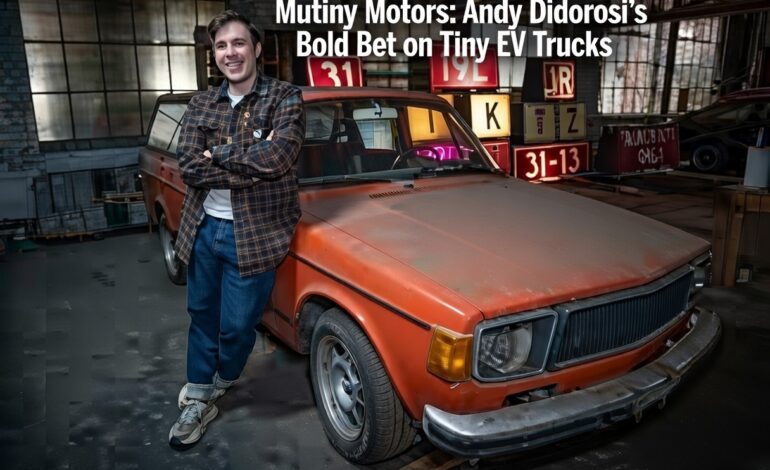
Image Suggestion: Photo of Andy Didorosi (age 39) at the Car Factory in Detroit, February 3, 2026. Alt text: ‘Andy Didorosi, founder of Mutiny Motors, at his Detroit factory working on a Japanese kei truck prototype.’ — Detroit Free Press/USA TODAY Network
3. What Is a Kei Truck — and Why Does It Matter?
What is a kei truck?
A kei truck (spelled K-E-I) is a class of miniature Japanese utility vehicle. To qualify, it must have an engine under 660cc and fit within strict size limits, which keeps it in a very cheap tax and insurance bracket in Japan. They typically have an open flat bed, a snub nose cab, and incredible practicality for tight urban spaces. They usually cost $900–$3,000 but add $3,000 in shipping from Japan.
The kei truck is hugely popular in Japan, where millions are used for deliveries, farming, and urban hauling. They’re compact, practical, and cheap to run. But they were never engineered to American safety standards.
“The whole front folds in like papier-mâché. There’s no structure in them.”
— Andy Didorosi, on imported Japanese kei trucks, February 2026
That’s the problem. You can import used kei trucks from Japan for as little as $900 (plus $3,000 shipping), but you can’t legally drive most of them on public U.S. roads. They have no crumple zones, no airbags, and minimal crash protection. That’s the gap Mutiny Motors wants to fill — a kei-inspired truck that’s designed and built to American safety standards.
Why Kei Trucks Are Gaining a Cult Following in the U.S.
Walk into any garden center or theme park and you’ll likely spot a kei truck puttering around. Small fleets of these Japanese mini-trucks have been quietly in service for years. They’re perfect for tight spaces, simple to maintain, and surprisingly versatile.
But they’ve never had a serious American-made, road-legal, modern version — until now. Didorosi sees a massive underserved market: tradespeople, urban farmers, small businesses, and delivery fleets who need a small, affordable, efficient workhorse.
| Feature | Traditional Kei Truck (Imported) | Mutiny Motors EV Kei Truck (Target) |
| Engine | 660cc gas (under 40hp) | Electric (specs TBD) |
| Safety Standards | Not U.S. road legal | Designed for U.S. roads |
| Purchase Method | Import brokers | Online, ships in a box |
| Price (estimate) | $900–$3,000 + $3,000 shipping | Not yet confirmed |
| Customization | Aftermarket modifications | Open-source, buyer-driven |
| Made In | Japan | Detroit, USA |
4. Inside Mutiny Motors: The Vision for American-Made EV Mini-Trucks
Mutiny Motors isn’t just a truck company. It’s a philosophy. Didorosi wants to build a vehicle that doesn’t become obsolete — one that’s simple enough to fix yourself, open-source enough to modify, and affordable enough for real people to buy.
Here’s what he’s envisioning for the production Mutiny truck, based on public statements and Detroit Free Press reporting from February 2026:
- Small, kei-inspired dimensions — compact enough for urban delivery and tight city blocks
- Electric drivetrain — no combustion engine, lower running costs, zero local emissions
- All-wheel drive available — the ‘halo’ prototype targets 550 horsepower AWD
- Open flat bed — base model has no roof, designed for hauling lumber, plants, equipment
- Multiple configurations — sketches show variants for different cargo types
- Open-source design — buyers encouraged to modify and adapt
- Flat-pack delivery — trucks ship in a box, assembled by the customer (Ikea-style)
- Online sales only — no dealerships, direct to consumer
“I’d like to see millions of these out there. That’s my end game.”
— Andy Didorosi, February 2026
He’s quick to temper the ambition with realism. The current factory can’t produce millions. A few thousand units would be considered a genuine success. But the long-term vision is clear: a new category of American EV utility vehicle that fills the gap between a golf cart and a full-size pickup.
The Open-Source Angle: Letting Customers Define the Product
One of the most radical ideas behind Mutiny Motors is the open-source approach. Didorosi doesn’t want to dictate what the truck is for. He wants buyers to mod it, hack it, and figure out the use cases for him.
This isn’t naive. It’s a calculated community-building strategy. His Discord server and Patreon are already packed with people brainstorming applications. He’s building the truck with his future customers — not for them.
5. The Prototype: ‘Sendpai’ — The World’s Fastest Kei Truck
Before Mutiny Motors can sell trucks, it needs to prove the concept. That’s where Sendpai comes in.
Sendpai is a 1996 Suzuki Carry kei truck that Didorosi bought for roughly $6,000 off Facebook Marketplace. The seller was an Ohio resident who’d imported it from Japan. It’s a real kei truck — the kind that was built for 38 horsepower.
Didorosi’s team is stuffing it with the drivetrain from a salvaged Tesla Model 3. That means 550 horsepower, all-wheel drive, and a battery pack in a chassis that never anticipated any of it. The build also includes a full race cage for safety.
“It’s going to be very adorable as it’s blowing people’s doors off.”
— Andy Didorosi, on the Sendpai prototype
Why Build an Insane 550HP Halo Car?
Smart marketing. A sensible, slow prototype doesn’t go viral. A 550-horsepower kei truck that can supposedly outrun sports cars at the drag strip? That gets millions of views.
The strategy mirrors what Tesla did with the Roadster — build something extreme first to prove the technology and capture attention. Then apply what you learn to the more practical, affordable production version.
Didorosi wants Sendpai ready to race by summer 2026. The team working on it includes friends who are also professional auto engineers, making this scrappy but technically serious.
| Spec | Detail |
| Base vehicle | 1996 Suzuki Carry kei truck |
| Original engine | 660cc, ~38hp |
| EV drivetrain source | Salvaged Tesla Model 3 |
| Target horsepower | 550 HP (all-wheel drive) |
| Safety additions | Full race cage |
| Purchase price of base truck | ~$6,000 (Facebook Marketplace) |
| Origin of base truck | Imported from Japan via Ohio seller |
| Target completion | Summer 2026 |
6. The Factory: Detroit’s 50,000 Sq. Ft. Comeback Story
The Car Factory is as much a character in this story as Andy Didorosi himself. The 50,000-square-foot complex on Detroit’s west side was built over 100 years ago by Link-Belt, a manufacturing company that was part of the auto industry’s supply chain. More recently, it was an envelope plant.
When Didorosi acquired it about five years ago, it was in rough shape. Caved-in roof sections had become swimming pools. Windows were boarded with plywood. The heating system was ancient and unreliable. The building had been broken into seven times. Thieves stole everything from pickup trucks to bus batteries to catalytic converters. A porta-potty truck was stolen mid-delivery and eventually crashed on the Lodge Freeway after a 10-police-car chase.
True story: The ‘honey wagon’ (porta-potty truck) was stolen right out of Didorosi’s lot while still running. He documented the whole thing on TikTok. Cops tracked it down after viewers of his video called it in. Only at the Mutiny Car Factory.
Five Buildings, Five Purposes
The factory complex has five separate buildings, each being renovated with a specific purpose:
- Building One — Original Link-Belt building, now the design center, filled with project cars and used for community events
- Building Two — Logistics and storage hub
- Building Three — Fabrication workshops
- Building Four (High Bay) — Reserved for large-scale builds: fire trucks, buses, and the Mutiny truck prototype
- Building Five — Race preparation garage
Building Four already has heavy power, compressed air, and industrial tools installed. But the roof leaks — a major issue that needs fixing before full-scale production can begin.
Industrial Robots: The Future of Manufacturing at Mutiny
One of the most ambitious elements of Didorosi’s plan is a fleet of ABB and Fanuc industrial robots he’s already acquired for the factory. These are sophisticated, high-speed machines used in major manufacturing plants worldwide. He’s installing a learning track so Detroit residents — with or without prior experience — can learn to operate them.
It’s a vision that goes beyond truck-building. Didorosi wants the Car Factory to be a training ground, an economic engine, and a cultural hub for Detroit.
7. Mutiny Motors vs. Competitors: How Does It Stack Up?
Mutiny Motors occupies a unique niche. It’s smaller than most EV startups in ambition but arguably more authentic. Here’s how it compares to some of the other players in the affordable EV truck space:
| Company | Vehicle Type | Price Target | Status (Feb 2026) | Key Differentiator |
| Mutiny Motors | EV kei truck (small) | TBD | Prototype phase (Sendpai) | Open-source, kit-car style, Detroit-made |
| Slate Auto | Compact EV pickup | Under $30,000 | Pre-orders open | Minimalist, 3D-printable parts |
| Rivian | Full-size EV pickup | $69,900+ | In production | Premium, adventure-focused |
| Telo Truck | Ultra-compact EV pickup | ~$38,000 | Pre-production | Bed fits in a standard parking spot |
| Ford F-150 Lightning | Full-size EV pickup | $49,995+ | In production (limited) | Brand trust, proven platform |
Mutiny’s closest conceptual comparison is Slate Auto — both aim for affordability and simplicity. But Slate is further along, better funded, and targeting a slightly larger truck segment. Mutiny is more radical: smaller, more customizable, and built from a literal factory rescue project.
The Slate Auto Comparison
Auto enthusiasts have been comparing Mutiny and Slate Auto online since both entered the conversation in late 2024 and 2025. The consensus? Slate is a more serious near-term competitor; Mutiny is a wilder bet with a more passionate community behind it.
Forum discussions on SlateForums.com note that Mutiny’s kit-car approach means it could sidestep some costly safety certifications — at least initially. But it also means buyers would need to complete assembly and handle their own registration, which can take years in some U.S. states.
8. Challenges: Trade Wars, Safety Standards, and Skeptics
Nobody said this would be easy. Didorosi is cheerfully aware that he’s walking into one of the hardest industries to succeed in. Here are the real headwinds Mutiny Motors faces:
The Parts Problem: Trade Wars and EV Policy
As an electric vehicle startup, Mutiny Motors is directly affected by the Trump administration’s trade war and shifting EV policy landscape. Tariffs on Chinese-made EV components — batteries, motors, electronics — are raising costs across the board for small EV companies.
The rollback of EV incentives further complicates consumer demand. Bigger companies can absorb these costs. Startups like Mutiny have far less room to maneuver.
Safety Standards: The Kit Car Workaround
Full automotive safety compliance — crash testing, airbag systems, Federal Motor Vehicle Safety Standards — is extraordinarily expensive. That’s why the kit car model is attractive: kit cars that require customer assembly may qualify for different regulatory treatment.
But it’s not a free pass. Getting a kit car street-legal can reportedly take up to two years in some states. That’s a significant barrier for buyers and a marketing challenge for Mutiny.
Capital and Scale
Building a car company — even a small one — requires enormous capital. The factory needs a new roof. Tooling costs money. Compliance costs money. Marketing at scale costs money. Didorosi has built his other ventures on scrappiness and social media, but manufacturing eventually demands real investment.
He’s realistic about this. His community on Patreon and Discord is part of the financial ecosystem, but for production to reach thousands of units, external investment will almost certainly be necessary.
The Skeptics
Not everyone is a believer. Some EV forum users note that without a completed prototype and a clear production timeline, Mutiny remains more concept than company. As one Slate Auto forum commenter put it: you can’t really call it competition yet when there’s no prototype, just a concept.
Didorosi’s answer? He’s building in public. Every failure, every victory, every stolen porta-potty truck — it’s all documented. Transparency is his credibility.
9. The Business Model: Ikea-Style EV Trucks Sold Online
Here’s the elegant simplicity of what Didorosi is proposing: buy the truck online, it arrives in a box, you (or a local mechanic) assemble it. No dealerships. No showrooms. No traditional distribution overhead.
This model, often called the ‘kit car’ or ‘flat-pack’ approach, has precedent in aviation (Van’s Aircraft kits) and specialty vehicles. It dramatically reduces the capital needed for retail infrastructure and sidesteps many automotive regulations that apply to fully assembled vehicles.
Revenue Streams
- Truck sales — the primary product, priced affordably (exact price not yet confirmed as of February 2026)
- Parts and accessories — open-source platform encourages add-on sales
- Detroit Bus Company — the existing transit business continues to generate revenue
- Mutiny Racing — racing team builds brand visibility and tests technology
- Patreon / community memberships — direct community support
- Content monetization — TikTok, YouTube, and social media revenue
The Community as Product
Perhaps the most underrated part of the Mutiny business model is the community itself. Didorosi has built a deeply engaged audience of hundreds of thousands of people who are emotionally invested in the project. They buy merchandise, support on Patreon, contribute ideas on Discord, and serve as free word-of-mouth marketing.
When the trucks are ready to sell, Didorosi won’t need a multi-million dollar advertising campaign. He has 877,000 followers who are already sold on the idea.
“I’d like to see millions of these out there. That’s my end game.”
— Andy Didorosi
That said, converting followers into customers is never automatic. The real test comes when there’s a real truck with a real price tag and a real wait list.
10. People Also Ask: Your Questions Answered
What is Mutiny Motors?
Mutiny Motors is an electric vehicle startup based in Detroit, Michigan, founded by Andy Didorosi. It is developing an affordable, American-made electric kei truck — a compact utility vehicle inspired by Japanese mini-trucks — intended to be sold online and assembled by the buyer.
Who is Andy Didorosi?
Andy Didorosi, 39, is a Detroit-born entrepreneur and college dropout who founded the Detroit Bus Company in 2011, built Arsenal of Clean during COVID-19, and launched Mutiny Motors to build electric kei trucks in a restored Detroit factory. He has 877,000+ social media followers documenting his factory journey.
What is a kei truck?
A kei truck is a class of Japanese miniature utility vehicle with an engine under 660cc. They’re extremely affordable and practical for urban use but were not built to U.S. road safety standards. Mutiny Motors aims to build a U.S.-road-legal electric version.
How much will the Mutiny Motors truck cost?
As of February 2026, the final pricing for the Mutiny Motors electric kei truck has not been confirmed. Didorosi has indicated the truck will be affordable, with an online purchase model similar to flat-pack furniture. Pricing is still being worked out, partly due to EV supply chain uncertainty from trade tariffs.
When will Mutiny Motors trucks be available to buy?
No official sale date has been announced as of February 2026. The team is currently completing the ‘Sendpai’ prototype — a 550HP Tesla-powered 1996 Suzuki Carry kei truck — targeting a racing debut in summer 2026. Production timing for the consumer truck has not been disclosed.
Where is Mutiny Motors located?
Mutiny Motors is based in Detroit, Michigan, operating out of a 50,000 square-foot former industrial factory on Detroit’s west side, which Didorosi purchased about five years ago and calls the Car Factory.
Is Mutiny Motors related to Mutiny Racing?
Yes. Mutiny Racing is the motorsport arm of Andy Didorosi’s Car Factory enterprise. The Detroit Student Race Team also operates out of the same complex. Racing is both a branding tool and a technology test bed for Mutiny Motors.
11. Key Takeaways: What to Watch for With Mutiny Motors
Andy Didorosi isn’t the first person to dream of disrupting the auto industry from a Detroit garage. But his story has some genuinely unusual elements that make Mutiny Motors worth watching closely.
5 Reasons Mutiny Motors Could Actually Work
- Built-in community. 877,000+ highly engaged followers are pre-sold on the brand before a single production truck exists.
- The kit-car model is smart. Bypassing full automotive regulation (even if temporarily) reduces startup costs dramatically.
- Detroit credibility. Building in the Motor City, in a rescued factory, with Detroit workers gives Mutiny authentic street cred that no Silicon Valley startup can buy.
- The market gap is real. Nobody makes a U.S.-road-legal, affordable, electric kei-style truck. That’s a blank space in the market.
- Didorosi’s track record. The Detroit Bus Company, Arsenal of Clean, and the racing team all succeeded against long odds. He has a proven pattern.
5 Risks That Could Derail It
- Capital shortfall. Manufacturing at scale requires funding that social media fans alone can’t provide.
- Regulatory maze. Kit car registration varies wildly by state and can take years, limiting the addressable market.
- Supply chain pressure. EV parts tariffs and policy uncertainty raise costs in ways that are hard to plan around.
- Competition arriving. Slate Auto and other small EV pickups are advancing faster with more resources.
- The roof. Literally. The factory still needs a new roof before Building Four can operate at full capacity.
What to Watch Next
- Sendpai prototype completion and summer 2026 racing debut
- Official pricing announcement for the production Mutiny truck
- Factory fundraising or investment announcements
- First production batch timeline and pre-order launch
- S. federal EV policy changes that could affect parts costs
Conclusion: Small Truck, Big Idea
Andy Didorosi is doing something genuinely rare in the American economy. He’s trying to restart manufacturing in a city that lost it, using a vehicle category that never existed in the U.S., powered by electricity, built by hand in a building that barely has a roof.
Is it crazy? Absolutely. But so was starting a bus company in Detroit with no money and a Facebook account. So was converting a factory into a hand sanitizer plant overnight during a pandemic. So was buying a 50,000-square-foot building on a hunch and a prayer.
The kei truck is tiny. The vision behind it is anything but.
Whether Mutiny Motors ever ships a single truck to a paying customer, the story of this project has already changed how thousands of people think about Detroit, about manufacturing, and about what one stubborn entrepreneur can accomplish with a phone, a factory, and a very fast Japanese mini-truck.
“It’s a lot of work. What word can I use? ‘Boondoggle,’ that’s a favorite. ‘Rigamarole,’ that’s another word.”
— Andy Didorosi, on the factory renovation
Follow along. This one’s worth watching.
ABOUT THE REPORTING
This article draws on reporting by Eric D. Lawrence, Senior Car Culture Reporter at the Detroit Free Press, published February 20, 2026, as well as original coverage from The Detroit News (August 2023), The Fabricator Podcast, and Supercar Blondie (June 2025). Additional context comes from Mutiny Motors’ official channels, Andy Didorosi’s social media documentation, and automotive community discussions on platforms including SlateForums.com. All facts have been cross-referenced against primary sources.
SOURCES & FURTHER READING
- Detroit Free Press — ‘Detroit entrepreneur Andy Didorosi wants to sell tiny trucks’ (Feb. 20, 2026)
- Detroit News — ‘Detroit social media guru faces bizarre crimes in pursuit of electric cars’ (Aug. 4, 2023)
- The Fabricator Podcast — ‘Buying a factory, starting a race team, and reviving Detroit with Andy Didorosi’
- Supercar Blondie — ‘A man who bought an abandoned car factory in Detroit is determined to get it running again’ (June 2025)
- Mutiny Motors Official Website — mutiny.fm
Discover more from MatterDigest
Subscribe to get the latest posts sent to your email.