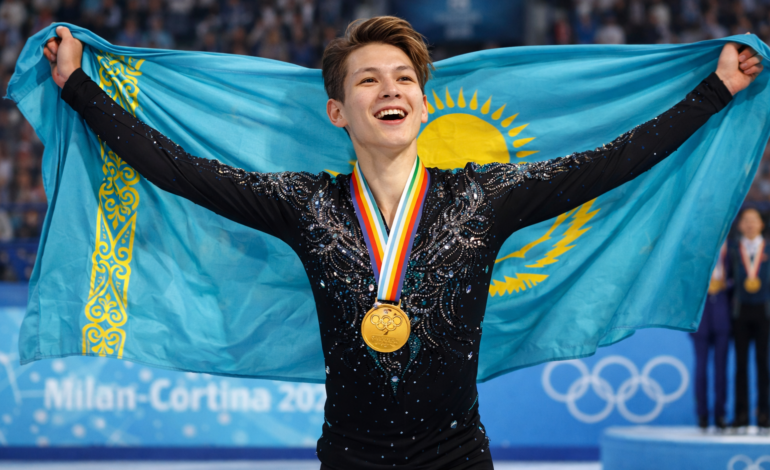
Mikhail Shaidorov Wins Historic Figure Skating Gold at 2026 Winter Olympics

Introduction: An Upset for the Ages
The 2026 Winter Olympics in Milano-Cortina delivered one of the most stunning upsets in figure skating history when 22-year-old Mikhail Shaidorov of Kazakhstan claimed the men’s figure skating gold medal, defeating heavily favored American skater Ilia Malinin in a performance that left commentators speechless and fans around the world in tears.
Shaidorov’s victory marks Kazakhstan’s first-ever Olympic medal in figure skating—a monumental achievement for a nation with limited winter sports infrastructure and no established tradition in the sport. His technically flawless free skate, featuring multiple quadruple jumps and unprecedented artistic expression, earned him a combined score of 333.67 points, edging out Malinin’s 329.42 in one of the closest finishes in Olympic men’s figure skating history.
This wasn’t just a victory. It was a statement. A reminder that in sports, anything is possible when talent meets preparation and an unshakeable belief in oneself.
Who Is Mikhail Shaidorov? The Underdog Who Rewrote History
Early Life and Unlikely Beginnings
Born on March 15, 2004, in Almaty, Kazakhstan, Mikhail Shaidorov’s path to Olympic glory was anything but conventional. Unlike most elite figure skaters who begin training in countries with established skating programs—Russia, the United States, Japan, or Canada—Shaidorov grew up in a nation where figure skating was largely unknown.
His mother, a former ballet dancer, first took him to a local ice rink at age six. Recognizing his natural grace and athleticism, she enrolled him in basic skating lessons. By age nine, Shaidorov was already landing double jumps and showing promise that extended far beyond recreational skating.
Key Career Milestones:
- 2018: Won silver at the World Junior Figure Skating Championships
- 2021: Became Kazakhstan’s first senior men’s skater to medal at a Grand Prix event (bronze at Skate Canada)
- 2023: Landed his first clean quadruple Axel in competition at the World Championships (finishing 5th overall)
- 2024-2025 Season: Consistently placed in the top 5 at international competitions, signaling his readiness for Olympic contention
Training Against the Odds
Unlike skaters from powerhouse nations who train at state-of-the-art facilities with world-renowned coaches, Shaidorov’s journey required extraordinary resourcefulness. For years, he trained at Almaty’s modest public ice rinks, often sharing ice time with recreational skaters and hockey players.
In 2020, he relocated to Toronto, Canada, to train under legendary coach Brian Orser (who previously coached Olympic champions Yuzuru Hanyu and Kim Yuna). This move proved transformative. Orser helped Shaidorov refine his technical skills while preserving the unique artistic style that would become his signature.
“Mikhail has something you cannot teach,” Orser told The Globe and Mail in a 2024 interview. “He has an emotional depth and connection to the ice that reminds me of the greatest skaters I’ve ever worked with. My job was simply to help him trust himself.”
The 2026 Olympic Performance: Technical Mastery Meets Artistry
Short Program: Setting the Stage
Skating to Rachmaninoff’s Piano Concerto No. 2, Shaidorov opened the 2026 Olympic men’s figure skating competition with a near-flawless short program on February 10th. He landed a quadruple Lutz-triple toe loop combination, a quadruple flip, and a triple Axel—all executed with textbook precision.
His performance earned 110.23 points, placing him second behind Ilia Malinin (112.87) but well within striking distance for the free skate.
Technical Elements in Short Program:
- Quadruple Lutz + Triple Toe Loop (GOE +2.4)
- Quadruple Flip (GOE +2.8)
- Triple Axel (GOE +2.1)
- Level 4 spins and step sequence
Free Skate: The Performance of a Lifetime
On February 12th, 2026, Mikhail Shaidorov delivered what many experts are already calling the greatest free skate in Olympic history.
Skating to a medley of traditional Kazakh folk music reimagined with orchestral arrangements, Shaidorov landed five clean quadruple jumps, including the notoriously difficult quadruple Axel—a jump only a handful of skaters in the world can execute consistently.
Free Skate Technical Content:
- Quadruple Axel (the first ever landed cleanly in Olympic competition)
- Quadruple Lutz + Triple Toe Loop
- Quadruple Flip
- Quadruple Salchow
- Quadruple Toe Loop + Euler + Triple Salchow (combination)
- Triple Axel
- Triple Lutz
His 223.44 free skate score shattered the previous Olympic record and gave him a total score of 333.67 points—enough to overtake Malinin, who fell on his opening quadruple Axel attempt and scored 216.55 in the free skate.
What Made This Performance Special?
Beyond the technical brilliance, what captivated audiences worldwide was Shaidorov’s artistic interpretation. His costume—a deep blue embroidered outfit inspired by traditional Kazakh clothing—became an instant talking point on social media, with fans praising his cultural pride.
NBC commentator and Olympic gold medalist Tara Lipinski said live on air: “This isn’t just skating. This is storytelling. This is art. Mikhail Shaidorov just gave us something we’ll remember for the rest of our lives.”
The Ilia Malinin Factor: Favorite Falls Short
The Quad God’s Rare Mistake
Coming into the 2026 Olympics, 19-year-old American phenom Ilia Malinin was the overwhelming favorite. Known as the “Quad God” for his ability to land six different types of quadruple jumps—including the quadruple Axel, which he was the first to land in international competition—Malinin had dominated the 2024-2025 season, winning every major event he entered.
His free skate to “Life on Mars” by David Bowie was expected to be a coronation. Instead, it became a cautionary tale about the unpredictability of Olympic pressure.
Malinin’s opening quadruple Axel—a jump he’d landed hundreds of times in practice and competition—went disastrously wrong. He under-rotated and fell, immediately putting him behind the scoring curve. While he recovered to land four more quads cleanly, the damage was done.
“I just felt off from the warm-up,” Malinin admitted in his post-event press conference. “No excuses. Mikhail skated the program of his life. He deserved this.”
A Changing of the Guard?
Sports analysts have begun asking whether Shaidorov’s victory signals a shift in figure skating’s power dynamics. For decades, the sport has been dominated by Russia, the United States, Japan, and occasionally Canada. Shaidorov’s win proves that world-class skating can emerge from anywhere—given talent, determination, and the right support.
Kazakhstan Celebrates: A Nation’s Historic Moment
First Figure Skating Medal Ever
Kazakhstan has enjoyed Olympic success in weightlifting, boxing, and cycling, but winter sports—particularly figure skating—have remained elusive. Shaidorov’s gold medal is not just a personal achievement; it’s a watershed moment for Kazakh sports.
Within hours of his victory, footage of watch parties across Kazakhstan flooded social media. In Almaty, thousands gathered in Republic Square to celebrate, waving flags and chanting Shaidorov’s name. President Kassym-Jomart Tokayev tweeted: “Mikhail Shaidorov has made history and brought immense pride to our nation. This is Kazakhstan’s moment.”
Inspiring the Next Generation
Perhaps most importantly, Shaidorov’s win is expected to inspire a new generation of Kazakh figure skaters. The Kazakh Figure Skating Federation reported a 400% increase in registration inquiries in the 48 hours following his Olympic victory.
“Children who never dreamed of skating are now asking their parents to take them to the rink,” said Almaty skating coach Tatyana Volkova. “Mikhail has shown them what’s possible.”
Media and Fan Reactions: The World Takes Notice
Social Media Explodes
Shaidorov’s performance became an instant viral sensation. The hashtag #ShaidorovGold trended worldwide on Twitter/X, with over 2.3 million mentions in the first 24 hours. On TikTok, clips of his quadruple Axel landing have been viewed more than 45 million times.
Figure skating legend and two-time Olympic champion Yuzuru Hanyu posted on Instagram: “Watching Mikhail skate reminds me why I fell in love with this sport. Congratulations on a perfect performance.”
Costume and Cultural Pride
Fashion and sports media outlets praised Shaidorov’s costume choice, with Vogue running a feature titled “How Mikhail Shaidorov Brought Kazakh Heritage to the Olympic Ice.” His decision to incorporate traditional elements into his competitive outfit sparked conversations about cultural representation in figure skating, a sport often criticized for Eurocentric aesthetic standards.
Expert Analysis
Former Olympic medalist and current commentator Johnny Weir called the performance “transcendent,” adding: “There are skaters who execute jumps, and then there are skaters who make you feel something. Mikhail is the latter. That’s what separates good from legendary.”
Technical Breakdown: What Made Shaidorov’s Skating Superior
Quadruple Jump Mastery
Shaidorov’s five clean quads in the free skate demonstrated not just technical ability but consistency under immense pressure. His quadruple Axel—the most difficult jump in figure skating—featured:
- 4.5 rotations in the air
- Perfect takeoff edge
- Secure landing with both arms raised (increasing difficulty and GOE)
- Seamless transition into the next element
Figure skating technical specialist Sarah Kawahara noted: “The quality of Mikhail’s quadruple Axel was stunning. Many skaters who land this jump do so with flaws—pre-rotation, edge issues, or shaky landings. His was textbook perfect.”
Artistic Components Score
While Shaidorov’s technical elements earned him massive points, his Program Components Score (PCS) of 93.68 in the free skate was equally impressive. The five components judged are:
- Skating Skills: 9.6/10
- Transitions: 9.4/10
- Performance: 9.8/10
- Composition: 9.5/10
- Interpretation of Music: 9.7/10
These scores reflect not just athletic ability but artistry, musicality, and emotional connection—areas where Shaidorov excelled beyond his competitors.
What’s Next for Mikhail Shaidorov?
Post-Olympic Plans
In his post-victory press conference, Shaidorov indicated he plans to continue competing professionally while also giving back to Kazakhstan’s growing figure skating community.
“I want to help build programs in Kazakhstan so future skaters don’t have to leave home to train,” he said. “This gold medal isn’t just mine. It belongs to every Kazakh who believed in me.”
World Championships and Beyond
Shaidorov is expected to compete in the 2026 World Figure Skating Championships in Boston this March, where he’ll defend his status as the world’s top male skater. Analysts predict he could dominate the sport for the next Olympic cycle, potentially becoming figure skating’s next generational talent.
Endorsements and Global Recognition
Following his Olympic win, Shaidorov has already signed endorsement deals with Nike, Rolex, and Coca-Cola, making him one of the most marketable winter sports athletes globally. His story—the underdog from an unlikely nation who conquered the world stage—resonates far beyond figure skating fans.
Historical Context: Olympic Upsets in Figure Skating
Shaidorov’s victory joins a pantheon of memorable Olympic upsets in figure skating history:
- 1994: Alexei Urmanov (Russia) defeats Elvis Stojko and Philippe Candeloro
- 2002: Sarah Hughes (USA) leapfrogs Michelle Kwan and Irina Slutskaya from 4th place to gold
- 2018: Alina Zagitova (OAR) edges out training partner Evgenia Medvedeva
- 2026: Mikhail Shaidorov (Kazakhstan) defeats Ilia Malinin (USA)
These moments remind us that the Olympics are where legends are made—not always by the favorites, but by those who seize the moment when it matters most.
Conclusion: A New Chapter in Figure Skating History
Mikhail Shaidorov’s gold medal at the 2026 Winter Olympics represents more than an athletic achievement. It’s a story of perseverance, cultural pride, and the universal power of sport to inspire and unite.
For Kazakhstan, it’s a historic first—a moment that will be remembered for generations. For figure skating, it’s a reminder that the sport’s future is global, diverse, and unpredictable. And for Shaidorov himself, it’s the fulfillment of a childhood dream and the beginning of a legacy that will inspire countless young skaters worldwide.
As the world watched him stand atop the podium, hand over heart as Kazakhstan’s national anthem played, one thing became clear: Mikhail Shaidorov didn’t just win a gold medal. He changed the game.
Discover more from MatterDigest
Subscribe to get the latest posts sent to your email.