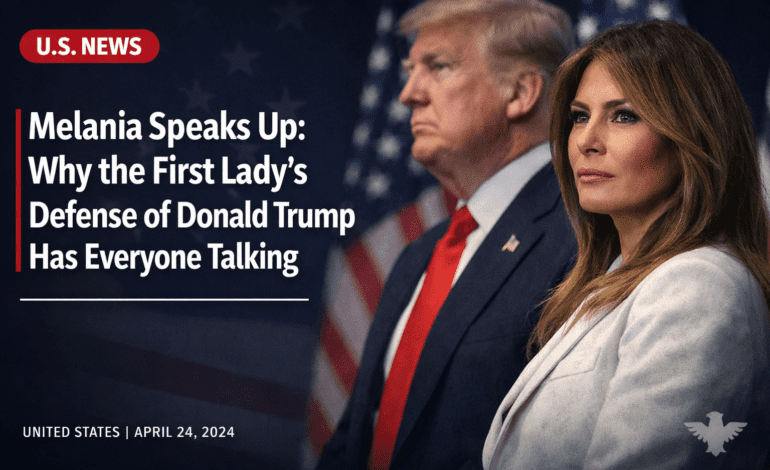
Melania Speaks Up: Why the First Lady’s Defense of Donald Trump Has Everyone Talking

In American politics, silence often says just as much as words. And when someone who has stayed quiet for a long time finally decides to speak, the whole country tends to stop and listen.
That is exactly what happened when Melania Trump stepped into the spotlight and broke her long silence to defend her husband, President Donald Trump, against what she called deeply unfair and personal attacks.
Her statement was not just a simple defense. It was a bold move that changed the tone of the political conversation happening across the country. In one moment, she went from being largely absent in public life to being one of the most talked-about figures in the news.
People across America reacted quickly and strongly, and their reactions could not have been more different. Some praised her for speaking up. Others questioned her timing and her motives. But almost everyone agreed on one thing: what she said mattered.
A Rare Public Moment From the First Lady
Melania Trump has never been the kind of public figure who seeks out the cameras. Throughout Donald Trump’s political career, she has kept a lower profile than many first ladies before her. She does not post on social media every day. She does not give endless interviews. She tends to stay in the background while the spotlight stays firmly on her husband.
That is exactly what makes this moment so unusual and so powerful. When someone who rarely speaks out finally chooses to do so, people pay attention. And Melania clearly knew that.
Her statement was measured and calm. She did not raise her voice or throw harsh words back at her husband’s critics. Instead, she made a clear and direct argument: the attacks on Donald Trump have gone too far, crossed too many lines, and turned from political disagreement into something far more personal and unfair.
She described her husband as a man carrying an enormous weight — someone who wakes up every day and keeps going despite constant attacks, constant criticism, and constant pressure. She framed him not as a controversial political figure, but as a committed and hard-working leader who genuinely believes he is doing what is right for the American people.
Whether you agree with that picture or not, the message was clear, and it landed with force.
What Melania Actually Said — And What She Meant
At the heart of Melania’s statement was a concern many Trump supporters have shared for years: that criticism of the former — and now current — president has moved beyond fair political debate and into something more damaging.
She suggested that there is a difference between holding a leader accountable for their decisions and launching personal, targeted attacks that are meant to destroy rather than to challenge. In her view, what Donald Trump has been facing falls into the second category.
She also spoke about sacrifice. This is a word that carries a lot of weight in American political culture. When a president or a public servant is described as making sacrifices, it connects them to a long tradition of leadership built on personal cost and public duty.
Melania leaned into that framing. She described her husband as someone who gives up personal comfort, private peace, and normal family life to serve the country. She asked the public to consider not just what he does, but why he does it — and whether the relentless criticism is a fair response to genuine sacrifice.
For many of his supporters, that message hit home immediately. They see the attacks on Trump as coordinated, unfair, and politically motivated. Hearing the First Lady say it out loud gave their feelings a new kind of validation.
Why His Supporters Are Cheering
Donald Trump’s base of support is large, loyal, and deeply emotional in its connection to him. For millions of Americans, Trump represents something beyond just policy positions. He represents a willingness to fight back against a political establishment they feel has ignored them for decades.
When Melania spoke up to defend him, many of those supporters felt a surge of emotion. Here was the First Lady — a woman who is private, careful, and rarely emotional in public — standing up for her husband in a moment when he is under enormous pressure.
For them, it was more than a political statement. It was a human one. It reminded them that behind the headlines and the controversy, there is a real person and a real family dealing with extraordinary pressure. Melania’s words helped humanize a figure who is often reduced to soundbites and attack ads.
Supporters also appreciated the timing. In a political environment where Donald Trump is constantly on defense — in the courts, in the media, and in public opinion — Melania stepping forward felt like reinforcement arriving at exactly the right moment.
Social media lit up with messages of support. Many people called it long overdue. Others said it was one of the most powerful things she had ever done as First Lady. The consensus among Trump supporters was clear: she said what needed to be said, and she said it well.
Why Critics Are Not So Sure
Not everyone responded with praise. In fact, some of the strongest reactions to Melania’s statement came from people who were deeply critical of it.
Critics made a fundamental point: people in power must be willing to face intense scrutiny. That is not unfair targeting — that is democracy working as it should. When you are the President of the United States, your decisions affect hundreds of millions of people. The criticism that follows those decisions is not personal cruelty. It is accountability.
Many of Trump’s critics argue that what Melania describes as personal attacks are actually legitimate responses to real actions. Policies that affect healthcare, immigration, foreign relations, and the economy are not personal matters. Criticizing them is not the same as attacking someone on a personal level.
Some also questioned whether framing Trump as a selfless sacrificer is accurate or fair. They point to the many ways in which holding the presidency — or being closely connected to it — has benefited the Trump brand, the Trump businesses, and the Trump family name.
Others raised a broader concern: is Melania’s statement meant to shift the conversation away from real issues? If the focus moves from what Trump has done to how unfairly he has been treated, that benefits him politically. Some critics see her timing as strategic rather than spontaneous.
These are fair questions, and they deserve serious consideration. The debate around Trump has always been intense, and Melania’s statement did not resolve it. If anything, it added more fuel to an already burning fire.
The Bigger Question: Where Does Criticism End and Attack Begin?
One of the most important things Melania’s statement did was force a hard and uncomfortable question into the public conversation: at what point does political criticism cross a line?
This is not a simple question, and there is no easy answer. In a democracy, free speech and press freedom are foundational. The ability to criticize those in power is not just a right — it is a responsibility. Without it, leaders cannot be held accountable, and power goes unchecked.
But most people would also agree that there are forms of attack that go beyond legitimate criticism. Mocking someone’s appearance, targeting their family members, spreading false information, or making deeply personal insults that have nothing to do with their public role — these things are harder to justify as “holding someone accountable.”
The problem is that different people draw this line in very different places. What looks like a vicious personal attack to one person looks like necessary and honest criticism to another. And when the person being discussed is as polarizing as Donald Trump, that gap becomes enormous.
Melania’s statement is valuable precisely because it pushed this question to the front of the conversation. She did not answer it. She probably could not. But she made it impossible to ignore.
Where does accountability end and unfair targeting begin? Can you criticize a leader’s decisions without making it personal? And who gets to decide what counts as “fair”? These are questions worth asking in any democracy, regardless of which side you are on.
The Role of a First Lady in Modern Politics
Melania’s decision to speak out also raises interesting questions about the role of the First Lady in American political life. Throughout history, First Ladies have handled this role in very different ways.
Some have been deeply involved in policy and public advocacy. Others have focused on specific causes and used their platform to promote social change. Some have stayed almost entirely out of political discussions and focused instead on their family and personal causes.
Melania has generally fallen into the quieter category. She has championed causes like anti-bullying and children’s well-being, but she has rarely waded into the kind of direct political defense we saw in this statement. That makes this moment stand out even more.
When a First Lady speaks on behalf of her husband in a direct and politically charged way, it carries weight that a campaign ad or a press release simply does not have. It feels personal. It feels real. And that emotional authenticity — whether you believe it or not — is powerful in the court of public opinion.
Her words were amplified across every major media platform within hours of being made public. Television networks ran clips. Social media exploded. News articles were written by the dozen. The response showed just how much influence the First Lady can have when she chooses to use her voice.
What This Moment Tells Us About American Politics Right Now
Beyond Melania and Donald Trump, this moment tells us something important about where American politics stands in 2026.
We live in a time when political narratives are built and destroyed faster than ever before. A single statement — from anyone — can shift the entire conversation. Social media, 24-hour news, and constant online discussion mean that nothing stays under the radar for long.
In this environment, Melania’s decision to speak was not just emotional — it was strategic. Whether that strategy was purely personal or also politically calculated is something only she knows. But the result was the same: the conversation changed.
People who had been debating policy were suddenly debating fairness. People who had been focused on what Trump had done were now asking whether the criticism had gone too far. That is a significant shift, and it happened because one person chose to speak up at the right moment.
It is also a reminder that in modern American politics, personal stories still matter. In a world of statistics, polling data, and policy debates, a human voice speaking about loyalty, sacrifice, and fairness cuts through the noise in a way that numbers simply cannot.
The Conversation Is Far From Over
Melania Trump’s public defense of her husband is one of those rare moments in politics that is significant not because it ends a debate, but because it deepens one.
She did not resolve the questions surrounding Donald Trump’s presidency or his legacy. She did not silence his critics or fully answer the concerns they have raised. But she did something important: she reminded everyone that behind the political machinery, there are human beings with real emotions, real beliefs, and real stakes in the outcome.
For supporters, her words were a rallying cry and a validation of their feelings. For critics, her words were a reminder to ask harder questions about the line between accountability and attack. For everyone else watching, it was a fascinating and genuinely moving moment in a political era that rarely slows down long enough to feel human.
Whether you stand with Donald Trump or against him, one thing is hard to argue with: when Melania Trump speaks, people listen. And this time, what she said will be remembered for a long time.
Because this is not just about one statement from one First Lady. It is about how we talk to each other in a divided country. It is about what fairness means when politics gets personal. And it is about the kind of leaders we want, the kind of criticism we allow, and the kind of country we are working to build.
That conversation, as Melania herself might say, is far from over.