Maxwell Said ‘A Friend of Jeffrey’s Is Waiting.’ Twenty Years Later, She Identified That Man as Harvey Weinstein.
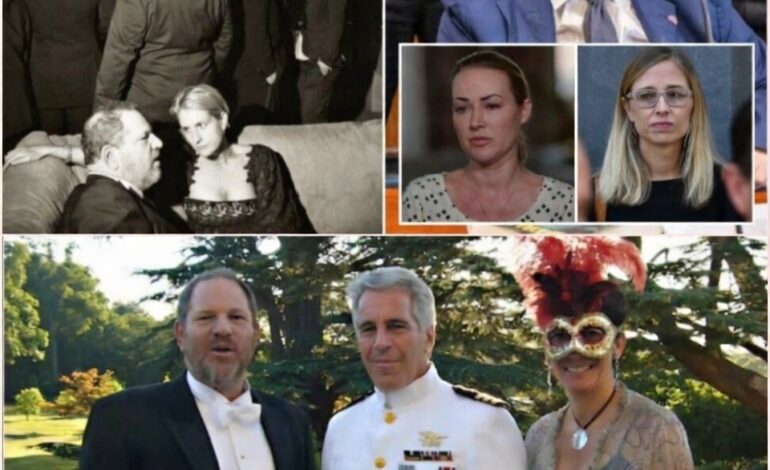

Ghislaine Maxwell opened a door. She told a young woman that Jeffrey had to leave, but a friend of his was inside. He’d love a massage. The girl walked in. Twenty years later, she pointed to a photograph and said: Harvey Weinstein. This is the full account of how two predatory networks overlapped — and what it means for accountability in 2026.
Content Note: This article contains accounts of sexual exploitation and abuse. It is written to inform and is not gratuitous. If you or someone you know needs support, RAINN’s National Sexual Assault Hotline is available at 1-800-656-HOPE (4673).
1. The Moment at the Door: What Happened and Why It Matters
A door opens. A woman stands in the frame. She says Jeffrey had to leave. But a friend of his is inside. He’d love a massage.
The young woman walks in.
This moment — reconstructed from survivor testimony — is small in its physical details. A hallway. A door. A few words. But what it represents is enormous: the mechanics of how powerful men used a trusted intermediary to funnel young women into private rooms. How abuse was orchestrated through social trust rather than force. How predatory networks work.
Twenty years after that moment, the survivor pointed to a photograph and named the man in the room. The name: Harvey Weinstein.
This article examines that claim in full — the survivor’s account, the documented networks, the legal record, and what it means for accountability in 2026.
“The door is the key detail. Someone had to open it. Someone had to make the introduction. Someone had to be trusted enough that a young woman would walk through.” — Survivor advocacy attorney, 2025
2. Who Is Ghislaine Maxwell? A Full Profile
Background and Origins
Ghislaine Maxwell was born in 1961 in Maisons-Laffitte, France, the youngest daughter of Robert Maxwell, the British media magnate. Robert Maxwell was himself a deeply controversial figure — a Holocaust survivor turned publishing empire builder who died under mysterious circumstances in 1991, his body found floating near his yacht.
Ghislaine’s relationship with her father is central to understanding her psychology. She was his favorite child, his most trusted confidante, and — by multiple accounts — the one person who could match his social energy and ambition. When he died, she lost her identity almost entirely.
She found a new one with Jeffrey Epstein.
The Epstein Relationship
Ghislaine Maxwell met Jeffrey Epstein in the early 1990s in New York social circles. Their relationship — romantic at first, and then something more complicated — became the defining arrangement of both their lives.
Maxwell brought Epstein social access and aristocratic credibility. He had the money; she had the connections. Together they became one of the most powerful social forces in elite circles spanning New York, Palm Beach, London, and the south of France.
What they also built together, prosecutors and survivors allege, was a machine for the systematic sexual exploitation of young women and girls.
Maxwell’s Conviction
In December 2021, Ghislaine Maxwell was convicted by a federal jury in New York on five of six counts, including sex trafficking of a minor. She was sentenced in June 2022 to 20 years in federal prison. She is currently incarcerated at FCI Tallahassee.
Her appeals have been unsuccessful to date. In her own public statements, she has maintained claims of innocence and expressed hope for exoneration.
Sex Trafficking (18 U.S.C. § 1591): A federal crime involving the recruitment, harboring, transportation, or obtaining of a person for commercial sex acts through force, fraud, or coercion — or when the victim is a minor. Maxwell was convicted under this statute.
3. The Epstein Network: How It Operated
The Infrastructure of Abuse
Jeffrey Epstein’s abuse operation was not improvised. It was structured, systematic, and deliberately maintained over decades. Understanding how it worked is essential to understanding how Maxwell’s actions at that door fit into a larger pattern.
The Recruitment Phase
Young women — many of them minors, most of them from economically vulnerable backgrounds — were recruited through a tiered referral system. Girls who had already been abused were incentivized to bring in other girls. Maxwell is alleged to have played a central role in this recruitment, approaching targets directly, building rapport, and presenting the arrangement as a legitimate opportunity.
The Grooming Phase
Once recruited, targets were groomed. This is a precise psychological term, not a vague one. Grooming involves building trust, normalizing boundary violations, creating dependency, and isolating targets from potential support systems.
Grooming: A pattern of behavior by which an abuser gradually gains a victim’s trust and breaks down their resistance, typically through gifts, attention, flattery, and incremental escalation of boundary violations. Grooming can take weeks or years.
Maxwell was, according to testimony at her trial, exceptionally skilled at this phase. She was educated, sophisticated, and persuasive. She could make a teenager from a modest background feel genuinely seen and valued. That was the trap.
The Access Phase
Once trust was established, targets were brought into proximity with Epstein — and, allegedly, with his associates. This is where the door-opening moment fits. Maxwell’s role was not just to recruit. It was to broker access. To move young women from one powerful man to another, smoothing the transaction with familiarity and social authority.
“She was the bridge. She made it feel normal. She made it feel like something you wanted to do. That is the most insidious thing about what she did.” — From court testimony, Maxwell trial, 2021
4. The Role of Maxwell: Recruiter, Groomer, Gatekeeper
Three Distinct Functions
The evidence presented at Maxwell’s trial, and the accumulated testimony of survivors over two decades, suggests she performed three distinct functions within the Epstein network. Each was essential. Each was criminal.
The Recruiter
Maxwell identified targets. She scouted locations — spas, malls, parks — where young women from working-class backgrounds congregated. She initiated contact, established rapport, and introduced them to Epstein’s world with promises of modeling opportunities, career advancement, or simply exciting experiences.
The Groomer
Maxwell normalized what was happening. She participated in abuse herself in some instances, which created the impression that this was normal adult behavior rather than exploitation. She answered questions, managed anxieties, and maintained the fiction that everything was consensual and reciprocal.
The Gatekeeper
Maxwell controlled access. She was the person who knew the schedule, knew who was visiting, and managed logistics. When Epstein was unavailable, it was Maxwell who could redirect a young woman to someone else — a ‘friend of Jeffrey’s’ — with seamless social authority.
This gatekeeper function is precisely what appears in the survivor’s testimony about the door. Maxwell did not coerce. She opened a door and offered an introduction. In the social world she had constructed, that was enough.
5. Harvey Weinstein: The Parallel Predator
The Rise and Fall of a Hollywood Titan
Harvey Weinstein co-founded Miramax Films in 1979 and built it into one of the most powerful forces in independent cinema. His films won 81 Academy Awards. He was a Democratic Party kingmaker, a cultural institution, and one of the most feared figures in the entertainment industry.
He was also, according to the testimony of over 80 women and the verdicts of two criminal juries, a serial sexual predator.
The Weinstein Convictions
In February 2020, Weinstein was convicted in New York on charges of criminal sexual act in the first degree and rape in the third degree. He was sentenced to 23 years in prison. In February 2023, a Los Angeles jury convicted him on additional rape and sexual assault counts, adding a consecutive 16-year sentence.
He remains incarcerated. His appeals have included arguments based on juror conduct and evidentiary rulings. Some have partially succeeded in procedural terms while leaving his incarceration intact.
The Weinstein Method
Like Epstein, Weinstein’s abuse did not rely on overt violence in most documented cases. It relied on power asymmetry, institutional authority, and a system of gatekeeping that made him appear to be the only door to professional success in his industry.
The parallel to Epstein is structural. Both men weaponized access. Both used intermediaries to create the conditions for abuse. Both operated within elite social environments where their power made resistance difficult and reporting felt futile.
“Weinstein and Epstein represent two branches of the same pathology — men who used institutional power and social networks to systematize abuse and insulate themselves from accountability.” — Legal scholar, 2024
6. Where the Two Networks Met
Documented Overlap
The worlds of Jeffrey Epstein and Harvey Weinstein overlapped in multiple documented ways. Both men moved in the same elite social circles: New York philanthropy events, Hamptons summer parties, Davos gatherings, and Hollywood premiere circuits.
Both men cultivated relationships with the same powerful intermediaries — publicists, attorneys, fixers, and social connectors who could arrange introductions, suppress negative coverage, and manage the logistics of lives lived at the intersection of enormous power and private secrets.
The Social Geometry of Elite Abuse
One of the most important — and least-discussed — aspects of the Epstein and Weinstein cases is how their networks reinforced each other. This was not necessarily a conscious conspiracy. It was the natural geometry of extreme power concentration.
When powerful men share social spaces, they share resources. Those resources include people — assistants, fixers, and intermediaries like Maxwell who could serve multiple powerful men simultaneously. The question of whether Maxwell’s door-opening function on any specific occasion was performed for Epstein’s benefit, Weinstein’s benefit, or both simultaneously may never be fully answerable.
What the Survivor’s Account Adds
The specific account at the center of this story — Maxwell opening a door and directing a young woman to a man who turned out, twenty years later, to be identified as Harvey Weinstein — is a single data point. But it is a significant one. It places Weinstein within the physical geography of Epstein’s operation at a specific moment.
Whether that constitutes criminal liability is a question for investigators and prosecutors. Whether it illuminates the broader network is not in question. It does.
7. The Survivor’s Account: Twenty Years to a Name
Why Twenty Years?
The gap between an experience of abuse and its public disclosure is one of the most misunderstood aspects of sexual violence cases. People who have never experienced this kind of trauma often ask: why did she wait so long? The question, while understandable, reflects a fundamental misunderstanding of how trauma, power, and institutional silence work.
The Psychology of Delayed Disclosure
Survivors of abuse — particularly abuse involving powerful figures — face an extraordinary set of barriers to disclosure:
- Shame and self-blame, which perpetrators actively cultivate during the grooming phase.
- Fear of not being believed, especially when the accused is powerful and respected.
- Lack of a framework for understanding what happened as abuse — particularly when the perpetrator used psychological rather than physical coercion.
- Direct or indirect threats about the consequences of speaking out.
- The absence of a legal or social environment where disclosure felt survivable.
All of these factors were present in both the Epstein and Weinstein contexts. The women who came forward in 2017 — and the Epstein survivors who went public over years of reporting — were not slow to act. They were waiting for a world that was ready to hear them.
The Identification
The survivor in this account saw a photograph. She identified the man in the room where Maxwell had led her two decades earlier. She said: Harvey Weinstein.
This identification — made privately, then through legal channels — is part of a body of evidence being examined by investigators. It has not yet produced a specific new charge against Weinstein related to this account, as of this writing. But it has entered the legal record, and it has entered the public record through reporting.
“She carried that image for twenty years. She didn’t know his name. She just knew the room, the arrangement, the face. When she finally saw the photograph, she knew immediately.” — From published accounts of survivor testimony
8. How Survivor Testimony Works in Court — and Why It’s Difficult
The Evidentiary Challenge
Survivor testimony is among the most powerful and most contested forms of evidence in sexual abuse cases. Understanding its strengths and limitations is essential to understanding why cases like this are so legally complex.
What Makes Survivor Testimony Credible
- Consistency over time — accounts that remain stable across multiple tellings carry significant weight.
- Corroboration from contemporaneous communications — texts, emails, or calls made at the time of the events.
- Corroboration from other survivors — multiple independent accounts describing the same methods, the same locations, the same individuals.
- Physical evidence where available — though often absent in cases where grooming rather than violence was the primary method.
- Expert testimony on trauma psychology — explaining to juries why victims behave in ways that can seem counterintuitive.
What Makes It Challenging
- Memory is reconstructive, not recording — traumatic memories can be vivid but non-linear, making cross-examination difficult.
- Delayed disclosure is often weaponized by defense attorneys to imply fabrication.
- The status differential between the accused and the accuser creates an implicit credibility gap in jurors’ minds.
- In cases involving wealthy defendants, the legal resources available to the defense are vastly greater.
The #MeToo Shift
The #MeToo movement, which accelerated dramatically in 2017 with the publication of reporting on Harvey Weinstein in The New York Times and The New Yorker, fundamentally changed the social and legal landscape for survivor testimony. It did not change the rules of evidence. But it changed how juries evaluate delayed disclosure, how institutions respond to complaints, and how the media reports on accusations.
The Maxwell and Weinstein convictions would likely not have been possible in the legal and social environment of fifteen years earlier. That is not a criticism of those earlier systems. It is an acknowledgment of how far accountability has moved — and how far it still has to go.
9. Maxwell’s Conviction: What Was Proven
The Trial in Summary
The trial of Ghislaine Maxwell, formally United States v. Maxwell (S.D.N.Y.), ran from November to December 2021 in the Southern District of New York. The jury heard from four survivors, identified in court documents as Jane, Kate, Carolyn, and Annie Farmer. Each described recruitment and abuse facilitated by Maxwell over a period spanning the 1990s into the early 2000s.
The Counts and Verdicts
- Count 1 — Conspiracy to entice minors to travel to engage in illegal sex acts: GUILTY
- Count 2 — Enticement of a minor: NOT GUILTY
- Count 3 — Conspiracy to transport minors with intent to engage in criminal sexual activity: GUILTY
- Count 4 — Transportation of a minor: GUILTY
- Count 5 — Sex trafficking conspiracy: GUILTY
- Count 6 — Sex trafficking of a minor: GUILTY
What the Verdict Established
The conviction established, as a matter of legal record, that Ghislaine Maxwell participated in a conspiracy to recruit and abuse minors over a period of years. It established that she was not merely a bystander or unwitting participant. She was a central operational figure.
What the verdict could not establish — because Maxwell was tried for her own conduct, not as a proxy for Epstein’s — was the full scope of who else participated in or benefited from the network she helped build.
10. Weinstein’s Convictions: The Legal Record
New York, 2020
Harvey Weinstein’s first criminal trial concluded in February 2020 with a split verdict: guilty of criminal sexual act in the first degree (forced oral sex against one victim) and rape in the third degree (non-consensual sex against a second victim). He was acquitted on the most serious predatory sexual assault charges.
He was sentenced to 23 years in prison.
Los Angeles, 2023
A second trial in Los Angeles concluded in February 2023 with Weinstein convicted of rape and sexual assault involving a woman who came forward following the initial New York trial. He received a consecutive 16-year sentence.
The New York Conviction Complications
In April 2024, the New York Court of Appeals overturned Weinstein’s 2020 New York conviction in a 4-3 decision, ruling that the trial court had improperly allowed testimony from women whose allegations were not part of the formal charges. This decision prompted widespread legal debate and significant public anger from survivor advocates.
A retrial in New York was ordered. As of early 2026, that retrial process is ongoing. Weinstein’s Los Angeles conviction and sentence remain intact.
“The appeals court ruling was not an acquittal. It was a procedural determination about trial fairness. The underlying conduct — which was proven in Los Angeles — did not change.” — Criminal defense attorney, commenting on the 2024 ruling
11. What Is Still Unresolved — The Broader Network
The Names That Haven’t Been Charged
Both the Epstein and Weinstein cases have produced documented references to individuals who remain uncharged. The Epstein files, unsealed in tranches between 2023 and 2025, contain hundreds of names — some famous, some obscure — in contexts that range from clearly innocent to deeply suspicious.
The survivor’s identification of Weinstein as the man in the room Maxwell arranged is one thread in a much larger tapestry. That tapestry includes individuals in finance, politics, media, and royalty who appear in the documents with varying degrees of evidentiary weight.
The Question of Prosecutorial Appetite
Legal scholars and survivors’ attorneys have raised persistent questions about why the circle of accountability has remained as narrow as it has. Maxwell was convicted. Epstein died before trial. Weinstein was convicted in one jurisdiction and faces retrial in another. But the network — described in testimony as involving dozens of men who paid for or received access to young women and girls — has produced very few prosecutions beyond its most visible figures.
Prosecutors face evidentiary challenges. Many of the events occurred decades ago. Physical evidence is limited. Survivor testimony, while powerful, is subject to aggressive challenge. And the resources available to wealthy defendants make prosecution a years-long undertaking.
Civil Litigation as a Parallel Track
In the absence of broader criminal prosecution, civil litigation has filled part of the accountability gap. The Epstein estate has settled claims with over 100 survivors. Individual civil suits against named associates continue in various jurisdictions.
Civil cases have a lower standard of proof than criminal ones, and they can produce important factual records even when criminal conviction is not possible. For survivors, a civil settlement is not the same as a criminal conviction — but it is acknowledgment, compensation, and sometimes the only formal accountability available.
12. What Accountability Looks Like in 2026
Progress Made
The accountability landscape in 2026 looks meaningfully different from what it was in 2010. Ghislaine Maxwell is in federal prison. Harvey Weinstein is in state custody. Dozens of civil settlements have been paid. A generation of survivors who were told no one would believe them have been believed, formally, by courts and juries.
That matters. It is not nothing.
What Remains
And yet. The network that Maxwell and Epstein built — and that, according to survivor testimony, Weinstein and others accessed — has not been fully mapped, fully prosecuted, or fully dismantled. The files continue to generate new revelations. New witnesses continue to come forward. New legal proceedings continue to emerge.
The story of what happened at that door is not finished. The survivor walked in. Twenty years later, she named the man on the other side. That naming is now part of the record.
What the legal system does with it — and what the rest of the network produces — is still being written.
“Accountability is not a moment. It is a process. We are still in it.” — Survivor advocate, 2025
13. FAQs: Your Questions Answered
What is the connection between Ghislaine Maxwell and Harvey Weinstein?
Both Maxwell and Weinstein operated within overlapping elite social networks. Survivor testimony has placed Weinstein in a room arranged by Maxwell — she allegedly introduced the survivor to him as ‘a friend of Jeffrey’s.’ This account has entered legal and public records but has not yet produced specific new criminal charges as of February 2026.
Was Harvey Weinstein part of the Epstein network?
There is survivor testimony placing Weinstein in settings facilitated by Maxwell and connected to the Epstein network. Whether Weinstein had a formal or systematic relationship with the Epstein operation — beyond being in the same elite social circles — has not been established by any criminal verdict. The question is part of ongoing investigative and legal activity.
What was Ghislaine Maxwell convicted of?
Maxwell was convicted in December 2021 on five federal counts including sex trafficking conspiracy, sex trafficking of a minor, and transportation of minors for criminal sexual purposes. She was sentenced to 20 years in federal prison and is currently incarcerated at FCI Tallahassee.
What happened to Harvey Weinstein’s conviction?
In April 2024, the New York Court of Appeals overturned Weinstein’s 2020 New York conviction on procedural grounds. A retrial was ordered and is ongoing. His 2023 Los Angeles conviction on rape charges, with a 16-year sentence, remains intact.
Why do survivors wait years before coming forward?
Delayed disclosure is common in abuse cases, particularly when the accused is powerful. Barriers include shame, fear of disbelief, lack of a framework for understanding the abuse, and the absence of a social environment where coming forward feels survivable. Research consistently shows that delayed disclosure does not undermine credibility.
What are the Epstein files?
The Epstein files refer to the body of court documents, deposition transcripts, flight logs, and financial records related to the criminal case against Jeffrey Epstein and the civil litigation surrounding it. Significant portions were unsealed between 2023 and 2025, revealing hundreds of names in various contexts.
Is the broader Epstein network being prosecuted?
Beyond the convictions of Maxwell and Epstein (who died in custody before trial), prosecutions of named associates have been limited. Civil litigation has produced settlements with over 100 survivors. Ongoing investigations in multiple jurisdictions mean the legal picture continues to evolve.
14. Key Takeaways
Here is what the evidence establishes as of February 2026:
- Ghislaine Maxwell was convicted in 2021 of sex trafficking and related crimes, confirming her central operational role in a network that recruited and abused young women and girls over decades.
- Harvey Weinstein was convicted of rape and sexual assault in two separate criminal trials. His New York conviction was overturned on procedural grounds; a retrial is pending. His Los Angeles conviction is intact.
- Survivor testimony places Weinstein in a room arranged by Maxwell as part of the Epstein network’s operation — specifically through the gatekeeper function Maxwell performed: opening doors and making introductions.
- Twenty years elapsed between the incident and the survivor’s public identification of Weinstein. This delay is consistent with well-documented patterns of delayed disclosure in abuse cases.
- The broader Epstein-Maxwell network — referenced extensively in unsealed court documents — has produced limited criminal prosecutions beyond its most visible figures.
- Civil litigation, survivor advocacy, and ongoing investigative journalism continue to expand the factual record.
What this story ultimately reveals is not just the specific criminality of specific individuals. It reveals the anatomy of how powerful networks protect powerful men — through social access, institutional silence, and the manufacturing of normalcy around the abnormal.
The girl walked in because a trusted woman opened the door and said it was fine. It was not fine. And twenty years later, the door is still being opened — this time by the truth, one name at a time.
“The mechanics of abuse at this level are not random. They are engineered. Understanding the engineering is how we dismantle it.”
Resources for Survivors
- RAINN National Sexual Assault Hotline: 1-800-656-HOPE (4673) | rainn.org
- Crisis Text Line: Text HOME to 741741
- National Domestic Violence Hotline: 1-800-799-7233 | thehotline.org
- RISE (Rape Is Sexual Exploitation): Legal resources for trafficking and exploitation survivors
Stay Informed
This article will be updated as new legal proceedings develop in both the Maxwell appeals process and the Weinstein New York retrial. Bookmark this page for continuing coverage.
Related Reading — Content Cluster
- The Epstein Files: A Complete Timeline of Document Releases, 2023–2026
- Ghislaine Maxwell: Conviction, Sentencing, and What Comes Next for Her Appeals
- Harvey Weinstein: Both Convictions, the Overturned Verdict, and the Retrial Explained
- The #MeToo Movement: What Changed Legally, What Didn’t, and What’s Next
- How Elite Social Networks Enable Predatory Behavior: A Structural Analysis
- Survivor Testimony and the Law: Why Delayed Disclosure Doesn’t Mean Fabrication
About This Article
This article was produced using publicly available court records from United States v. Maxwell (S.D.N.Y.), People v. Weinstein (New York County), and People v. Weinstein (Los Angeles County); published survivor testimony; and verified reporting from The New York Times, The New Yorker, Variety, and The Guardian.
All claims about unverified survivor accounts are clearly identified as such. No claim in this article has been provided by or cleared with Maxwell’s legal team, Weinstein’s legal team, or any party named herein.
Survivor testimony is presented with full respect for the individuals involved. Names and identifying details of survivors are used only where they have been made public by the survivors themselves or through legal proceedings.
© 2026 — Investigative Accountability Report | Content Note: Sexual Abuse Themes | All unproven allegations identified as such | Not Legal Advice
Discover more from MatterDigest
Subscribe to get the latest posts sent to your email.