Lawsuit Filed to Remove Trump’s Name From the Kennedy Center — The Legal Battle Just Exploded
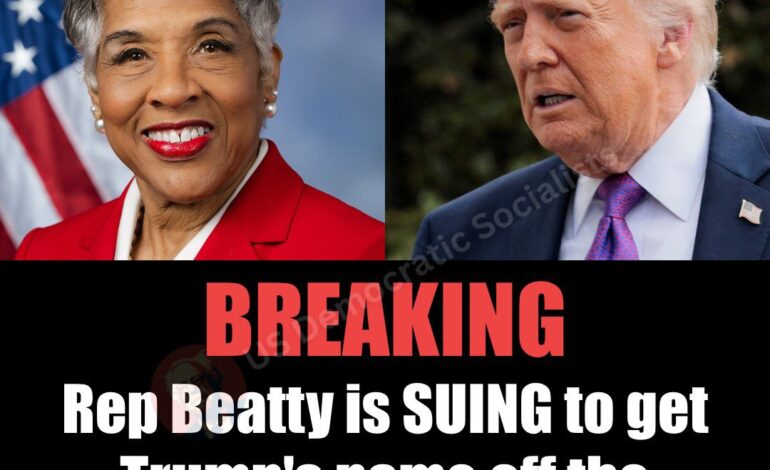

Rep. Beatty’s Lawsuit to Remove Trump’s Name From the Kennedy Center: The Full Legal Case Explained
| Quick Answer On March 26, 2026, Rep. Joyce Beatty (D-OH) filed a federal motion for partial summary judgment asking a Washington, D.C. judge to remove President Trump’s name from the Kennedy Center. Her attorneys argue the 1964 federal statute that created the Center designates it as a memorial to John F. Kennedy exclusively — and that only Congress, not a presidentially-appointed board, can change that name. |
Introduction: A Memorial, a Name, and a Federal Lawsuit
There is a law. It is clear. It says the building is designated as the John F. Kennedy Center for the Performing Arts. Full stop.
That is the core of Rep. Joyce Beatty’s federal lawsuit — filed on March 26, 2026 — asking a federal judge in Washington, D.C. to order Trump’s name removed from the Kennedy Center’s exterior, its website, and all official branding. She is also asking the court to block a planned two-year closure of the institution that she calls unlawful and irrational.
This article covers everything you need to understand the case: the 1964 law at its center, what fiduciary duty means and why it matters here, the full timeline of how the name change happened, the artists who walked away, the closure plan, and what the court could do next.
Who Is Rep. Joyce Beatty — and Why Is She Suing?
Rep. Joyce Beatty is a Democratic congresswoman from Ohio’s 3rd congressional district, centered on Columbus. She has served in Congress since 2013.
Crucially, she is also an ex officio member of the Kennedy Center’s board of trustees. That is not just a political title. Ex officio board members have legal standing within the institution — which is exactly what gives her the ability to bring this lawsuit in the first place.
She filed her first lawsuit against the Kennedy Center board in December 2025, days after the Trump-appointed board voted to add Trump’s name to the institution. Her March 26 filing is a motion for partial summary judgment — a legal request asking the judge to rule in her favor on specific points of law without a full trial, because she argues the statutory language is unambiguous.
What Is the Kennedy Center — and How Was It Created?
The John F. Kennedy Center for the Performing Arts is the United States’ national cultural center. It sits on the banks of the Potomac River in Washington, D.C. It hosts opera, ballet, symphony, theater, and jazz. It is home to the Kennedy Center Honors — arguably the most prestigious arts award in America.
The Center was created by an Act of Congress in 1964 — one year after President John F. Kennedy was assassinated on November 22, 1963. Congress designated the building as a living memorial to the 35th president and committed federal funding to its construction and ongoing operation.
The building opened in 1971. It receives both federal appropriations and private donations. Because it was created by federal statute and receives federal funds, its governance structure — including its board of trustees — is defined by law. This is the legal foundation for Beatty’s lawsuit.
| Fact | Detail |
| Created by Congress | 1964 — National Cultural Center Act amended to honor JFK |
| Opened | September 8, 1971 |
| Federal designation | Living memorial to President John F. Kennedy |
| Board structure | Presidentially appointed members + ex officio congressional members |
| Annual visitors (pre-2025) | Approximately 2 million |
| Name change date | December 2025 — board vote |
| New signage installed | Day after the December board vote |
| New name used | The Trump-Kennedy Center for the Performing Arts |
| Proposed closure | July 2026 for approximately two years |
The Complete Timeline: From Kennedy Memorial to Trump-Kennedy Center
Understanding this case requires understanding how we got here. Here is the full sequence of events:
| Date | Event | Significance |
| November 1963 | President Kennedy assassinated in Dallas, Texas | Nation mourns; Congress begins planning memorial |
| December 1964 | Congress passes legislation designating the Center as a Kennedy memorial | Building is named by federal statute — not by presidential order |
| September 1971 | Kennedy Center opens on the Potomac | Becomes America’s premier performing arts venue |
| January 2025 | Trump returns to White House; replaces Kennedy Center board leadership | New board chair and members are Trump allies |
| December 2025 | Trump-appointed board votes to rename Center the Trump-Kennedy Center | Beatty, an ex officio member, barred from voting |
| December 2025 | Signage updated the day after the board vote | Trump name added to the exterior of the building |
| December 2025 | Beatty files first lawsuit challenging the name change | Case assigned to U.S. District Court for D.C. |
| February 2026 | Board announces plan to close Kennedy Center for approx. two years for renovations | Board cites need to completely rebuild the facility |
| March 2026 (early) | Beatty files lawsuit to block two-year closure | Judge issues temporary restraining order; allows her to receive documents and attend board meeting |
| March 16, 2026 | Judge allows Beatty to participate in board meeting about closure plan; does not order them to let her vote | Board finalizes closure plan |
| March 26, 2026 | Beatty files motion for partial summary judgment on name change and closure | Asks judge to rule without full trial; argues the law is unambiguous |
The 1964 Law: What Congress Actually Said
The entire legal case rests on what Congress wrote in 1964. Beatty’s attorneys argue the language is not open to interpretation — it is explicit.
The law designates the building as the John F. Kennedy Center for the Performing Arts. The word designated carries specific legal weight. It is not a suggestion. It is not a preference. It is a statutory designation — meaning it can only be changed by another act of Congress.
| The Core Legal Argument
“Can the Board of the Kennedy Center — in direct contradiction of the governing statutes — rename this sacred memorial to John F. Kennedy after President Donald J. Trump? The answer is, unequivocally, ‘no.’ By renaming the Center — in violation of the law — Defendants have breached the terms of the trust and their most basic fiduciary obligations as trustees.” — Norm Eisen and Nathaniel Zelinsky, Beatty’s attorneys |
The filing also cites specific statutory language restricting new plaques and memorials at the Kennedy Center, with only narrow exceptions. Beatty’s legal team argues none of those exceptions apply to the name change the board approved.
What the Law Says About Plaques and Memorials
This is a detail most reporting has missed. Federal law governing the Kennedy Center contains specific provisions about what can and cannot be added to the building in terms of commemorative materials. The law was written to protect the integrity of the Kennedy memorial designation.
Beatty’s attorneys argue the Trump name addition — whether on the exterior facade, the website, or official branding — falls under these restrictions. The law provides narrow exceptions. Adding a sitting president’s name while he is in office does not qualify for any of them, they argue.
What Is Fiduciary Duty — and Did the Board Breach It?
Fiduciary duty is a legal concept. It means a person or group entrusted with managing something — a company, a fund, an institution — has a legal obligation to act in the best interest of that institution and those it serves. Not in their own interest. Not in the interest of whoever appointed them.
| What Is Fiduciary Duty? (Plain English Definition) A fiduciary duty is a legal obligation to act in the best interest of another party. Board members of institutions like the Kennedy Center are fiduciaries — they are legally required to prioritize the institution’s mission and legal obligations above personal loyalty, political allegiance, or the wishes of whoever appointed them. Violating fiduciary duty can expose board members to personal legal liability. |
Beatty’s attorneys argue the board’s fiduciary duty is specifically defined by the 1964 law: their core obligation as trustees is to maintain the Center as a memorial to John F. Kennedy — and to no one else. Those last five words appear in the filing and are key.
| The Fiduciary Breach Argument (Direct from the Court Filing)
“There is no clearer or more significant breach of fiduciary duty than the Board flouting the central purpose of the institution it is charged with protecting and which Congress enshrined into law: to maintain the Center as a memorial to John F. Kennedy — and to no one else.” — Beatty’s attorneys, motion for partial summary judgment, March 26, 2026 |
The filing further notes that the Trump administration and the board have not provided what it calls a coherent defense of their actions. Attorneys Norm Eisen and Nathaniel Zelinsky wrote that the defendants have not spelled out any justification for what they called nakedly unlawful actions.
This matters legally. In a motion for partial summary judgment, Beatty is arguing there is no genuine dispute of material fact — that the law is clear enough that a judge can rule without a trial. If the defendants cannot articulate a coherent legal justification, that argument becomes stronger.
The Two-Part Legal Motion: Name Change AND Closure
Beatty’s March 26 filing actually contains two distinct legal challenges. They are related but separate.
Part 1: Remove Trump’s Name
The first part asks the federal judge to issue an order requiring the Kennedy Center to revert to its statutory name: The John F. Kennedy Center for the Performing Arts. This would apply to the building’s exterior signage, its official website, its social media accounts, and all official branding.
The legal theory: the board lacked the authority to rename the Center because only Congress — which created and named it by statute — has the power to change that name.
Part 2: Block the Two-Year Closure
The second part of the filing challenges Trump’s plan to shut down the Kennedy Center for approximately two years beginning in July 2026 for what the administration calls a complete rebuild.
Beatty’s attorneys argue this closure plan also breaches fiduciary duty. The filing states: Turning the Kennedy Center into a lifeless husk for two years would constitute a fundamental breach of Defendants’ most basic fiduciary obligations as trustees.
Their additional argument: the closure was not based on any legitimate independent analysis. The board relied on four capital maintenance reports commissioned by prior Kennedy Center management in 2021, 2022, and 2024 — reports that were not ordered by the current board and that Beatty’s team calls insufficient justification for a two-year shutdown.
| The Closure Allegation
Beatty’s filing alleges that the board rushed the closure decision without independent analysis, and that the February 2026 announcement of a closure following an extensive one-year review was a lie. The documents provided to Beatty were four pre-existing reports from 2021, 2022, and 2024 — none commissioned by the current Trump-aligned board. Her legal team called the closure plans a haphazard and irrational process that portends irreparable damage to a national treasure. |
Beatty also alleges the closure decision was a retaliatory response. When Trump’s name was added to the building, prominent artists began canceling scheduled performances. Beatty argues the sudden closure announcement came as a direct response to that artistic exodus — not from any genuine assessment of renovation needs.
Artists Who Withdrew: How the Name Change Reshaped the Kennedy Center
The name change to Trump-Kennedy Center set off an extraordinary wave of artistic departures. For many performers, conductors, and arts organizations, the politicization of what had been a nonpartisan national cultural institution was a line they would not cross.
Among the most prominent departures:
- Philip Glass — composer and Kennedy Center Honors recipient — withdrew from planned performances. His decision carried particular symbolic weight given that he had previously been honored by the very institution he was now refusing to appear at.
- Multiple orchestras, dance companies, and theatrical productions scheduled for the 2025-2026 season withdrew or declined to renew their engagements.
The scale of the artistic walkout gave credence to Beatty’s closure argument. If the Trump administration anticipated this level of withdrawal — or was responding to it — then the closure timeline makes more sense as damage control than as genuine renovation planning.
What the Trump Administration and Board Have Said
The Trump administration and the Kennedy Center board have not filed a detailed public defense of their legal position in response to the March 26 motion. That response will come in court filings.
The Kennedy Center’s vice president of public relations, Roma Daravi, referred to a prior statement when asked about Beatty’s initial lawsuit participation: “Despite her claims in court, Congresswoman Beatty was invited to the board meeting and is welcome to attend.” She said the center would abide by the court’s rulings and was prepared to provide information demonstrating the need for closure and renovations.
Trump’s broader public position has been that he has the authority as president to reshape federal institutions, including their names and leadership. The White House has not issued a specific legal defense of the Kennedy Center renaming.
Beatty’s attorneys noted in their filing that the defendants have not articulated a coherent defense of what the filing calls nakedly unlawful conduct — leaving the legal record, as of the filing date, with only Beatty’s arguments on the statutory question.
What Legal Experts Say About the Strength of the Case
Legal observers have noted several factors that strengthen Beatty’s position:
The Statutory Language Is Unusually Clear
Federal statutes that use the word designated to name an institution are typically understood to mean that name is fixed by law. Courts have held that what Congress creates by statute, only Congress can undo. The Kennedy Center’s name is not the result of a presidential order or an executive action — it is embedded in a federal law passed by both chambers and signed by a president.
The Board’s Authority Has Limits
Even presidentially-appointed board members of federally-chartered institutions cannot override federal statutes. They can make operational decisions within the law. They cannot make decisions that contradict the law. The question before the court is whether the name change does exactly that.
The Motion for Partial Summary Judgment Is a Strategic Choice
Beatty’s attorneys chose to file for partial summary judgment — not a full trial. This tells you they believe the legal question is simple enough that a judge can decide it on the face of the statute without hearing extensive factual evidence. That is a high bar to clear, but legal analysts note the statutory text is remarkably explicit.
The Fiduciary Duty Theory Has Teeth
Fiduciary duty breaches can expose individual board members to personal liability — not just the institution. This is why Beatty’s lawsuit names Trump and other board members individually. If the court agrees the board violated its fiduciary duty, the legal consequences could extend to the trustees personally.
Who Are Beatty’s Attorneys?
The two lead attorneys on this case are notable figures in constitutional and political law:
- Norm Eisen — co-founder and board member of Democracy Defenders Action, a nonprofit legal organization focused on defending democratic institutions. Eisen is a former U.S. ambassador and served as Special Counsel to the House Judiciary Committee during Trump’s first impeachment proceedings.
- Nathaniel Zelinsky — senior counsel at the Washington Litigation Group. He has extensive experience in complex federal litigation and constitutional cases.
Their combined profile in high-profile constitutional litigation is significant. This is not a case being handled by a small regional firm. It is being argued by attorneys with deep experience in exactly this type of institutional and statutory dispute.
People Also Ask: Key Questions Answered
What is Rep. Joyce Beatty’s lawsuit against the Kennedy Center?
Rep. Beatty filed a federal lawsuit in December 2025 challenging the Trump-appointed board’s decision to rename the Kennedy Center the Trump-Kennedy Center. On March 26, 2026, she filed a motion for partial summary judgment asking the court to order Trump’s name removed and to block a planned two-year closure. She argues the 1964 federal statute that created the Center designates it exclusively as a memorial to John F. Kennedy, and that only Congress can change that name.
Can Trump rename the Kennedy Center?
Beatty’s lawsuit argues no. The Kennedy Center’s name is established by a 1964 federal statute. Trump’s board voted to rename it, but Beatty’s attorneys argue the board lacks the legal authority to override a congressional statute. Only Congress — which created the name by law — can change it through new legislation. The federal court will decide whether this argument prevails.
What is fiduciary duty and why does it apply to the Kennedy Center board?
Fiduciary duty is the legal obligation of board members to act in the best interest of the institution they govern, not in their own interest or the interest of whoever appointed them. The Kennedy Center’s board members are fiduciaries. Beatty’s attorneys argue the board violated its fiduciary duty when it renamed the Center, because that duty is specifically defined by law as maintaining the Center as a memorial to JFK — and to no one else.
What is a motion for partial summary judgment?
A motion for partial summary judgment asks a court to rule in favor of one side on specific legal questions without holding a full trial. It is used when a party argues the law is so clear that no factual dispute is possible. Beatty filed this motion because she believes the 1964 statutory language designating the Kennedy Center as a Kennedy memorial is unambiguous — leaving no room for the board to argue otherwise.
Why is the Kennedy Center planning to close for two years?
The Trump-aligned board announced in February 2026 that the Kennedy Center would close for approximately two years beginning in July 2026 for a complete rebuild and renovations. Beatty’s attorneys argue the decision was rushed, based on outdated pre-existing reports rather than any new independent analysis, and possibly a response to the mass artistic withdrawals that followed the name change. They call it a haphazard and irrational process.
Which artists withdrew from the Kennedy Center after the name change?
Prominent composer Philip Glass, a Kennedy Center Honors recipient, withdrew from planned performances after Trump’s name was added to the building. Multiple orchestras, dance companies, and theatrical productions also withdrew. The breadth of the artistic walkout was cited by Beatty’s legal team as context for the subsequent closure announcement.
Who created the John F. Kennedy Center for the Performing Arts?
The Kennedy Center was created by an Act of Congress in 1964, one year after President Kennedy’s assassination. Congress designated it as a living memorial to the 35th president. It was funded in part by federal appropriations and opened in September 1971. Because Congress created and named it by statute, Beatty argues only Congress can change that name.
Discover more from MatterDigest
Subscribe to get the latest posts sent to your email.