Lamborghini Abandons Full EVs, Pivots to Hybrids: Full Story
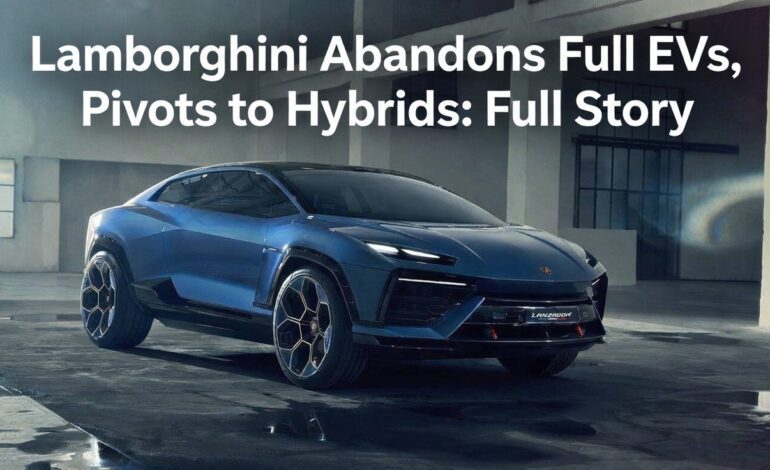

CEO Stephan Winkelmann canceled the $300,000 Lanzador EV, called full-EV development ‘an expensive hobby,’ and committed every Lamborghini to a plug-in hybrid future. The complete breakdown of why — and what it signals for the supercar industry.
1. Introduction: The Bull That Won’t Go Silent
There’s a sound that defines Lamborghini. It’s the howl of a naturally aspirated V10. The thunder of a twelve-cylinder engine at 8,500 RPM. It rattles windows, turns heads three blocks away, and makes grown adults stop mid-sentence and stare.
That sound — and everything it means about the driving experience — is precisely why Lamborghini just killed its first electric car.
In late 2025, Lamborghini quietly retired the Lanzador, its planned $300,000 fully electric 2+2 crossover that had been announced with great fanfare at Pebble Beach in 2023. On February 23, 2026, CEO Stephan Winkelmann confirmed the decision in an interview with The Sunday Times — and the reasoning he gave was both blunt and revealing.
Lamborghini customers don’t want an electric car. Not yet. Maybe not ever. And building one anyway, Winkelmann said, would be ‘an expensive hobby, and financially irresponsible’ to everyone the company answers to.
Instead: plug-in hybrids. Every model, by 2030. Combustion engines retained ‘for as long as possible.’ The soul of the raging bull preserved, even as it learns to run a little cleaner.
This guide covers the whole story — the canceled Lanzador, the PHEV pivot, the record-breaking sales that validate the strategy, and what all of it signals for the future of performance driving.
Quick Answer: Why did Lamborghini abandon full EVs? Lamborghini CEO Stephan Winkelmann confirmed in February 2026 that the company has canceled its planned Lanzador electric vehicle and will not build any fully electric models for the foreseeable future. He cited ‘close to zero’ customer demand for EVs among Lamborghini’s target clientele and called full-EV development ‘an expensive hobby, and financially irresponsible.’ Instead, Lamborghini is committing its entire lineup to plug-in hybrid (PHEV) technology by 2030, retaining internal combustion engines ‘for as long as possible.’
2. What Lamborghini Decided — The Quick Answer
What did Lamborghini decide about electric vehicles?
Lamborghini has canceled its first planned fully electric vehicle, the Lanzador EV, and committed to building only plug-in hybrid (PHEV) models by 2030. CEO Stephan Winkelmann told The Sunday Times in February 2026 that customer interest in battery-electric supercars is ‘close to zero’ and that full-EV investment would be ‘financially irresponsible.’ The company plans to keep combustion engines ‘for as long as possible’ while meeting emissions regulations through hybrid technology.
| Lamborghini EV Decision Snapshot | Detail |
| Decision announced | February 23, 2026 (Sunday Times interview) |
| Confirmed by | CEO Stephan Winkelmann |
| Vehicle canceled | Lanzador EV — planned fully electric 2+2 crossover |
| Lanzador announced | Pebble Beach Concours d’Elegance, August 2023 |
| Lanzador original target | 2028–2029 production launch; $300,000 price; 1,341 hp |
| When quietly retired | End of 2025 |
| Reason stated | ‘Close to zero’ customer demand; would be ‘expensive hobby’ |
| Replacement strategy | PHEV version of Lanzador concept possible; full lineup PHEV by 2030 |
| Combustion engines | Retained ‘for as long as possible’ |
| Electric Urus plan | Also canceled — next-gen Urus will remain PHEV |
| 2025 sales result | Record 10,747 vehicles — hybrid lineup credited |
| Lamborghini’s owner | Volkswagen AG (via Audi subsidiary) |
3. The Lanzador: What Was Canceled and Why It Mattered
The Lanzador was supposed to be a landmark moment. In August 2023, at the most prestigious automotive gathering in the world — the Pebble Beach Concours d’Elegance in Monterey, California — Lamborghini unveiled a striking concept: a fully electric, four-seat, high-riding crossover with 1,341 horsepower and a silhouette unlike anything the brand had ever made.
The name came from Spanish: ‘Lanzador’ means ‘launcher’ or ‘thrower.’ A fitting name for an electric vehicle with that kind of power figure. The concept had angular lines, a greenhouse roof, and proportions that said ‘Lamborghini’ without being another scissor-doored supercar.
“The Lanzador was unveiled as a window into Sant’Agata Bolognese’s EV future, with plans to launch a production version in 2028.”
— Motor1, February 2026
The Timeline of Delays and Cancellation
| Date | Lanzador Status | Context |
| August 2023 | Concept unveiled at Pebble Beach | 1,341 hp; fully electric; 2+2 crossover format; planned for 2028–2029 |
| Late 2024 | Production delayed one year — to 2029 | First sign of internal hesitation |
| Late 2025 | Quietly retired | Lamborghini internally cancels the EV project |
| Feb 23, 2026 | Cancellation officially confirmed | CEO Winkelmann tells Sunday Times it won’t reach production as an EV |
| Future possibility | PHEV version remains possible | Winkelmann: could arrive as PHEV ‘by end of the decade’ |
The Lanzador mattered because it was Lamborghini’s answer to the question every automaker was being asked around 2021–2023: ‘What’s your EV strategy?’ For a $300,000 supercar brand, the answer was a $300,000 electric supercar. That answer has now changed.
Image Suggestion: Lamborghini Lanzador concept car at Pebble Beach 2023. Alt text: ‘Lamborghini Lanzador concept unveiled at Pebble Beach Concours d’Elegance in August 2023 — the fully electric 2+2 crossover that was quietly canceled by end of 2025 before CEO Winkelmann confirmed the decision in February 2026.’
4. ‘Close to Zero’: What Lamborghini’s Own Customers Said About EVs
Lamborghini didn’t make this decision from an ivory tower. They talked to their customers. For more than a year.
“The decision was made after over a year of continuous internal discussion, engaging with customers, dealers, market analysis, and global data.”
— Stephan Winkelmann, Lamborghini CEO, Sunday Times, February 2026
What they heard back was unambiguous. The acceptance curve for battery-electric supercars among Lamborghini’s target customers is, in Winkelmann’s word, ‘close to zero.’
Who buys a Lamborghini? Ultra-high-net-worth individuals — predominantly men, predominantly over 40, with the means and the desire to own one of the most theatrically visceral driving experiences money can buy. They’re not buying a Lamborghini for efficiency. They’re not buying it to reduce their carbon footprint. They’re buying it for the sound, the fury, and the sensation of a naturally aspirated engine that rewards every tenth of a second you push it harder.
Lamborghini even confirmed in a statement to Ars Technica that “the pace of adoption of pure BEV vehicles has slowed considerably, particularly within the luxury super sports segment, where demand remains very limited.” And while the technology exists — Lamborghini’s parent Volkswagen Group has full EV platforms developed for Audi and Porsche — the company concluded that “market readiness within the segment is not yet aligned with this transition.”
“The technology exists, but the checkbooks aren’t opening for it.”
— Technology.org analysis, citing Lamborghini’s Ars Technica statement, February 2026
5. ‘An Expensive Hobby’: Winkelmann’s Full Rationale
Three words from a CEO interview rarely become a viral headline. ‘An expensive hobby’ did.
Winkelmann’s full quote, delivered to The Sunday Times, is worth reading in its entirety — because it’s more nuanced than the headline:
“Investing heavily in full-EV development when the market and customer base are not ready would be an expensive hobby, and financially irresponsible toward shareholders, customers, to our employees and their families.”
— Stephan Winkelmann, Sunday Times, February 2026
Note what he’s saying. It’s not that Lamborghini is philosophically opposed to EVs. It’s not that EVs are technically inferior. It’s a financial responsibility argument: spending hundreds of millions developing a product the company’s customers won’t buy is bad stewardship of resources that belong to shareholders, workers, and buyers alike.
The VW Group Factor
There’s a crucial piece of context here: Lamborghini is owned by Volkswagen AG through its Audi subsidiary. As part of the VW Group, Lamborghini has direct access to the same EV platforms being used in Audi and Porsche models. Building a Lamborghini EV wouldn’t require inventing new technology from scratch.
But VW Group itself has been hammered by massive EV write-downs and restructuring. General Motors took a $7 billion hit tied to EV plan changes. Ford took a $19.5 billion hit. Stellantis recorded a $26 billion EV write-down. In this context, Winkelmann’s ‘expensive hobby’ argument resonates across the industry — even from a company that technically already has the platform to do it.
“EVs, in their current form, struggle to deliver this specific emotional connection.”
— Stephan Winkelmann, FoxBusiness interview, February 2026
6. The 2030 PHEV Roadmap: What Lamborghini Will Build Instead
Lamborghini isn’t abandoning electrification. It’s redefining what electrification means for a supercar brand. By 2030, every single Lamborghini will be a plug-in hybrid. Not a mild hybrid. Not a 48-volt starter-generator. A genuine PHEV with meaningful electric-only range and electric motor assistance.
“Plug-in hybrids offer the best of both worlds, combining the agility and low-rev boost of electric battery technology with the emotion and power output of an internal combustion engine.”
— Stephan Winkelmann, Euronews, February 2026
What does this mean in practice? A PHEV Lamborghini gives you the instant, massive torque fill from electric motors at low speeds — making urban driving and initial acceleration smoother and more responsive. Then, as RPMs climb, the combustion engine takes over and delivers everything that makes a Lamborghini sound like a Lamborghini.
It’s not silence — it’s amplification. The electric motor fills the gaps in a combustion engine’s power band. The result can actually be more dramatic and more powerful than combustion alone.
| 2030 Lamborghini PHEV Strategy | Detail |
| Target date for full PHEV lineup | 2030 |
| Models already PHEV | Revuelto (V12 PHEV), Urus SE (V8 PHEV), Temerario (V8 PHEV) |
| Models to become PHEV | All future models, including Lanzador successor |
| Combustion engines | Retained ‘for as long as possible’ |
| Full EVs planned | None — not for foreseeable future |
| Electric-only range (Urus SE) | Up to 37 miles (60 km) |
| Horsepower benchmark | Revuelto: 1,001 hp combined; Temerario: ~920 hp combined |
| VW Group platform access | Available but not being used for full EV |
| Regulatory compliance | PHEVs meet EU fleet CO2 targets without full EV requirement |
| Lanzador future | Possible PHEV version ‘by end of decade’ — no timeline confirmed |
7. The Urus PHEV Factor: Why the Best-Seller Drove the Decision
Want to understand why Lamborghini made this choice? Follow the money. And the money is the Urus.
The Urus — Lamborghini’s twin-turbocharged V8 SUV — is the company’s financial foundation. It’s the car that most Lamborghinis are. In 2025, the Urus comfortably led all sales as Lamborghini delivered a record 10,747 vehicles.
“Supercars may command higher margins, but they occupy what he calls a ‘tiny segment’ compared with the Urus market, which is ‘bigger and more stable.’ In other words, you do not gamble with the model that pays everyone’s salary.”
— Carscoops, quoting Winkelmann, February 2026
The original plan called for the next-generation Urus to go fully electric in 2029. That plan is dead. The new-generation Urus will remain a PHEV — the same configuration as the current Urus SE, which already delivers 789 horsepower with up to 37 miles of pure electric range.
Why is this so significant? Because an Urus owner who doesn’t like the EV experience could walk out of the dealership and never come back. That’s not a risk Lamborghini can absorb. The Urus isn’t a niche product — it’s the product.
8. The Regulatory Tightrope: EU Emissions Rules vs. the Open Road
Lamborghini’s EV pivot isn’t purely about customer preference. There’s a regulatory dimension that makes the PHEV strategy not just appealing, but necessary.
The EU 2030 and 2035 Targets
The European Union has mandated that automakers cut fleet CO2 emissions by 55% versus 2021 levels by 2030, and by 90% by 2035. These aren’t aspirational goals — they’re regulatory requirements with significant financial penalties for non-compliance.
“We have a big task as an automotive industry. Everybody’s speaking about 2035, but there’s a big date which is very dangerous at 2030, due to the emissions. And this is something which is not clear enough, in my opinion, today.”
— Stephan Winkelmann, Sunday Times, February 2026
Winkelmann is highlighting that 2030 is the harder near-term hurdle — less discussed, but highly consequential. PHEVs count as low-emission vehicles under EU regulations. A fleet of PHEVs — not full EVs, but PHEVs — can potentially meet the 2030 emissions targets.
The Small Manufacturer Exemption
Lamborghini also has a regulatory advantage most automakers don’t. As a small-volume manufacturer, Lamborghini is exempt from full EU emissions regulations through 2035. The company makes about 10,000 to 11,000 cars per year globally. It has lobbied regulators with the argument that its cars accumulate less than 2,000 miles per year on average — making their aggregate environmental impact minimal.
That exemption gives Lamborghini flexibility that Volkswagen, BMW, or Mercedes-Benz simply don’t have. They can evolve toward the PHEV standard on their own schedule, rather than being forced by fleet-wide compliance math.
Important nuance: Lamborghini’s small-manufacturer exemption from EU regulations doesn’t mean they’ll ignore environmental rules indefinitely. European national regulations, UK rules, California CARB standards, and customer social expectations all still apply. The PHEV strategy is partly compliance-driven, even if the timeline is more flexible.
9. Record Sales Prove the PHEV Strategy Is Working
This is the number that validates everything: Lamborghini delivered 10,747 vehicles in 2025 — a new all-time record.
This happened with a fully hybridized lineup. The Revuelto PHEV replaced the legendary Aventador. The Urus SE PHEV replaced the Urus S. The Temerario PHEV replaced the Huracán. Every major product transition involved going from pure combustion to PHEV.
And sales went up.
| Metric | 2025 Data | Context |
| Total vehicles delivered | 10,747 | New all-time annual record for Lamborghini |
| Key growth driver | Hybrid lineup (Revuelto, Urus SE, Temerario) | All three major models are now PHEVs |
| Strongest regions | Europe and Middle East | Primary markets per Euronews, Feb 2026 |
| Weakest region | Americas (nearly 10% decline) | US market softness noted in official reports |
| Revuelto starting price | From £450,000 (~$570,000) | V12 PHEV successor to Aventador |
| Urus SE PHEV power | 789 hp combined | V8 + 2 electric motors; 37 miles EV range |
| Temerario power | ~920 hp combined est. | Twin-turbo V8 PHEV successor to Huracán |
| Previous record (2024) | ~10,112 delivered | PHEV transition year — still record-breaking |
The record sales are the most powerful argument for Winkelmann’s strategy. When you’re setting delivery records precisely because you went hybrid — not despite it — the case for staying hybrid is overwhelming.
10. The Sound Problem: Why EV Silence Is a Supercar Deal-Breaker
You can explain Lamborghini’s decision in financial terms. In regulatory terms. In market research terms. But underneath all of those justifications is something more fundamental: the sound.
“Lamborghini is all about the drama of noisy combustion engines. Electric motors deliver brutal acceleration and instant torque, sure — but they do it quietly. And quiet is the last thing someone spending six or seven figures on a raging bull wants.”
— Technology.org, February 2026
Sound is not an accessory for Lamborghini. It is the product. A Revuelto’s V12 screams to 8,500 RPM. A Temerario’s twin-turbo V8 barks through its titanium exhaust. These aren’t byproducts of combustion — they’re features that Lamborghini engineers tune, amplify, and shape as deliberately as any other aspect of the car.
What Synthetic Sound Can and Cannot Do
Some manufacturers have tried to address EV silence with ‘active sound design’ — using speakers to pipe in synthesized engine noise. Lamborghini hasn’t done this, and for good reason. The people who spend $300,000 on a supercar know what a real V12 sounds like. The difference between the real thing and a speaker playing a recording is immediately obvious to the target audience.
As Winkelmann put it, EVs in their current form struggle to deliver the ’emotional connection’ his customers are paying for. It’s not a performance argument — it’s an experiential one. And it’s honest.
11. Lamborghini vs. Ferrari: Diverging Paths on Full Electrification
Not every supercar brand made the same call as Lamborghini. Ferrari is heading in the opposite direction.
“Not everyone agrees with Lamborghini’s view on EVs. Archrival Ferrari is just months away from introducing the Luce, its first Prancing Horse without a combustion engine, which premieres on May 25.”
— Motor1, February 2026
The Ferrari Luce — Italian for ‘light’ — will be Ferrari’s first fully electric vehicle. It premieres on May 25, 2026. The timing is striking: as Lamborghini announces it won’t build full EVs, Ferrari is about to unveil one.
| Brand | EV Strategy | First Full EV | Timeline | Current Electrified Models |
| Lamborghini | PHEV-only by 2030; no full EV | Canceled (Lanzador) | 2030 for full PHEV lineup | Revuelto V12 PHEV, Urus SE PHEV, Temerario V8 PHEV |
| Ferrari | Hybrid AND full EV | Luce — premieres May 25, 2026 | 2026 launch | SF90 Stradale PHEV, 296 GTB PHEV |
| Porsche | Mixed strategy | Taycan (2019) | Already launched | Taycan, Cayenne E-Hybrid, Panamera hybrid |
| McLaren | Hybrid-forward | No confirmed full EV | TBD | Hybrid V6 Artura; ICE models |
| Bentley | First EV incoming | Urban SUV (PPE platform) | 2026-2027 est. | Flying Spur hybrid, Bentayga hybrid |
| Bugatti (VW Group) | ICE-hybrid focus | No confirmed full EV | TBD | W16 hybrid Tourbillon |
The Ferrari vs. Lamborghini divergence is the most interesting storyline in the supercar world right now. Ferrari is betting that its brand equity and customer base can accommodate a silent electric sports car. Lamborghini’s data says its can’t.
Both companies have done extensive customer research. Both are making strategic decisions based on that data. One of them is right. We’ll find out which when the Ferrari Luce hits the market and when Lamborghini’s all-PHEV lineup completes its transition by 2030.
12. The Broader Industry Retreat From Full EVs
Lamborghini’s decision didn’t happen in a vacuum. It’s part of a wave.
| Company | EV Retreat / Write-Down | Amount / Action |
| Ford | EV pivot away from all-electric F-150 Lightning (discontinued early 2026) | $19.5 billion write-down; pivoting to more affordable EVs and hybrids |
| General Motors | EV plan changes | $7 billion hit tied to EV restructuring |
| Stellantis | EV write-down | $26 billion EV write-down in early 2026 |
| Lamborghini | Lanzador EV canceled; no full EVs planned | Full lineup PHEV-only by 2030 |
| Nissan | Ariya EV suspended (US 2026 model year); Leaf S canceled | Retreating on multiple EV fronts simultaneously |
| Tesla Cybertruck | Sales fell 48% in 2025 | New base trim launched at $59,990 to recover volume |
The headline EV metric tells a different story, though. Global EV registrations grew 20% in 2025, driven by a 17% boost in China and a 33% surge in Europe. What’s retreating isn’t EVs broadly — it’s specific segments: North America (down 4%), luxury/performance vehicles, and products that don’t have a compelling enough value proposition at their price points.
“The woes of higher-end brands do not reflect the greater EV industry. EV registrations grew 20% in 2025.”
— Fortune, citing Benchmark Mineral Intelligence, February 2026
Lamborghini’s retreat is specific: premium, emotional, performance-first buyers who don’t see EVs as delivering their desired experience. Mass-market EV adoption is fine. Ultra-premium EV adoption is, as Winkelmann puts it, ‘close to zero.’
13. Will Lamborghini Ever Build a Full EV? What Winkelmann Actually Said
Will Lamborghini ever make a fully electric car?
Lamborghini CEO Stephan Winkelmann said in February 2026 that a full EV is possible in the future — but only ‘when the time is right.’ His exact words to The Sunday Times: ‘Never say never, but only when the time is right. For the foreseeable future, only PHEVs.’ He also noted the brand will ‘continue to develop electrification because we also need to be ready.’ A full EV Lamborghini is not planned for this decade.
Winkelmann gave three notable quotes on this question, and they’re worth reading together:
“Never say never, but only when the time is right.”
— Stephan Winkelmann, Sunday Times, February 2026
“For the foreseeable future, only PHEVs. We will continue to develop electrification because we also need to be ready.”
— Stephan Winkelmann, Sunday Times, February 2026
“The times we are living in are fast moving; if you don’t react fast, you risk going out of business or losing momentum.”
— Stephan Winkelmann, Sunday Times, February 2026
The second quote is the most telling: they’re still developing EV technology. They’re not abandoning it — they’re warehousing it. The infrastructure, the engineering capability, and the platform access (via VW Group) will be there when and if customer demand materializes.
What Lamborghini is refusing to do is spend money building a product it doesn’t believe will sell. That’s not the same as refusing to build EVs forever. It’s a pragmatic suspension, not an ideological rejection.
14. Lamborghini’s Current PHEV Lineup: Revuelto, Urus SE, Temerario
Every Lamborghini you can buy right now is a hybrid. Here’s the full picture:
| Model | Engine | Power | Electric System | Price Range | Role |
| Revuelto | 6.5L naturally aspirated V12 + 3 electric motors | 1,001 hp combined | Rear-axle hybrid assist; PHEV | From £450,000 (~$570,000+) | Supercar flagship; replaces Aventador |
| Urus SE | 4.0L twin-turbo V8 + electric motors | 789 hp combined | Front axle electric drive; 37 mi EV range | ~$250,000–$350,000 | SUV best-seller; financial foundation |
| Temerario | 4.0L twin-turbo V8 + 3 electric motors | ~920 hp combined | Integrated PHEV; electrified all-wheel drive | ~$250,000–$350,000 | Sports car; replaces Huracán |
The Revuelto is the most important product in the current lineup from a brand-statement perspective. It replaced the iconic Aventador — one of the most beloved naturally aspirated supercars ever made — with a PHEV version that’s even more powerful. The fact that buyers accepted and embraced a 1,001-hp hybrid Lamborghini sent a clear signal: hybridization doesn’t diminish the Lamborghini experience when done right.
“The formula seems to be working. Last year, Sant’Agata shifted a record 10,747 cars, with the Urus comfortably leading the charge.”
— Carscoops, February 2026
15. People Also Ask: Your Questions Answered
Why did Lamborghini cancel the Lanzador EV?
Lamborghini canceled the Lanzador EV after more than a year of internal discussions, customer consultations, dealer feedback, and market analysis. CEO Stephan Winkelmann cited ‘close to zero’ demand for fully electric vehicles among Lamborghini’s target customers. He also said investing in a full EV when the market wasn’t ready would be ‘financially irresponsible.’ The Lanzador had been planned as a $300,000 fully electric 2+2 crossover for 2028–2029 production.
What is a plug-in hybrid (PHEV) Lamborghini?
A plug-in hybrid Lamborghini combines a traditional internal combustion engine (V8 or V12) with one or more electric motors and a battery pack that can be charged externally. PHEVs provide electric-only driving range for short trips (up to 37 miles in the Urus SE), instant torque from electric motors at low speeds, and the full combustion engine experience at higher speeds. Current PHEV Lamborghinis include the 1,001 hp Revuelto (V12), the 789 hp Urus SE (V8), and the Temerario (V8).
Is Lamborghini going electric?
Lamborghini is not going fully electric. The company canceled its only planned full EV (the Lanzador) in late 2025. Instead, Lamborghini’s entire lineup will be plug-in hybrid (PHEV) by 2030 — combining combustion engines with electric motors, rather than replacing combustion entirely. CEO Stephan Winkelmann said a full EV is possible in the future but ‘only when the time is right.’ For the foreseeable future, all Lamborghinis will be PHEVs.
What did Lamborghini CEO Stephan Winkelmann say about EVs?
In an interview with The Sunday Times published February 23, 2026, Lamborghini CEO Stephan Winkelmann said demand for battery-electric supercars among Lamborghini’s customers is ‘close to zero.’ He called full-EV investment ‘an expensive hobby, and financially irresponsible toward shareholders, customers, and our employees and their families.’ He said EVs ‘struggle to deliver the emotional connection’ Lamborghini buyers expect and committed the company to PHEVs, saying ‘never say never’ on a full EV ‘but only when the time is right.’
How did Lamborghini perform financially in 2025?
Lamborghini delivered a record 10,747 vehicles in 2025 — an all-time annual delivery record. The record was credited to the success of its hybrid-powered lineup: the Revuelto PHEV (V12), the Urus SE PHEV (V8), and the newly launched Temerario PHEV (V8). Europe and the Middle East remained the strongest markets. The Americas saw a nearly 10% decline in sales. The record performance is cited as key evidence supporting Lamborghini’s PHEV-over-EV strategy.
How does Lamborghini compare to Ferrari on EV strategy?
Lamborghini and Ferrari have diverged significantly on electrification. Lamborghini canceled its planned Lanzador EV in late 2025 and committed to PHEV-only models by 2030, citing ‘close to zero’ customer demand for full EVs. Ferrari is pursuing a different path: the Ferrari Luce — the brand’s first fully electric car — premieres on May 25, 2026. Both companies have PHEVs (Ferrari’s SF90 Stradale and 296 GTB), but only Ferrari is adding a full EV to its range.
What is the most powerful Lamborghini in 2026?
The most powerful production Lamborghini in 2026 is the Revuelto, which produces 1,001 horsepower combined from its naturally aspirated 6.5-liter V12 combustion engine and three electric motors. It is a plug-in hybrid with a starting price from approximately £450,000 (around $570,000 USD). The Revuelto replaced the Aventador and is the supercar flagship of Lamborghini’s fully-hybridized 2026 lineup.
16. Key Takeaways: What This Means for the Industry
Lamborghini’s decision is more than one supercar company’s product strategy. It’s a data point about what electrification can and cannot deliver to buyers who care first about emotional experience.
The 5 Biggest Lessons From Lamborghini’s Pivot
- ‘Close to zero’ demand is a real market signal — not every product category can be led into electrification by regulatory pressure alone. Customer willingness must follow.
- PHEVs are a legitimate long-term strategy, not just a transition phase — Lamborghini is committing to them as a permanent product architecture, not a stepping stone to full EVs.
- Sound and theater are product features, not byproducts — for premium performance vehicles, the sensory experience of combustion is the purchase justification, and PHEVs can preserve it in a way full EVs currently cannot.
- Record sales validate the PHEV approach — 10,747 deliveries in 2025 is the strongest possible evidence that Lamborghini customers accept and embrace hybrid drivetrains.
- Ferrari and Lamborghini will now give us a real-world test — one is going full EV, one is not. The market response to each over 2026–2030 will be the most valuable data in the premium EV debate.
What to Watch For
- Ferrari Luce premiere — May 25, 2026. The first fully electric supercar from a comparable brand enters the market. Watch order volume and customer response.
- PHEV Lanzador concept — Winkelmann suggested a PHEV version of the Lanzador could arrive ‘by end of the decade.’ Watch for development updates.
- Next-gen Urus — arriving around the same time as the Lanzador (early 2030s). Will maintain PHEV; watch whether the customer response validates the no-EV decision.
- EU 2030 fleet emissions targets — the 55% CO2 reduction target arrives in 2030. Watch whether Lamborghini’s PHEV fleet meets the requirement or whether the small-manufacturer exemption needs to be extended.
- VW Group EV strategy — as Lamborghini’s parent faces its own EV challenges, watch whether portfolio consolidation affects Lamborghini’s platform access or technology roadmap.
Conclusion: When the Market Speaks, Even the Raging Bull Listens
Lamborghini didn’t abandon EVs because it couldn’t build one. It could. The VW Group platform and engineering resources are there. The Lanzador concept existed. The horsepower figures were extraordinary.
It abandoned the Lanzador because the people who would be asked to pay $300,000 for it didn’t want one. And in a business where every vehicle is a financial event — not a volume product, but a singular transaction worth more than most people earn in a decade — building something nobody wants isn’t a strategic error. It’s an existential one.
Plug-in hybrids are not a compromise for Lamborghini. They’re the answer: more power, more drama, compliance with emissions regulations, and the preservation of the combustion soundtrack that defines the brand. The Revuelto has 1,001 horsepower and the most glorious V12 alive. The Urus SE can drive 37 miles on electricity and then unleash 789 horsepower of twin-turbo V8 fury.
Lamborghini abandoning full EVs and pivoting to hybrids isn’t a retreat from the future. It’s a reading of the present — careful, data-driven, and backed by a record 10,747 deliveries that say the strategy is working.
The bull roars on.
SOURCES & REFERENCES
- Motor1 — ‘Lamborghini Kills Its First EV, Calls Them An Expensive Hobby’ (February 23, 2026) — motor1.com
- Carscoops — ‘Lamborghini Scraps EV Supercar After Admitting Interest Was Close To Zero’ (February 23, 2026) — carscoops.com
- InsideEVs — ‘Lamborghini Abandons Its EV Plans’ (February 2026) — insideevs.com
- Fortune — ‘Lamborghini CEO axes $300,000 luxury EV, chalking it up to an expensive hobby with close to zero demand’ (February 24, 2026) — fortune.com
- Euronews — ‘Lamborghini CEO says EV plans on hold due to weak luxury demand’ (February 23, 2026) — euronews.com
- org — ‘Lamborghini Cancels Its Electric SUV, Turns Out Supercar Buyers Like Their Engines Loud’ (February 25, 2026)
- The Truth About Cars — ‘Lamborghini Cancels EV Development’ (February 2026) — thetruthaboutcars.com
- com.au — ‘Lamborghini CEO Says EV Market for Luxury Cars Is Close to Zero’ (February 24, 2026)
- my — ‘Lamborghini Cancels EV Plans to Focus On PHEV Lanzador’ (February 24, 2026)
- The Sunday Times — Original Stephan Winkelmann interview (February 23, 2026, subscription required)
- Ars Technica — Lamborghini statement on market readiness (cited in Technology.org, February 2026)
- Benchmark Mineral Intelligence — EV registration data cited in Fortune, 2026
Discover more from MatterDigest
Subscribe to get the latest posts sent to your email.