Pilots Warned of LaGuardia Safety Fears Before Fatal Air Canada Crash
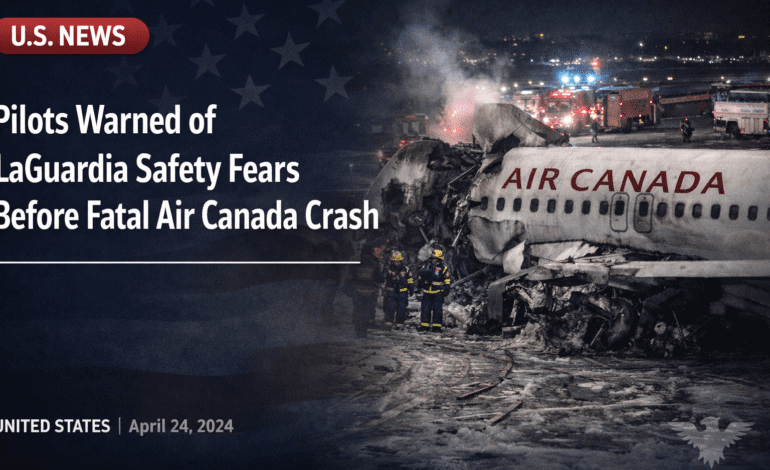

At least a dozen reports to a federal safety database begged officials to act — months before two pilots were killed on a New York runway. Here’s what happened, what was missed, and what needs to change.
One pilot’s plea, filed in a federal safety database during the summer of 2025, was direct and desperate: “Please do something.” The warning described controllers at LaGuardia Airport pushing the limits of safe operations — and drew a haunting comparison to Washington, D.C.’s Reagan National Airport before a mid-air collision killed more than 60 people in January 2025. No one acted on those warnings in time. On March 23, 2026, two young pilots died on LaGuardia’s Runway 4.
⚠ What You Need to Know — Fast
On the night of March 23, 2026, Air Canada Express Flight 8646 — a Bombardier CRJ-900 operated by Jazz Aviation — collided with a Port Authority fire truck while landing at LaGuardia Airport in New York City. Both pilots were killed instantly. Forty-one others were hospitalized. The NTSB is investigating.
What Happened on March 23, 2026
It started, as many tragedies do, with a cascade of smaller problems. Air Canada Express Flight 8646 departed Montreal’s Trudeau International Airport more than two hours late, touching down at LaGuardia just before midnight Eastern Time. The 72 passengers and four crew members aboard the Bombardier CRJ-900 had no way of knowing what was waiting for them on the runway.
Moments earlier, a United Airlines Boeing 737 MAX had aborted its takeoff — twice — after anti-ice warning lights activated and the crew detected an unusual odor in the cabin. That plane declared an emergency. With no open gate, LaGuardia dispatched a Port Authority Aircraft Rescue and Firefighting truck to assist.
Flight 8646 departs Montréal-Trudeau, already more than two hours behind schedule.
United Flight 2384 aborts takeoff twice; crew reports a foul odor. An emergency is declared, and a Port Authority fire truck is dispatched toward the aircraft.
The CRJ-900 touches down on Runway 4. The fire truck, cleared by air traffic control to cross, enters the runway. The controller frantically radios “Stop truck 1. Stop.” — but it is too late.
The plane’s nose strikes the fire truck head-on. The cockpit and forward galley section are destroyed. Both pilots are killed instantly.
LaGuardia reopens on a single runway after being shut down for nearly 15 hours. Runway 4 remains closed until Friday.
A controller, speaking over radio after the crash, said he had been “dealing with an emergency earlier” and that he “messed up.” Those words, candid and heartbreaking, now sit at the center of a federal investigation.
The Human Cost
The two pilots who died — both Canadian citizens, both described as young men at the start of their careers — lost their lives because the cockpit and front section of their aircraft took the full force of the impact. One has been identified as Antoine Forest, a native of Coteau-du-Lac, Quebec. His great-aunt told the Toronto Star that he “never stopped” pursuing his love of flying.
In total, 41 people were hospitalized — including passengers, flight attendants, and two firefighters from the truck. By Monday morning, most had been released. A flight attendant, Solange Tremblay, was ejected from the aircraft still strapped into her seat and found more than 300 feet from the wreckage. She survived — suffering multiple fractures — in what her daughter called “a complete miracle.”
“Because that aircraft hit directly in the middle of the fire truck, the fire truck was moved forward, and the aircraft was damaged in the nose.”
— David Soucie, former FAA Safety Inspector, speaking to CNN
Former FAA safety inspector David Soucie explained to CNN that the crash could have been far worse. Had the truck been positioned just 40 feet to either side, the plane would have struck the wing, engines, or fuel cells — almost certainly causing an explosion. The exact point of impact may have saved dozens of lives, even as it claimed two.
The Warnings That Came First
This crash did not come without warning. That’s the part that makes it so painful to reckon with.
A CNN investigation reviewed NASA’s Aviation Safety Reporting System — the voluntary, confidential database where pilots, controllers, and aviation workers can anonymously flag safety concerns. What they found in records from the two years before the crash was alarming: at least a dozen reports describing dangerous scenarios at LaGuardia Airport.
“Please do something. The pace of operations is building in LGA. The controllers are pushing the line. On thunderstorm days, LGA is starting to feel like DCA did before the accident there.”
— Anonymous pilot report to NASA’s Aviation Safety Reporting System, Summer 2025
That reference to “DCA” — Reagan National Airport in Washington, D.C. — is chilling in retrospect. In January 2025, a mid-air collision near the Potomac River killed more than 60 people. That pilot, writing months before the LaGuardia crash, saw the parallels forming and begged someone to listen.
What Pilots Described in Their Reports
The reports paint a detailed picture of an airport operating at its limits. Common themes included:
| Issue Reported | Frequency | Risk Level |
|---|---|---|
| ATC miscommunication / unclear instructions | Multiple reports | High |
| Near-collisions narrowly avoided on runway/taxiway | Multiple reports | Critical |
| Aircraft coming dangerously close to other aircraft on ground | Documented Dec. 2024 | High |
| Confusing or dangerous ATC scenarios | Several reports | Moderate–High |
| Controllers “pushing the line” during busy periods | Direct quote, Summer 2025 | High |
The reporting system works like this: aviation workers submit concerns anonymously. A team of safety analysts reviews them and is tasked with alerting the FAA to any hazards. But the individual reports have not necessarily been verified by government regulators — and crucially, the database can take several months to include the most recent submissions.
A Pattern of Near-Misses at LaGuardia
The fatal crash on March 23 was not LaGuardia’s first recent scare. Just a few months earlier, in October 2025, two Delta Airlines regional jets collided on a LaGuardia taxiway — sending one person to the hospital. And in the days just before the Air Canada crash, a close call occurred at nearby Newark Liberty Airport, where two aircraft tried to land on intersecting runways simultaneously.
LaGuardia handled more than 16.7 million departing passengers in 2024, making it the 19th-busiest airport in the United States. It operates four main runways in a tight, constrained footprint in the Queens borough of New York City. Takeoffs and landings are packed closely together. There is very little margin for error.
The Air Traffic Control Failure
At the heart of this crash is a critical question: why did one controller end up managing both air and ground traffic at one of the nation’s busiest airports, alone, at midnight?
According to multiple reports, a single air traffic controller was handling both air traffic control and ground control at the time of the collision — even though two controllers were technically working in the tower. Managing both is not always unusual for late-night shifts when traffic is lighter. But at the moment of the crash, there was nothing light about the situation: an emergency had just been declared by United Airlines, and an international flight was approaching for landing.
How LaGuardia ATC normally works
Under standard operations, at least one controller directs ground traffic (vehicles and taxiing planes) while at least one separate controller directs arrivals and departures. Combining both roles — known as “combined operations” — is permitted but increases cognitive load significantly, particularly during emergencies.
Former FAA air traffic control chief Mike McCormick stated publicly that LaGuardia is “not a control tower that has perennial staffing problems.” But the facts that night told a different story. The controller was managing multiple active emergencies simultaneously. And the crash happened on the overnight shift, when staffing is routinely reduced.
“Once that aircraft was cleared to land… it owned that runway.”
— Mary Schiavo, former U.S. Department of Transportation Inspector General
Schiavo’s point cuts to the core of the failure. The moment the Air Canada jet was cleared to land, no vehicle should have been permitted to cross that runway — period. Aviation law and protocol are unambiguous on this. The question investigators must now answer is how and why the controller cleared the fire truck anyway.
The Controller’s Admission
Audio from airport communications in the minutes after the crash reveals a controller who knew immediately what he had done. In radio transmissions, he told others: “I was dealing with an emergency earlier. I messed up.” Those words will likely be central to the NTSB investigation. Investigators have already retrieved both the cockpit voice recorder and the flight data recorder and transported them to NTSB labs in Washington, D.C.
Who Is Investigating — and What They’re Looking For
The National Transportation Safety Board (NTSB) is leading the investigation, assisted by the FAA and Canada’s Transportation Safety Board. NTSB Chair Jennifer Homendy confirmed the black boxes have been recovered. The agency says it will not rest until the investigation is complete.
Investigators are expected to examine several key areas:
- Controller workload and staffing: Was combining air and ground control duties appropriate given conditions?
- Fatigue and shift patterns: Did overnight scheduling contribute to impaired decision-making?
- Surface detection systems (ASDE-X): Whether the airport’s ground radar showed the fire truck on the runway in real-time, and whether that information was visible to the controller.
- Emergency response coordination: How the United Airlines emergency created a chain of events that put the fire truck in harm’s way.
- Prior safety reports: Whether NASA ASRS warnings about LaGuardia were flagged to the FAA and, if so, whether any action was taken.
New York City Mayor Zohran Mamdani, speaking at a press conference, called the crash “an absolute tragedy” and said the city would cooperate fully with federal investigators. U.S. Transportation Secretary Sean Duffy and FAA Administrator Bryan Bedford also appeared publicly, calling it “an absolute tragedy” — while deferring most questions to the NTSB.
The Bigger Picture: A System Under Strain
The LaGuardia crash did not happen in a vacuum. It is the latest in a disturbing series of aviation incidents across the United States — a country whose air traffic control infrastructure is under mounting pressure.
A Year of Deadly Incidents
Just 14 months before the LaGuardia crash, in January 2025, a mid-air collision near Washington, D.C.’s Reagan National Airport killed more than 60 people. That crash — the one the anonymous pilot had warned LaGuardia was beginning to resemble — shocked the nation and led to promises of reform. The LaGuardia crash suggests those reforms have not moved fast enough.
And the crisis is not confined to New York. Newark Liberty International Airport experienced a close call just days before this crash. ATC staffing shortages have been reported across the country, driven by chronic understaffing of control facilities, government funding disputes, and a wave of retirements. The FAA has struggled to recruit and train new controllers fast enough to keep pace.
LaGuardia’s Special Challenges
LaGuardia is not like most airports. It is physically constrained, hemmed in by bodies of water and urban development. Its runways are short. Its airspace is shared with two of the busiest airports on earth — JFK and Newark. Pilots and controllers describe it as one of the most demanding environments in commercial aviation.
It is also the airport’s first fatal crash in more than 34 years. The last deadly incident at LaGuardia occurred on March 22, 1992 — exactly 34 years and one day before the Air Canada crash — when a US Air flight attempting to take off killed 27 people. That record had been a source of pride. Now it is broken.
| Airport | Recent Incident | Date | Outcome |
|---|---|---|---|
| Reagan National (DCA) | Mid-air collision over Potomac | Jan. 2025 | 67+ killed |
| LaGuardia (LGA) | Delta regional jets taxiway collision | Oct. 2025 | 1 hospitalized |
| Newark (EWR) | Aircraft on intersecting runways | Mar. 2026 | Near-miss, no injuries |
| LaGuardia (LGA) | Air Canada / fire truck runway collision | Mar. 23, 2026 | 2 killed, 41 hospitalized |
People Also Ask: Your Questions Answered
What caused the Air Canada crash at LaGuardia Airport?
An air traffic controller cleared a Port Authority fire truck to cross Runway 4 while Air Canada Express Flight 8646 was landing. The controller — who was managing both air and ground traffic alone during the late-night shift — tried to stop the truck at the last second but could not. The plane struck the truck at approximately 93–105 mph, destroying the cockpit.
How many people died in the LaGuardia Air Canada crash?
Two pilots were killed — the captain and first officer of Jazz Aviation, operating as Air Canada Express Flight 8646. Both were Canadian citizens described as young men early in their careers. Forty-one others were hospitalized, including passengers, crew, and two firefighters.
Did pilots warn about safety problems at LaGuardia before the crash?
Yes. A CNN review of NASA’s Aviation Safety Reporting System found at least a dozen safety complaints about LaGuardia in the two years before the crash. Pilots described ATC miscommunications, near-misses, and dangerous operational pace. One wrote “Please do something” in the summer of 2025, comparing the airport to Reagan National before a deadly 2025 disaster there.
Was LaGuardia understaffed the night of the crash?
Transportation Secretary Sean Duffy said the claim of only one controller in the tower was “not accurate.” But reports confirm a single controller was handling both air and ground traffic at the time of the collision. Investigators are examining whether staffing levels and overnight scheduling contributed to the accident.
Is LaGuardia Airport safe to fly into?
LaGuardia remains operational and handled over 16.7 million passengers in 2024 without a fatal incident until this crash — its first in 34 years. However, the pattern of safety reports and near-misses suggests systemic pressures that demand serious reform. The NTSB investigation will determine specific corrective actions required.
What is the NASA Aviation Safety Reporting System?
NASA’s Aviation Safety Reporting System (ASRS) is a voluntary, confidential database where pilots, controllers, and aviation workers can anonymously report safety concerns. Reports are reviewed by safety analysts who can alert the FAA to hazards. The system is a critical early-warning mechanism — but it relies on those warnings being acted upon.
Key Takeaways
What This Story Tells Us
- At least 12 pilot safety reports warned of dangerous conditions at LaGuardia in the two years before the fatal crash — and none appear to have triggered meaningful corrective action.
- A single air traffic controller was managing both air and ground traffic during a simultaneous aviation emergency, creating conditions primed for a catastrophic mistake.
- The LaGuardia crash is the latest in a string of serious U.S. aviation incidents, following the fatal Reagan National mid-air collision in January 2025.
- The two pilots killed — described as “young men at the start of their careers” — died because the cockpit bore the full brunt of a collision that could have been prevented.
- Passengers and industry insiders credit the pilots’ instinct to brake hard immediately after touchdown with likely preventing a far worse outcome for those in the cabin.
- The NTSB is examining black box recordings, ATC staffing, shift patterns, fatigue factors, and whether ground radar systems showed the fire truck on the runway in real time.
- Systemic reform — in staffing, ATC training, combined-operations protocols, and oversight of anonymous safety reports — is urgently needed across the U.S. aviation system.
Stay Informed on Aviation Safety
This story is developing. The NTSB investigation is expected to take months. As findings emerge, they will reshape policy, training, and the way air traffic control handles late-night combined operations at complex airports.
Sources & Further Reading
- CNN: ‘Please do something’ — Concerns raised about LaGuardia safety before fatal runway collision
- Wikipedia: Air Canada Express Flight 8646
- ABC News: LaGuardia Airport crash — Plane was traveling 93–105 mph at time of ground collision
- Al Jazeera: Air Canada crash at LaGuardia — What happened, who were the victims?
- NASA Aviation Safety Reporting System (ASRS)