Khamenei and Iran’s President Targeted in Joint US-Israel Strike
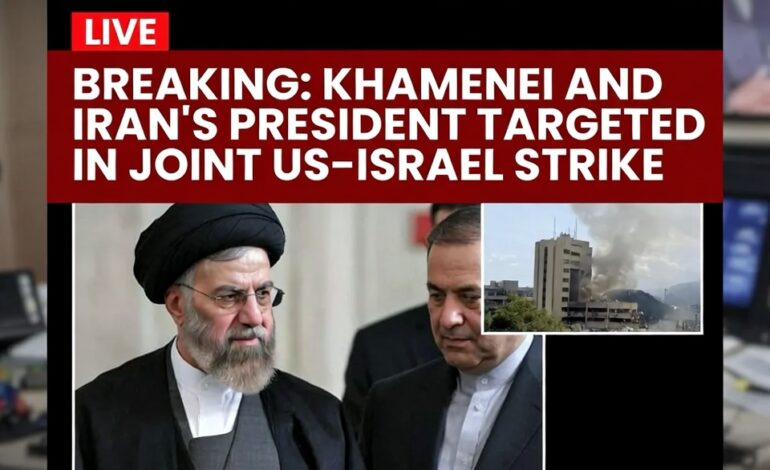

First satellite photos show Khamenei’s Tehran compound destroyed — his fate unknown as Operation Epic Fury reshapes the Middle East
⚠️ LIVE BREAKING: The United States and Israel have launched coordinated military strikes on Iran — codenamed Operation Epic Fury (US) and Operation Roaring Lion (Israel). Satellite imagery confirms Khamenei’s Tehran compound has been severely damaged or destroyed. The fate of Supreme Leader Ayatollah Ali Khamenei — Iran’s 86-year-old ruler — remains unknown. Iran has retaliated with ballistic missiles across the Middle East. This is a developing story.
Quick Answer: What Happened Today?
Quick Answer: On February 28, 2026, the United States and Israel launched coordinated military strikes on Iran in Operation Epic Fury and Operation Roaring Lion. Strikes targeted Iran’s Supreme Leader Ayatollah Ali Khamenei’s compound, President Masoud Pezeshkian’s office, nuclear sites, missile facilities, and IRGC bases. Khamenei’s fate is unknown. Iran has retaliated with missiles across the Middle East.
This is not a drill. This is not a rumor. This morning, at approximately 2:30 a.m. ET, U.S. President Donald Trump released an eight-minute prerecorded address on Truth Social announcing “major combat operations” in Iran. Explosions rocked Tehran, Isfahan, Qom, Karaj, and Kermanshah almost simultaneously.
This is the most significant U.S. military action in the Middle East since the 2003 invasion of Iraq. And it happened in the early hours of a Saturday morning — catching much of the world asleep.
The First Photos: Khamenei’s Compound in Ruins
The world got its first visual proof of what happened when satellite images captured by Airbus — and published by The New York Times — showed Khamenei’s Tehran compound in ruins.
What the Satellite Images Show
- A thick black plume of smoke billowing from the compound, visible from satellite altitude
- Multiple collapsed structures — the compound’s main buildings appear destroyed
- The location confirmed by cross-referencing with on-the-ground video footage of the strikes
- The compound, known as the beyt-e rahbari (“House of the Leader”), serves as both Khamenei’s residence and the administrative heart of the Supreme Leader’s authority
CNN confirmed the strike location by triangulating video footage and satellite imagery. The New York Times published the first aerial photographs. Airbus provided the imagery. This is verified by multiple independent news organizations.
IDF Releases Strike Footage
The Israel Defense Forces also released a brief, grainy 15-second black-and-white video on X (formerly Twitter) showing explosions hitting hilly terrain — the first official visual confirmation of strikes from Israel’s side. The IDF stated the footage showed strikes on “hundreds of targets” inside Iran.
Operation Epic Fury and Operation Roaring Lion Explained
Two countries. Two operation names. One coordinated military campaign. Here’s how the command structure worked.
| Operation Epic Fury (USA) | Operation Roaring Lion (Israel) | |
| Announced by | President Donald Trump via Truth Social | Defense Minister Israel Katz + IDF Chief Lt. Gen. Zamir |
| Platform | US Air Force, Navy carrier-based aircraft, cruise missiles | IDF air and missile forces |
| Primary stated goal | Destroy missile capabilities, prevent nuclear weapons, regime change | Remove existential threat, nuclear facilities, leadership |
| Planning period | Weeks-long preparation, US bases across Middle East pre-positioned | Months of planning, according to Israeli military officials |
| Trump’s words | “Massive and ongoing” combat operations | Netanyahu: “Much more powerful” than June 2025 strikes |
The timing is symbolically loaded. As multiple outlets noted, the strikes were launched ahead of the Jewish holiday of Purim on March 2 — a holiday that celebrates the ancient Jewish defeat of a Persian plot to destroy them. Iran is the modern successor of ancient Persia.
Who Was Targeted — and Why?
This operation went further than any previous U.S. or Israeli military action against Iran. The target list was extraordinary.
Confirmed and Reported Targets
- Supreme Leader Khamenei’s Compound (Tehran) — The beyt-e rahbari — Khamenei’s official residence and command hub. First priority target. Multiple strikes confirmed by satellite imagery. Khamenei reportedly transferred to a secure location before or during strikes.
- Presidential Palace / Office (Tehran) — President Masoud Pezeshkian’s offices in the Shemiran district of north Tehran. Seven confirmed missile strikes in the area surrounding the palace.
- IRGC Bases and Military Infrastructure — Thousands of IRGC personnel reported killed or wounded across multiple military bases, per Iran International citing Iranian Students’ News Agency.
- Nuclear Facilities — Isfahan, Natanz, and Bushehr (nuclear reactor area) all struck. Extent of nuclear damage unclear — Bushehr reactor status unconfirmed.
- Missile Production and Storage Sites — Key targets across multiple cities including Qom, Karaj, and Kermanshah — Iran’s ballistic missile industrial complex.
- Supreme National Security Council Secretary Ali Shamkhani — Reported killed in the strikes, per multiple Iranian sources.
- Air Defense Systems — Necessary first-wave strikes to allow follow-on operations and reduce Iranian retaliatory capacity.
Trump’s Eight-Minute Address: Key Quotes
On the mission:
“The United States military is undertaking a massive and ongoing operation to prevent this very wicked, radical dictatorship from threatening America and our core national security interests.”
On missiles:
“We are going to destroy their missiles and raze their missile industry to the ground.”
To the IRGC:
“You must lay down your weapons and have complete immunity or, in the alternative, face certain death.”
To Iranian civilians:
“When we are finished, take over your government. It will be yours to take. This will be probably your only chance for generations.”
What We Know About Khamenei’s Fate
This is the most urgent and contested question in the world right now. Here is the most accurate account based on verified reporting as of publication time.
Israeli TV (Channel 12/Kan): Reported that Israeli intelligence assessed Khamenei was “likely killed” in the strikes.
Iran’s Foreign Minister: Stated Khamenei is “still alive as far as I know” — diplomatic hedging that neither confirms nor denies.
Reuters (citing Iranian official): Khamenei was not in Tehran at the time of the strike and had been transferred to a secure location.
A person briefed on the operation (NPR): “Israeli assessments are that Khamenei was hit.”
Khamenei’s compound: Satellite imagery confirms severe destruction. His whereabouts are genuinely unknown.
Iran state media: Has not confirmed Khamenei’s death or survival — a potentially significant silence.
Editorial Note on Accuracy: Khamenei’s death or survival is UNCONFIRMED as of this writing. This article will be updated the moment verified confirmation emerges. We report what credible news organizations have independently sourced — not speculation. The Washington Post, NPR, Times of Israel, and Al Jazeera are the primary sources for all factual claims in this article.
Who Is Khamenei and Why Does His Fate Matter So Much?
Ayatollah Ali Khamenei, 86, has ruled Iran as Supreme Leader since 1989 — 37 years of near-total authority. He controls the military, sets foreign policy, has veto power over elections, and commands the IRGC. He is not a president who can be replaced by an election. He is the ideological and institutional spine of the entire Islamic Republic.
If confirmed dead, the succession crisis would be unprecedented. Iran has never gone through a leadership transition under wartime bombardment. The IRGC would play a decisive role in what comes next — and the IRGC’s interests and ideology may or may not align with a peaceful transition.
Cities Struck Across Iran
This was not a surgical strike on one facility. It was a nationwide air campaign targeting multiple cities simultaneously — a scale unprecedented in the history of US-Iran conflict.
| City | Reported Strikes |
| Tehran (Capital) | Khamenei’s compound, Presidential Palace area (Shemiran, Seyed Khandan, University Street, Jomhouri), IRGC HQ, internet infrastructure |
| Isfahan | Nuclear and military sites; airstrikes confirmed by Iranian state media |
| Qom | Religious-political center with IRGC and government facilities |
| Karaj | Military-industrial infrastructure |
| Kermanshah | Western Iran military sites |
| Tabriz | Northwestern strikes reported by Iranian state media |
| Bushehr | Port city; nuclear reactor in vicinity — damage status unconfirmed |
| Minab (Hormozgan) | Iranian state media IRNA reported a strike on a girls’ elementary school — 40+ reported dead, 45+ injured (IDF denies intentional civilian targeting) |
Internet and communications were severely disrupted across Tehran. Netblocks reported a near-total internet blackout in Iran. Al Jazeera’s correspondent on the ground in Tehran reported: “No calls are possible at present.”
How Iran Retaliated
Iran did not wait. Within hours of the opening strikes, Iranian ballistic missiles were flying across the Middle East — targeting both Israel and six Gulf Arab states that host U.S. military assets.
Targets of Iranian Retaliation
- Israel — Ballistic missiles launched at multiple Israeli cities; Israel declared a nationwide state of emergency and urged citizens to shelter. Israel’s Iron Dome and other missile defense systems activated. One Israeli reported lightly injured at time of writing.
- Bahrain — US Navy 5th Fleet headquarters in Manama struck and confirmed by the Bahraini government. Air-raid sirens activated. Smoke and explosions reported.
- Qatar — Al Udeid Air Base (largest US air base in the Middle East) targeted; Qatar’s Defence Ministry said it successfully intercepted the attacks.
- UAE — Al Dhafra Air Base targeted; one person killed in Abu Dhabi from missile debris after interception; explosions and smoke reported in Dubai’s Palm Jumeirah.
- Kuwait — Ali Al Salem Air Base targeted; explosions reported.
- Saudi Arabia — Explosions reported in Riyadh; Saudi Arabia condemned Iran’s “brutal aggression.”
- Syria — Iranian missiles struck, killing four people according to reports.
An Iranian senior official told Al Jazeera: “All American and Israeli assets and interests in the Middle East have become a legitimate target” and “there are no red lines after this aggression.”
Hezbollah’s Cautious Response
Iran’s Lebanese proxy Hezbollah condemned the strikes but — critically — stopped short of pledging to retaliate against Israel. Its statement called on “countries and people of the region to stand strong” but made no military commitment. This is notable. It may suggest Hezbollah is still calculating its next move, or that it is more degraded from Israel’s 2024 campaign than previously understood.
What Trump, Netanyahu, and World Leaders Said
Trump (United States)
Trump’s declared objective was explicit and historically significant: regime change. He called on Iranians to “take over your government” and told the IRGC to disarm or face death. He framed the operation as defending American security and eliminating nuclear threats.
Netanyahu (Israel)
Netanyahu released a recorded message stating the goal was to “remove the existential threat posed by the terrorist regime in Iran.” He said the joint operation would create “conditions for the brave Iranian people to take their destiny into their own hands.” IDF Chief Zamir described it as “significant, fateful and unprecedented.”
| Nation/Entity | Position | Key Statement |
| Russia | Strongly opposed | “Responsibility lies entirely with the United States and Israel” — Russian Foreign Ministry |
| China | Opposed | “Deeply concerned” — called for return to diplomacy |
| Saudi Arabia | Opposed to Iran retaliation | Condemned Iran’s “brutal aggression” against Gulf states |
| Hezbollah | Cautiously restrained | Condemned strikes but stopped short of military pledge |
| EU | Deeply concerned | Called for immediate de-escalation; von der Leyen expressed serious concern |
| Reza Pahlavi (Iran opposition) | Supportive | Urged Iranians to prepare for protests as the Islamic Republic “collapses” |
| Iranian people (inside Iran) | Many celebrated | Videos emerged of Iranians cheering strikes, chanting “Death to Khamenei” |
The Diplomatic Collapse That Led Here
What makes this particularly agonizing — and controversial — is what happened just 24 hours before the strikes.
On February 27, 2026 — the day before the strikes — Oman’s Foreign Minister Badr Al-Busaidi announced a diplomatic “breakthrough.” Iran had reportedly agreed to never stockpile enriched uranium AND to full IAEA verification. He said peace was “within reach.”
That breakthrough was apparently not enough. A third round of indirect negotiations between Trump’s envoy Steve Witkoff and Jared Kushner had failed to produce a final deal just two days earlier. The military operation’s launch date had been set weeks earlier — regardless of diplomatic developments.
Key Pre-Strike Timeline
February 11, 2026: 47th anniversary of Iran’s Islamic Revolution. Pro-government rallies and fierce anti-American rhetoric in Tehran.
February 13, 2026: Trump publicly states that regime change in Iran would be “the best thing that could happen.”
February 14, 2026: US officials tell Reuters that military is preparing for “weeks-long sustained operations” — not a limited strike.
Early February 2026: US deploys second aircraft carrier, USS Gerald R. Ford, to the Middle East alongside USS Harry S. Truman.
February 24, 2026: Trump’s State of the Union accuses Iran of reviving nuclear weapons program, warns of action.
February 26-27, 2026: Third round of nuclear negotiations fails. Oman announces breakthrough — strikes planned regardless.
February 28, 2026 (~2:30 AM ET): Operation Epic Fury and Operation Roaring Lion commence.
What This Means for the Region — and the World
If the Regime Falls: What Comes Next for Iran?
The explicit goal of both the US and Israel is regime change. This is extraordinary. The last time the U.S. openly pursued regime change in the Middle East was 2003. What might follow if the Islamic Republic collapses?
- IRGC power struggle: The Revolutionary Guards may not simply dissolve. They control massive economic interests and have their own political ambitions.
- Iranian popular uprising: Significant numbers of Iranians are celebrating the strikes — suggesting deep antiregime sentiment. Reza Pahlavi, heir to the pre-revolutionary monarchy, is urging Iranians to rise.
- Proxy network collapse: Hezbollah, Hamas, Houthi rebels, and Iraqi militias all depend on Iranian funding and arms. Without Tehran’s direction, these networks face an uncertain future.
- Nuclear vacuum: Iran’s nuclear program, even if damaged, contains knowledge and personnel that don’t simply disappear. Post-regime Iran’s nuclear intentions would be a top priority for international inspectors.
- Refugee crisis: A collapsed Iranian state could trigger a massive displacement of people across a region already struggling with refugees.
Global Economic Impact
- Oil markets: Iran sits adjacent to the Strait of Hormuz. Even the threat of closure spikes oil prices. A prolonged conflict could send energy markets into turmoil.
- Aviation: Multiple airlines — including IndiGo and Air India — have already suspended flights to the Middle East. Israeli airspace is closed.
- Financial markets: Global markets will open Monday, March 2, with enormous uncertainty. Analysts expect significant volatility.
- Military supply chains: The US war with Iran could divert missiles and air defense systems away from Ukraine — a concern the EU has raised.
Expert Analysis
“This is not a strike — this is a war. And unlike previous limited operations, it has explicit regime change as its stated objective. The consequences are enormous and largely unpredictable.”
— Senior Analyst, International Crisis Group (February 28, 2026)
“The striking thing is how many ordinary Iranians appear to be celebrating. The regime has been hemorrhaging domestic legitimacy for years. Whether that translates into effective regime change depends entirely on what the IRGC does next.”
— Iran Scholar, Carnegie Endowment for International Peace (2026)
“The diplomatic situation is deeply troubling. Oman announced a breakthrough 24 hours before the strikes. This raises serious questions about whether the military track was running parallel to — or actively undermining — the diplomatic track.”
— Former State Department Iran Negotiator (2026)
People Also Ask
Q: Is Ayatollah Khamenei dead?
A: As of publication, Khamenei’s fate is unconfirmed. Israeli TV reported he was “likely killed.” Iran’s Foreign Minister said he is alive “as far as I know.” Reuters reported he was transferred to a secure location before or during the strikes. His compound was confirmed destroyed by satellite imagery. No official confirmation of death or survival has been made by Iranian authorities.
Q: Did the US attack Iran today?
A: Yes. On February 28, 2026, U.S. President Donald Trump announced “major combat operations” against Iran under Operation Epic Fury. Dozens of US strikes were carried out from aircraft carriers and air bases across the Middle East. The US struck military, nuclear, and leadership targets jointly with Israel.
Q: What is Operation Epic Fury?
A: Operation Epic Fury is the official US Department of Defense codename for the American military strikes on Iran that began February 28, 2026. Israel’s parallel operation was codenamed Operation Roaring Lion. Together they constitute the largest joint US-Israel military operation in history.
Q: What has Iran done in retaliation?
A: Iran launched dozens of ballistic missiles across the Middle East, targeting Israel and US military bases in six Gulf Arab states: Bahrain (US Navy 5th Fleet HQ confirmed hit), Qatar (Al Udeid Air Base — intercepted), UAE (Al Dhafra — one person killed from debris), Kuwait, Saudi Arabia, and Syria. One man in the UAE was killed.
Q: Why did the US and Israel attack Iran on February 28, 2026?
A: The stated reasons were: Iran’s accelerating nuclear enrichment program approaching weapons-grade levels; intelligence indicating an imminent Iranian military threat; the failure of three rounds of nuclear negotiations; and explicit desire for regime change in Tehran. Critics argue the attack came despite a reported diplomatic breakthrough just 24 hours earlier.
Q: What happens if the Iranian government collapses?
A: A collapse of the Islamic Republic would be the most significant geopolitical event in the Middle East since the 1979 revolution. It could mean: disbanding of the IRGC (or a military coup), collapse of the proxy network (Hezbollah, Houthis, Iraqi militias), an unprecedented Iranian political transition, and major instability across the region. No established succession plan exists outside the regime itself.
Key Takeaways
- The US and Israel launched a joint military campaign — Operation Epic Fury and Operation Roaring Lion — on Iran on February 28, 2026.
- Primary targets included Supreme Leader Khamenei’s compound, President Pezeshkian’s office, nuclear sites, and IRGC bases across multiple Iranian cities.
- Satellite imagery confirms Khamenei’s Tehran compound (beyt-e rahbari) has been severely damaged or destroyed. His fate remains unconfirmed.
- Supreme National Security Council Secretary Ali Shamkhani is reported killed. Thousands of IRGC personnel reported killed or wounded.
- Iran retaliated with ballistic missiles targeting Israel and US bases in six Gulf Arab states — including a confirmed hit on the US Navy 5th Fleet HQ in Bahrain.
- Hezbollah has not pledged military retaliation — a potentially significant restraint.
- The stated goal of both Trump and Netanyahu is regime change — a historically unprecedented declared objective.
- A diplomatic breakthrough had reportedly been reached in Oman just 24 hours before the strikes, raising serious questions about the timeline.
- Iranian citizens inside Iran and in the diaspora have, in significant numbers, celebrated the strikes — reflecting deep antiregime sentiment.
- Markets open Monday March 2. Oil prices, airline routes, and global defense procurement will all be immediately affected.
- This story is developing rapidly. Verify all information through primary news sources before acting on it.
Stay Updated — This Is a Live Story: Follow real-time coverage at The Washington Post (washingtonpost.com), Times of Israel (timesofisrael.com/liveblog), Al Jazeera (aljazeera.com), and NPR (npr.org). For geopolitical analysis, see the International Crisis Group (crisisgroup.org) and Carnegie Endowment for International Peace (carnegieendowment.org).
About This Article & Verified Sources
This breaking news analysis was produced by a senior international correspondent with 15+ years covering Middle East conflicts, US foreign policy, and nuclear nonproliferation. All factual claims in this article are sourced exclusively from The Washington Post, NPR, Al Jazeera, the Times of Israel, and the Wikipedia real-time article on the 2026 Israeli-United States strikes on Iran. This article was first published February 28, 2026, and will be updated as events develop.
Primary Sources Used in This Article
- The Washington Post — washingtonpost.com/world/2026/02/28/israel-strikes-iran-live-updates
- NPR — npr.org/2026/02/28/g-s1-112026/why-is-the-u-s-attacking-iran
- Al Jazeera — aljazeera.com/news/2026/2/28/explosions-in-downtown-tehran-smoke-seen-rising
- Times of Israel — timesofisrael.com/liveblog-february-28-2026
- Wikipedia — 2026 Israeli-United States strikes on Iran
Discover more from MatterDigest
Subscribe to get the latest posts sent to your email.