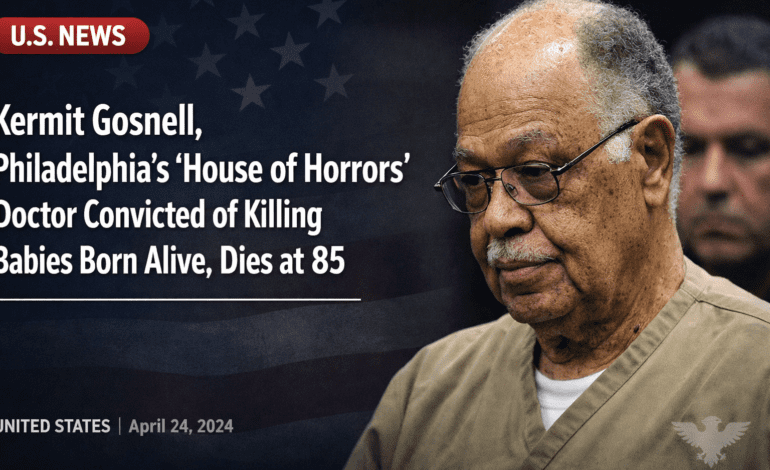
Kermit Gosnell, Philadelphia’s ‘House of Horrors’ Doctor Convicted of Killing Babies Born Alive, Dies at 85

| U.S. NEWS REPORT
CRIME & JUSTICE |
The disgraced abortion doctor — convicted of three first-degree murders and 237 total crimes — died March 1, 2026, while serving multiple life sentences in a Pennsylvania prison.
| Published | March 24, 2026 |
| Last Updated | March 24, 2026 |
| Category | Crime & Justice | U.S. News |
| Search Intent | Informational — Obituary / News Event |
| URL Slug | /us-news/kermit-gosnell-dead-85-philadelphia-house-of-horrors |
Introduction: The End of a Case That Shocked the Nation
Kermit Gosnell is dead. The Philadelphia abortion doctor, whose West Philadelphia clinic was described in court as a “house of horrors,” died on March 1, 2026, at the age of 85. He had been serving multiple consecutive life sentences at State Correctional Institution-Smithfield in Huntingdon, Pennsylvania, before being transferred to an outside hospital, where he died at approximately 11:45 p.m.
Pennsylvania Department of Corrections spokesperson Maria Bivens confirmed the death on March 23, 2026 — more than three weeks after it occurred. His cause of death has not been disclosed.
Gosnell’s story is one of the most disturbing criminal cases in American medical history. He was convicted in 2013 of three counts of first-degree murder for killing babies who had been born alive during illegal late-term abortions. He was also convicted of involuntary manslaughter in the death of a patient, and found guilty of 237 total crimes — including 211 violations of Pennsylvania’s 24-hour waiting period law and 21 counts of performing illegal late-term abortions.
“Convicted serial killer Kermit Gosnell left a path of destruction in Pennsylvania which shook the Commonwealth to its core.” — Maria V. Gallagher, Pennsylvania Pro-Life Federation
His clinic, the Women’s Medical Society at 3801 Lancaster Avenue, operated in the city’s Mantua neighborhood for decades. It became a focal point in debates about abortion regulation, medical oversight, and the protection of vulnerable patients.
Who Was Kermit Gosnell?
Kermit Barron Gosnell was born in Philadelphia. By many accounts, he had a promising early career as a community physician serving low-income patients in West Philadelphia. He was described by a childhood friend as “very dynamic, charming, and inclined to make money,” according to The Philadelphia Inquirer.
He opened the Women’s Medical Society in 1979, positioning himself as a provider for women who had few other options — particularly poor women and immigrant communities who could not easily access reproductive healthcare elsewhere. For decades, he cultivated this image as a compassionate caregiver for the underserved.
The reality inside his clinic told a very different story.
In addition to his abortion practice, Gosnell ran what federal authorities later called a “pill mill” — prescribing opioid painkillers in large quantities without legitimate medical justification. He ultimately pleaded guilty to federal drug charges in July 2013, receiving a separate 30-year sentence and a $50,000 fine on top of his state convictions.
He is survived by his wife, Pearl Gosnell — who was herself imprisoned for aiding her husband in his crimes — and six children.
The 2010 Raid That Exposed Everything
Gosnell’s crimes came to light not through a tip about abortion practices, but through a narcotics investigation. In February 2010, FBI agents and Philadelphia police executed a search warrant at the Women’s Medical Society related to prescription drug trafficking. What they found went far beyond anything they expected.
Investigators described a clinic that reeked of cat urine and feces. The floors, furniture, and walls were stained with blood. Medical instruments were dirty and outdated. Patients were left to recover on filthy recliners covered with blood-stained blankets, sedated by unlicensed staff who could not tell investigators what medications had been administered.
Most disturbing of all: fetal remains were found throughout the facility. According to the subsequent 281-page grand jury report, body parts — including the severed feet of fetuses preserved in jars — were discovered in cabinets, a freezer, and other storage areas. The grand jury called it a “baby charnel house.”
Investigators found bags and bottles of fetuses, jars of preserved body parts, bloodstained furniture, and medical instruments that hadn’t been properly sterilized in years.
The grand jury report described conditions that violated virtually every standard of basic medical practice. It was, the report concluded, a facility that had been allowed to operate for years without meaningful oversight from state regulators.
Gosnell’s medical license was suspended by the Pennsylvania State Board of Medicine immediately following the raid. He was arrested in January 2011 and initially charged with the murders of seven babies and one adult patient.
Inside the ‘House of Horrors’: What Investigators Found
The Practice of ‘Snipping’
Former employees testified that Gosnell and his staff regularly performed abortions well past Pennsylvania’s 24-week gestational limit. In many cases, the procedure resulted in a live birth — a baby showing signs of movement, breathing, or making sounds.
In these situations, Gosnell would use scissors to sever the baby’s spinal cord at the neck. He referred to this as “snipping.” Staff testified that this happened routinely, sometimes multiple times a week. Prosecutors argued it constituted first-degree murder under Pennsylvania law, which defines a person as any individual who has been born and is alive.
The grand jury estimated the practice occurred hundreds of times over the years. Because Gosnell had destroyed nearly all patient records, many of these cases could not be individually prosecuted.
Conditions at the Clinic
Beyond the murders, the conditions inside the Women’s Medical Society reflected years of unchecked neglect. Among the specific findings:
- Fetal remains stored in bags, bottles, and a freezer
- Jars containing the severed feet of aborted fetuses
- Bloodstained recliners used as recovery “beds” for patients
- Unsterilized medical instruments reused across procedures
- Unlicensed and untrained staff administering anesthesia and other medications
- Strong odors of urine and feces throughout the facility
- Cats allowed to roam freely, leaving waste on clinic floors
The 2013 Trial: 237 Crimes, Three Murders
Gosnell’s trial began in early 2013 in Philadelphia’s Court of Common Pleas. Notably, major national news organizations largely ignored the early weeks of proceedings — a media blackout that drew significant criticism and eventually prompted wider coverage.
Gosnell chose not to testify in his own defense. His attorney argued that none of the babies were born alive — that any movement observed by witnesses was involuntary spasm or twitching after death, not signs of life.
The jury did not accept that argument.
After ten days of deliberation, the jury returned its verdict in May 2013:
- Guilty of three counts of first-degree murder (Babies A, C, and D)
- Guilty of involuntary manslaughter in the death of patient Karnamaya Mongar
- Guilty of 21 counts of performing illegal late-term abortions
- Guilty of 211 counts of violating Pennsylvania’s 24-hour waiting period
- Guilty of conspiracy, corruption, and other related offenses
- Total: 237 criminal convictions
Gosnell could have faced the death penalty on the murder counts. Instead, he agreed to waive his right to appeal in exchange for a sentence of three consecutive life terms without the possibility of parole. He would spend the rest of his life in prison — and he did.
The Victims: Who Were They?
The Babies
Prosecutors charged Gosnell with the murders of seven babies who had been born alive. He was ultimately convicted in three of those cases. Former staff testified that the actual number of babies killed in this manner was far higher — potentially in the hundreds over the years Gosnell operated. At least one former employee estimated the number exceeded 100 infants.
One case stood out even among the clinic’s hardened staff. Baby Boy A, referred to in testimony and court documents, was so large at birth that even Gosnell’s employees were shaken. A photograph taken after his death — showing the infant curled in a small container — became a significant piece of evidence at trial. Baby Boy A had lived for approximately one hour before he was killed.
Karnamaya Mongar
Karnamaya Mongar was a 41-year-old refugee from Bhutan who had come to the United States seeking safety. Just four months after arriving in America, she died at Gosnell’s clinic in 2009. According to the grand jury report, unlicensed and untrained staff administered dose after dose of sedatives and painkillers over several hours to keep her sedated. She went into cardiac arrest and never recovered.
The grand jury found that Mongar died from anesthetic overdose. Gosnell was convicted of her death under a theory of involuntary manslaughter.
Semika Shaw
Semika Shaw was a 22-year-old mother of two who died in March 2000 after a botched abortion procedure at Gosnell’s clinic. A $400,000 settlement was paid to her family by Gosnell’s insurer in 2002, according to the grand jury report. Gosnell was not charged in connection with Shaw’s death, but the case illustrated a pattern of fatal negligence that predated the more high-profile charges by more than a decade.
How the System Failed for 15 Years
One of the most troubling aspects of the Gosnell case is not just what he did — but how long he was allowed to do it.
Pennsylvania state authorities had failed to conduct routine inspections of abortion clinics for fifteen years by the time the Women’s Medical Society was raided. The grand jury report stated bluntly that hair and nail salons in Pennsylvania received greater regulatory scrutiny than Gosnell’s clinic did during that period.
The report also noted that the National Abortion Federation — whose stated mission includes ensuring safe abortion care — sent an evaluator to Gosnell’s clinic and found conditions so bad that the evaluator recommended against NAF membership. The evaluator did not report the conditions to authorities.
“We have to question why an evaluator from NAF, whose stated mission is to ensure safe, legal, and acceptable abortion care, did not report Gosnell to authorities.” — Pennsylvania Grand Jury Report
Multiple complaints had been filed over the years. Former patients reported injuries. Lawsuits were settled. And still, no inspection came.
In the aftermath of the scandal, Pennsylvania acted. Two senior state health officials were fired. The state imposed significantly tougher inspection requirements for abortion clinics. And the Gosnell case became a reference point in ongoing national debates about the appropriate level of medical oversight for abortion providers.
Legacy, Policy Impact, and Cultural Significance
The Gosnell case generated substantial policy and cultural debate that persisted well beyond the 2013 trial. In 2018, documentary filmmakers Phelim McAleer and Ann McElhinney — who had co-authored a book on the case titled Gosnell: The Untold Story of America’s Most Prolific Serial Killer — released a feature-length documentary covering the trial and the broader pattern of institutional failure.
McAleer and McElhinney were also the first to publicly report Gosnell’s death on March 23, 2026, citing prison and law enforcement sources. Prison officials confirmed the death later that same day.
The case is frequently cited in discussions of:
- Abortion clinic regulation and state inspection requirements
- Patient safety standards for outpatient surgical procedures
- The responsibilities of medical licensing boards to act on complaints
- Systemic inequalities in healthcare access for low-income and immigrant communities
- Media coverage decisions regarding sensitive criminal trials
Detective Jim Wood, the narcotics officer whose investigation ultimately exposed Gosnell’s crimes, issued a statement upon hearing of his death: “May God have mercy on his soul, but his soul was filled with evil so there may be no mercy for him, like there was no mercy for the babies.”
Reactions to His Death
Reactions to Gosnell’s death on March 23, 2026 — the day it became publicly known — ranged from grim acknowledgment to pointed calls for remembrance of his victims.
Maria V. Gallagher, executive director of the Pennsylvania Pro-Life Federation, said: “Convicted serial killer Kermit Gosnell left a path of destruction in Pennsylvania which shook the Commonwealth to its core. We continue to grieve the loss of the babies and women who fell victim to Gosnell’s violent crime spree.”
Ann McElhinney, co-producer of the Gosnell documentary, released a statement focused on the victims rather than the perpetrator: “Gosnell is gone, but we should take time to think of the thousands of innocent babies who were his victims.” She singled out Baby Boy A, Karnamaya Mongar, and Semika Shaw by name.
Pennsylvania corrections officials confirmed that a cause of death had not been disclosed. Gosnell had been transported from SCI-Smithfield to an outside hospital before he died.
Frequently Asked Questions
What did Kermit Gosnell do?
Gosnell operated an abortion clinic in West Philadelphia where he routinely performed illegal late-term abortions past Pennsylvania’s 24-week limit. When babies were born alive during these procedures, he and his staff killed them by cutting their spinal cords with scissors — a practice he called “snipping.” He was convicted of three first-degree murders and 234 other crimes.
How did Gosnell get caught?
Gosnell was exposed during a 2010 FBI narcotics investigation into a prescription drug operation he was running out of his clinic. Agents who arrived with a search warrant for drug evidence discovered the horrific conditions inside the facility and the fetal remains stored throughout the clinic.
How many people did Gosnell kill?
He was convicted of murdering three babies born alive during procedures and the involuntary manslaughter of patient Karnamaya Mongar. However, former employees testified the actual number of infants killed could exceed 100, and possibly reach into the hundreds. The destruction of patient records prevented most cases from being individually prosecuted.
Did Kermit Gosnell face the death penalty?
He could have. Prosecutors sought the death penalty on the three first-degree murder counts. Gosnell agreed to waive his appeal rights in exchange for being sentenced to three consecutive life terms without parole instead.
When and how did Gosnell die?
Gosnell died on March 1, 2026, at a hospital outside the Pennsylvania prison system. He was 85. He had been incarcerated at State Correctional Institution-Smithfield before being transferred to the hospital. His cause of death was not disclosed by corrections officials. His death was not publicly announced until March 23, 2026.
What happened to the Women’s Medical Society clinic?
The clinic at 3801 Lancaster Avenue in the Mantua neighborhood of West Philadelphia was shut down following the February 2010 raid. Gosnell’s medical license was suspended immediately, and the facility was permanently closed. Pennsylvania subsequently imposed stricter inspection requirements for abortion clinics in the wake of the scandal.
Key Takeaways
- Kermit Gosnell died on March 1, 2026, at age 85, while serving multiple life sentences in a Pennsylvania prison. His death was not publicly confirmed until March 23, 2026.
- Gosnell was convicted in 2013 of three counts of first-degree murder for killing babies born alive, plus involuntary manslaughter in the death of patient Karnamaya Mongar.
- He was found guilty of 237 total crimes, including 21 illegal late-term abortions and 211 violations of Pennsylvania’s 24-hour waiting period law.
- The Women’s Medical Society on Lancaster Avenue, which he operated for decades, was described by a grand jury as a “baby charnel house” and became widely known as the “house of horrors.”
- Pennsylvania had failed to inspect abortion clinics for 15 years before the raid. Two state health officials were subsequently fired and tougher inspection laws were enacted.
- The case remains one of the most significant criminal and regulatory failures in American medical history.
Sources & Further Reading
The following authoritative sources were used in the preparation of this article:
- The Philadelphia Inquirer — March 23, 2026
- WHYY News Philadelphia — March 23, 2026
- NBC10 Philadelphia — March 23, 2026
- CBS News Philadelphia — March 23, 2026
- The Washington Times — March 23, 2026
- Pennsylvania Grand Jury Report (2011) — 281-page report on Women’s Medical Society
- McAleer & McElhinney, Gosnell: The Untold Story of America’s Most Prolific Serial Killer (2017)
| This article is part of the U.S. News: Crime & Justice content cluster. For related coverage, see: Pennsylvania Criminal Justice Reform | Medical Licensing Oversight | Abortion Law & Regulation in the United States. |
Discover more from MatterDigest
Subscribe to get the latest posts sent to your email.