“Federal Judge Pushes Back on Donald Trump Administration—Pope Leo XIV’s Victory Sparks Debate”
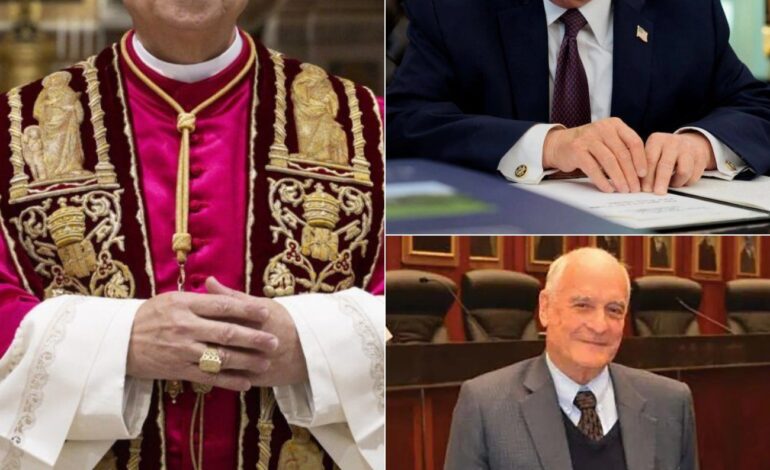

Federal Judge Defies Trump Administration as Pope Leo XIV Wins Landmark Religious Freedom Victory Over Detained Migrant Clergy Access
A federal judge has directly defied the Trump administration in a ruling that is already sending shockwaves through political, legal, and religious circles across the United States. District Judge Robert Gettleman ordered the Trump administration to allow clergy members into an ICE detention facility in Broadview, Illinois — overruling a government policy that had blocked religious leaders from providing spiritual care to detainees held inside. The decision is being called one of the most significant religious freedom rulings connected to immigration enforcement in recent American history.
At the center of the legal and moral debate that produced this ruling stands a question that is both simple and deeply emotional: Should detained migrants — people held inside federal facilities, stripped of their freedom and separated from their communities — be denied access to spiritual care? For months, clergy members had reportedly been blocked from entering the Broadview facility, cutting them off from what had previously been a consistent practice of religious outreach. Judge Gettleman’s ruling says that practice cannot continue. And in saying so, he has placed the federal judiciary directly in confrontation with the immigration enforcement priorities of the Trump White House.
The ruling arrives at a moment of heightened tension where immigration policy, religious freedom, and the limits of executive authority are colliding in ways that are unprecedented in their scope and their public visibility. And behind the legal battle stands the influential voice of Pope Leo XIV — the first American pope — who has repeatedly and publicly called for compassion, human dignity, and access to spiritual care for migrants, regardless of their legal status.
What Did Federal Judge Robert Gettleman Actually Rule and Why Does It Matter?
Judge Gettleman’s ruling is precise, principled, and — in the context of the current political environment — remarkably direct. He ordered the Trump administration to allow individuals to gather and pray outside the Broadview ICE detention facility on federal property, and he extended the scope of religious expression permitted in and around the facility in ways that the administration had been actively seeking to restrict.
The ruling rests on a foundational principle that many Americans believe lies at the core of national identity: the freedom to practice one’s religion, regardless of one’s legal status or the circumstances in which one finds oneself. That principle is embedded in the First Amendment of the United States Constitution, and it does not contain an exemption for people who are detained by immigration enforcement authorities.
In his ruling, Judge Gettleman addressed the government’s argument directly and dismissed it with a clarity that legal observers noted was striking in its precision. He stated that the religious interests far outweigh any interest the government has articulated — a finding that places the burden squarely on the Trump administration to justify its restriction on religious access, and concludes that the administration has failed to meet that burden. He further described the ruling as a matter of both administrative authority and constitutional rights — signaling that the decision is grounded not just in statutory interpretation but in the constitutional bedrock that courts exist to protect.
The religious interests far outweigh any interest the government has articulated. That is not a close call or a narrow reading. It is a direct statement from a federal judge that the Trump administration’s policy fails the most basic test of constitutional justification.
The ruling also introduces a provision that allows individuals to gather and pray outside the facility on federal property — a decision that expands the scope of recognized religious expression beyond the walls of the building itself. This aspect of the ruling has been particularly noted by religious freedom advocates, who argue that it affirms a principle of collective faith and solidarity that is especially meaningful during periods of religious observance — a ruling that came at a moment closely associated with Easter and the broader Christian observance of sacrifice, renewal, and hope.
The practical consequences of the ruling are immediate. Clergy members who had been denied access to the Broadview facility can now enter and provide spiritual care to the detainees held inside. The community of faith leaders who had been working to maintain their presence at the facility — and who had been repeatedly turned away — now have a federal court order supporting their right to do so.
Why Did the Trump Administration Block Clergy Access to the ICE Facility in Broadview?
The Trump administration’s decision to restrict clergy access to the ICE detention facility in Broadview, Illinois was framed by administration officials as a matter of operational security and administrative protocol. The government argued that managing access to detention facilities is a core function of ICE administration and that restricting who can enter is a necessary element of maintaining the security and order of facilities that hold large numbers of detainees.
Critics of the policy have rejected this framing as pretextual — an administrative justification designed to dress up what is, in their view, a deliberate effort to isolate detainees from the community support networks and religious institutions that would otherwise provide them with assistance, comfort, and potentially legal and advocacy connections. The argument is not that facility security is unimportant. It is that the specific restriction on clergy access is not actually about security at all — that it is, instead, a tool for making the experience of detention more isolating and the situation of detainees more difficult to contest or humanize from the outside.
That argument found a receptive audience in Judge Gettleman’s courtroom. His ruling’s conclusion that the government’s articulated interest does not outweigh the religious interests at stake reflects a judicial finding that the administration’s justification for the policy did not hold up under scrutiny. That finding is significant not just for what it means in this specific case, but for what it signals about how federal courts are likely to evaluate similar administration arguments in related cases.
The lawsuit that led to this ruling was brought by an alliance of faith leaders who argued that the government’s restriction constituted a clear violation of religious freedom — the freedom to practice, to minister, and to bring the resources of faith communities to people who are in desperate need of exactly those resources. Their attorney, Thomas Geoghegan, publicly expressed frustration at what he described as an unnecessarily rigid stance by authorities. He noted that the plaintiffs are tired of a loss when the justification for the government taking such a hard line is absent from any credible accounting.
How Has Pope Leo XIV’s Voice Shaped the Religious Freedom Debate Around Immigration?
Behind the legal battle over the Broadview facility stands a moral voice that has been growing consistently louder and more influential throughout the immigration debate: Pope Leo XIV, the first American to lead the Catholic Church, whose repeated public calls for compassion and access to spiritual care for migrants have given the religious freedom argument a global platform and an unmistakable moral weight.
The Pope’s intervention in this debate is not casual or rhetorical. He has spoken about the treatment of migrants with a specificity and a consistency that reflects genuine conviction rather than political positioning. He has argued repeatedly that the legal status of a person does not determine their human dignity — that a person held in a detention facility has the same spiritual needs, the same right to pastoral care, and the same claim on the compassion of religious communities as any other human being.
His remarks in November — following reports that the ruling had been denied to allow clergy to distribute Holy Communion, which he called a deeply moral loss — crystallized what is at stake in a way that moved the conversation beyond the legal and political dimensions and into the territory of fundamental human value. The denial of the Eucharist to Catholic detainees — the central sacrament of the faith — was presented by the Pope not as a policy dispute but as a violation of something essential to the dignity of the people being held.
Pope Leo XIV asked: How did you receive the foreigner? That question does not ask for a legal answer. It asks for a moral one. And it challenges both institutions and individuals to examine what their treatment of the most vulnerable people in their midst actually reflects about who they are.
The Pope’s words carry particular weight in the current political environment because they come from a figure who is simultaneously the spiritual leader of more than a billion Catholics worldwide and the first American pope — someone with a unique claim to speak both from within the tradition of the universal Church and from within the specific cultural and political context of the United States. His voice on immigration and religious freedom is not easily dismissed as foreign interference or as the perspective of someone who does not understand the American situation. He understands it from the inside.
By framing the issue as one of compassion rather than policy, he elevated the conversation into a broader ethical debate — one that resonates across borders and belief systems and that has made the situation of detained migrants at facilities like Broadview a matter of international moral attention rather than simply a domestic administrative dispute.
What Does This Ruling Mean for the Broader Legal Battle Between the Courts and the Trump Administration?
Judge Gettleman’s ruling in the Broadview case is one of a growing number of federal court decisions that have placed the judiciary in direct confrontation with Trump administration immigration enforcement policies. The pattern is significant and deserves to be understood in its broader legal and constitutional context.
The Trump administration has pursued immigration enforcement with a breadth and an aggression that has generated an unprecedented volume of legal challenges. Detention policies, deportation practices, asylum restrictions, and facility management decisions have all been contested in federal courts across the country. The judiciary has, in a significant number of these cases, concluded that the administration’s policies violate existing law, constitutional protections, or both.
Each such ruling — including Judge Gettleman’s decision in the Broadview case — adds to a body of federal court precedent that will shape how similar policies are evaluated in the future. The cumulative effect of multiple federal courts reaching similar conclusions about the limits of executive authority in immigration enforcement is to create a legal record that will be difficult for the administration to overcome even if individual rulings are appealed and modified.
Some critics of the rulings argue that federal judges are overstepping their role — substituting their own policy preferences for the legitimate decisions of an elected administration. That argument reflects a genuine constitutional tension between judicial review and executive authority that has been present in American law since the founding era. Courts have always had the authority to review executive action for constitutional compliance. The question of where that authority ends and executive discretion begins is one that different courts have answered differently over time.
What is clear in the Broadview case is that Judge Gettleman found the administration’s policy to fail even a relatively permissive constitutional test. His conclusion that the government’s articulated interests are outweighed by the religious interests at stake is a finding of constitutional inadequacy — not a close call, not a matter of competing reasonable interpretations, but a conclusion that the policy, as implemented, cannot be justified under the standards that the Constitution requires.
What Are Supporters of the Ruling Saying and What Are the Critics Arguing?
Supporters of Judge Gettleman’s ruling have celebrated it as a long-overdue affirmation of a principle that should never have required a federal court order to establish: that people held in government detention facilities retain their constitutional right to religious practice and their human right to spiritual care.
Faith leaders across denominations — Catholic, Protestant, Jewish, Muslim, and others — have praised the ruling as a vindication of their months-long effort to maintain their pastoral presence at the Broadview facility. Many of them have personal relationships with detainees inside the facility and have described the experience of being turned away at the gate as one of the most morally distressing experiences of their ministries.
Supporters have also noted the timing of the ruling — coming in a period closely associated with Easter — as carrying a symbolic resonance that goes beyond the legal outcome. The affirmation that even people in detention can receive the sacraments, can gather in prayer, and can access the spiritual community they belong to, arriving at a moment that Christianity associates with sacrifice, renewal, and the promise of new life, has been received by many faith leaders as something more than a legal victory.
Critics of the ruling have raised concerns that fall into two broad categories. The first concerns the separation of powers — the argument that federal judges should not be substituting their judgment for that of executive branch officials on matters of facility management and immigration enforcement. The second concerns the practical implications of the ruling — specifically, whether allowing broader access to detention facilities creates security or operational challenges that the court did not adequately weigh.
Both sets of concerns are legitimate and deserve serious engagement. The separation of powers concern is the more significant of the two — it goes to fundamental questions about how the constitutional system distributes authority among the three branches of government. But it is also a concern that the American constitutional tradition has a well-established answer to: courts review executive action for constitutional compliance, and when executive action fails that review, courts have both the authority and the obligation to say so. Judge Gettleman’s ruling is an exercise of exactly that authority.
Key Takeaways: The Broadview Ruling, Pope Leo XIV, and the Religious Freedom Showdown
Federal Judge Robert Gettleman ruled that the Trump administration must allow clergy members to access the ICE detention facility in Broadview, Illinois — finding that the government’s restriction on religious access fails to meet constitutional standards under the First Amendment.
The ruling affirms that detainees in federal immigration facilities retain their right to religious practice and spiritual care regardless of their legal status — a principle that Judge Gettleman described as a matter of both administrative authority and constitutional rights.
Pope Leo XIV’s consistent and public advocacy for compassion and spiritual access for migrants has provided a global moral framework for the religious freedom arguments that ultimately prevailed in the Broadview case.
The ruling is part of a growing pattern of federal court decisions placing the judiciary in direct confrontation with Trump administration immigration enforcement policies — each adding to a body of precedent that will shape how similar policies are evaluated going forward.
Supporters have celebrated the ruling as a long-overdue affirmation of human dignity and religious freedom. Critics have raised separation of powers concerns that reflect genuine constitutional tensions the courts will continue to navigate as the administration pursues its enforcement agenda.
The question that Pope Leo XIV posed — how did you receive the foreigner? — has now received a partial answer from the federal judiciary. It is an answer that says, in the clearest possible legal language, that receiving the foreigner means allowing them access to the spiritual care and community that their faith requires. Whether the Trump administration accepts that answer or continues to contest it will define the next chapter of this battle.
© 2026 Matter News. All rights reserved.
Discover more from MatterDigest
Subscribe to get the latest posts sent to your email.