Judge Blocked Haitian TPS Termination Death Threats Aloud in Court
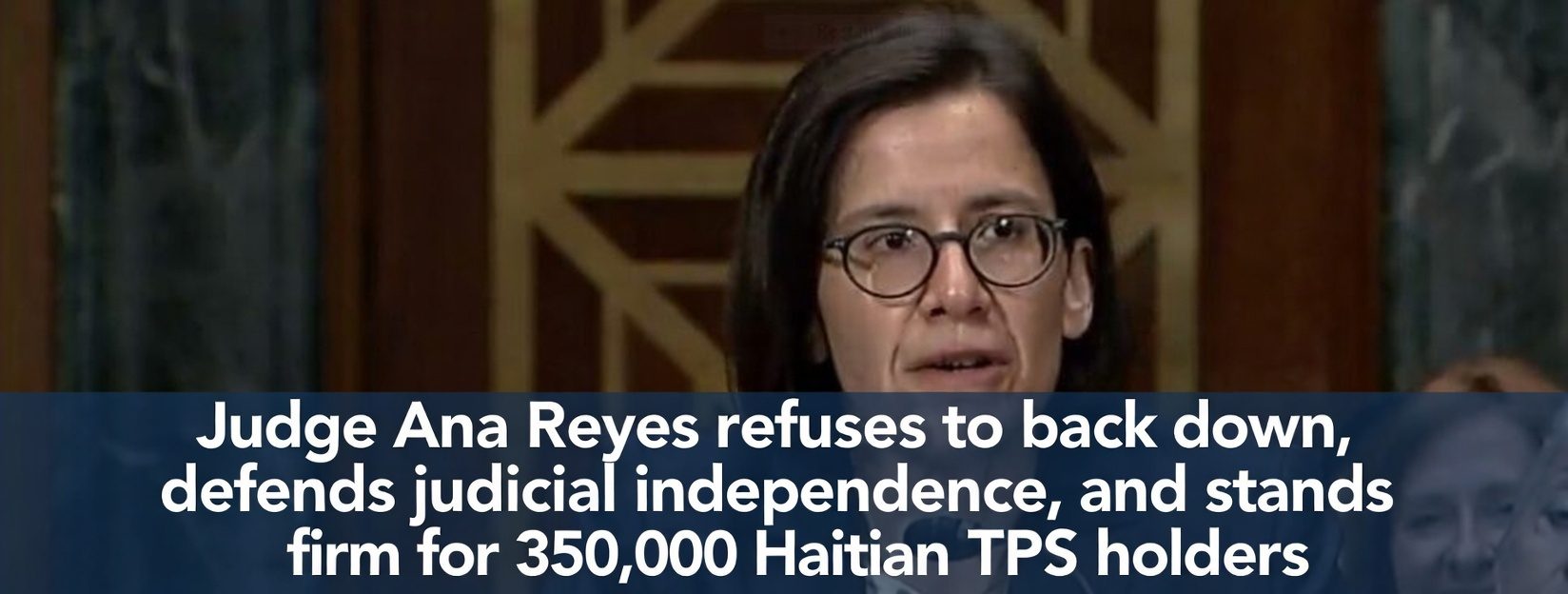

Judge Ana Reyes refuses to back down, defends judicial independence, and stands firm for 350,000 Haitian TPS holders
1. The 30-Second Summary: What Happened
A federal judge turned a routine court hearing into a national moment. On February 13, 2026, U.S. District Judge Ana Reyes stood before lawyers in Washington, D.C., and read death threats out loud — threats she had received for doing her job.
Her offense? Blocking the Trump administration from ending Temporary Protected Status (TPS) for roughly 350,000 Haitian immigrants. Her response to the threats? She denied the government’s motion to pause her order and told the courtroom: “We will not be intimidated.”
Quick Answer: Judge Ana Reyes, a U.S. District Judge in Washington, D.C., blocked the Trump administration’s termination of Haitian TPS on February 2, 2026. At a follow-up hearing on February 13, she read death threats she received and refused to reverse her ruling, denying the Justice Department’s motion to pause her order.
| Key Detail | What You Need to Know |
| Judge | Ana Reyes, U.S. District Court, D.C. |
| Original Ruling Date | February 2, 2026 |
| Ruling | Blocked termination of Haiti’s TPS designation |
| People Protected | Approximately 350,000 Haitian TPS holders in the U.S. |
| February 13 Hearing | Reyes denied DOJ’s motion to stay; read threats aloud |
| Administration Response | Appealed to DC Circuit Court of Appeals |
| Appeal Briefing Deadline | April 19, 2026 (DHS briefs due) |
| Judge’s Background | Biden appointee; first Latina and openly LGBTQ judge on DC District Court |
2. Who Is Judge Ana Reyes?
Judge Ana Reyes isn’t a household name — but she is. President Joe Biden nominated her to the U.S. District Court for the District of Columbia in 2022. When confirmed, she became the first Hispanic woman and the first openly LGBTQ person to serve on that court.
Reyes came to the United States from Uruguay as an immigrant. She holds a law degree from Harvard Law School, graduating magna cum laude, and spent 22 years practicing law at a top firm before joining the bench. She’s pointed, sharp, and apparently unintimidated.
At the February 13 hearing, she made a point of noting that her biography — the parts actually worth discussing — rarely gets mentioned. People focused on her identity as a ‘foreign-born lesbian,’ she said, while ignoring her academic record and professional career.
“I don’t hear anyone talking about how she was magna cum laude at Harvard Law and practiced law at a top firm for 22 years.” — Judge Ana Reyes, February 13, 2026 hearing
3. What Is Haitian TPS — and Why Does It Matter?
Temporary Protected Status is a legal immigration designation created by Congress. It allows people from countries affected by natural disasters, armed conflict, or other extraordinary conditions to live and work legally in the United States — without fear of deportation.
TPS does not create a path to citizenship. It’s temporary by design. But ‘temporary’ has a meaning: it ends when the dangerous conditions end — not when a new administration decides it should end.
How Haiti Got TPS
Haiti first received TPS in 2010 after a catastrophic earthquake killed over 200,000 people. The protections were extended repeatedly through both Republican and Democratic administrations, as conditions in Haiti remained dangerous — gang violence, political instability, economic collapse, and food insecurity.
As of 2026, the U.S. State Department classifies Haiti as a Level 4: Do Not Travel country — its highest risk designation. That classification is significant, because it’s the same standard used to evaluate whether TPS should continue.
Who Are the 350,000 Haitian TPS Holders?
They are workers, caregivers, parents, and neighbors. The numbers tell a clear story:
- Haitian TPS recipients contribute approximately $3.4 billion annually to the U.S. economy
- About 69% of Haitian TPS holders aged 16 and older participate in the civilian labor force
- Approximately 75,000 Haitian TPS holders work in labor-shortage industries
- Massachusetts alone employs dozens of Haitian TPS holders in its Department of Developmental Services
These are not abstract statistics. These are people with jobs, leases, children in school, and mortgages. Ending their status overnight — which is what the Trump administration attempted — would have affected every community where they live.
4. Why Did Judge Reyes Block the TPS Termination?
On November 28, 2025, the Trump administration announced it would end Haiti’s TPS designation, effective February 3, 2026. The administration gave no evidence that conditions in Haiti had improved. The State Department’s own Level 4 travel warning remained in place.
Judge Reyes issued her stay on February 2, 2026 — one day before the TPS termination was set to take effect. Her 83-page ruling went deep into the law and the facts.
The Legal Basis for Her Ruling
Reyes found that Homeland Security Secretary Kristi Noem had violated the process Congress required before terminating TPS. Specifically, Noem had failed to consult with other relevant agencies — including the State Department — before making her decision.
“My determination is Congress required her to consult with appropriate agencies, and she did not consult with any agency, including the Department of State,” Reyes said at the February 13 hearing.
Reyes also found that Noem had ‘preordained’ the decision — meaning her mind was made up before any real review took place. The ruling noted that Noem had terminated the TPS designation for every country whose case had reached her desk: twelve countries reviewed, twelve terminations ordered.
Judge Reyes’s Ruling Quote: “The statutory design is straightforward: TPS exists because threats to life exist; when the threat persists, so should TPS protection, unless the Secretary articulates a well-reasoned and well-supported national interest to the contrary.”
She also pushed back sharply on characterizations of TPS holders, citing the five named plaintiffs in the case and writing that they are not, as some had described them, ‘killers, leeches, or entitlement junkies.’
5. The Death Threats: What She Read Aloud in Court
This is the part that made global headlines. At the end of the February 13 hearing, Judge Reyes said she had something ‘important’ to put on the record.
She said she had been hesitant to share the threats she had received after her February 2 ruling. She consulted colleagues first. Then she read them out loud, entering them into the public record.
| Note on Content: The threats Judge Reyes read contain profane and violent language. The direct quotes below are paraphrased or partially quoted in keeping with responsible reporting standards. |
Among the messages Reyes read from emails sent to her chambers:
- “I hope you lose your life by lunchtime.”
- “God damn you. I hope you die today.”
- “The best way you could help America is to eat a bullet.”
- “I hope you lose your life by lunchtime. Enjoy choking on your tongue.”
She also read from social media posts, including one that called for her to be hanged. After reading the threats, Reyes addressed the room — and through the public record, anyone who might be listening:
“We will act without fear or favor. We will continue to do our jobs. We will not be intimidated.” — Judge Ana Reyes, February 13, 2026
She also noted that she is not the only target. Many of her colleagues on the federal bench are receiving similar threats. Some threats have extended to the families of judges.
6. The February 13 Hearing: What Happened Step by Step
The hearing was called to consider the Justice Department’s motion to pause Reyes’s February 2 ruling. The government filed both an appeal to the D.C. Circuit Court of Appeals and a separate request asking Reyes herself to reverse her decision — an unusual dual-track approach.
Key Moments From the Hearing
- Reyes grilled DOJ attorney Dhruman Sampat about what would actually happen to TPS holders if she paused her order. Sampat said the government had no plans to immediately target them for removal. Reyes rejected that assurance as inadequate.
- Attorneys for the Haitian plaintiffs told the court that some TPS holders were already experiencing real-world harm — federal systems had begun showing their protections as expired, causing problems when they tried to renew driver’s licenses.
- Reyes issued a stern warning to government lawyers, telling them she is not ‘one of those judges who is going to sit around and wait for you all to violate court order after court order.’ She added: ‘There will be serious consequences.’
- The DOJ attorney attempted to compare Reyes’s ruling to a Biden-era immigration action. Reyes shut that down, saying the comparison was ‘legally meaningless’ because that decision ‘is not in front of me.’
- After announcing her decision to deny the stay, Reyes addressed the threats she had received. She read them into the record and defended the judiciary.
The hearing lasted several hours and was, by multiple accounts, unusually contentious — even by the standards of the current moment in federal immigration courts.
7. The Government’s Arguments — and Why Reyes Rejected Them
The Trump administration made several arguments for why Reyes should pause her ruling. She rejected all of them. Here’s what they said, and what she said back.
| Government’s Argument | Judge Reyes’s Response |
| The administration was likely to win on appeal because Reyes lacked authority to review the TPS decision. | She denied the stay and said she would let the appeals court decide jurisdiction — not preemptively abandon her ruling. |
| The government would face ‘irreparable harm’ if forced to maintain TPS. | She questioned this strenuously, asking how harm to the government outweighed harm to 350,000 people who could be detained and deported. |
| The DOJ promised not to target TPS holders for removal if she paused her order. | She called this insufficient — absent a court order, ‘law-abiding’ TPS holders were ‘likely’ to be detained indefinitely. |
| Reyes’s ruling was comparable to Biden-era immigration actions. | She rejected the comparison as ‘legally meaningless’ — that case was not before her. |
Perhaps most pointedly, Reyes also criticized the administration for what she described as a misleading interpretation of her ruling in their appeal filings. Noem had, according to Reyes, failed to follow the law before making the termination decision. That failure was at the heart of the case — and Reyes made clear she wasn’t backing down from that finding.
8. What Happens Next: The Appeal and the DC Circuit Court
The case is now before the U.S. Court of Appeals for the D.C. Circuit. The government’s appeal was filed immediately after Reyes issued her February 2 ruling. The DOJ has until April 19, 2026, to submit its briefs to the appeals court.
Reyes said she would issue a written order before February 19, preserving her reasoning for the appeals court to review.
Separately, a coalition of 18 state attorneys general — led by Massachusetts AG Andrea Joy Campbell — filed an amicus brief with the D.C. Circuit in support of Reyes’s ruling. The coalition argued the lower court was correct to halt what they called an ‘unlawful’ termination of Haiti’s TPS designation.
What Could the Appeals Court Do?
- Uphold Reyes’s ruling — keeping TPS protections in place while the full case proceeds
- Overturn her ruling — which would immediately end TPS for 350,000 Haitians
- Issue a partial stay — pausing some aspects while allowing others to continue
- Decide the jurisdictional question — whether Reyes had authority to review the TPS decision at all
For context, the 9th Circuit Court of Appeals ruled differently in a related case: it determined the government was justified in halting deportation protections for immigrants from Honduras, Nepal, and Nicaragua. That ruling lifted a lower court’s order. The D.C. Circuit may — or may not — see things the same way.
9. The Broader Pattern: Federal Judges Under Pressure in 2025–2026
Judge Reyes’s experience is not isolated. Across the federal judiciary, judges who have ruled against Trump administration policies — particularly on immigration — have faced a surge in threats, harassment, and public attacks.
Reyes herself said at the February 13 hearing that ‘many of my colleagues have received threats,’ and that threats have extended to the families of judges as well.
This pattern carries serious consequences for American democracy. Judicial independence — the idea that courts make decisions based on law, not political pressure or personal safety fears — is a foundational principle of the U.S. legal system. When judges are threatened for their rulings, that principle is under attack.
Notable Recent Cases of Judges Facing Pressure
- Judge James Boasberg ordered the Trump administration to return over 100 Venezuelans deported under the Alien Enemies Act — a ruling that drew fierce political backlash.
- Multiple judges hearing immigration cases have noted frustration at what they describe as the administration’s disregard for court orders.
- The administration has increasingly made public statements attacking judges by name, which legal scholars say creates a climate hostile to judicial independence.
Context: Federal judges cannot be fired for their rulings. They serve lifetime appointments specifically to insulate them from political pressure. Threatening or intimidating judges is a federal crime under 18 U.S.C. § 875.
10. What This Means for Haitian TPS Holders Right Now
As of February 18, 2026, Haitian TPS holders retain their legal status and work authorization. Judge Reyes’s order remains in effect. This means:
- TPS holders cannot be detained or deported based on the February 3 termination date
- Work authorization remains valid during the stay
- Driver’s licenses and other documents tied to TPS status should remain valid — though some holders have reportedly experienced confusion at the administrative level
However, uncertainty remains. The case is on appeal. Until the D.C. Circuit rules, the situation could change. Advocates are encouraging TPS holders to consult with immigration attorneys and keep documentation of their status current.
The practical impact of the uncertainty is real. Some TPS holders have reported difficulties renewing driver’s licenses because federal systems show their status as expired — even though Reyes’s order is still in effect. The judge noted this issue at the hearing and pressed the government lawyer about it.
11. Frequently Asked Questions
Who is Judge Ana Reyes?
Judge Ana Reyes is a U.S. District Court judge for the District of Columbia. She was nominated by President Biden in 2022 and is the first Latina and openly LGBTQ person to serve on that court. She came to the U.S. from Uruguay and holds a law degree from Harvard Law School.
Why did Judge Reyes block Haitian TPS termination?
She found that DHS Secretary Kristi Noem violated federal law by failing to consult with appropriate agencies — including the State Department — before terminating Haiti’s TPS designation. Reyes also found that Noem’s decision appeared to have been made in advance, without genuine review of Haiti’s conditions.
What death threats did Judge Reyes receive?
At her February 13, 2026 hearing, Reyes read several threats aloud, including emails wishing for her death and calling for her to be shot. She said she consulted colleagues before deciding to read them publicly, and entered them into the court record. She said many other federal judges are receiving similar threats.
What is TPS and who qualifies for it?
Temporary Protected Status (TPS) is a legal designation created by Congress that allows people from countries facing natural disasters, armed conflict, or other extraordinary conditions to live and work legally in the United States. It does not create a path to citizenship. Haiti has had TPS since 2010, following a devastating earthquake.
How many Haitians have TPS?
Approximately 350,000 Haitians are currently living and working in the U.S. under TPS. They contribute an estimated $3.4 billion annually to the U.S. economy and have high rates of labor force participation.
What happens to TPS holders while the appeal is pending?
While Judge Reyes’s order remains in effect, TPS holders are protected from detention and deportation, and their work authorization remains valid. The case is now before the D.C. Circuit Court of Appeals, which will ultimately decide whether Reyes’s ruling stands.
Is threatening a federal judge illegal?
Yes. Threatening a federal judge is a federal crime under 18 U.S.C. § 875, which covers interstate threats. It can also violate other federal statutes depending on the nature of the threat. The FBI investigates threats against federal judges.
12. Key Takeaways
- Judge Ana Reyes blocked the Trump administration from ending Haitian TPS on February 2, 2026 — one day before it was set to expire — in a detailed 83-page ruling.
- At a February 13 hearing, she refused to pause her ruling and read death threats she had received aloud in court, entering them into the public record.
- Her ruling found that DHS Secretary Noem violated federal law by failing to consult with other agencies and appeared to have made the decision without genuine review.
- The case is now before the U.S. Court of Appeals for the D.C. Circuit, with government briefs due April 19, 2026.
- A coalition of 18 state attorneys general filed a brief supporting Reyes’s ruling.
- Roughly 350,000 Haitian TPS holders remain protected while the case proceeds.
- Reyes’s experience reflects a broader pattern: federal judges across the country are receiving threats for rulings that cross political lines.
What to Read Next
This story sits at the intersection of immigration law, judicial independence, and U.S.-Haiti relations. To go deeper, explore:
- What Is TPS? A Complete Guide to Temporary Protected Status in the U.S.
- The Full Timeline of Haiti’s TPS Designations, 2010–2026
- Mass Deportation Policy Under Trump: What Courts Have Blocked and What Has Proceeded
- The Legal Battle Over TPS for Venezuela, Honduras, and Other Nations
- Federal Judicial Independence: How Lifetime Appointments Work and Why They Matter
Sources and External References
- NBC News: Judge reads death threats during hearing on Trump decision to end legal protections for Haitians (February 13, 2026)
- Massachusetts Attorney General’s Office: AG Campbell Urges Court to Preserve Block on Unlawful Haitian TPS Termination (February 16, 2026)
- ABC News: Judge blocks administration from ending TPS protections for more than 350,000 Haitian immigrants (February 2, 2026)
- S. News & World Report: Judge won’t pause ruling keeping in place temporary protections for Haitians (February 12, 2026)
| About This Article
This article was researched using primary court documents, reporting from the Associated Press, NBC News, ABC News, U.S. News & World Report, the Miami Herald, and the Massachusetts Attorney General’s office. All quotes are drawn from public court records or verified news reporting. This content is for informational purposes only and does not constitute legal advice. Last updated: February 18, 2026. |
Discover more from MatterDigest
Subscribe to get the latest posts sent to your email.