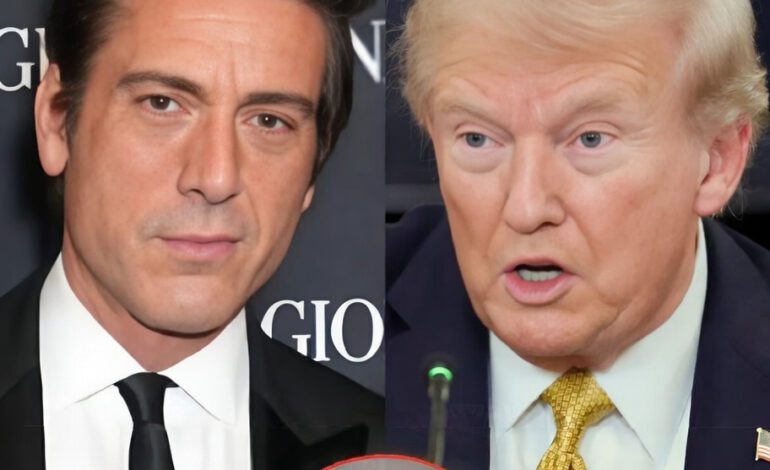
“Journalist Goes Rogue”: David Muir Breaks the Silence With a Shaking Voice

|
Picture this. You are scrolling your phone and you see a short clip. A familiar face — someone you have watched on television for years — appears to be losing it on camera. They are pounding the desk. They are cursing. They are calling out politicians by name and demanding prosecutions. It looks real. It sounds real. Within minutes, you want to share it.
Stop. Before you do, ask yourself one question: Does this seem like something that would actually happen on live television?
The answer, almost certainly, is no. What you are looking at is one of the most effective misinformation formats circulating online today: the fabricated ‘journalist goes rogue’ clip. These fake stories and videos are engineered to hijack your emotions, exploit your trust in real journalists, and bypass your critical thinking — all in under 60 seconds.
This guide explains exactly how they are made, why they are so convincing, and — most importantly — how you can spot one before it spreads further.
What Is the ‘Journalist Goes Rogue’ Format?
Defining the Format
The term covers a specific category of misinformation. It is content — written, video, or audio — that falsely depicts a real journalist or news anchor as abandoning professional norms in a dramatic, shocking way. The “journalist” in these stories always does one or more of the following:
- Uses profanity and aggressive language on air
- Makes sweeping political accusations against a specific party or administration
- Calls for criminal prosecutions of named officials
- Defies producers or network executives in real time
- Delivers a monologue that perfectly mirrors the political views of the target audience
That last point is key. The content is always tailored to what the intended audience already believes. The fake journalist never says anything surprising. They say everything the viewer has been wanting to hear — just louder, angrier, and with more apparent authority.
How Is This Different From Satire?
Good satire is clearly labeled. It exaggerates known positions to make a point. The Onion, for example, writes satirical news that no reasonable person mistakes for genuine reporting.
Fabricated journalist clips are different. They are designed to be mistaken for real news. There is no label saying “parody” or “fictional.” The framing is meant to look like a genuine broadcast or leaked footage. The intent is deception, not commentary.
| Key Distinction
Satire = clearly fictional, designed to provoke thought. Fabricated clip = designed to be believed, intended to manipulate. If you have to look closely to tell the difference, that is by design. |
Why This Format Is So Effective
It Exploits Existing Trust
Journalists on major networks spend years — sometimes decades — building credibility with audiences. That credibility becomes an asset that bad actors can borrow. When a fake clip uses a trusted anchor’s face and name, it inherits all the trust that person has earned. The viewer is not evaluating a stranger. They are watching someone they feel they know.
It Confirms What People Already Believe
Psychologists call this “confirmation bias” — our tendency to accept information that aligns with our existing views and reject information that challenges them. Fabricated journalist outburst clips are laser-targeted at this weakness.
If someone already believes a political administration was corrupt, a fake clip of a famous journalist “finally” saying so feels like validation. It feels like truth breaking through. That feeling is more powerful than any fact-check.
It Creates Emotional Arousal
Research on misinformation spread consistently shows one finding: emotionally arousing content travels faster and farther than neutral content. Outrage, in particular, is one of the most powerful sharing triggers.
A fake clip showing a familiar anchor screaming political accusations creates instant outrage — either from people who agree (“finally, someone said it!”) or from people who disagree (“how dare they say that!”). Either reaction drives sharing. The misinformation wins either way.
It Moves Faster Than Fact-Checkers
Professional fact-checkers are good at their jobs. But they take time. A story needs to be identified, sourced, investigated, written, edited, and published. That process takes hours at minimum. A fake clip can reach millions of people in minutes. By the time a correction appears, the original has already been seen, shared, and believed by vast numbers of people who will never see the correction.
| Research Finding
A landmark 2018 study from MIT’s Sloan School of Management found that false news spreads significantly farther, faster, and more broadly than true news on social media — and that human behavior, not bots, is primarily responsible for this difference. The pattern has only intensified since then. |
How These Stories Are Made and Distributed
The Three Main Production Methods
1. Fully Written Fiction
The simplest form. Someone writes a fake news article in the style of a legitimate outlet. They invent quotes attributed to a real journalist and publish it on a website designed to look like a news organization. No video required. Just convincing prose and a believable headline.
These spread primarily through social media sharing, where most people read only the headline and opening paragraph before sharing. The fiction never needs to be more than a few paragraphs long.
2. Decontextualized Real Video
Here, a real clip exists — but is stripped of its original context. A journalist who was clearly speaking about one topic in a specific setting gets re-captioned to suggest they said something entirely different. The person is real. The event was real. But the meaning has been completely fabricated through false context.
This is sometimes called “cheap fake” to distinguish it from more technologically sophisticated manipulation. No advanced tools are required — just a video clip and a misleading caption.
3. AI-Generated Deepfakes
The most technically advanced form uses artificial intelligence to generate video or audio of a journalist saying things they never said. As of 2025-2026, AI voice cloning and video synthesis tools have become accessible to non-experts. A realistic fake audio clip can be produced in minutes using widely available software.
Fully convincing deepfake video remains harder to produce, but audio deepfakes are already sophisticated enough to fool casual listeners, and video tools are improving rapidly.
| Method | What Makes It Dangerous |
| Written fiction | Fast to produce, targets social media share behavior, hard to trace to origin |
| Decontextualized video | Uses real footage making debunking harder, exploits ‘seeing is believing’ |
| Audio deepfake | Accessible to non-experts, convincing to casual listeners, spreads via podcasts and audio platforms |
| Video deepfake | Most convincing format, technology improving rapidly, extremely difficult to counter once viral |
Distribution Networks
Fabricated clips rarely go viral on their own. They are typically seeded across several platforms simultaneously, amplified by coordinated sharing networks, and sometimes boosted by paid promotion. The distribution pathway usually looks like this:
- Content is created and published on a low-credibility or newly created website.
- It is posted simultaneously to multiple social media platforms — Facebook groups, X (formerly Twitter), Telegram channels, and WhatsApp groups.
- Early sharers — sometimes coordinated, sometimes genuinely fooled — spread it organically.
- Algorithmic amplification kicks in as engagement (clicks, comments, shares) rises.
- Mainstream social media users encounter it and share it to their own networks.
- By the time fact-checkers respond, the clip has reached its target saturation.
The Anatomy of a Fake Clip: Seven Warning Signs
You do not need sophisticated tools to identify most fabricated journalist clips. You need to know what to look for. Here are seven warning signs that appear in nearly every example of this format.
Warning Sign 1: The Behavior Is Completely Out of Character
Real journalists — even opinionated ones — operate within professional norms. They do not pound desks, curse on air, or deliver political screeds that sound like party slogans. If a clip shows a journalist behaving in a way that is radically inconsistent with every other thing they have ever done publicly, that inconsistency is a red flag.
Ask yourself: Have I ever seen this person behave like this before? If the answer is no, the clip deserves serious scrutiny.
Warning Sign 2: The Quotes Are Too Perfect
Fabricated clips are written to be maximally satisfying to their target audience. The “journalist” says exactly what that audience has been wanting to hear — no hedging, no nuance, no complexity. Real people, even passionate ones, do not speak in perfectly constructed outrage monologues. Real speech is messy. Fake speech is polished.
Warning Sign 3: No Corroboration From Legitimate Outlets
If a major news anchor genuinely had a meltdown on live television, it would be everywhere. NBC, CNN, Fox News, AP, Reuters, the BBC — all of them would be covering it. A story that exists only on obscure websites and social media posts, with no coverage from any mainstream outlet, almost certainly did not happen.
Key Rule: If you cannot find the story on at least two major, established news outlets, treat it as unverified until you can.
Warning Sign 4: The Source Is Anonymous or Unverifiable
Fabricated clips rely heavily on phrases like “sources close to,” “an insider revealed,” or “leaked footage shows.” These constructions exist to create the impression of credibility without providing any actual accountability. A real news story names its sources, or provides a specific, verifiable reason why they must remain anonymous.
Warning Sign 5: The Story Has No Date, Time, or Broadcast Details
Real television broadcasts are documented. Every major network keeps archives. If a clip supposedly aired on a specific channel, it should be possible to find when it aired, on which program, and during which segment. Fake clips are vague on these details because those details can be checked.
Warning Sign 6: The Emotional Intensity Is Engineered
Pay attention to how you feel when you encounter the clip. If your first reaction is powerful and immediate — outrage, vindication, shock — pause. That reaction is exactly what the creators intended. Strong emotional reactions are a signal to slow down, not speed up.
Warning Sign 7: The Clip Perfectly Matches Your Own Views
This is the hardest one. When content aligns perfectly with what we already believe, we are far less likely to question it. If a clip makes you think “I always knew this journalist agreed with me,” that feeling of recognition should actually increase your skepticism, not reduce it. We are all more vulnerable to misinformation that flatters our existing beliefs.
| The Seven Warning Signs — Quick Reference
1. Behavior radically out of character 2. Quotes sound too perfectly polished 3. No coverage by established outlets 4. Anonymous or untraceable sources only 5. No specific broadcast date, time, or program 6. Engineered to produce immediate strong emotion 7. Content perfectly matches your existing views |
The Psychology Behind Why We Believe Them
Fluency and Familiarity
When we recognize a face or a name, our brain processes that familiarity as a form of credibility. Cognitive psychologists call this the “fluency effect” — things that feel familiar feel true. Fake clips that use well-known journalists as their subjects benefit from this effect automatically.
The Liar’s Dividend
As deepfake technology improves, researchers have identified a troubling secondary effect: people are becoming more willing to dismiss real, unflattering footage as potentially fake. This is called the “liar’s dividend” — the existence of convincing fakes gives bad actors a tool to discredit real evidence. Both problems stem from the same root: the erosion of trust in audiovisual evidence.
Emotional Processing Bypasses Critical Thinking
Neuroscience research shows that content processed primarily through the emotional brain — the amygdala — is less likely to be subjected to critical analysis than content processed more slowly and deliberately. Content designed to produce strong emotional reactions is literally bypassing the part of your brain most likely to catch the deception.
Social Proof and Cascade Effects
When we see that many people have already shared something, we unconsciously treat that as evidence of its credibility. “If this many people believe it, it must be true.” This social proof effect can create rapid cascade: early shares make the content appear credible, which drives more shares, which makes it appear even more credible.
Real-World Consequences: What Happens When They Spread
Damage to Real Journalists
When fake clips go viral using a journalist’s name and face, the real person suffers direct, measurable harm. They receive threats and harassment. Their professional reputation is damaged by things they never said. Their employer must spend resources issuing denials and corrections. In some cases, journalists have received credible threats to their physical safety as a result of fabricated content.
Erosion of Trust in Real Journalism
Every convincing fake makes the next piece of real journalism slightly harder to believe. When audiences cannot reliably distinguish real from fabricated, they tend to default to trusting nothing — or, more precisely, trusting only the sources that already confirm what they want to hear. This polarization of information is one of the most serious long-term effects of the fake clip ecosystem.
Political Manipulation
Fabricated journalist clips are often designed to serve specific political purposes — to discredit politicians, to inflame public opinion about policies, or to create false impressions of media consensus. They are, in this sense, a form of influence operation. Some have been traced to organized state-level disinformation campaigns. Others are domestic in origin. All of them interfere with the public’s ability to form accurate political opinions.
Legal Consequences for Creators
Creating and distributing fabricated content that portrays real people making false statements can constitute defamation — a legal claim that requires proving false statements of fact, publication to third parties, and resulting harm. Several high-profile defamation cases have established that fabricated quotes and misrepresented video can meet this legal threshold. Creators are not always anonymous, and legal consequences are becoming more common.
How to Verify Any Viral News Clip in Under Two Minutes
You do not need to be a professional fact-checker. You need a process. Here is one that takes less than two minutes and catches the vast majority of fabricated journalist clips.
The Two-Minute Verification Process
- Step 1 — Check the journalist’s verified social media accounts directly. Real journalists respond to viral moments involving themselves. If they have not addressed it, that is a red flag.
- Step 2 — Search the journalist’s name plus the alleged action on Google News, filtered to the past 24-48 hours. If no established outlet is covering it, it almost certainly did not happen.
- Step 3 — Search the specific phrase or quote attributed to the journalist on a fact-checking site such as Snopes, PolitiFact, or FactCheck.org.
- Step 4 — Look for broadcast details. What show? What date? What time? Search those details. If they are absent or vague, treat the clip as unverified.
- Step 5 — Run any suspicious video through a reverse video search (Google or TinEye) to check whether the original clip exists in a different context.
Two-minute rule: If you cannot verify a claim in two minutes using the steps above, do not share it. Uncertainty is a reason to pause, not to pass it on.
Trusted Verification Resources
- com — one of the oldest and most comprehensive fact-checking sites
- com — specialized in political claims and statements
- org — run by the Annenberg Public Policy Center
- AP Fact Check — from the Associated Press wire service
- Reuters Fact Check — from the global news agency
- Google Fact Check Explorer — aggregates fact-checks from multiple sources
Platform Responsibility: What Social Media Is (and Is Not) Doing
Current Platform Policies
As of early 2026, major social media platforms have taken a range of approaches to synthetic and fabricated media. The landscape is shifting quickly, and enforcement remains inconsistent.
| Platform | Current Approach (as of 2026) |
| Meta (Facebook/Instagram) | Requires labeling of AI-generated content; has a third-party fact-checking program in the US, though its scope was reduced in early 2025 |
| X (formerly Twitter) | Community Notes system relies on user-contributed context labels; no systematic AI detection |
| YouTube | Requires creators to disclose AI-generated content; can remove deepfakes of real people under harassment policies |
| TikTok | Labels AI-generated content and prohibits synthetic media that misleads about real events |
| Prohibits deepfakes; less frequently targeted by this format |
The Enforcement Gap
Policies and enforcement are not the same thing. Most platforms acknowledge that their automated detection systems catch only a fraction of fabricated content. The volume of content uploaded every minute makes comprehensive review impossible. User reporting systems help, but they are reactive — they operate after the content has already been seen by potentially millions of people.
Many researchers and press freedom organizations argue that current platform efforts are insufficient and that stronger regulatory frameworks are needed. Others warn that heavy regulation risks suppressing legitimate speech. This debate is ongoing and unresolved.
What Journalists Themselves Say About This Problem
Journalists who have been targeted by fabricated clips describe the experience in strikingly consistent terms: it is disorienting, it is exhausting, and it does not stop.
Several themes emerge consistently from journalists who have spoken publicly about being the subject of fabricated content:
- The sheer volume of fake content referencing them makes it impossible to address everything individually.
- Issuing denials often amplifies the original false claim by drawing more attention to it.
- Friends, family members, and sources sometimes believe the fabricated clips — damaging personal and professional relationships.
- The threat is not just reputational. Fabricated clips have directly preceded physical threats and harassment campaigns.
- Many feel their employers do not fully appreciate the severity or frequency of the problem.
Press freedom organizations including the Committee to Protect Journalists and Reporters Without Borders have documented this problem extensively, noting that fabricated content targeting journalists is increasingly being used as a tool of intimidation — particularly against journalists covering politics, conflict, and investigative subjects.
Key Takeaways and Action Steps
What We Know
- Fabricated ‘journalist goes rogue’ clips are a deliberate misinformation format, not random internet noise.
- They work because they exploit trust, confirmation bias, emotional arousal, and the speed advantage of falsehood over fact.
- They are produced through written fiction, decontextualized real video, and increasingly via AI-generated audio and video.
- They cause real harm to the journalists named in them and to public trust in journalism broadly.
- Platforms are taking steps but enforcement remains inadequate relative to the scale of the problem.
What You Can Do Right Now
- Pause before sharing any viral clip involving a journalist behaving dramatically or politically.
- Apply the seven warning signs checklist to any suspicious content.
- Use the two-minute verification process before forming or sharing a judgment.
- Report fabricated content to the platform using its native reporting tools.
- When you discover a clip is fake, share the fact-check — not the original clip.
- Talk about this format with people in your network. Awareness is the first line of defense.
The most powerful tool against this kind of misinformation is not technology. It is the two seconds of hesitation you choose before you hit share.
Sources and Further Reading
- Vosoughi, S., Roy, D., & Aral, S. (2018). ‘The spread of true and false news online.’ Science, 359(6380). MIT Sloan School of Management.
- Reuters Institute for the Study of Journalism — Digital News Report 2025
- Committee to Protect Journalists (CPJ) — Reports on digital threats to journalists, 2024-2026
- Reporters Without Borders (RSF) — World Press Freedom Index, 2025
- First Draft (now part of Meedan) — guides on visual verification and synthetic media
- Stanford Internet Observatory — research on coordinated inauthentic behavior and synthetic media
About This Article
This article is an educational resource on media literacy and misinformation. It does not reference, reproduce, or amplify any specific fabricated clip or the individuals named in them. All research citations refer to publicly available academic and institutional sources. Last updated: March 6, 2026.
Discover more from MatterDigest
Subscribe to get the latest posts sent to your email.