Jesse Watters vs. Rachel Maddow: The Viral Moment That Silenced a Silencer
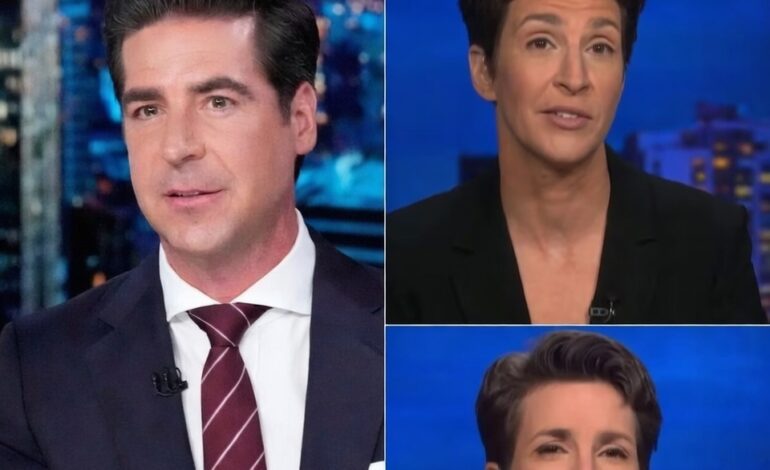

How one calm, composed on-air response became television’s quietest — and most powerful — takedown of 2025
1. What Happened: The Viral TV Moment Explained
Sometimes the most powerful moments on television aren’t explosions — they’re silences.
In early 2025, a clip from Jesse Watters’ Fox News program began spreading rapidly across social media. In it, Watters calmly reads a tweet from MSNBC host Rachel Maddow — a tweet in which Maddow called Watters “dangerous” and implied he should be silenced.
He didn’t raise his voice. He didn’t mock her. He simply read every word aloud, let them hang in the air, and then offered a brief, measured response.
“Disagreement is not dangerous. And silencing voices is not democratic.” — Jesse Watters, on air
The studio fell quiet. The clip hit social media within minutes. Viewers across the political spectrum called it one of the most effective on-air rebuttals in recent cable news history — not because of what Watters said, but because of how he said it.
Why This Moment Matters in 2025
We live in an era of peak media noise. Pundits shout. Chyrons scream. Headlines catastrophize. Against that backdrop, Watters’ composure felt genuinely startling — almost out of place. And that contrast is exactly what made the clip spread.
This wasn’t just a spat between two cable hosts. It was a flashpoint in a much bigger conversation about media power, free expression, and who gets to decide which voices are “dangerous.”
2. Rachel Maddow’s Tweet — What She Actually Said
Rachel Maddow is one of MSNBC’s most prominent and longest-serving political commentators. She built her brand on in-depth investigative reporting and progressive analysis. But her tweet about Jesse Watters drew criticism from an unexpected range of viewers — including some who don’t typically align with Fox News.
In the tweet, Maddow described Watters as “dangerous” — a word with significant weight in political discourse. She suggested that his commentary was not merely disagreeable, but harmful. The implication: that voices like his shouldn’t have a platform.
Why the Word ‘Dangerous’ Is Loaded
Calling a political commentator “dangerous” doesn’t just criticize their ideas — it frames those ideas as a threat. It’s a rhetorical move that shifts the debate from “I disagree with you” to “you shouldn’t be allowed to speak.”
Critics of Maddow’s tweet argued this was exactly the kind of language that gets used to justify deplatforming, cancellation, and media suppression. Supporters said she was simply calling out commentary she believes causes real-world harm.
The problem? Maddow didn’t expect the tweet to be read back to her — on television, by the person she was criticizing.
3. Jesse Watters Reads the Tweet Live on Air
What followed was simple, but devastatingly effective.
Watters pulled up Maddow’s tweet on air. He read it aloud — slowly, clearly, without editorial interruption. He let viewers hear the words in full. Then he paused.
That pause was intentional. It gave the audience a moment to sit with what they had just heard. And then came his response — two sentences that many viewers found more persuasive than any rant could have been.
“Disagreement is not dangerous. And silencing voices is not democratic.”
No name-calling. No strawmanning. No counter-accusations. Just a direct, principled response to the substance of the tweet.
The Power of Restraint in an Age of Outrage
Cable news has trained us to expect escalation. When one host calls another dangerous, we brace for a firestorm. The fact that Watters didn’t deliver one was itself newsworthy.
Psychologists who study persuasion have long noted that calm, measured responses to attacks are often more credible than heated ones. They signal confidence. They suggest the speaker isn’t threatened — that the attack didn’t land the way the attacker hoped.
In this case, Watters’ restraint made Maddow’s tweet look more extreme by comparison — not because he said so, but because the contrast was visible in real time.
4. Why “Disagreement Is Not Dangerous” Struck a Nerve
In the post-2020 media landscape, calls to “silence” or “deplatform” political voices have become increasingly common. From social media bans to editorial decisions to advertiser pressure campaigns, the tools for suppressing voices are more varied — and more normalized — than ever.
Watters’ line cut through all of that with unusual clarity. It didn’t engage in whataboutism. It didn’t rehash old grievances. It simply stated a democratic principle: that disagreement — even sharp, partisan disagreement — is not inherently dangerous.
The Free Speech Dimension
The First Amendment protects speech from government suppression, not from criticism or social consequences. Watters’ response wasn’t a legal argument — it was a values argument. And it resonated with viewers across the political spectrum who are skeptical of the growing cultural norm of labeling disfavored speech as harmful.
A 2024 Gallup survey found that 64% of Americans believe the political climate prevents people from saying what they really think. That number crosses party lines. When Watters said “silencing voices is not democratic,” he was speaking to an anxiety that millions of people share — regardless of whether they watch Fox News or MSNBC.
5. The Psychology of Calm: Why Quiet Beats Outrage
Why do we find calm responses more convincing than angry ones? The answer lies in basic psychology.
When someone responds to an attack with fury, it suggests the attack hit a nerve — that it was, at least partly, true. When someone responds with composure, it signals the opposite: that the attack was so wrong, so off-base, that it barely warrants a rise in heart rate.
Cognitive Dissonance and the Backfire Effect
Research in social psychology shows that aggressive rebuttals often trigger the “backfire effect” in the audience — rather than changing minds, they harden existing beliefs. Calm, evidence-based responses are significantly more likely to shift neutral viewers.
Watters likely understood this instinctively. Or his producers did. Either way, the choice to read the tweet without comment — and then respond briefly and rationally — was strategically brilliant.
What Communication Experts Say
Communication scholars have written extensively about the persuasive power of underreaction. When you respond to a bomb with a shrug, you neutralize its explosive potential. You reframe the moment. You make the attacker look reckless and yourself look assured.
The viral spread of this clip is itself evidence: viewers recognized something authentic in Watters’ response. They shared it not because he “won” in a traditional debate sense, but because his approach felt different — and in cable news, different is rare.
6. Media Bias, Silencing, and the Free Speech Debate
This moment doesn’t exist in a vacuum. It’s the latest skirmish in a long-running war over whose voices get amplified — and whose get muted — in American political media.
The Deplatforming Debate
Over the past several years, numerous political commentators, journalists, and public figures have been suspended, banned, or quietly throttled on social media platforms. Some of these decisions were widely supported; others were deeply controversial.
Maddow’s suggestion that Watters is “dangerous” fits a broader rhetorical pattern: first label a voice harmful, then argue that removing it is a public safety measure rather than censorship. Critics call this a fig leaf — a way to suppress speech while maintaining the appearance of principled moderation.
The Asymmetric Outrage Problem
One reason the clip resonated is that many viewers perceive a double standard in how political speech is policed. When a progressive commentator says something extreme, they are often defended as speaking truth to power. When a conservative commentator says something similar, they are more likely to be labeled dangerous.
Whether or not that perception is accurate in any given case, it’s widespread — and Watters’ calm response tapped directly into it.
7. Viewer Reactions: Why the Clip Went Viral
Within hours of the segment airing, clips were circulating on X (formerly Twitter), TikTok, YouTube, and Instagram. The reaction was notable for its political diversity.
Responses From Across the Spectrum
Conservative viewers celebrated Watters’ composure and called the clip a masterclass in on-air rebuttal. But the more surprising reactions came from non-conservatives — viewers who don’t typically align with Fox News, but who found something in the moment that resonated regardless.
Many comments focused not on the political substance, but on the style. “This is how you respond to someone calling you dangerous,” wrote one widely-shared reply. “No anger. No theatrics. Just the words, and then the principle.”
The ‘Quietest Takedown on Television’ Label
Several media commentators dubbed the moment “the quietest takedown on television” — a phrase that itself went viral. It captures something true about the clip: its power came from absence. No yelling. No graphics package. No dramatic music sting. Just silence doing the work.
In a media environment engineered to trigger emotional responses, the absence of emotion was itself a kind of statement.
8. Comparison: Maddow vs. Watters Communication Styles
| Rachel Maddow | Jesse Watters |
| Long-form investigative style | Punchy, conversational delivery |
| MSNBC prime time anchor | Fox News prime time anchor |
| Progressive political alignment | Conservative political alignment |
| Called Watters ‘dangerous’ on Twitter | Read the tweet live, responded calmly |
| Did not respond publicly to the segment | Clip went viral within hours |
| Known for detailed narrative arcs | Known for short, direct statements |
Both hosts are skilled communicators in their respective styles. But in this specific moment, Watters’ approach outmaneuvered Maddow’s tweet — not by being louder, but by being quieter.
9. What This Moment Tells Us About Modern Political Media
The Watters-Maddow moment is a case study in something media scholars call “asymmetric communication advantage.” When one party attacks loudly and the other responds quietly, the quiet response often wins on credibility — even if it loses in raw volume.
The Changing Architecture of Viral Moments
For years, political media’s viral moments were defined by heat: the shouting match, the dramatic walkout, the cutting insult. But increasingly, audiences are responding to a different kind of moment — the pause, the measured word, the refusal to escalate.
This shift reflects something real about audience psychology in 2025. After years of relentless political outrage — from both sides — many viewers are exhausted by heat. They’re drawn to light. And that’s what Watters offered: not warmth exactly, but clarity.
Implications for Political Communicators
If you’re a political communicator, a journalist, or simply someone who engages in public debate, the lesson here is straightforward: composure is a form of power. The ability to let someone else’s words land — without flinching, without retaliating, without adding fuel — is a skill. And in the current media environment, it’s a rare one.
10. FAQs: People Also Ask
What did Rachel Maddow say about Jesse Watters?
Rachel Maddow posted a tweet calling Jesse Watters “dangerous” and suggesting that his voice should be silenced. The tweet was later read aloud by Watters on live television, sparking widespread discussion about free speech, media bias, and the ethics of calling political commentators dangerous.
Why did Jesse Watters go viral after reading Maddow’s tweet?
Watters went viral because of how he responded — calmly and without escalation. After reading the tweet aloud, he simply stated: “Disagreement is not dangerous. And silencing voices is not democratic.” Viewers found the restraint striking and widely shared the clip as an example of effective on-air communication.
Did Rachel Maddow respond to Jesse Watters’ on-air reaction?
As of the time of this article’s publication, Rachel Maddow had not issued a public response to Watters’ on-air reading of her tweet or his reply.
What does ‘silencing voices is not democratic’ mean?
Watters was making a values-based argument: in a democratic society, calling for voices to be silenced — even voices you strongly disagree with — contradicts the core democratic principle of open debate. The statement resonated with many viewers who are concerned about growing cultural pressure to deplatform political commentators.
Is Jesse Watters actually dangerous?
Whether any political commentator is “dangerous” is a matter of interpretation and political perspective. Maddow’s supporters argue she was highlighting commentary she believes contributes to real harm; Watters’ supporters argue the label is a rhetorical tool used to justify suppression of political speech. This article does not take a position on the underlying political debate.
What is the ‘quietest takedown on television’?
This phrase, coined by media commentators following the viral clip, refers to the moment when Watters read Maddow’s tweet without embellishment and responded with two measured sentences. The phrase captures how the absence of emotion and escalation was itself the most powerful element of the response.
11. Key Takeaways
Here’s what this moment teaches us about communication, media, and public debate in 2025:
- Composure is a competitive advantage in modern media. Calm beats loud.
- Words are more powerful when you let them land — without defense, without deflection.
- Calling political commentary ‘dangerous’ is a rhetorical move with significant cultural consequences.
- Virality increasingly favors restraint, not outrage — a meaningful shift in how audiences respond to political media.
- Democratic discourse depends on the freedom to disagree, even sharply and publicly.
- The most effective rebuttals often involve saying less, not more.
What Do You Think?
Was Jesse Watters’ response an example of masterful communication — or simply effective political theater? Was Rachel Maddow’s original tweet a legitimate critique or an overreach? These are questions worth sitting with.
One thing is clear: the moment cut through the noise. And in 2025, that’s harder than ever to do.
Share this article with someone who would find it interesting. And if you want to explore more on media culture, political communication, and the changing dynamics of American broadcast journalism, see the related content section below.
Sources & Further Reading
- Gallup (2024): “Most Americans Say They Self-Censor Political Opinions” — gallup.com
- American Psychological Association: Research on persuasion and the backfire effect — apa.org
- Pew Research Center (2024): “Trust in Media” — pewresearch.org
- Columbia Journalism Review: Coverage of cable news communication trends — cjr.org
- Nieman Lab (2025): Trends in political media virality — niemanlab.org
Discover more from MatterDigest
Subscribe to get the latest posts sent to your email.